

You typed "bookkeeper near me" into Google because your books are a mess, tax season is looming, or you just realized spreadsheets aren't cutting it anymore. Maybe you got burned by a bookkeeper who missed deadlines, or you're a new business owner who has no idea what to even look for. Either way, the search results are full of generic listings that don't tell you who's actually qualified.
Here's the direct answer: the right bookkeeper isn't necessarily the closest one on a map. What matters is finding someone with the right credentials, experience with your industry, and a communication style that fits how you run your business. Local proximity matters less than it used to, since most bookkeeping today happens through secure remote access to your accounts anyway.
This article walks through exactly how to vet candidates, what questions to ask before you hire, and the red flags that separate a solid bookkeeper from someone who'll cost you more in cleanup fees than they saved you. You'll also see when it makes sense to skip the local search entirely and work with a firm that combines bookkeeping with CPA-level tax expertise.
1. Tax Experts of OC for full-service remote bookkeeping
If you're tired of juggling a bookkeeper, a separate CPA, and a tax preparer who never talk to each other, Tax Experts of OC solves that by putting all three under one roof. This Orange County firm handles bookkeeping and accounting alongside tax preparation, tax resolution, and payroll, so the person reconciling your bank accounts is working with the same team that files your return and handles the IRS if something goes wrong. It's built for clients who want a bookkeeper near me search to end with someone who actually understands the tax consequences of every entry they make.

How it works
You start with a free 30-minute consultation, either by phone or video, where a CPA or Enrolled Agent reviews your current books and financial situation. From there, the firm sets up secure remote access to your accounting software (typically QuickBooks) and manages your books on a monthly, quarterly, or annual cadence depending on your volume. Because the team includes CPAs and Enrolled Agents rather than just data-entry staff, they catch tax-relevant issues, like misclassified expenses or missed deductions, before they become year-end surprises.
A bookkeeper who only enters numbers is a cost center. One who understands tax law is an investment.
Who it's best for
This option fits small and medium business owners, LLCs, corporations, and individuals who want their bookkeeping and tax planning handled by the same firm instead of coordinating between separate vendors. It's also a strong fit if you're behind on filings or dealing with IRS notices, since the firm can clean up your books and resolve tax debt in the same engagement.
Typical cost
Pricing is customized based on transaction volume, entity type, and whether you need catch-up work on prior years. Tax Experts of OC provides transparent upfront pricing during the free consultation, plus flexible payment options if you're facing financial hardship, something that's rare among firms bundling CPA-level service.
Questions to ask before hiring
- Will a CPA or Enrolled Agent review my books, or only support staff?
- Can you handle multi-state filings if my business operates in more than one state?
- What's included in the monthly fee versus billed as an extra?
- How do you handle catch-up bookkeeping for prior years?
2. Local CPA firms and accounting practices
Many people typing "bookkeeper near me" actually land on a local CPA firm instead of a standalone bookkeeper. These practices often bundle basic bookkeeping into a broader tax and accounting relationship, which can work well if you want everything under one local roof, even if that roof charges CPA-level rates for data entry.
How it works
CPA firms typically assign a junior staff accountant or bookkeeper on their team to handle your day-to-day entries, while a CPA reviews the file periodically and signs off on tax filings. You'll usually meet in person or by phone for onboarding, then the firm accesses your accounting software remotely for ongoing work. Turnaround times vary a lot depending on the firm's size and how busy they are during tax season.
Paying CPA rates for basic data entry is the most common way small businesses overspend on bookkeeping.
Who it's best for
This route suits business owners who already have a trusted local CPA relationship and want to keep everything with one firm rather than adding another vendor. It's less ideal if your books need constant, hands-on attention, since bookkeeping is often a side service, not the firm's core focus.
Typical cost
Expect $150 to $450 per month for basic bookkeeping bundled with a CPA firm, though prices climb quickly if the firm bills bookkeeping tasks at CPA hourly rates ($200+) instead of a flat bookkeeping rate.
Questions to ask before hiring
- Who actually does the monthly bookkeeping, a CPA or support staff?
- Is bookkeeping billed separately from tax prep, or bundled?
- How quickly do you respond to questions outside of tax season?
- Can I see a sample of your monthly reporting?
3. Independent freelance bookkeepers
Searching "bookkeeper near me" often turns up a solo operator working from a home office or coworking space rather than a firm. These independent freelance bookkeepers are typically former corporate accountants or QuickBooks-certified professionals who left a firm to run their own client roster, and they can be a genuinely good deal if you vet them properly.
How it works
Most freelancers work entirely remote, connecting to your accounting software through shared login access or a cloud platform like QuickBooks Online. You'll typically get a dedicated point of contact (the freelancer themselves, not a rotating team), which means faster answers but also a single point of failure if they get sick, go on vacation, or simply move on to other clients.
A freelancer's biggest strength, personal attention, is also their biggest risk if they disappear.
Who it's best for
Freelance bookkeepers suit solo entrepreneurs and small LLCs with straightforward finances, low transaction volume, and no complex payroll or multi-state issues. They're a weaker fit for businesses needing backup coverage, audit-ready documentation, or CPA-level tax strategy layered on top of the bookkeeping.
Typical cost
Rates run $25 to $80 per hour, or a flat monthly fee of roughly $200 to $600 depending on transaction volume and whether payroll is included.
Questions to ask before hiring
- What happens to my books if you're unavailable for an extended period?
- Do you carry professional liability insurance?
- Are you certified in the software I use (QuickBooks, Xero, etc.)?
- Can you provide references from clients in my industry?
4. Online bookkeeping services like QuickBooks Live
If your "bookkeeper near me" search turned up more app store listings than actual people, you've bumped into the subscription bookkeeping model. Services like QuickBooks Live pair you with a remote bookkeeper through the software itself, no local office, no in-person meeting, just a dashboard and a chat window.
How it works
Once you sign up, QuickBooks assigns you a dedicated bookkeeper (or small team) who works exclusively inside your QuickBooks Online account. They categorize transactions, reconcile accounts monthly, and send you reports through the platform. Communication happens through video calls and in-app messaging rather than phone calls to a local number.
Convenience is the product here, not customization.
Who it's best for
This fits solo founders and very small businesses already committed to QuickBooks Online who want basic categorization and reconciliation without managing a human relationship. It's a weak fit if you need tax strategy, multi-state guidance, or someone who understands your industry's quirks, since the service stops at bookkeeping and doesn't extend into CPA-level advice.
Typical cost
QuickBooks Live runs $50 to $400+ per month depending on your monthly expenses, with cleanup of prior books billed as a separate one-time fee.
Questions to ask before hiring
- Will I keep the same bookkeeper month to month, or does staff rotate?
- Does the plan include tax filing, or just bookkeeping?
- What's the cleanup fee if my books are behind?
- Can I export my data if I switch providers later?
5. Certified advisor directories from QuickBooks and Xero
When a plain "bookkeeper near me" search feels like a gamble, the software makers themselves run directories that filter for you. QuickBooks ProAdvisor and Xero Advisor Directory both list bookkeepers who've passed certification exams on that specific platform, giving you a shortcut past unverified freelancers and vague local listings.
How it works
You search the directory by location, industry, or certification level (like QuickBooks ProAdvisor Advanced) and browse profiles that show credentials, client reviews, and years of experience. Reaching out happens directly through the platform, and most listed bookkeepers work remotely regardless of where you filtered by. The certification only proves software fluency, not tax knowledge or business judgment, so you still need to interview candidates the same way you would anyone else.
A certification badge tells you someone passed a test, not that they'll answer your calls.
Who it's best for
This route suits business owners already locked into QuickBooks or Xero who want a vetted starting pool instead of cold-searching Google. It works less well if you need someone who also handles tax filing or resolution, since directory listings skip that vetting entirely and leave you coordinating a separate CPA on your own.
Typical cost
Rates mirror independent freelancers, roughly $30 to $90 per hour or flat monthly packages between $250 and $700, since directory-listed bookkeepers set their own pricing.
Questions to ask before hiring
- How many years have you held this certification?
- Do you specialize in my industry or business size?
- Will you handle tax filing, or only bookkeeping?
- Can you share reviews from clients using the same software tier as me?
6. Local directories and review sites like Yelp and Thumbtack
When you type "bookkeeper near me" straight into Google, you often land on Yelp, Thumbtack, or Google Business Profile listings before you ever reach a firm's actual website. These platforms aggregate local providers by ZIP code and let past clients leave star ratings, which makes them a fast way to build a shortlist even though the vetting stops at whatever reviewers bothered to write.

How it works
You search your city or ZIP code, filter by category, and get a list of bookkeepers ranked by rating, proximity, and how much they've paid to advertise on the platform. Thumbtack goes a step further by letting you post a job description and having local bookkeepers bid on it directly, which can surface providers who don't show up in a plain search. Neither platform verifies credentials like CPA or Enrolled Agent status, so a five-star rating tells you about customer service, not tax competence.
Star ratings measure how a bookkeeper made someone feel, not whether their books were accurate.
Who it's best for
These sites suit business owners who want to compare several local options quickly and don't yet know exactly what they need. They're a poor fit if you're dealing with IRS issues or complex entity structures, since review sites skew toward general bookkeeping rather than tax resolution work.
Typical cost
Pricing varies wildly by provider, but expect $25 to $75 per hour for listed bookkeepers, since the platforms themselves don't set rates.
Questions to ask before hiring
- Are you licensed or certified, and can you show proof?
- How many years have you served clients in my industry?
- Do you have references beyond the platform reviews?
- What's your process if my books need cleanup first?
7. Referrals from your network and other professionals
Sometimes the best answer to "bookkeeper near me" isn't a search at all, it's a text to your attorney, your insurance agent, or another business owner in your industry. Referral-based hiring skips the algorithm entirely and relies on people who've already seen the work firsthand, which filters out a lot of the guesswork that comes with anonymous online listings.
How it works
You ask people who already deal with money professionals on your behalf, think your business attorney, financial advisor, or a fellow entrepreneur in your networking group, who they trust with their books. These referrals often come with context you can't get from a review site: how the bookkeeper handled a messy year, whether they caught a costly mistake, or how they communicate under pressure. Most connections happen through a warm introduction, so you typically skip the cold-pitch stage entirely.
A referral from someone who's already trusted this person with real money beats a dozen anonymous star ratings.
Who it's best for
Owners who value trust over speed and have an existing professional network, other business owners, attorneys, financial planners, get the most from this route. It works less well if you're new to an area or industry and simply don't have anyone to ask yet.
Typical cost
Referred bookkeepers charge whatever their normal rates are, generally $25 to $90 per hour depending on experience, so referrals save you vetting time, not money.
Questions to ask before hiring
- How long have you worked with the person who referred me?
- What specifically did they handle well or poorly?
- Do you specialize in businesses like mine?
- Can I get one more reference beyond the referral itself?
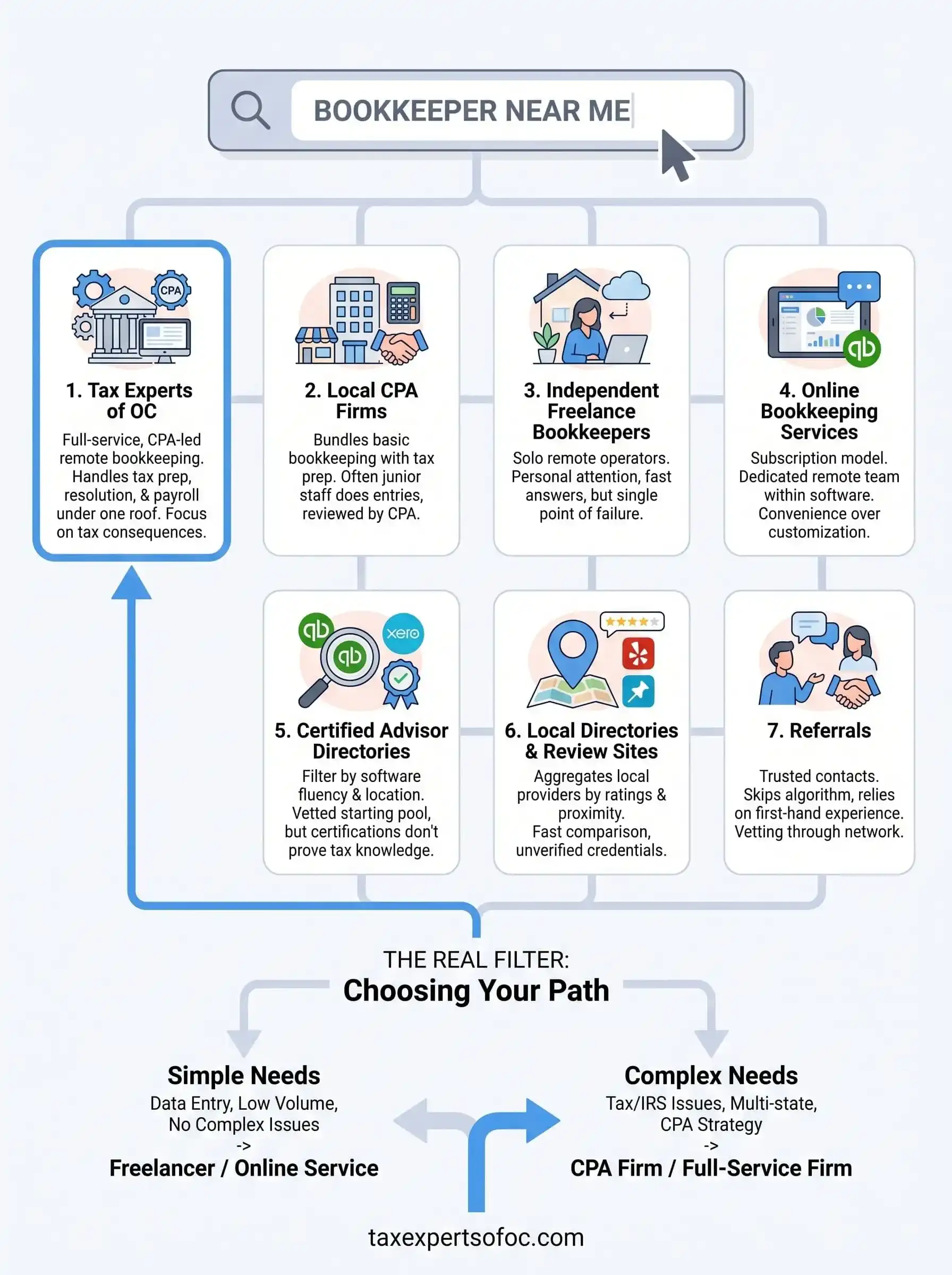
Choosing the option that fits your books
Seven paths can start from the same "bookkeeper near me" search, and none of them is automatically wrong. A freelancer works fine for a simple LLC with low transaction volume. A directory listing works if you're already locked into QuickBooks or Xero. But the moment your books touch IRS notices, back taxes, or multi-state filings, proximity and star ratings stop mattering and credentials start mattering a lot.
That's the real filter. Ask yourself whether you need someone to enter numbers, or someone who understands what those numbers mean for your tax return. If it's the latter, skip the coordination headache of separate vendors and go with a team that handles bookkeeping, tax prep, and resolution under one roof.
If that sounds like where you landed, book your free 30-minute consultation with Tax Experts of OC and get your books handled by people who actually know tax law.