
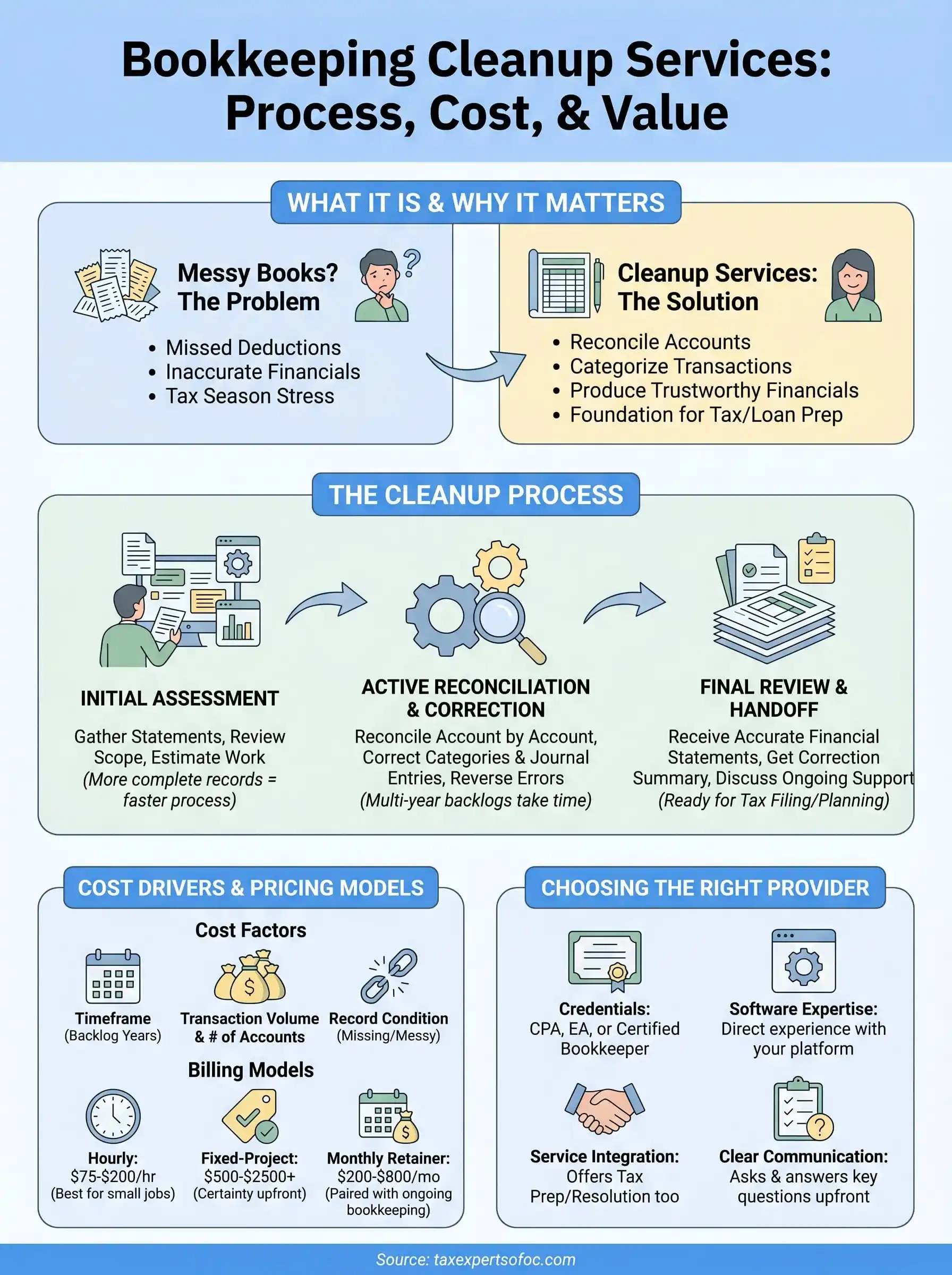
Maybe your bank statements don't match your ledger. Maybe you've got months, or years, of uncategorized transactions sitting in QuickBooks. Whatever the cause, messy books create real problems: missed deductions, inaccurate financial statements, and stress every time tax season rolls around. Bookkeeping cleanup services exist to fix exactly this, and understanding what's involved can help you decide whether it's time to call in a professional.
A cleanup isn't just about making numbers look neat. It's about reconciling every account, categorizing every transaction, and producing financials you can actually trust. For business owners preparing for a tax filing, applying for a loan, or simply trying to understand where their money went, accurate books are the starting point, not a nice-to-have.
At Tax Experts of OC, our CPAs and accounting team handle bookkeeping cleanups for individuals and businesses across all 50 states, often as a first step before tax preparation or resolution work. This article breaks down what bookkeeping cleanup services typically include, what drives the cost, and how to tell if your books need professional attention.
What bookkeeping cleanup services include
A full cleanup goes deeper than fixing a few entries. Bookkeeping cleanup services cover the complete range of tasks needed to bring your financial records from disorganized to accurate, whether your books are one month behind or three years behind. The scope of work depends on how far back the problems go and which accounts are affected.
Account reconciliation
Reconciliation is the foundation of any cleanup. It means matching every transaction in your accounting software to the corresponding entry on your bank and credit card statements. If those two sources don't agree, you have an error somewhere, and that error compounds the longer it sits unresolved. A professional reconciles each account, month by month, until the records align.

Unreconciled accounts are one of the leading reasons business owners get hit with unexpected tax bills, because income and expenses have been recorded incorrectly for months without anyone catching it.
This process also catches duplicate entries and missing transactions, as well as incorrectly applied payments that automated tools like QuickBooks or Xero often miss on their own.
Transaction categorization and correction
Every transaction in your books needs a category: payroll, rent, cost of goods sold, office supplies, and so on. Miscategorized expenses can inflate your income on paper, cause you to miss deductions, and produce financial statements that don't reflect reality. During a cleanup, a professional reviews each transaction and assigns the correct category according to your chart of accounts.
Your cleanup provider will also reverse and re-enter any journal entries that were posted incorrectly, which is common when business owners handle their own books without an accounting background.
Financial statement rebuilding
Once the accounts are reconciled and transactions are categorized correctly, your provider rebuilds your core financial statements: the profit and loss statement and balance sheet, and sometimes a cash flow statement. These documents are what lenders, investors, and the IRS actually look at when evaluating your financial position.
Accurate statements also give you a clear baseline for future tax planning, which is especially important if you are working with a CPA to reduce your liability going forward.
How the cleanup process works
Most bookkeeping cleanup services follow a defined sequence. Your provider handles the bulk of the work, but you contribute by supplying documents that make the process possible.
Initial assessment
Your provider reviews your books and identifies how far back the problems go and which accounts need attention. Before work begins, you'll typically need to provide:
- Bank and credit card statements for all affected periods
- Access to your accounting software (QuickBooks, Xero, or similar)
- Any prior tax returns or financial statements you have on file
The more complete your records are at this stage, the faster and less expensive the cleanup will be.
Active reconciliation and correction
Once the scope is confirmed, your provider works month by month through each affected period, reconciling accounts and correcting miscategorized transactions. Incorrect journal entries get reversed and re-entered with the right classifications.
For businesses with multiple years of backlogged records, this phase can take several weeks. Your provider may check in periodically to clarify specific transactions they cannot identify from statements alone.
Final review and handoff
After the cleanup is complete, you receive accurate financial statements along with a summary of every correction made. Your provider should also flag recurring issues, such as a consistently miscategorized vendor, so you know what to monitor going forward.
This handoff is also a practical moment to discuss ongoing bookkeeping support or connect with a CPA if tax preparation or planning is your immediate next step.
What affects bookkeeping cleanup cost
No two cleanups are the same, and the cost reflects that. Bookkeeping cleanup services are priced based on the actual complexity of the work involved, not a flat fee applied to every situation. Understanding the main cost drivers helps you set realistic expectations before you request a quote.
How far back your records go
The most significant factor is how many months or years need to be corrected. A three-month cleanup takes far less time than a three-year one. Each additional period adds reconciliation work, transaction review, and statement matching, all of which increase labor hours directly.
If you have unfiled tax returns tied to those years, your CPA will need accurate books for each period before they can file, which makes resolving the backlog a priority, not just a preference.
Number of accounts and transaction volume
Your cleanup provider works through every bank account, credit card, and loan account connected to your business. If you have five accounts with moderate activity, the scope is manageable. If you have ten accounts with hundreds of transactions per month, the workload increases substantially. High-volume businesses, such as retail or e-commerce operations, typically face higher costs for this reason.
Condition of your existing records
Starting with partial records, missing statements, or a chart of accounts that was never set up correctly adds significant time to the process. Clean, organized source documents reduce the hours your provider spends reconstructing what happened, which keeps your total cost lower.
Typical pricing ranges and billing models
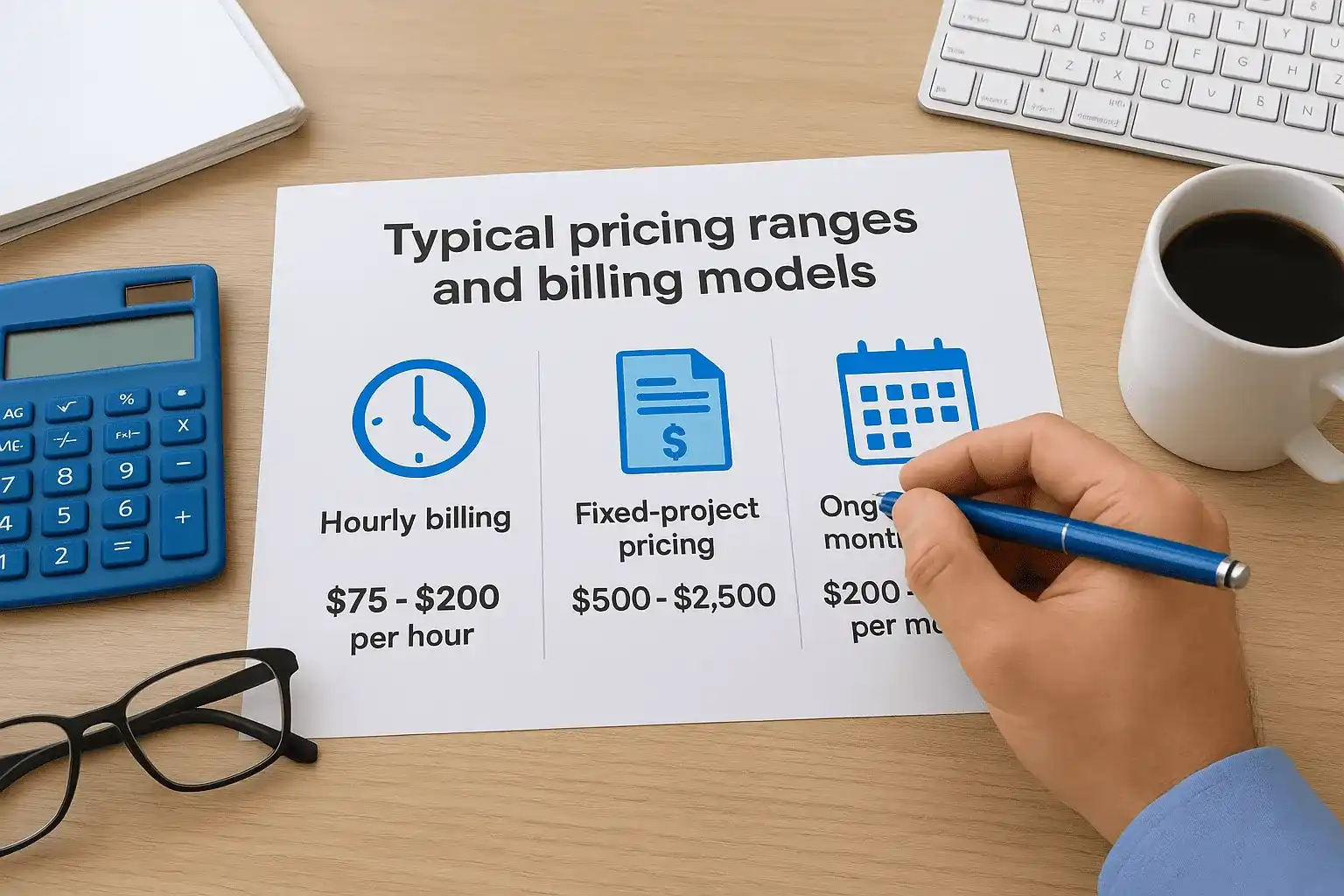
Bookkeeping cleanup services are not priced like a standard monthly subscription. Because the work is project-based and varies significantly by complexity, providers use different billing structures depending on the scope. Knowing what to expect helps you compare quotes accurately and avoid surprises once the work begins.
Hourly billing
Many providers charge by the hour for cleanup work, with rates typically falling between $75 and $200 per hour depending on the professional's credentials and your location. A CPA or Enrolled Agent handling your cleanup will generally charge more than a bookkeeper, but their expertise reduces the risk of errors that require correction later.
For smaller cleanups covering one to three months, hourly billing often works in your favor because the total hours are predictable.
Fixed-project pricing
For cleanups with a clearly defined scope, many firms offer a flat project fee instead of hourly billing. This approach gives you cost certainty upfront. Fixed fees for a single-year cleanup commonly range from $500 to $2,500, while multi-year projects can run $3,000 or higher depending on transaction volume and account complexity.
Ongoing monthly retainers
Some businesses choose to pair their cleanup with ongoing bookkeeping support once the backlog is cleared. Monthly retainer pricing typically ranges from $200 to $800 per month for small businesses, with higher-volume operations paying more. Bundling the cleanup and ongoing work with the same provider often results in better pricing and a smoother transition since they already know your accounts.
How to choose the right cleanup provider
Not every bookkeeper handles cleanup work, and not every cleanup provider has the credentials to prepare or advise on the taxes that follow. Choosing the right professional upfront saves you from paying twice when errors in the cleanup require correction before your CPA can file.
Check credentials and experience
Your cleanup provider should hold a recognized credential: a CPA, Enrolled Agent, or certified bookkeeper with documented experience in cleanup projects specifically. General bookkeeping experience is useful, but cleanup work requires the ability to identify and correct errors that accumulated over time, which is a different skill from maintaining current records.
A provider who also offers tax preparation or resolution services can handle both the cleanup and the filing in one place, which reduces miscommunication and saves time.
You should also confirm that the provider has direct experience with your accounting software, whether that's QuickBooks, Xero, or another platform. Rebuilding accurate records in a system your provider does not know well adds time and increases the risk of new errors.
Ask the right questions before you hire
Before you commit, ask these questions directly:
- How do you price cleanup projects, by the hour or as a fixed fee?
- What do you need from me to start, and how long will the project take?
- Will you flag recurring issues so I can avoid the same problems going forward?
- Do you offer ongoing bookkeeping support after the cleanup is complete?
When you evaluate bookkeeping cleanup services, a provider who answers these questions clearly and upfront is one you can trust with your records.
Next steps
If your books are behind, miscategorized, or simply don't match your bank statements, the gap between where your records are and where they need to be is fixable. Bookkeeping cleanup services are a direct, practical solution, and starting the process now means your financials are ready when tax deadlines, loan applications, or IRS notices require accurate numbers.
Your first move is to gather your bank and credit card statements for every affected period and identify which accounting software you use. This preparation shortens the initial assessment and gives your provider a clear picture of the scope before work begins.
From there, working with a firm that offers both cleanup and tax services under one roof removes the handoff risk between separate providers. At Tax Experts of OC, our CPAs handle the full process from reconciliation to filing. Schedule your free 30-minute consultation and get your books back on track.