

How much you'll actually pay to get your taxes done depends on a lot more than most people expect. Tax preparation services cost anywhere from under $200 for a basic individual return to well over $1,000 for complex business filings, and the range in between can feel hard to pin down. Factors like your filing status, the number of schedules involved, whether you're self-employed, and who prepares your return all shift the final price significantly.
That uncertainty is exactly why so many taxpayers either overpay for simple returns or underpay for help they genuinely need. A straightforward W-2 filing doesn't require the same level of expertise as a multi-state partnership return, but pricing from national chains and independent firms doesn't always reflect that distinction clearly. Understanding what drives these fees gives you a real advantage when comparing providers, and helps you avoid surprises at checkout.
At Tax Experts of OC, we handle everything from individual filings to corporate and nonprofit returns, with transparent upfront pricing before any work begins. We built this guide to break down average tax preparation fees by return type, explain what CPAs and Enrolled Agents typically charge versus national franchises, and help you figure out where your money is actually going. Whether you're filing a 1040 or a 1120S, you'll walk away knowing what a fair price looks like.
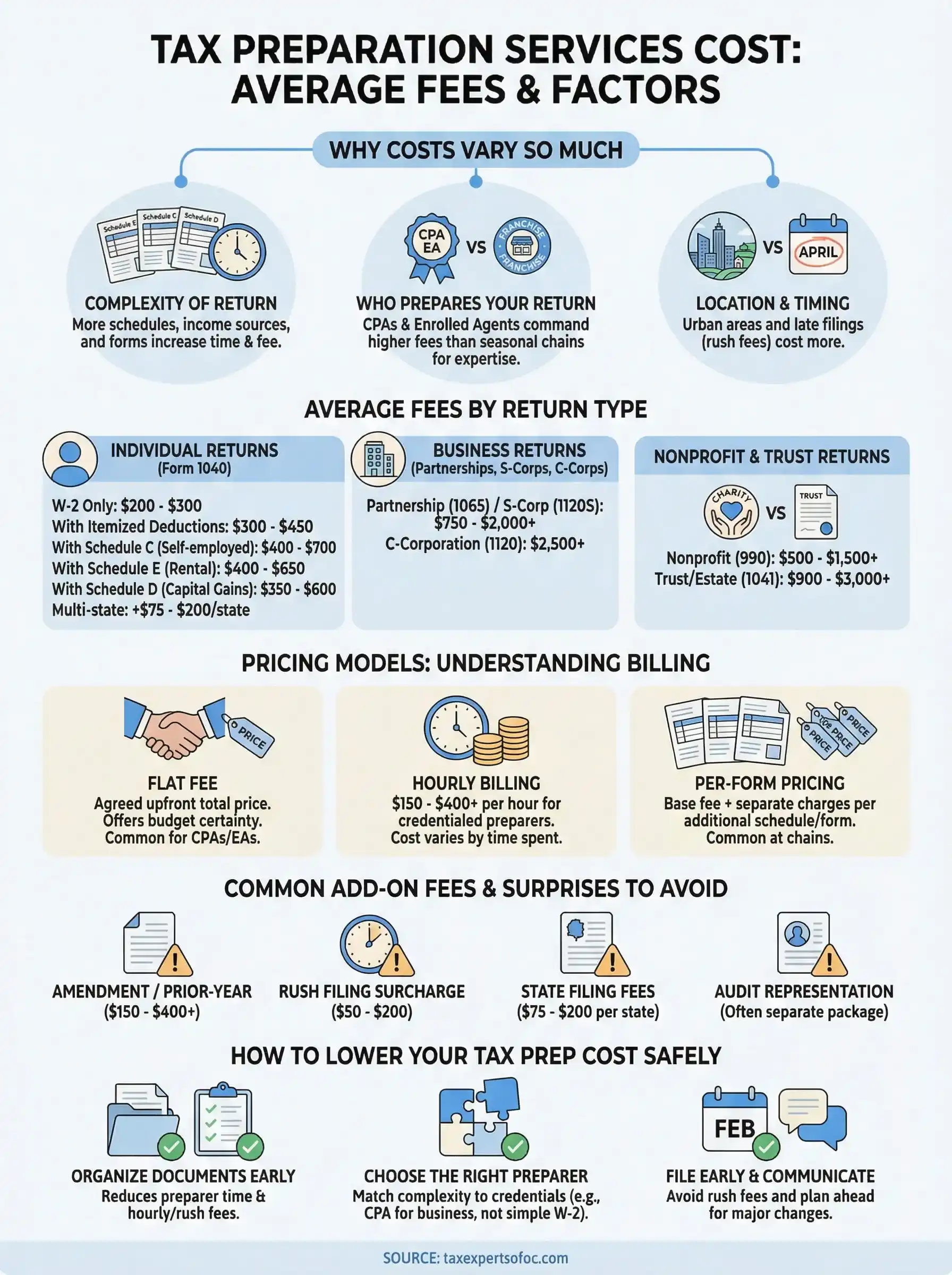
Why tax preparation services costs vary so much
The single biggest reason tax preparation services cost can swing so dramatically from one return to the next is complexity. A preparer working on your return is essentially pricing their time and expertise, so the more complicated your tax situation, the more both of those things get consumed. Two people can walk into the same firm, hand over their paperwork, and walk out with bills that differ by hundreds of dollars because their financial lives look nothing alike.
The complexity of your return
Every additional schedule, form, or income source your return requires adds time and responsibility for the preparer. A basic Form 1040 with only W-2 income takes a fraction of the time that a return with rental property income, stock sales, or self-employment income requires. The IRS reports that the average individual taxpayer spends over 13 hours preparing their own return, and that number climbs sharply with complexity. When a professional handles that work, their fee reflects that time directly.
The more schedules your return includes, the more a preparer has to do, and that work shows up directly in the price you pay.
Here are some common factors that push a return into higher-complexity territory:
- Self-employment income (Schedule C)
- Rental properties (Schedule E)
- Capital gains and investment sales (Schedule D)
- Foreign income or foreign bank accounts (FBAR filing)
- Multi-state filings
- Business ownership (K-1 income from partnerships or S-corps)
- Itemized deductions across multiple categories
Who prepares your return
The credentials of your preparer matter as much as any other factor when it comes to pricing. A Certified Public Accountant (CPA) or Enrolled Agent carries years of education, licensing requirements, and ongoing continuing education obligations. That expertise commands higher fees than what you'd pay at a seasonal tax preparation chain staffed by people with limited training. The gap in knowledge between a credentialed professional and a basic preparer often justifies the price difference, especially when your return has meaningful complexity or involves any IRS exposure.
National franchise firms tend to use a per-form pricing model that layers fees on top of a base rate, which can add up faster than you expect. Independent CPAs and Enrolled Agents typically charge a flat fee or an hourly rate, which may feel higher upfront but often includes a more thorough review of your return and direct access to someone who can answer questions year-round.
Your location and the time of filing
Where you live directly affects what preparers in your area charge. Urban markets consistently run higher than rural ones due to overhead costs and local demand. A CPA in Los Angeles or New York City will generally charge more than one in a smaller market for the same return, not because the work differs but because operating costs and market rates differ significantly between regions.
Timing plays a meaningful role too. Preparers charge more for returns filed close to the April deadline because demand spikes and their available capacity shrinks. If you come in during the final two weeks before the deadline with a disorganized pile of documents, expect to pay a premium on top of the base fee for the rushed turnaround. Clients who schedule early, ideally in February, and arrive with their documents organized consistently pay less than those who wait until the last minute. Getting ahead of the deadline is one of the most underused cost-control strategies available to you.
Average tax preparation fees by return type
Knowing what a typical return actually costs gives you a baseline to work from when you're comparing quotes. Tax preparation services cost varies widely across return types, but the ranges below reflect what most taxpayers and business owners pay when working with a credentialed professional. These figures align closely with data from the National Society of Accountants, which surveys preparer fees annually across the country.
Individual returns (Form 1040)
Your personal return is where most people start, and the base fee depends heavily on how many schedules your situation requires. A straightforward 1040 with only W-2 income typically runs between $200 and $300. Once you add complexity, the price climbs fast.
The moment you add self-employment income, rental properties, or significant investment activity, your filing moves into a higher fee bracket regardless of who prepares it.
Here is what individual filers generally pay based on return complexity:
| Return type | Typical fee range |
|---|---|
| 1040 (W-2 only, standard deduction) | $200 - $300 |
| 1040 with itemized deductions | $300 - $450 |
| 1040 with Schedule C (self-employed) | $400 - $700 |
| 1040 with Schedule E (rental income) | $400 - $650 |
| 1040 with Schedule D (capital gains) | $350 - $600 |
| Multi-state individual return | Add $75 - $200 per additional state |
Business returns
Business filings carry significantly higher fees because they require more documentation review, stricter compliance checks, and a deeper understanding of entity-specific tax rules. A partnership return (Form 1065) or S-corporation return (Form 1120S) typically runs between $750 and $2,000, depending on the number of partners, transactions, and supporting schedules involved. A C-corporation return (Form 1120) can push past $2,500 for companies with substantial revenue, multiple deductions, or any foreign activity.
Nonprofit and trust returns
Returns for nonprofit organizations (Form 990) and trusts or estates (Form 1041) sit in a specialized category that fewer preparers handle well. A Form 990 for a smaller nonprofit typically costs between $500 and $1,500, while complex trust returns with multiple beneficiaries or asset distributions often run from $900 to $3,000. Working with a CPA or Enrolled Agent who has direct experience in these return types is not optional; errors in these filings carry serious compliance consequences.
Pricing models: flat fee, hourly, per form
Understanding how preparers structure their charges helps you compare quotes on equal footing. Tax preparers use three main billing approaches: flat fee, hourly, and per-form pricing. Each model has tradeoffs, and the one your preparer uses directly affects how predictable your tax preparation services cost will be before you hand over a single document.
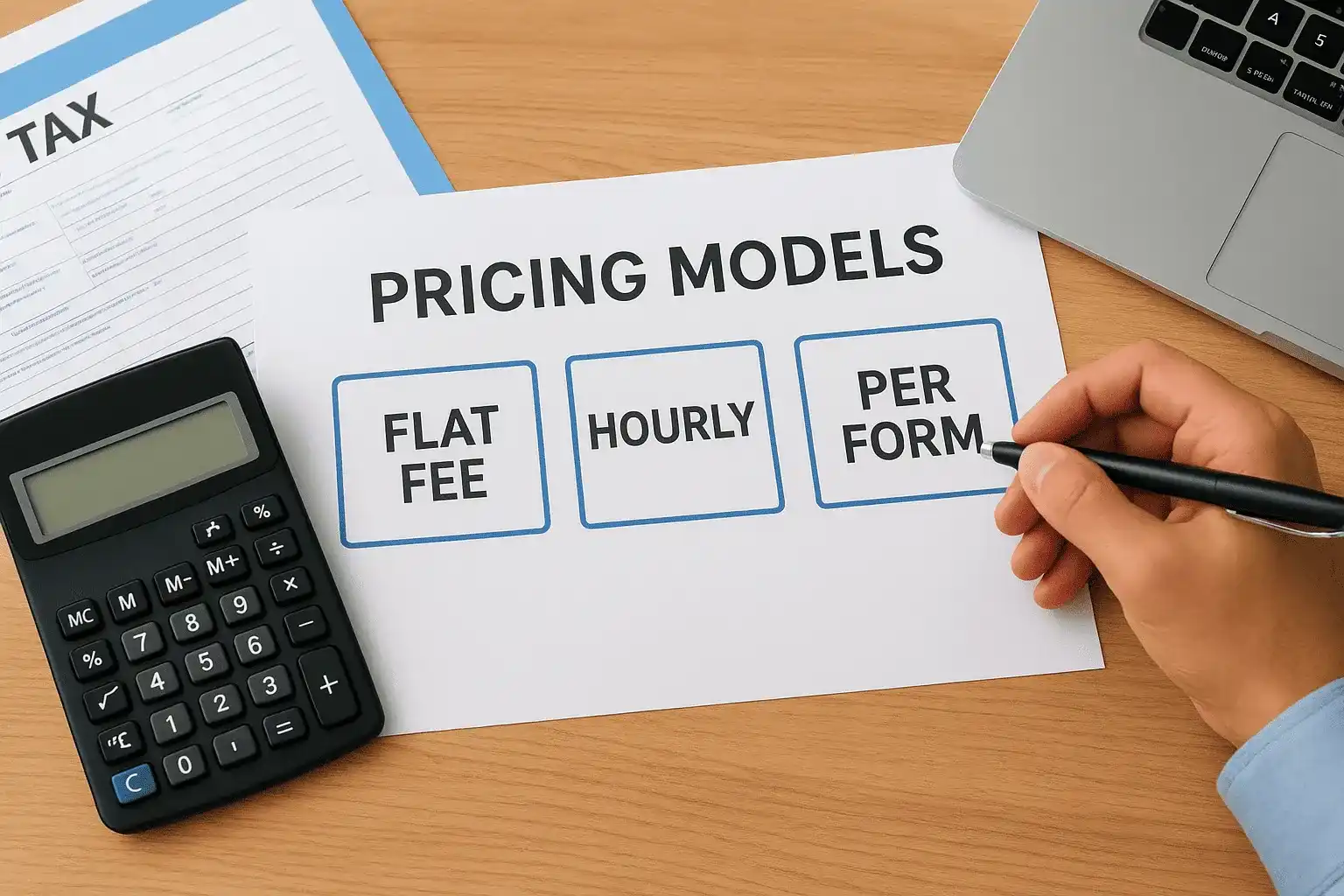
Flat fee pricing
Flat fee pricing means you agree on a total price upfront, and that number does not change regardless of how long the return takes. Most CPAs and Enrolled Agents prefer this model because it gives both parties clarity before work begins. For you, the main advantage is budget certainty: you know exactly what you're paying before the preparer touches your documents, which removes the uncertainty of watching the clock through a complicated filing.
Flat fee pricing works best when your return type is well-defined and your documents are organized before the appointment.
The tradeoff is that preparers build flat fees to account for worst-case scenarios, so a return that comes in under the expected time may cost slightly more than the same return billed hourly. Most people still prefer the predictability over the potential savings of an hourly model.
Hourly billing
Hourly rates for credentialed tax preparers typically run from $150 to $400 per hour, depending on the preparer's qualifications and your location. CPAs and Enrolled Agents sit at the higher end of that range. Hourly billing can work in your favor when your return is genuinely simple and takes little time to prepare, but it introduces real uncertainty when your documents are incomplete or require multiple rounds of follow-up to resolve.
Disorganized records are expensive under an hourly model. Every missing form, phone call, or clarification request adds billable time. If a preparer quotes you an hourly rate, ask them to estimate the expected total hours before you commit so you can compare that figure against a flat fee from another firm.
Per-form pricing
Per-form pricing is the dominant model at national franchise tax chains, where a base fee covers the main return and each additional schedule carries its own separate charge. A Schedule C might add $75 to $150. A Schedule E could add another $50 to $100. These individual charges stack quickly, and a return that looks affordable based on an advertised base price can easily double once every applicable form gets added to your bill.
Request a full itemized estimate before agreeing to per-form pricing. Without that breakdown, you have no reliable way to compare the total cost against a flat fee quoted by an independent CPA or Enrolled Agent.
Common add-on fees and cost surprises to avoid
Most quotes you receive cover the base return only. Add-on fees are where the tax preparation services cost can jump well past your original estimate, and these charges rarely get disclosed upfront unless you specifically ask. Knowing which extras to expect lets you compare total costs accurately rather than just the advertised starting price.
Amendment, prior-year, and rush filing fees
If your return needs correction after filing, you will need Form 1040-X, which most preparers bill as a separate engagement. Amendment fees typically run from $150 to $400 on top of what you already paid for the original return. Prior-year unfiled returns work the same way: each year is generally its own return with its own fee, not bundled into a discount. Arriving close to the April deadline with incomplete records almost always triggers a rush surcharge ranging from $50 to $200, and disorganized documents that require extra sorting time get absorbed into your bill one way or another.
If you have multiple unfiled years, ask upfront whether each year is priced separately or whether the firm offers any combined pricing for catching up.
Several situations commonly trigger these add-on charges:
- Filing an amended return after receiving a corrected 1099 or W-2
- Catching up on two or more years of unfiled returns
- Requesting a same-week turnaround in April
- Providing receipts and records that require the preparer to organize before work can begin
State filings and audit representation
Each state return you file carries its own separate fee, and multi-state filers see their totals climb quickly. A single additional state return typically adds $75 to $200 to your base cost, and that number multiplies fast if you worked in or earned income from multiple states during the year.
Beyond state filings, audit support is frequently excluded from standard preparation fees. Many firms offer packages that cover filing only, with IRS correspondence, audit representation, or response letters treated as separate billable work. Ask directly what happens if the IRS contacts you after your return is filed, because that answer tells you exactly what your base fee covers and what it does not. A preparer who includes basic audit support in their standard fee is offering meaningfully more value than one who charges the same rate but bills separately the moment the IRS sends a letter.
How to lower your tax prep cost safely
Cutting your tax preparation services cost does not require sacrificing quality or moving to a less qualified preparer. Most of the practical ways to reduce what you pay come down to preparation, timing, and knowing the right questions to ask before any work begins. Small changes in how you approach the process consistently produce real savings without any added risk to your return.
Organize your documents before your appointment
Nothing drives up your bill faster than handing over a disorganized stack of receipts and asking a CPA or Enrolled Agent to sort through them. Under any pricing model, preparers absorb time spent organizing your records into the final cost you pay. Arriving with a clear, complete set of documents reduces the hours or complexity the preparer has to work through, which directly lowers your bill.
A preparer who spends 30 minutes organizing your documents before they can even start your return will charge you for that time one way or another.
Before your appointment, gather these items and have them ready in one place:
- All W-2s, 1099s, and K-1s for the tax year
- Records of any deductible expenses (charitable donations, business costs, medical bills)
- Prior-year return for reference
- Social Security numbers for yourself, your spouse, and any dependents
- Bank account information if you want direct deposit of your refund
Choose the right preparer for your return complexity
Matching the preparer to your actual filing complexity avoids paying CPA-level rates for a return that a less senior professional could handle accurately. A simple W-2-only return with the standard deduction does not require a senior CPA. On the other hand, self-employment income, rental properties, or business ownership genuinely warrants a credentialed professional rather than a seasonal chain employee. Getting that match right protects both your money and the accuracy of your return.
File early and communicate year-round
Scheduling your appointment in February instead of April is one of the most reliable ways to avoid rush fees, which can add $50 to $200 to an otherwise reasonable quote. Beyond timing, staying in contact with your preparer throughout the year means fewer surprises at filing time. Reporting major financial changes, a new job, a business start, or a property purchase, as they happen gives your preparer time to plan proactively rather than scramble reactively when the deadline is close.
Next steps
Now you have a clear picture of what drives tax preparation services cost, what different return types typically run, and how billing structures affect your final bill. The next move is comparing quotes with that full context in mind, rather than picking the lowest number without understanding what it includes or leaves out.
If your return involves self-employment income, a business entity, rental properties, or any IRS correspondence, working with a credentialed professional is worth the investment. A CPA or Enrolled Agent brings both accuracy and accountability that seasonal preparers and software cannot match for complex situations.
Tax Experts of OC offers a free 30-minute consultation to review your situation and give you transparent, upfront pricing before any work begins. Whether you're filing a simple 1040 or a multi-state business return, you get direct access to a qualified professional who can answer your questions. Schedule your free consultation and find out exactly what your return will cost before you commit.