
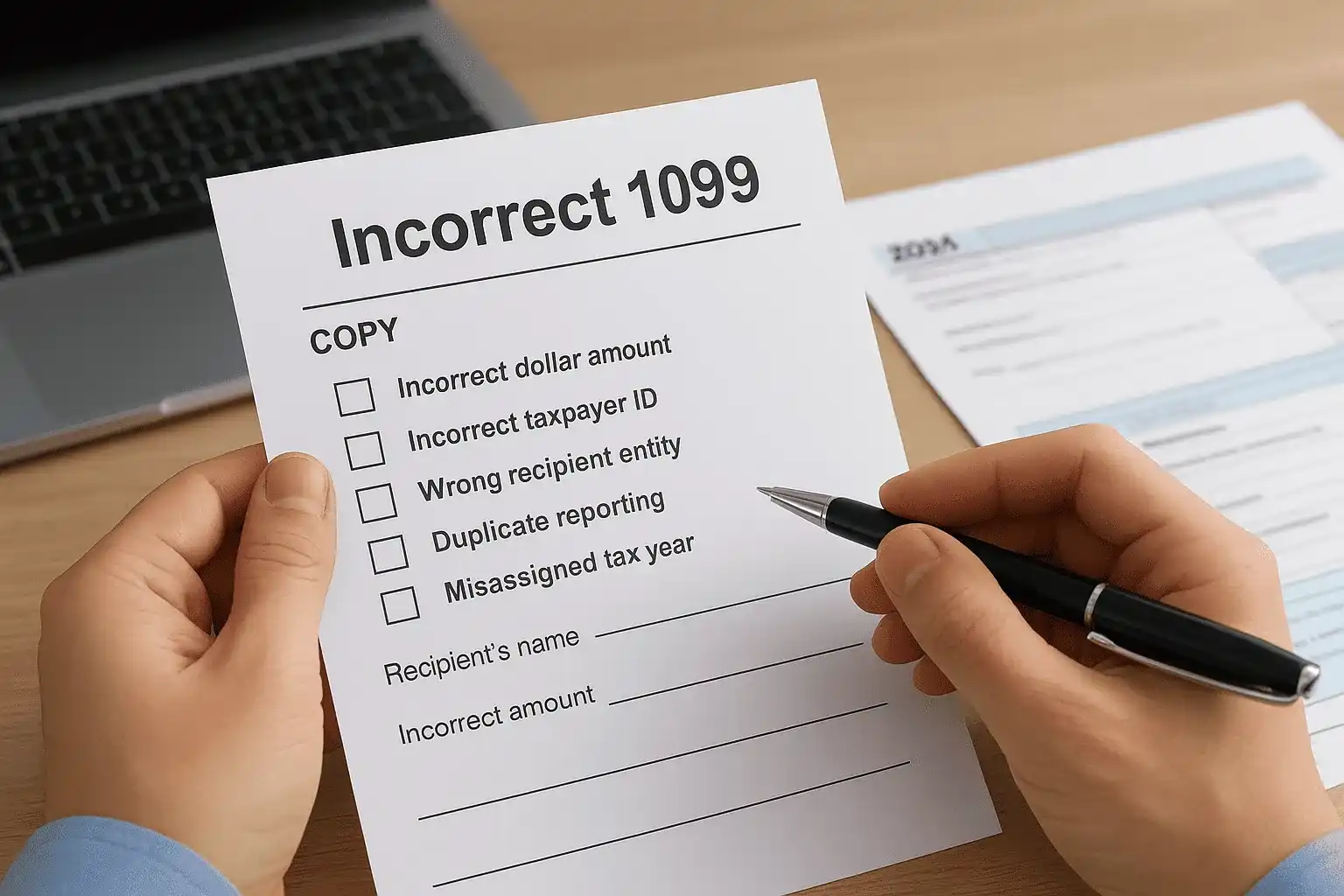
You open your mailbox, see a 1099 with your name on it, and something looks wrong. Maybe the income amount is inflated, maybe it lists a business you closed two years ago, or maybe it's addressed to you when the payment actually went to your LLC. An incorrect 1099 is more common than most people realize, and ignoring it is the worst move you can make. The IRS gets a copy too, and if the numbers on your return don't match, you can expect a notice within a year or two.
The fix depends on how fast you catch the error and how cooperative the issuer is. In most cases, you contact the payer directly and request a corrected 1099 before you file. If they refuse or drag their feet, you still have a legitimate way to report the accurate income and protect yourself from an audit trigger.
This guide walks through both scenarios step by step: getting the issuer to correct their filing, and what to do on your tax return when they won't budge. If the situation has already escalated into an IRS notice or a mismatch letter, our team at Tax Experts of OC handles exactly this kind of dispute every week.
What counts as an incorrect 1099
Not every mistake on a 1099 is a crisis, but you need to know which ones matter before you decide whether to push back. A 1099 error generally falls into one of three buckets: the payer reported the wrong dollar amount, they used the wrong taxpayer ID or name, or they issued the form to the wrong entity entirely, like sending you a personal 1099-NEC for income your S-corp actually received. Each of these creates a mismatch between what the IRS has on file and what belongs on your return.
Common types of 1099 errors
Some errors show up more often than others, especially with 1099-NEC and 1099-MISC forms used for freelance and contractor payments. Watch for these:
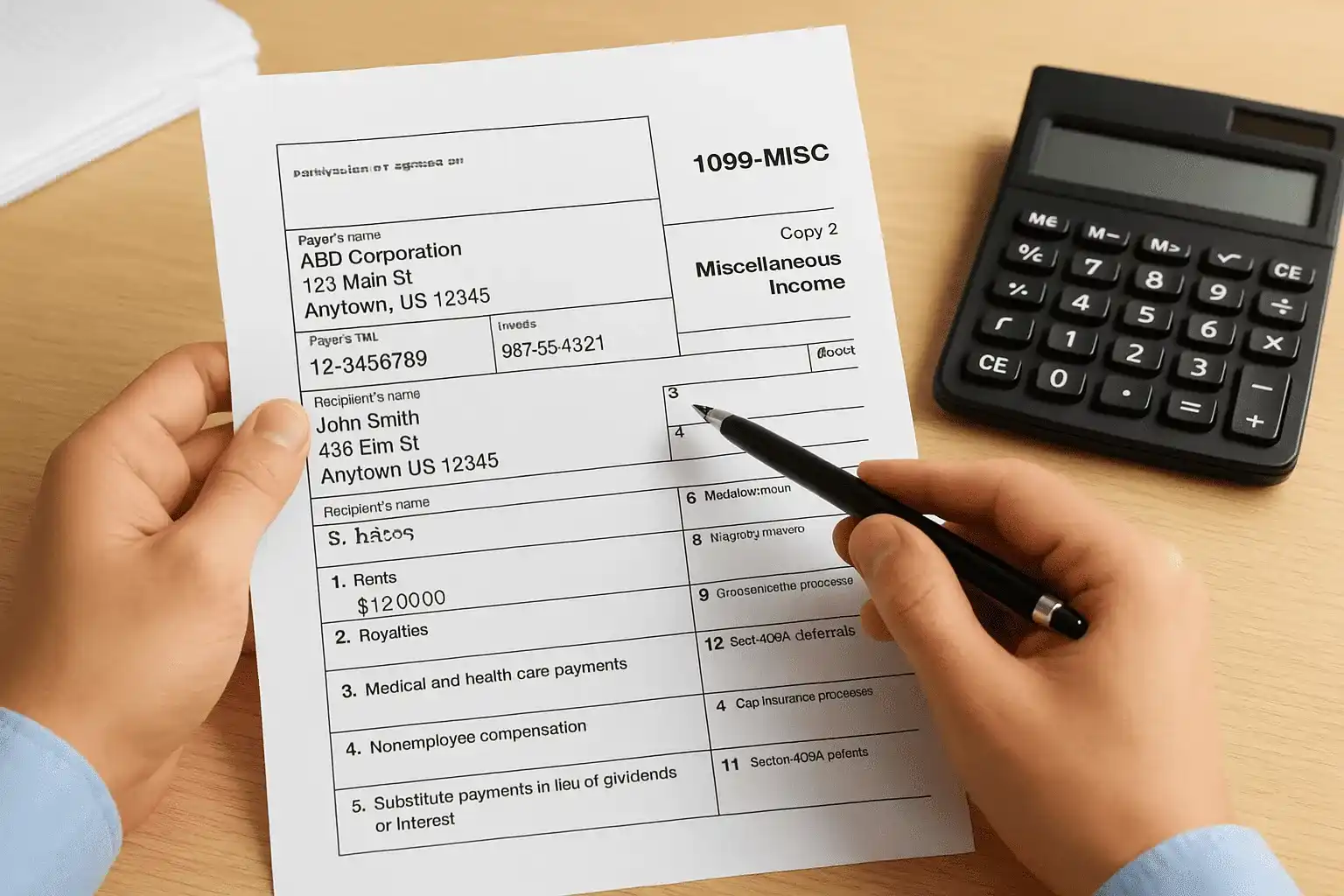
- Income amount is wrong: too high, too low, or includes a payment you never received.
- Wrong Social Security number or EIN: this creates a mismatch even if the dollar amount is correct.
- Wrong recipient: the payment belonged to your business entity, not you personally, or vice versa.
- Duplicate reporting: two 1099s for the same job because a client and their payment platform both filed.
- Wrong tax year: income you earned in December got reported for the following year, or the reverse.
Errors that don't actually need a correction
Minor typos, like a misspelled street name or an old apartment number, rarely require a corrected 1099 because the IRS matches by taxpayer ID, not address. Focus your energy on errors that affect the numbers the IRS actually cross-checks against your return.
If the dollar amount or your taxpayer ID is wrong, fix it. Everything else is usually noise.
Before you contact anyone, pin down exactly which category your error falls into, since that determines the next move you'll take.
Step 1. Confirm the error and gather your records
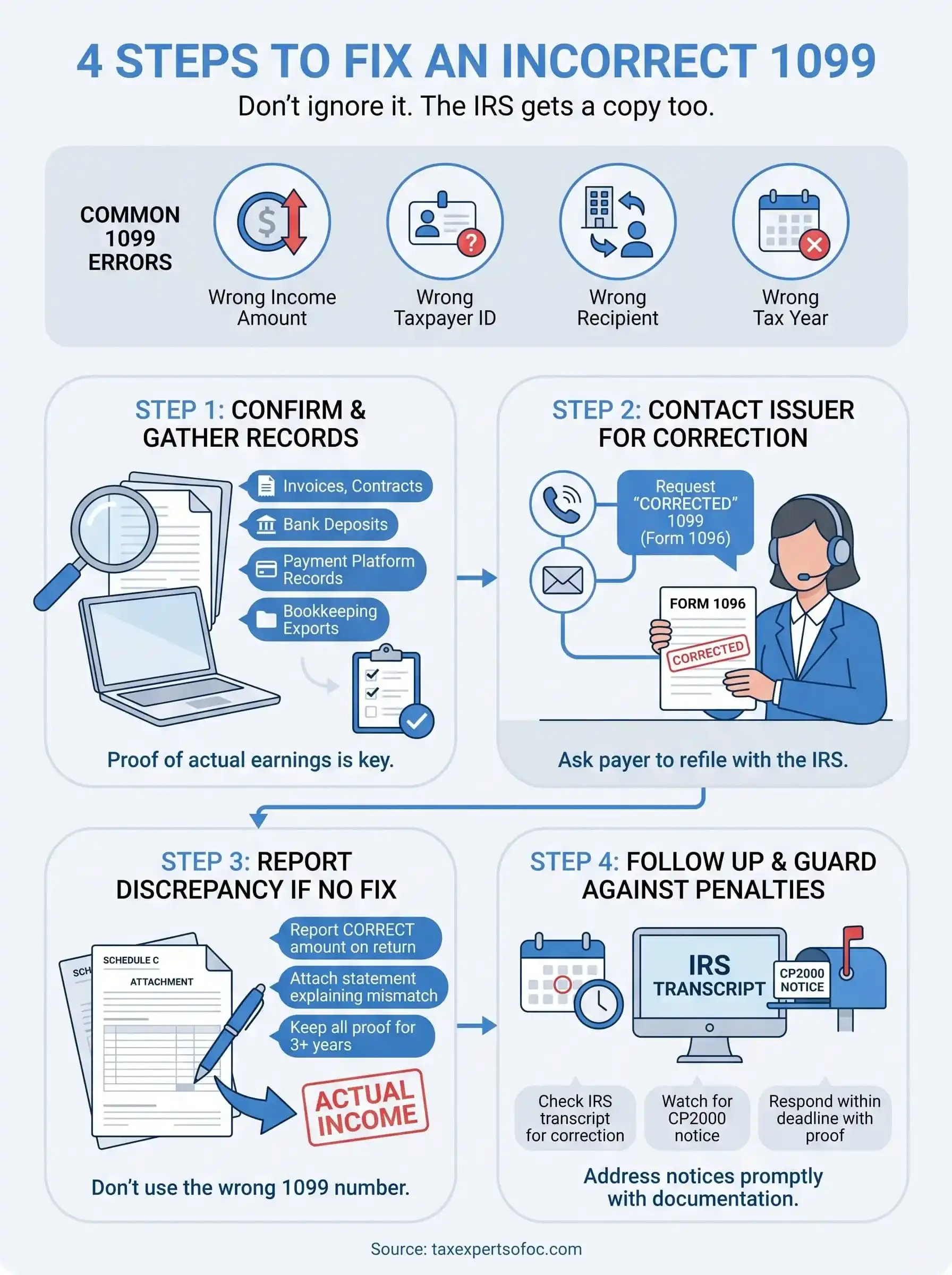
Grab last year's invoices, bank deposits, and contracts before you call anyone. You need proof of what you actually earned, not just a gut feeling that the number looks off. Compare the 1099 line by line against your own records, since a 1099 discrepancy often comes down to a client counting a January payment in the wrong tax year or double-reporting a job that ran through two payment methods.
Documents to pull together
Line up these records before you contact the issuer, so you're not scrambling mid-call:
- Bank statements or deposit records showing actual payments received
- Invoices or contracts tied to the disputed income
- Payment platform records (PayPal, Venmo, Stripe) if the client paid through a third party
- Prior year 1099s from the same payer for comparison
- Your own bookkeeping or accounting software export
Why documentation matters early
A payer won't issue a corrected 1099 on your word alone. They'll want to see numbers that match their own records or clearly contradict them.
Bring proof, not just a complaint, and the correction happens faster.
Once you've confirmed the error and have your paperwork organized, you're ready to make contact.
Step 2. Contact the issuer for a corrected form
Call or email the payer's accounting department first, not the person who hired you. Whoever handles their 1099 filings can pull up the original submission and see exactly where the numbers diverge from yours. Explain the discrepancy plainly, reference your documentation, and ask them to file Form 1096 with a corrected 1099 marked "CORRECTED" at the top. This is standard paperwork on their end, so a cooperative payer usually turns it around within a week or two.
What to include in your request
Put the request in writing, even if you also call. Cover these points:
- The exact box and dollar amount you believe is wrong
- Your supporting documents (attach copies, not originals)
- The tax year affected
- A deadline, ideally before their filing cutoff with the IRS
If they agree to fix it
Ask for a copy of the corrected form once it's filed, and confirm they've also submitted the correction to the IRS, not just sent you a revised copy. A payer who only fixes your copy hasn't actually resolved the mismatch on the IRS's end.
A corrected 1099 only counts once it's refiled with the IRS, not just reprinted for you.
Step 3. Report the discrepancy if the issuer won't fix it
Some payers stall, ignore your emails, or flat-out refuse to amend anything. When that happens, don't just copy their wrong number onto your return and hope for the best. Report the actual income you can document, not the figure printed on the incorrect 1099, and keep every piece of proof from Step 1 in a labeled file for at least three years.
How to report it correctly
On your tax return, list the income under the correct category and attach a brief statement explaining the mismatch. For self-employment income, this usually means:
- Reporting the correct amount on Schedule C
- Noting the payer's name, EIN, and the amount they reported
- Explaining the discrepancy in a short attached statement
Report what you actually earned and document why the 1099 is wrong, don't let a stubborn payer decide your tax liability for you.
What happens next
Expect the IRS's automated matching system to flag the difference eventually. That's fine. You'll have the paper trail ready when they ask, and a documented 1099 discrepancy is far easier to defend than an unexplained gap on your return.
Step 4. Follow up and guard against penalties or audits
Set a calendar reminder to check your IRS transcript a few months after filing, since the IRS matching system can take a year or more to flag a mismatched 1099. Pulling your wage and income transcript online lets you see exactly what the payer reported, confirming whether they ever filed that correction they promised.
Watch for CP2000 notices
If a notice does arrive, it's almost always a CP2000, an automated letter comparing your return against third-party filings, not a formal audit. Respond within the deadline printed on the letter, attach your documentation, and reference the statement you filed with your original return.
- Keep copies of every email or letter sent to the issuer
- Save proof of your correct income for at least three years
- Respond to any IRS notice by its stated deadline, never let it sit
A CP2000 notice isn't an audit, it's a chance to show your paper trail before things escalate.
Treat that response window as your last easy off-ramp before the dispute gets harder to resolve.
When to bring in a tax professional
Some disputes resolve with one phone call. Others drag on for months while a payer stonewalls you and the IRS clock keeps ticking. If you've sent documentation twice and heard nothing back, or if you're staring at a CP2000 notice with a deadline you don't fully understand, that's the point to stop handling it alone. A wrong number on a 1099 can snowball into penalties, interest, and an audit if the response isn't filed correctly the first time.
You've now got the full playbook for fixing an incorrect 1099, from confirming the error to reporting the correct income when the payer won't budge. Most people can work through Steps 1 and 2 on their own. Once you're drafting a response to the IRS or fighting a payer who refuses to refile, get someone who does this professionally. Schedule a free consultation with Tax Experts of OC and let a CPA or Enrolled Agent handle the paperwork and the IRS correspondence for you.