
Filing your federal income tax return doesn't have to cost you anything. The IRS Free File program gives millions of taxpayers access to brand-name tax software at no charge, helping them complete and submit their returns without paying preparation fees. If your adjusted gross income falls below a certain threshold, you may qualify for guided tax preparation through one of several IRS-approved partners.
But free doesn't always mean simple. The program comes with eligibility limits, income caps, and specific rules about which forms you can use. Understanding these details before you start can save you from surprises mid-filing or, worse, discovering you don't qualify after you've already entered your information. This guide breaks down who qualifies for IRS Free File, what the income limits are for 2026, and how to access the program through the IRS website.
At Tax Experts of OC, we help clients across the country navigate tax preparation and resolution, from straightforward filings to complex multi-state returns and IRS disputes. While Free File works well for many taxpayers with simple tax situations, some returns require professional oversight to avoid costly errors. Below, you'll find everything you need to decide whether Free File fits your needs or whether working with a CPA or Enrolled Agent makes more sense for your circumstances.
What IRS Free File is and how it works
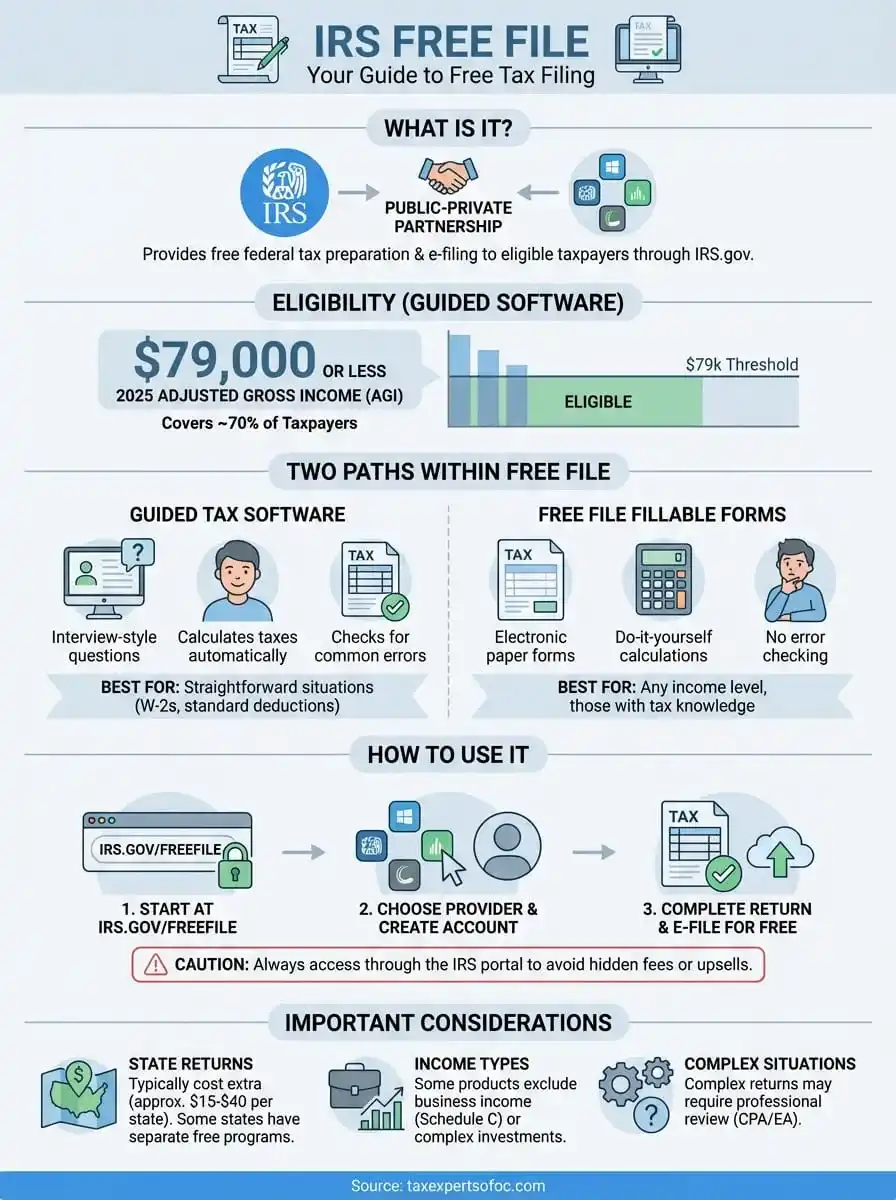
IRS Free File is a public-private partnership between the Internal Revenue Service and a group of tax software companies. These companies agree to provide free online tax preparation to taxpayers who meet specific income requirements in exchange for being listed on the IRS website. You access the program through the official IRS portal at irs.gov, which directs you to the participating company's website where you complete and submit your return electronically.
The two main paths within Free File
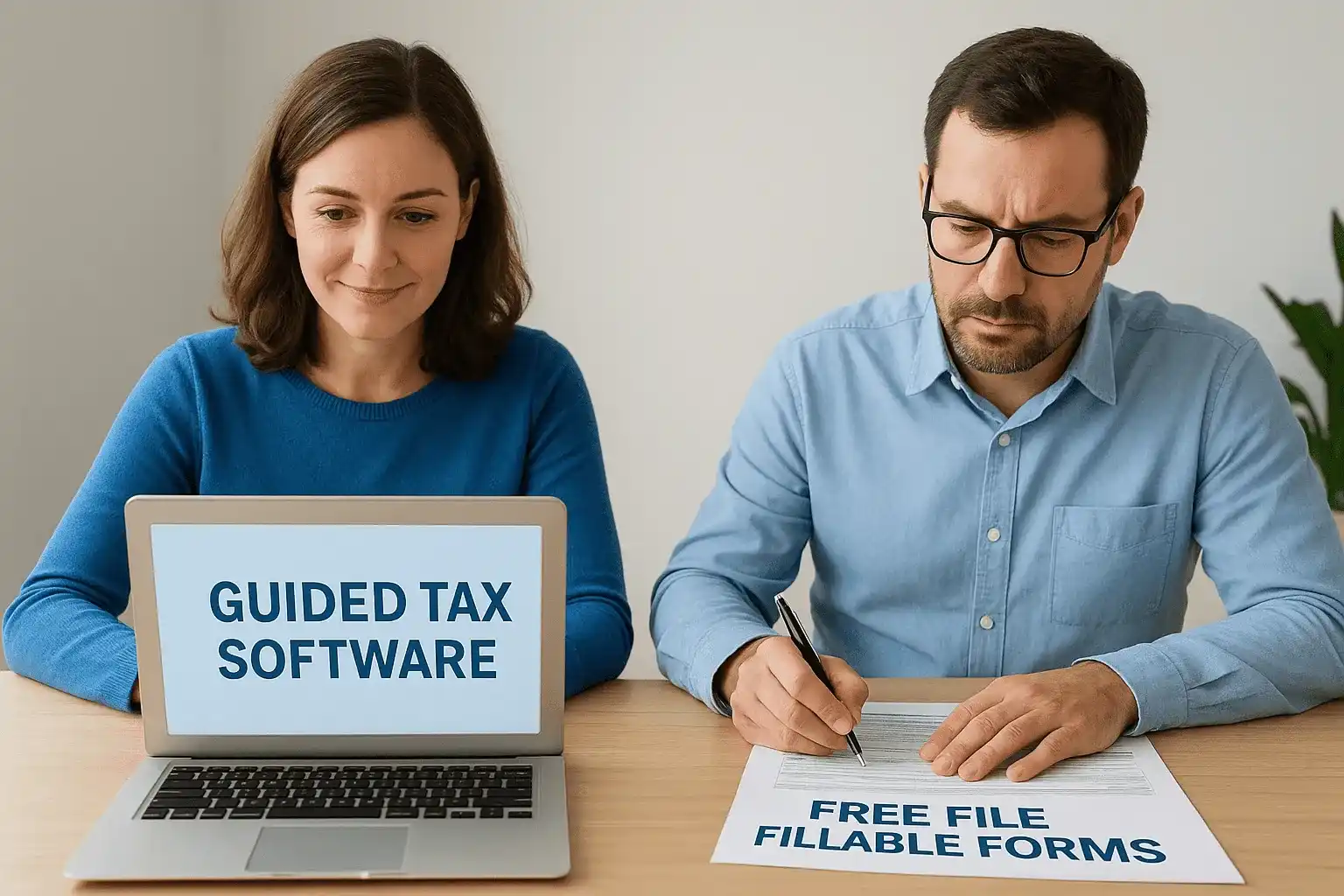
The program offers two distinct options depending on your comfort level with tax forms. If you qualify by income, you can use guided tax software from one of the participating companies. These programs walk you through your return with interview-style questions, automatically calculate your tax, and check for common errors before you file. You never see the actual tax forms unless you choose to review them.
Alternatively, taxpayers at any income level can use Free File Fillable Forms, which are electronic versions of paper IRS forms. You fill out the forms yourself, perform your own calculations, and take responsibility for accuracy. This option requires more tax knowledge but gives you complete control over the process.
If your income exceeds the Free File threshold, you can still use the fillable forms option to file electronically at no cost.
How the partnership works
The IRS does not develop or maintain the tax preparation software itself. Instead, participating companies like TaxSlayer, TaxAct, and others build and host their own platforms. Each company sets its own eligibility rules within the IRS income cap, meaning you might qualify for one company's free product but not another's. The IRS simply provides the gateway and ensures that each company offers a genuinely free federal filing option to qualifying taxpayers without upselling during the preparation process.
Who qualifies and the current income limits
Your eligibility for IRS Free File's guided software depends entirely on your adjusted gross income (AGI) from the previous tax year. For the 2025 tax year (filed in 2026), you qualify if your AGI is $79,000 or less. This threshold applies regardless of your filing status, meaning single filers and married couples filing jointly both use the same income cap.
Income thresholds by tax year
The IRS adjusts the income limit periodically based on its agreement with participating software companies. For 2025 returns, the $79,000 threshold covers roughly 70% of all taxpayers. You calculate your AGI by taking your total income and subtracting specific deductions like student loan interest, IRA contributions, and self-employment tax, which means your AGI is typically lower than your gross wages.
If your AGI exceeds the limit, you can still file electronically for free using Free File Fillable Forms instead of guided software.
Who cannot use the program
Some tax situations disqualify you from using certain Free File products even if you meet the income requirement. Most participating companies exclude returns with business income reported on Schedule C or complex investment transactions. Each software provider sets its own restrictions beyond the basic income cap, so you need to check eligibility with individual companies through the IRS Free File portal.
How to use IRS Free File to file your return
You start by visiting the official IRS Free File page at irs.gov/freefile, not by searching for free tax software through a search engine. Many tax companies advertise "free" products that carry hidden fees or upsells, but the IRS Free File portal guarantees access to truly free federal filing for qualifying taxpayers. The portal displays all participating software providers and their specific eligibility requirements beyond the basic income threshold.

Choosing your software provider
Each participating company sets additional eligibility criteria like age limits, state residency, or military status. You review these requirements on the IRS portal, then click through to the company whose product matches your situation. Once you land on the provider's website through the IRS Free File link, you create an account and begin entering your tax information using their guided interview process.
Always access Free File software through the IRS portal to ensure you receive the free version rather than a paid product.
The software asks questions about your income, deductions, and credits, then completes the appropriate forms automatically. You review your completed return, electronically sign it, and submit it directly to the IRS. Most taxpayers receive their federal tax refund within 21 days when they file electronically and choose direct deposit.
Guided tax software vs Free File Fillable Forms
The IRS Free File program splits into two fundamentally different approaches to tax preparation. Guided software handles the complexity for you by asking simple questions and completing forms automatically, while Free File Fillable Forms require you to know which forms you need and how to fill them out correctly. Your choice depends on your tax knowledge and how comfortable you feel calculating your own liability.
When to use guided software
Guided software works best if you have a straightforward tax situation and want the computer to do the math. The program catches basic errors, suggests credits you might qualify for, and prevents you from skipping required information. You answer questions about your income and expenses without needing to understand IRS form numbers or tax law details.
Guided software automatically checks your return for common mistakes before you submit it to the IRS.
Most taxpayers with W-2 wages and standard deductions benefit from this option because it minimizes the risk of filing errors that trigger IRS notices.
When fillable forms make sense
Fillable forms suit you if you understand tax forms and your income exceeds the guided software threshold. You select each form manually, enter your information, and verify your own calculations. This path requires you to catch your own mistakes since the system provides minimal error checking beyond basic math validation.
State returns, credits, and common pitfalls
The IRS Free File program covers your federal return only, meaning you typically pay extra when you add a state tax return through the same software. Each participating company sets its own state filing fees, usually between $15 and $40 per state. Some providers waive the state fee for military members or specific state residents, but most taxpayers face charges to complete both returns in one platform.
State filing costs add up
You pay separately for each state return you file, so working in multiple states quickly increases your preparation costs even when federal filing costs nothing. Many states operate their own free filing programs through state revenue departments, which you can use after submitting your federal return through IRS Free File. This approach splits your filing across two systems but eliminates state fees.
Credits you commonly overlook
Free File software prompts you about major credits like the Earned Income Tax Credit and Child Tax Credit, but smaller deductions often get missed. Taxpayers frequently skip education credits, retirement contribution deductions, and self-employment tax deductions when they rush through interview questions.
Always review your completed return carefully before submitting, even when using software that checks for errors.
Next steps
IRS Free File removes financial barriers to tax compliance when your income falls below the program's threshold and your return stays straightforward. You file electronically without paying preparation fees, claim the refundable credits you qualify for, and submit your return directly through IRS-approved software. Most taxpayers with W-2 income and standard deductions complete their returns successfully using this program.
Complex situations require different support. Returns involving business income, multi-state filings, IRS disputes, or significant deductions benefit from professional review before you submit. Tax software catches calculation errors but cannot advise you on planning strategies that reduce your liability or help you respond to collection notices correctly.
When your tax situation extends beyond basic filing, Tax Experts of OC provides direct access to CPAs and Enrolled Agents who handle resolution, planning, and compliance nationwide through secure virtual consultations.