
Filing IRS Offer in Compromise forms can feel overwhelming, especially when you're already dealing with the stress of tax debt. The process involves specific documents, strict deadlines, and financial disclosures that the IRS scrutinizes closely. One missing form or a miscalculated figure can result in a rejected application and months of wasted effort.
But here's the good news: the paperwork is manageable once you understand exactly what's required and how each piece fits together. The core forms, Form 656, Form 433-A (OIC), and Form 433-B (OIC), follow a logical structure. You just need a clear roadmap to complete them correctly the first time.
That's what this guide provides. At Tax Experts of OC, our CPA and Enrolled Agent have helped clients across all 50 states negotiate tax settlements with the IRS, and we've seen firsthand how proper form preparation makes or breaks an offer. Below, we'll walk you through every form you need, what each section asks for, and how to avoid the most common mistakes that lead to denials.
Understand which offer in compromise forms you need
Before you fill out a single line, you need to know exactly which IRS offer in compromise forms apply to your situation. The IRS uses a packet-based system, meaning your application must include specific forms depending on whether you're an individual or a business. Sending the wrong combination will get your entire application returned before anyone even reviews your offer amount.
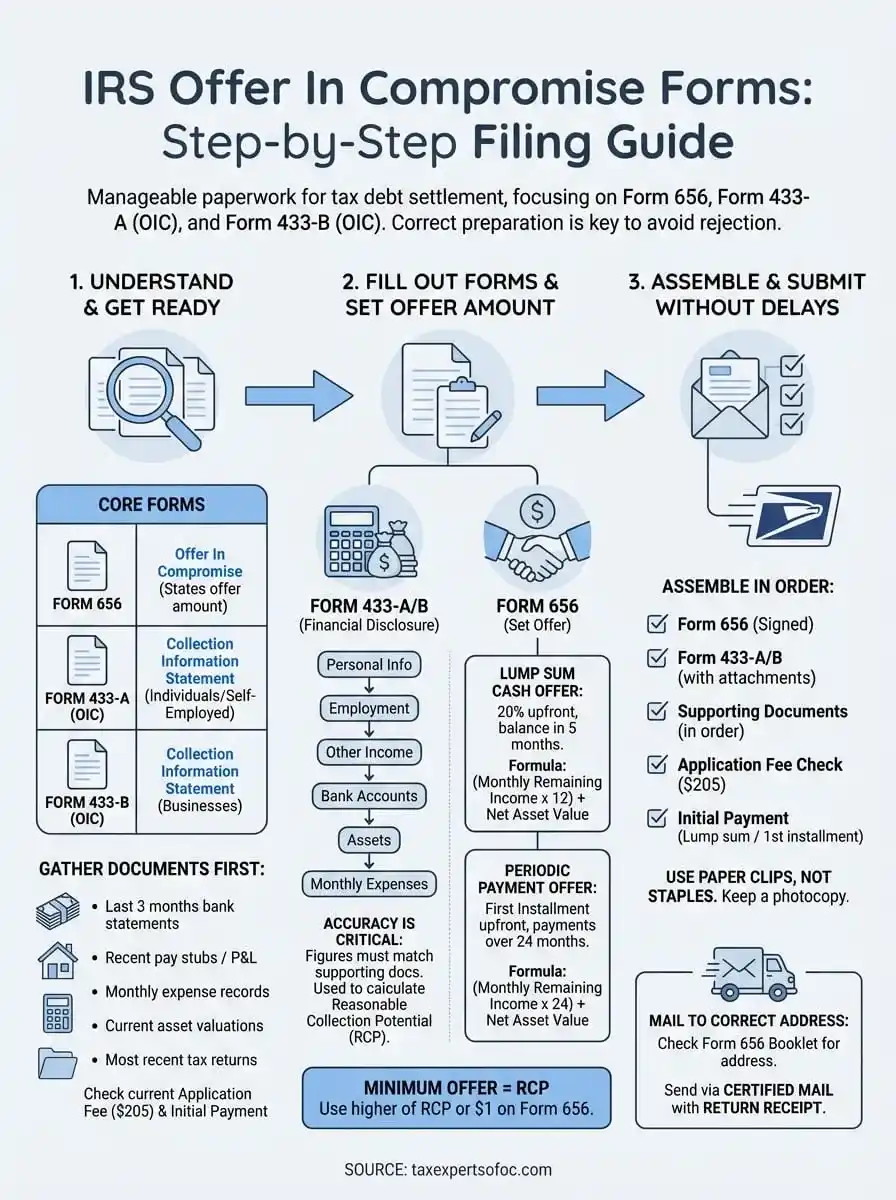
The three core forms
Your OIC application is built around three documents. Each one serves a distinct purpose, and the IRS reviews all of them together when evaluating your offer.
| Form | Official Name | What It Does |
|---|---|---|
| Form 656 | Offer in Compromise | States your offer amount and proposed payment terms |
| Form 433-A (OIC) | Collection Information Statement for Wage Earners and Self-Employed Individuals | Documents your personal income, expenses, and assets |
| Form 433-B (OIC) | Collection Information Statement for Businesses | Documents a business's income, expenses, and assets |
If you submit Form 656 without the correct collection information statement attached, the IRS will return your entire package without processing it.
Which collection information statement applies to you
Your filing status determines which version of the 433 you need. If you are an individual taxpayer or a self-employed person, you complete Form 433-A (OIC). If you are submitting an offer on behalf of a corporation, partnership, or LLC, you complete Form 433-B (OIC).
Some situations require both forms. For example, if you personally guaranteed a business tax debt and the IRS holds both you and the company liable, you may need to submit Form 433-A (OIC) and Form 433-B (OIC) in the same package. You can download the most current versions of all three forms directly from the IRS website. Never use old printed copies, since the IRS rejects outdated form versions.
Get your information ready before you start
Gathering your documents before you open the IRS offer in compromise forms saves significant time and prevents inconsistent information from derailing your application. The IRS cross-checks every figure against third-party records, and missing or inaccurate documentation is one of the most common reasons the agency returns packages unprocessed.
Financial records to collect
Pull together your finances on paper before you write a single number. Collect your last three months of bank statements for every account, along with records for every asset you own, including real estate, vehicles, and retirement funds.
- Last 3 months of bank statements for all accounts
- Recent pay stubs or a profit-and-loss statement if self-employed
- Monthly expense records: rent, utilities, insurance, and car payments
- Current valuations for real estate, vehicles, and investment accounts
- Most recent year's tax returns
Use official sources for asset valuations, such as county assessor records for property and official account statements for retirement funds, rather than personal estimates.
Application fee and initial payment
Your package must include a $205 application fee and an initial payment unless you qualify for the low-income certification waiver. Confirm the current fee amount directly on the IRS website before you mail anything, as this figure is subject to change.
Fill out Form 433-A OIC or Form 433-B OIC
Form 433-A (OIC) and Form 433-B (OIC) are the financial disclosure core of your application. The IRS uses these forms to calculate your reasonable collection potential (RCP), which determines the minimum offer they'll accept. Every figure you report directly affects that number, so accuracy here matters more than anywhere else in the package.
What each section of the form covers
Work through the form in order, using the documents you already gathered. Each section builds on the previous one, and skipping ahead creates inconsistencies the IRS will flag.
| Section | What to Report |
|---|---|
| Personal info | Name, SSN, address, contact details |
| Employment | Wages, pay frequency, employer information |
| Other income | Business, rental, or investment income |
| Bank accounts | Current balances across all accounts |
| Assets | Real property, vehicles, retirement accounts |
| Monthly expenses | Rent, utilities, food, insurance, car payments |
The IRS compares your reported monthly expenses against its National and Local Standards, so any expense that exceeds those limits requires written documentation to support it.
When filling out all irs offer in compromise forms, double-check that the dollar amounts you enter on Form 433 match the bank statements and pay stubs you plan to include as attachments. Inconsistencies between your form and your supporting documents are a fast path to rejection.
Fill out Form 656 and set your offer amount
Form 656 is where you state your offer amount and select how you'll pay it within the full set of IRS offer in compromise forms. After completing Form 433-A (OIC) or Form 433-B (OIC), you pull your RCP figure directly into this form to anchor your proposed settlement number.
Choose your payment option
Your choice of payment structure directly affects your minimum required offer. A lump sum cash offer requires 20% of your total offer upfront with the application, with the remaining balance due within five months of IRS acceptance. A periodic payment offer spreads payments over 24 months, with your first installment submitted alongside the application.
If you select the periodic payment option, you must keep making monthly payments throughout the entire review period, or the IRS will treat your offer as withdrawn.
Calculate your minimum offer amount
The minimum offer you submit must equal your RCP (reasonable collection potential), calculated from the figures on your Form 433. Use the table below to calculate it based on the payment type you chose.
| Payment Type | Formula |
|---|---|
| Lump sum | (Monthly remaining income x 12) + net asset value |
| Periodic payment | (Monthly remaining income x 24) + net asset value |
Enter the higher of your RCP calculation or $1 as your offer amount on Form 656, Section 3.
Assemble your package and submit it without delays
With all your IRS offer in compromise forms completed, assembling and mailing your package correctly is the final step between you and a pending review. A disorganized or incomplete submission gets returned without processing, which restarts your timeline entirely.
Put the documents in the right order
Stack your package in the sequence the IRS expects so the reviewer can follow your application without searching for documents. Place everything in a single envelope and use a paper clip rather than a staple to hold multiple-page documents together.
- Form 656 (signed and dated)
- Form 433-A (OIC) or Form 433-B (OIC) with all attachments
- Supporting documents in the order they appear on the 433
- Application fee check or money order for $205 made out to "United States Treasury"
- Initial payment (lump sum or first installment)
Keep a complete photocopy of your entire package before you mail it, including all supporting documents and payment receipts.
Mail everything to the correct IRS address
The mailing address depends on your state of residence and whether you are an individual or a business. You can find the correct address in the Form 656 Booklet, which is available directly on the IRS website. Send your package via certified mail with return receipt so you have documented proof of the submission date.
A simple plan for your next step
You now have a complete picture of the irs offer in compromise forms process, from identifying the right documents to mailing your final package. The practical path forward is straightforward: download the current Form 656 Booklet directly from the IRS website, gather your three months of bank statements and asset records, and complete Form 433-A (OIC) or Form 433-B (OIC) before you touch Form 656.
Most rejected applications share one root cause: applicants rush the financial disclosure section and submit figures that contradict their supporting documents. Work through your 433 form first, verify every number against your actual statements, and only then calculate your RCP to anchor your offer on Form 656.
If your tax situation is complex, or you want a professional to review your figures before you submit, speak with a tax resolution specialist at Tax Experts of OC. A 30-minute free consultation could prevent a costly rejection.