
Owing the California Franchise Tax Board money you can't pay feels different from owing the IRS. State collectors move fast, wages get levied, bank accounts get frozen, and the debt keeps growing with penalties and interest. If you're staring at a balance you'll never realistically pay off, a california ftb offer in compromise might let you settle for less than what you owe, but only if you understand how the state actually evaluates these requests.
The FTB doesn't approve offers the way the IRS does. It runs its own math on your disposable income and asset equity, and it wants proof you've exhausted other options first. Get the numbers wrong or skip a required step, and your offer gets rejected before anyone reviews the hardship behind it.
We've represented California taxpayers through this exact process, so this article breaks down what actually qualifies, not just what the FTB's website says. You'll learn the eligibility requirements, what documentation the state expects, how the application and review timeline typically plays out, and where taxpayers most often get denied. By the end, you'll know whether an offer in compromise fits your situation or whether a different resolution path makes more sense.
Why an FTB offer in compromise matters for California taxpayers
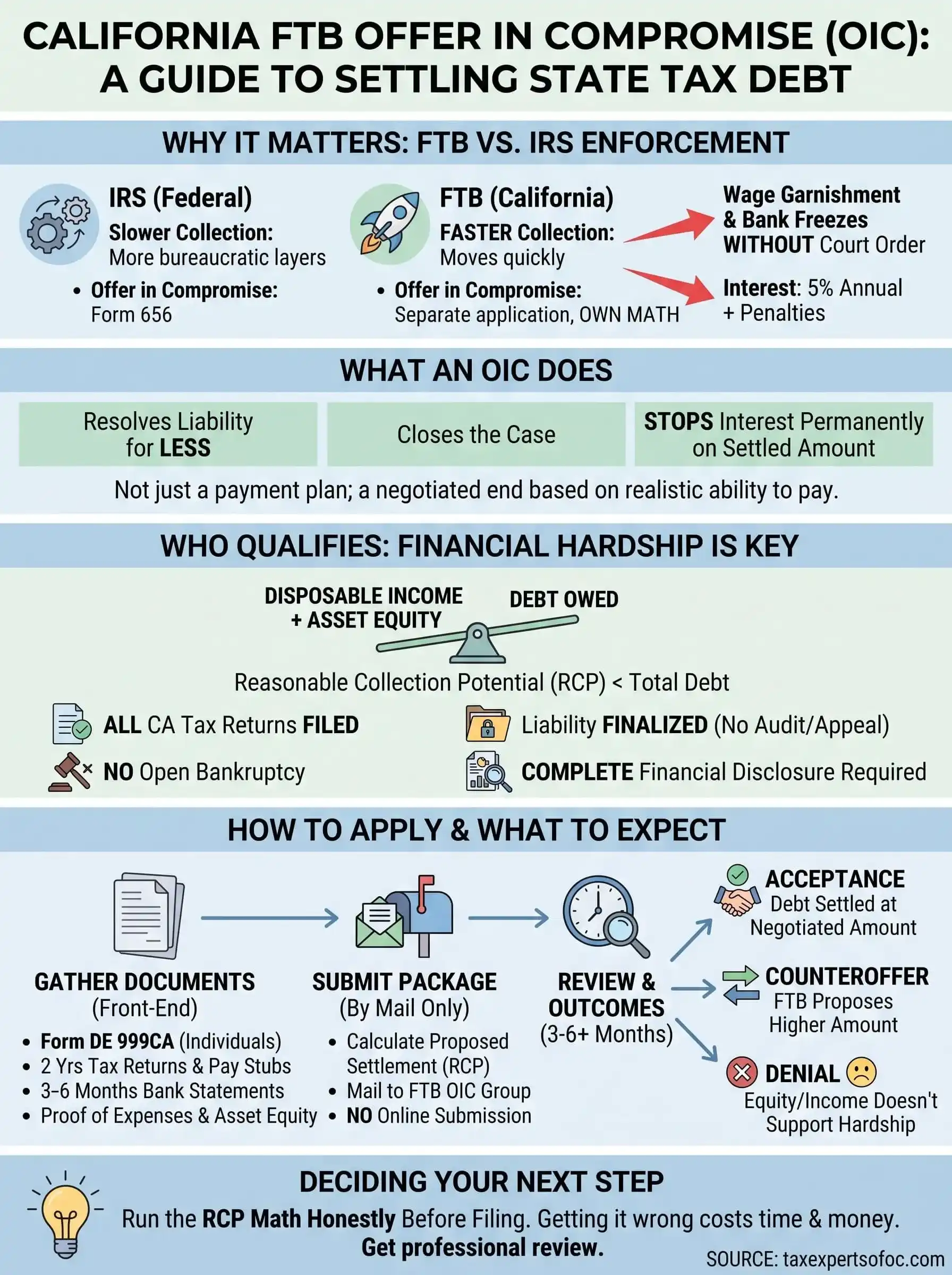
California doesn't wait around like some creditors do. The Franchise Tax Board can issue a wage garnishment, called an earnings withholding order, without going to court first, and it can freeze your bank account with a single notice. Meanwhile, your balance grows every month thanks to a 5% annual interest rate plus penalties that can add up fast. For someone already behind, that combination turns a manageable debt into an unpayable one within a couple of years.
The gap between IRS and FTB enforcement
Many taxpayers assume that because they've dealt with the IRS, they know what to expect from the state. That assumption costs people money. The FTB has fewer bureaucratic layers than the IRS, which means faster collection action but also, in some cases, more flexibility once you're actually working with a caseworker on a resolution.
| Factor | IRS | California FTB |
|---|---|---|
| Wage garnishment without court order | Yes | Yes |
| Typical interest rate | Federal short-term rate + 3% | 5% (adjusted periodically) |
| Offer in compromise program | Yes, Form 656 | Yes, separate application |
| State tax lien filing | N/A | Recorded with county recorder |
What an offer in compromise actually changes
An approved offer resolves your liability for less than the full balance, closes the case, and stops the interest clock permanently on the settled amount. That's the real value here. It's not a payment plan that just spreads out the pain. It's a negotiated end to the debt, based on what the state's own analysis says you can realistically pay given your income, expenses, and equity in assets.
An FTB offer in compromise doesn't lower your debt because you ask nicely, it lowers it because the numbers prove you can't pay more.
For taxpayers facing years of growing state debt, understanding this program isn't optional homework. You can review the FTB's own program details on the Franchise Tax Board's offer in compromise page, but knowing how the eligibility math works before you apply is what actually determines whether you get relief or a denial letter.
Who qualifies for an FTB offer in compromise
The FTB doesn't hand out settlements to anyone who asks. You need to show the state that collecting the full balance is genuinely unlikely, not just inconvenient for you. That means proving your reasonable collection potential (what the FTB calculates you could pay through income and asset liquidation) falls below what you actually owe. If your numbers show you could pay it off in a few years through a payment plan, expect a denial.
Baseline requirements before you apply
Before the FTB even looks at your financial hardship, you have to clear a few procedural hurdles. Skip one, and your application gets kicked back regardless of how strong your case is.
- All required California tax returns must be filed, no exceptions.
- You can't currently be in an open bankruptcy proceeding.
- The tax liability must be finalized, not still under audit or appeal.
- You need to provide complete financial disclosure, including income, expenses, assets, and equity.
Financial hardship is the deciding factor
The FTB weighs your disposable income against necessary living expenses using its own standards, which don't always match your actual budget. It also looks at equity in real estate, vehicles, and retirement accounts. If you have equity you could tap into, the FTB expects you to use it before settling for less.
Qualifying isn't about hardship you feel, it's about hardship the FTB's formula can prove.
Taxpayers with steady income and minimal assets tend to have the strongest cases.
How to apply for an FTB offer in compromise
Filing an FTB offer in compromise starts with paperwork, not negotiation. The state uses Form DE 999CA for individuals (or DE 999B for businesses) along with a detailed financial statement covering income, expenses, assets, and liabilities. Miss a supporting document and the FTB won't call you to ask for it, they'll just close the file and send you a rejection notice.
Documents the FTB expects upfront
Before you submit anything, pull together a complete financial picture. The FTB cross-checks what you report against your actual bank and payroll records, so gaps here slow everything down.
- Two years of federal and state tax returns
- Recent pay stubs or proof of self-employment income
- Bank statements for the last three to six months
- Documentation of monthly living expenses
- Statements showing equity in real estate, vehicles, or retirement accounts
Submitting the offer package
Once your financial statement is complete, you calculate a proposed settlement amount based on your reasonable collection potential, then submit the full package by mail to the FTB's offer in compromise group. There's no online submission option for this program, which surprises taxpayers used to digital filing everywhere else.
A sloppy financial statement gets you denied faster than an honest hardship story gets you approved.
Accuracy matters more than persuasion here. The FTB's reviewers work from numbers, not narrative, so every figure needs to hold up against your supporting records.
What happens after you submit your offer
Submitting the package doesn't mean the FTB stops collecting right away. Your file goes into a review queue, and depending on the office's backlog, a caseworker may not touch it for several weeks. During that gap, existing levies or garnishments can stay active unless you've separately negotiated a hold, so don't assume paperwork alone buys you protection from enforcement.
Review timeline and collections hold
Expect the review itself to take three to six months once an examiner is assigned. That person will verify your financial statement against your bank records, income documents, and any asset equity you reported. If numbers don't match, they'll request clarification, and missing a response deadline can close your case without a formal denial letter explaining why.
Possible outcomes
Three outcomes are possible once review finishes:

- Acceptance: the FTB agrees to your proposed amount, you pay per the accepted terms, and the remaining balance is written off.
- Counteroffer: the examiner proposes a higher settlement based on their own reasonable collection potential calculation.
- Denial: the FTB rejects the offer outright, usually because equity or income doesn't support the hardship claim.
An acceptance letter from the FTB isn't a formality, it's the state legally agreeing your debt ends at the negotiated amount.
Rejected offers aren't necessarily final. You can often appeal or resubmit with stronger documentation, which is exactly where working with someone who's negotiated these before starts paying for itself.
Deciding your next step with FTB tax debt
An FTB offer in compromise works when your numbers genuinely support hardship, not when you simply wish the balance would disappear. If your disposable income and asset equity leave real room to pay, the state will counter or deny, and you'll have burned months waiting for that answer while collections potentially continue. Before you file anything, run the reasonable collection potential math honestly against your own finances.
Getting this wrong costs you time you don't have, especially with penalties and interest compounding monthly. That's why most taxpayers who succeed with a california ftb offer in compromise have someone experienced checking their financial statement before it ever reaches an examiner's desk.
If you're carrying FTB debt and want a straight answer about whether an offer, a payment plan, or another path fits your situation, talk to Tax Experts of OC for a free consultation before you file.