

You're settling an estate or managing a trust, and now you need a estate tax preparer near me who actually knows Form 1041, not just personal returns. Most general tax preparers touch maybe a handful of estate and trust returns a year. That's not enough experience when the IRS scrutinizes fiduciary income, distributions to beneficiaries, and basis calculations that don't show up on a typical 1040.
Here's the direct answer: what matters isn't just proximity, it's finding a trust tax preparer who's a CPA or Enrolled Agent with real fiduciary tax experience, and who can work remotely if the best fit isn't down the street. Local searches often lead people to generalists who learn estate rules on the fly, which creates costly mistakes on already stressful filings.
In this article, we'll walk through exactly what qualifications separate a competent tax preparer for trusts from someone just filling out forms, what questions to ask before hiring, and why credentials and multi-state capability often matter more than a physical office address. You'll leave knowing how to vet a preparer with confidence.
Why estate and trust returns need a specialized preparer
Estate and trust taxation runs on a different rulebook than personal income tax. Form 1041, the U.S. Income Tax Return for Estates and Trusts, requires you to track fiduciary accounting income separately from taxable income, calculate distributable net income (DNI), and issue Schedule K-1s to beneficiaries so they can report their share correctly. Get DNI wrong and you either overtax the estate or shift the wrong amount of income onto beneficiaries, both of which invite IRS correspondence months later. A preparer who mostly files 1040s for wage earners simply hasn't built the muscle memory this form demands.
The compressed tax brackets problem
One detail catches almost every generalist off guard: trusts and estates hit the top federal tax bracket at a shockingly low income threshold. In 2024, a trust reaches the 37% bracket at roughly $15,200 of retained income, compared to over $600,000 for a single individual filer. That single fact changes the entire strategy. A trust tax preparer near me search should turn up someone who automatically thinks about distributing income out to beneficiaries in lower brackets rather than letting it accumulate and get taxed at the trust level.

A trust preparer's first job isn't filling out forms, it's deciding whether income should stay in the trust or flow out to beneficiaries, because that choice alone can swing the tax bill by tens of thousands of dollars.
Basis step-up and asset valuation
Estates also deal with basis rules that don't exist anywhere on a personal return. When someone dies, most inherited assets get a step-up in basis to fair market value as of the date of death, which can wipe out decades of capital gains for the beneficiaries who eventually sell. Calculating that correctly means knowing which assets qualify, how to value real estate or a closely held business, and how to document it in case the IRS asks. Miss the step-up or misapply it, and beneficiaries either overpay tax on a future sale or claim a basis the IRS will reject.
Fiduciary duties add legal weight
Unlike a personal tax return, a fiduciary return sits inside a legal relationship. The trustee or executor has a duty to beneficiaries, and an inaccurate return can expose them to liability beyond just an IRS penalty. A qualified tax preparer for trusts understands this dynamic and communicates clearly with the fiduciary about deadlines, required distributions, and documentation, not just the numbers on the form. According to the IRS instructions for Form 1041, fiduciaries are personally responsible for the return's accuracy, which raises the stakes considerably compared to a typical individual filing.
State-level complications
Geography adds another layer most generalists never encounter. Estates and trusts often have beneficiaries living in different states than where the trust was created or administered, and several states tax trust income based on factors like the trustee's residence, where the trust was created, or where beneficiaries live. California, for example, taxes trust income if the trustee or a non-contingent beneficiary resides in the state, regardless of where the trust document was drafted. A preparer who only handles in-state personal returns won't catch these triggers, and the estate or trust could end up owing tax in a state nobody expected.
What specialized experience actually looks like
Here's a quick way to compare a generalist against someone genuinely equipped for this work:
| Factor | General tax preparer | Specialized estate/trust preparer |
|---|---|---|
| Forms filed annually | Mostly 1040s | Regular volume of 1041s, K-1s |
| Bracket strategy | Rarely discussed | Actively manages distributions vs. retention |
| Basis step-up | May not calculate at all | Documents and applies correctly |
| Multi-state exposure | Overlooked | Reviews trustee/beneficiary residency |
| Fiduciary liability awareness | Limited | Advises trustee on legal exposure |
This is why proximity alone shouldn't drive your decision. A local generalist with a nice office might feel convenient, but if they've filed three 1041s in their career, you're the one absorbing the risk of their learning curve. Credentials and case volume matter more than a short drive.
How to find and vet an estate tax preparer near you
Finding a qualified estate tax preparer near me starts with widening your definition of "near." Search engines and directories still push local results, but the professional most equipped to handle your Form 1041 might work three states away and meet with you entirely by phone or video. Start your search with state CPA society directories or the IRS Directory of Federal Tax Return Preparers, which lets you filter by credential type. That single step eliminates most of the unqualified generalists before you even pick up the phone.
Verify credentials before anything else
Confirm the preparer is a licensed CPA or an Enrolled Agent, not just someone with a PTIN and a storefront. Enrolled Agents are federally licensed specifically to handle tax matters and often specialize in complex filings like fiduciary returns. Ask directly how many 1041s they've filed in the past year, not over their career. A preparer who files five to ten estate and trust returns annually has current, working knowledge of DNI calculations, K-1 issuance, and basis rules. Someone who files one every couple of years is guessing as much as learning.
If a preparer can't tell you how many 1041s they filed last year without pausing to think, that hesitation is your answer.
Ask about multi-state experience
Multi-state exposure trips up even experienced preparers, so ask pointed questions about it upfront. Does the trust have beneficiaries in a different state than where it was created? Has the trustee moved since the trust was funded? A capable trust tax preparer should ask these questions before you do, not after the return is already filed and a state notice shows up. This is also where remote-capable firms have an edge: a preparer licensed and experienced across multiple jurisdictions can catch filing obligations a local, single-state practitioner would miss entirely.
Run through a short vetting checklist
Before you hire anyone, work through these questions in an initial consultation:
- Are you a CPA or Enrolled Agent, and can you confirm your license or enrollment number?
- How many estate or trust returns (Form 1041) did you prepare last year?
- Can you walk me through how you'd handle distributable net income for this specific trust?
- Do you have experience with multi-state fiduciary filings?
- What's included in your fee, and is it flat or hourly?
- Can you communicate directly with the trustee, executor, or attorney involved?
Running through this list takes fifteen minutes and saves you from discovering gaps after the return is already filed. Treat the free consultation many firms offer as your chance to ask every one of these questions before committing, since a preparer who answers clearly and specifically is far more trustworthy than one who speaks in generalities about "handling all kinds of returns."
What estate and trust tax preparation typically costs
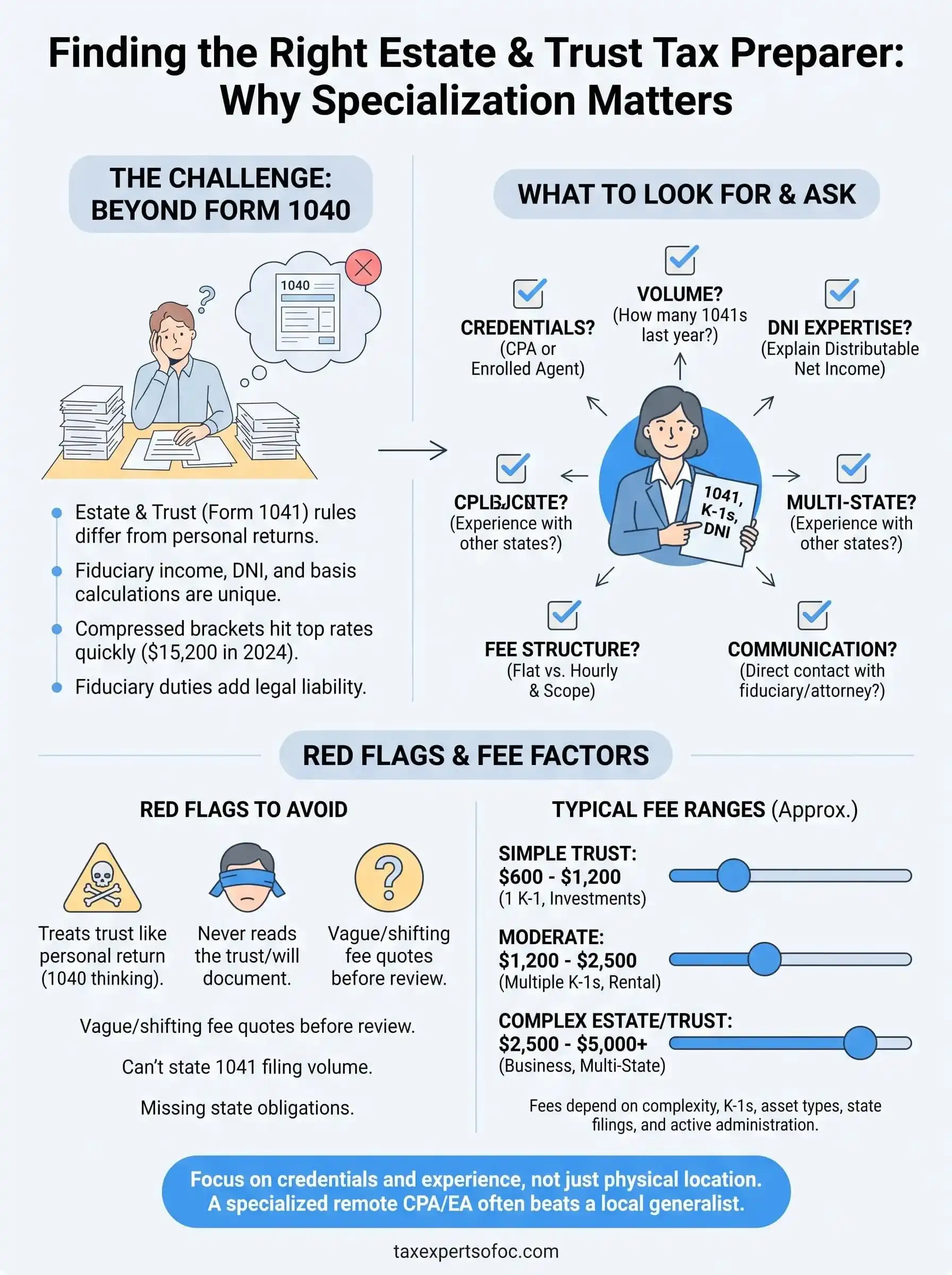
Pricing for a tax preparer for trusts varies more than personal tax prep because every 1041 carries different levels of complexity. A simple trust with one beneficiary and a handful of investment accounts costs far less to prepare than an estate with a closely held business, real estate in three states, and ongoing distributions. Expect quotes anywhere from $600 to $3,500 or more, depending on the number of K-1s, the value and type of assets involved, and whether the trust or estate has multi-state filing obligations.
Typical fee ranges by complexity
Here's a general breakdown of what you might see quoted, though every firm sets its own rates:
| Complexity level | Typical fee range | Common characteristics |
|---|---|---|
| Simple trust | $600 to $1,200 | One beneficiary, investment income only, single state |
| Moderate complexity | $1,200 to $2,500 | Multiple beneficiaries, rental property, several K-1s |
| Complex estate/trust | $2,500 to $5,000+ | Business interests, multi-state exposure, active administration |
The fee should reflect the number of decisions the return requires, not just the number of pages it fills.
Flat fee versus hourly billing
Ask upfront whether the quote is a flat fee or hourly, because this changes how predictable your final bill will be. Flat fees give you certainty and reward the preparer for efficiency, while hourly billing can balloon quickly if the estate has messy records or unresolved beneficiary disputes. Reputable firms usually quote a flat fee after reviewing your documents in the initial consultation, since a preparer with real fiduciary experience can estimate the scope accurately once they see the trust document and prior year returns.
What drives the price up
Several factors push costs toward the higher end of the range, and knowing them helps you understand a quote instead of just reacting to the number:
- Number of K-1s issued: each additional beneficiary adds preparation and review time.
- Business or rental income: pass-through activity requires extra schedules and reconciliation.
- Multi-state filings: every additional state return adds hours and fees.
- First-year estate returns: opening an estate's books and calculating basis step-up takes longer than an ongoing trust filing.
- Amended or late returns: catching up unfiled prior-year 1041s costs more than a current, on-time filing.
Why upfront pricing matters here more than usual
Estates and trusts already involve enough uncertainty around asset valuation and beneficiary expectations. Transparent, upfront pricing removes one more variable and lets the trustee or executor budget accurately before authorizing the work. Firms offering a free consultation before quoting a fee give you the chance to compare pricing without committing, which matters when the estate tax preparer near me you're evaluating might be quoting a flat rate while another bills hourly for the exact same work. Compare the scope of services included in each quote, not just the headline number, since a lower flat fee that excludes state filings can end up costing more once the extra invoices arrive.
Common mistakes and red flags to avoid
Hiring the wrong preparer for a Form 1041 rarely shows up as an obvious disaster on day one. Problems usually surface months later, when a beneficiary gets a K-1 that doesn't match their expectations or a state sends a notice for a filing nobody knew was required. Knowing the warning signs before you sign an engagement letter saves you from becoming another cautionary story.
Treating a trust return like a personal return
Generalist preparers sometimes plug trust numbers into software built for 1040 workflows without adjusting for fiduciary accounting rules. This shows up as missed distributable net income calculations, incorrect Schedule K-1 allocations, or a failure to distinguish between principal and income under the trust document's own terms. If a preparer starts talking about your trust the same way they'd talk about a wage-earner's return, ask more questions before moving forward.
A trust return prepared with 1040-level thinking almost always undercounts what beneficiaries actually owe or overpays tax the trust never needed to pay.
Ignoring the trust or will's actual language
Every trust and estate has governing documents that dictate how income and principal get allocated, and a competent estate tax preparer near me reads that document before touching the return. A red flag worth taking seriously is a preparer who asks for numbers but never asks to see the trust agreement or will itself. Without that document, they're guessing at distribution requirements instead of following what's legally required.
Missing state filing obligations
As covered earlier, trusts and estates can trigger tax obligations in states beyond where they were created, based on trustee residency or beneficiary location. A preparer who files only the federal 1041 and one home-state return without asking where the trustee lives or where beneficiaries are located is leaving exposure on the table. This mistake often doesn't surface until a state issues a notice years later, complete with penalties and interest.
Vague or shifting fee quotes
Watch for preparers who won't commit to a number until after the work is done, or who quote a low flat fee that later grows once "extra" schedules or state filings appear. Legitimate firms review your documents first, then quote a fee that covers the actual scope. A pattern of surprise invoices is a sign the initial quote was designed to win the engagement, not reflect the real work involved.
A quick red-flag checklist
Keep this list handy while you're comparing preparers:
- Can't state how many 1041s they filed last year
- Never asks to see the trust document or will
- Doesn't ask where the trustee or beneficiaries live
- Quotes a price before reviewing any documents
- Struggles to explain distributable net income in plain terms
- Has no PTIN, CPA license, or Enrolled Agent credential on file
Any single item here isn't automatically disqualifying, but two or more together should push you toward a different trust tax preparer. The cost of switching preparers now is far lower than the cost of correcting a filed return later.
Finding the right fit for your situation
Getting a Form 1041 right takes more than a nearby office and a PTIN. You need a preparer who files fiduciary returns regularly, reads the trust document before touching the numbers, and asks about state exposure before it becomes a problem. Credentials matter more than a short commute, and a trust tax preparer near me search should end with a CPA or Enrolled Agent who treats your estate or trust as the specialized filing it actually is.
Working remotely with a genuine fiduciary specialist beats settling for a local generalist who's learning DNI calculations on your dime. Ask the questions from this guide, compare quotes on scope rather than price alone, and trust your instincts if answers feel vague.
If you're ready to talk through your specific situation, schedule a free consultation with Tax Experts of OC and get clarity before you file.