
Filing your taxes with software or a seasonal preparer might work when your situation is simple. But once you're dealing with business income, multi-state filings, IRS notices, or anything beyond a standard W-2, the margin for error gets thin. That's where CPA tax preparation becomes worth serious consideration, and where understanding what you're actually paying for starts to matter. The difference between a CPA and a general tax preparer isn't just a credential on a wall; it directly affects the accuracy, strategy, and legal protection behind your return.
At Tax Experts of OC, our CPA and Enrolled Agent work directly with individuals and business owners across all 50 states who need more than just a filed return, they need qualified professionals who understand tax code and can apply it to their specific situation. We see firsthand how the right preparation prevents problems that cost far more to fix later. A free 30-minute consultation is where most of our clients start.
This article breaks down what CPA tax preparation actually involves, what it costs, how it compares to other options, and how to decide whether hiring one makes sense for your situation. Every section is built around real considerations, not generic advice, so you can make a clear, informed decision before the next filing deadline.
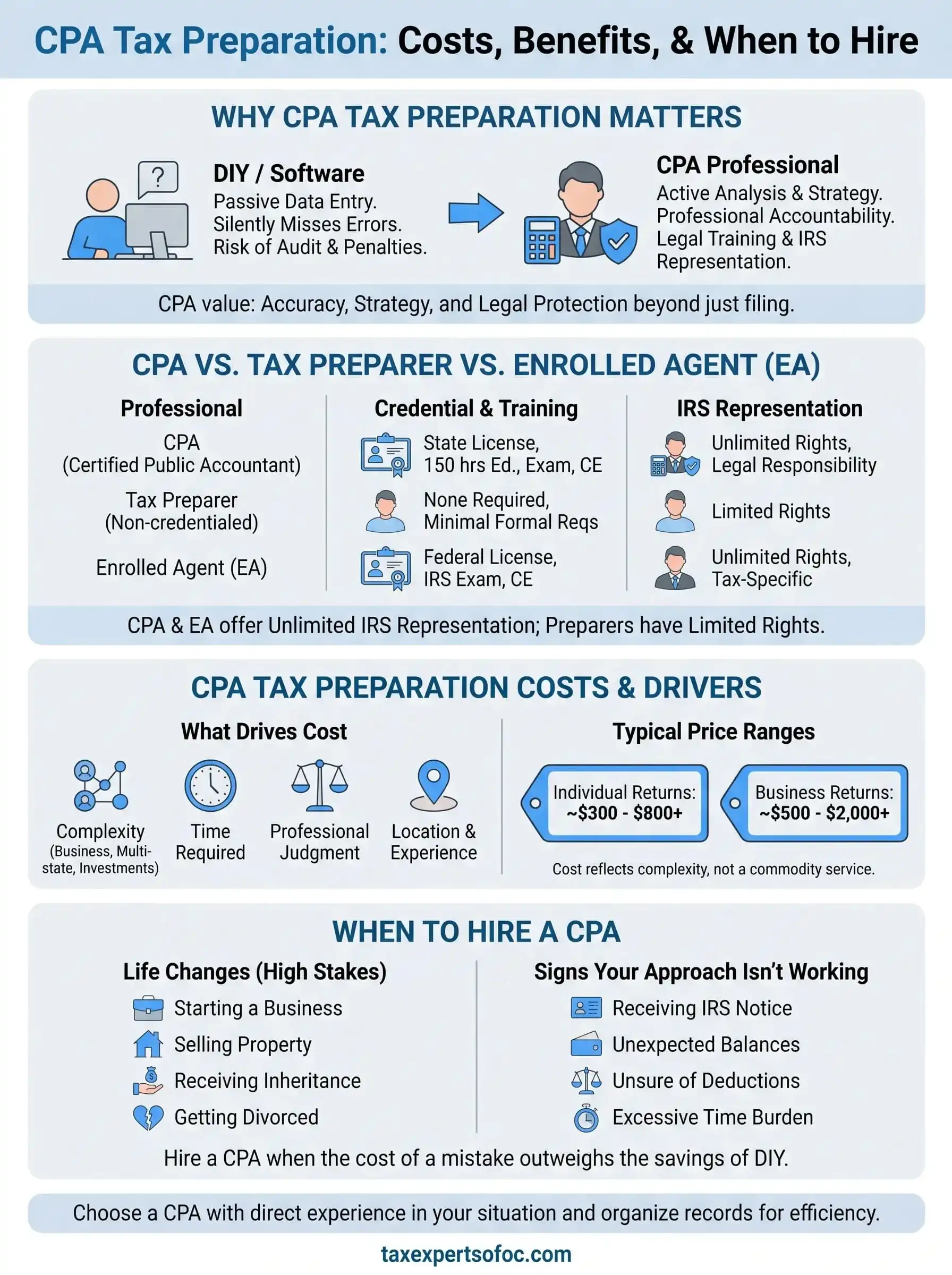
Why CPA tax preparation matters
Most people file taxes every year without incident until something changes. A new business, a real estate sale, an inheritance, a divorce, or an IRS notice can turn a routine filing into a serious liability. CPA tax preparation isn't just about filling out forms; it's about applying deep, current knowledge of tax law to your specific financial picture and making sure nothing is overlooked. The risk of missing a deduction or misreporting income isn't abstract; the IRS assessed over $31 billion in additional taxes through examination activities in a recent reporting year.
The accuracy gap between professional and DIY filing
Tax software works well when your income comes from one employer and your deductions are straightforward. Once you add self-employment income, rental properties, stock sales, or business expenses, the software relies entirely on your ability to interpret the questions correctly. Most people don't know what they don't know, which means errors tend to happen silently, without any warning in the program.
A CPA brings professional accountability and legal training that software simply cannot replicate. They ask the right questions, flag inconsistencies, and identify situations where additional documentation is required. The difference often shows up not in the filing itself but in the years that follow, when an audit or a notice arrives and you need someone who can defend what was filed.
The cost of a CPA's time almost always runs lower than the cost of correcting a mistake the IRS finds first.
What a CPA can do that software can't
CPAs don't just record numbers; they analyze your full financial situation and apply strategies that reduce your liability within the bounds of the law. That includes timing income and deductions, identifying overlooked credits, structuring business expenses correctly, and planning ahead for the current and future tax years. These are active decisions, not passive data entry.
For business owners, the value compounds quickly. Proper classification of expenses, entity structure decisions, and payroll tax treatment each carry significant tax implications that vary based on your situation. A CPA reviews all of it with an eye toward both compliance and long-term tax efficiency. For individuals with complex situations, the same principle applies, especially when multiple states are involved or when life changes have shifted your tax exposure.
Your filing isn't just a snapshot of the past year; it's also a baseline for future planning. Working with a CPA creates continuity, so the professional filing your return this year understands your history and can make better recommendations going forward. That ongoing relationship is something a tax kiosk or seasonal preparer rarely provides.
CPA vs tax preparer vs enrolled agent
The three most common professionals who handle tax work are CPAs, non-credentialed tax preparers, and Enrolled Agents. They are not interchangeable. Each carries a different level of training, different licensing requirements, and different authority when dealing with the IRS on your behalf. Knowing the distinction helps you match your situation to the right professional before something goes wrong.
What each credential actually means
A Certified Public Accountant (CPA) holds a state-issued license that requires passing a rigorous four-part exam, completing 150 hours of college education, and fulfilling ongoing continuing education requirements. CPAs can prepare taxes, advise on broader financial matters, and take legal responsibility for their work while representing clients before the IRS.
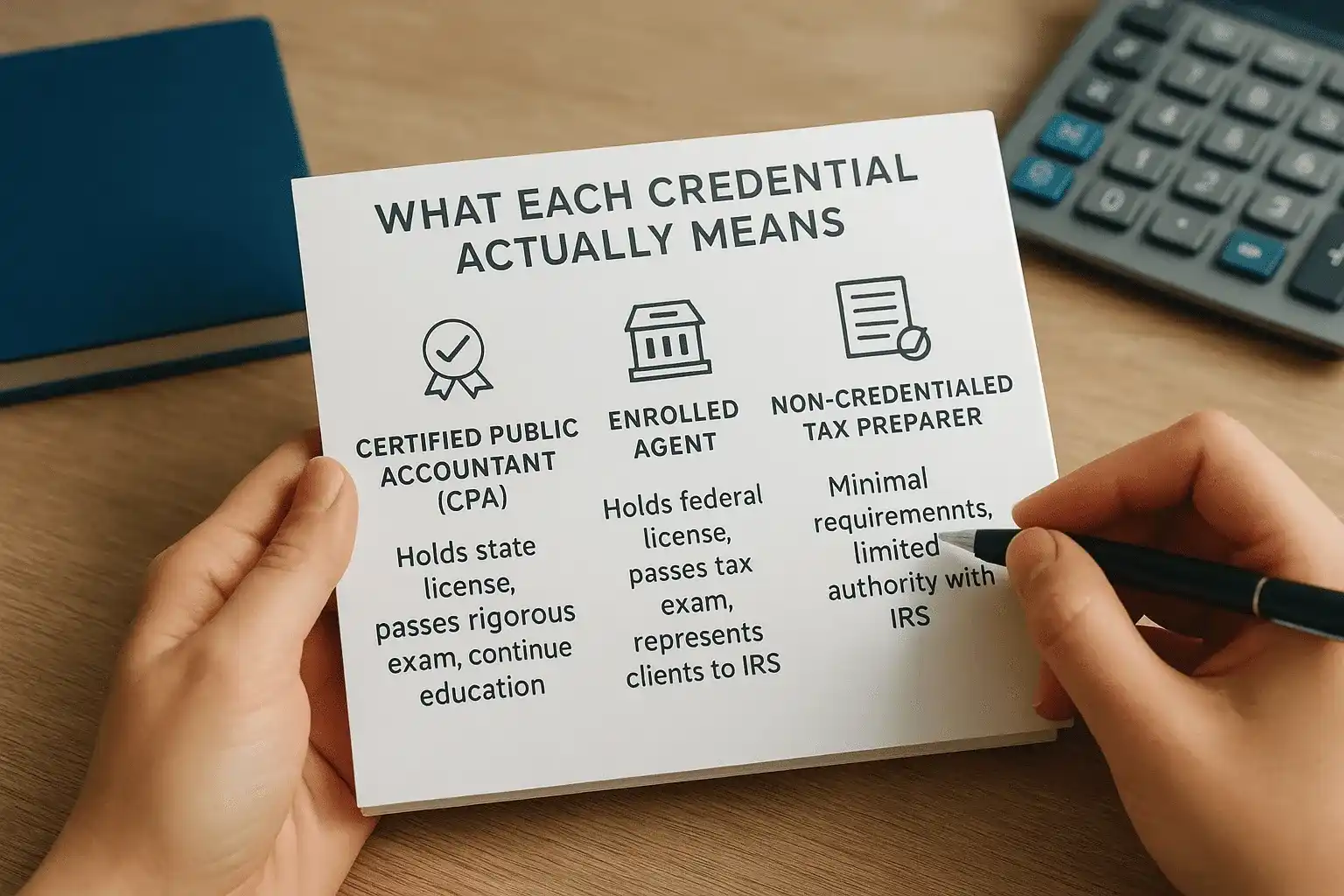
Enrolled Agents hold federal licenses issued directly by the IRS, specifically for tax matters. They pass a comprehensive three-part exam covering individual and business tax law and hold unlimited representation rights before the IRS. Their focus is narrowly tax-specific, which makes them especially strong in audit defense and complex resolution cases.
Non-credentialed tax preparers can legally file returns in most states with minimal formal requirements. Many handle straightforward returns competently, but they carry no federal licensing, no continuing education mandate, and limited representation rights if the IRS questions your return.
If your return ever comes under IRS scrutiny, only a CPA, EA, or tax attorney can represent you in the full range of proceedings.
Which professional fits your situation
For simple W-2 returns with standard deductions, a non-credentialed preparer may be sufficient. Once your return involves business income, multi-state filings, investment activity, or IRS correspondence, a CPA or EA provides meaningful protection that a general preparer cannot offer. When your needs extend beyond compliance into financial planning and strategic decisions, CPA tax preparation gives you the broadest professional coverage. Matching the credential to the actual complexity of your situation is the clearest way to make that call.
CPA tax preparation costs and what affects price
CPA fees vary more than most people expect, and understanding what drives the price helps you budget accurately and avoid surprises. CPA tax preparation is not priced like a commodity service; the cost reflects the actual complexity of your return, the time required, and the professional judgment applied. Most CPAs charge either a flat fee per form or schedule, or an hourly rate depending on how they structure their practice.
What determines your final cost
Several factors push your fee higher or lower. A straightforward individual return with one income source and simple deductions sits at the lower end of the range. Add a Schedule C for self-employment income, rental properties, stock sales, or business entity returns, and the price increases because each element requires additional analysis and documentation review.
Your location also plays a role. CPAs in major metropolitan areas typically charge more than those in smaller markets, though nationwide remote services have narrowed that gap significantly for clients who file across multiple states.
The complexity of your financial situation, not the CPA's hourly rate, is usually the biggest driver of your final bill.
Typical price ranges to expect
Most individual returns handled by a CPA fall somewhere between $300 and $800, with complex returns involving business income, multiple states, or investment activity running higher. Business returns for LLCs, S-Corps, and partnerships commonly range from $500 to $2,000 or more depending on the volume of transactions and entity type.
These numbers shift based on your CPA's location, experience level, and the full scope of work involved. Firms that include year-round access, tax planning, and audit support as part of their service often charge more upfront, but that broader coverage regularly saves clients more than the added cost when it prevents a problem before it starts.
When to hire a CPA for tax preparation
Not every tax situation requires a CPA, but certain circumstances make professional CPA tax preparation far less optional than it might seem. The general rule is simple: the higher the stakes, the more you benefit from having a licensed professional responsible for your return. If a mistake would cost you thousands or expose you to IRS action, the cost of a CPA becomes straightforward to justify.
Life changes that raise your tax complexity
Major financial events often shift your return from manageable to genuinely complex in a single year. Starting a business, selling property, receiving an inheritance, or getting divorced each carries tax implications that require more than data entry to handle correctly. These events introduce new forms, new rules, and often new state obligations that interact with your federal return in ways that are easy to mishandle without professional guidance.
When your financial picture changes significantly, your tax strategy needs to change with it, and that requires someone who can see the full picture.
For business owners, the trigger is even clearer. Payroll, self-employment income, depreciation, and multi-state activity each add layers that a seasonal preparer or software program handles inconsistently at best. A CPA reviews your entity structure, expense classifications, and filing obligations together, which is where the real value shows up.
Signs your current approach isn't working
Sometimes the clearest signal is what has already happened. Receiving an IRS notice, owing unexpected balances at filing, or feeling unsure whether your deductions are defensible are all indicators that your current approach carries more risk than it should. These aren't problems you want to discover after the IRS does.
Your time also has a cost. Spending hours reconciling records, second-guessing deductions, or researching tax rules takes you away from your business or personal priorities. When the time burden and uncertainty both rise, bringing in a qualified professional typically pays for itself.
How to choose a CPA and get ready to file
Once you decide that CPA tax preparation fits your situation, the next step is finding the right professional and showing up prepared. Choosing the wrong CPA or walking into the first meeting without your records organized wastes time and often increases your cost. A little preparation on your end makes the entire process faster and more accurate.
What to look for when evaluating a CPA
Not all CPAs handle the same types of work. Verify that your CPA holds a current, active license in their state, which you can confirm through your state's Board of Accountancy. Beyond credentials, look for someone with direct experience in your specific situation, whether that's self-employment, multi-state filings, business returns, or IRS resolution. A CPA who works primarily with individuals may not be the best fit for a growing S-Corp.
Ask any prospective CPA directly how many clients they serve with situations similar to yours before committing to a working relationship.
Ask about pricing upfront. Flat-fee structures give you cost certainty, while hourly billing can escalate if your records need significant cleanup. Also confirm whether the CPA provides year-round access or just seasonal filing support, since ongoing availability matters when questions or IRS notices arrive outside of tax season.
How to prepare your documents before the first meeting
Coming in organized directly affects what you pay and how smoothly the process runs. Gather all income documents including W-2s, 1099s, K-1s, and any records of business revenue. Bring your prior year's tax return as well, since your CPA will use it as a baseline to catch changes, identify carryovers, and spot anything that needs to be addressed this year.
Tracking down missing documents after the process starts slows everything down and increases billable time. Organizing your records before the first conversation shows your CPA exactly what they're working with and allows them to give you a more accurate cost estimate from the start.
Final takeaways
CPA tax preparation makes the most sense when your financial situation carries real complexity or when the cost of a mistake outweighs what you'd save by handling it yourself. The distinction between a CPA, an Enrolled Agent, and a general preparer isn't minor; it determines who can stand behind your return and represent you if the IRS comes calling. Fees vary based on your situation, not a fixed rate, so understanding what drives your cost helps you budget and plan before filing season arrives.
Your situation may not require a CPA every year, but when life changes, business activity, or IRS correspondence enters the picture, the right professional pays for themselves quickly. Choosing someone with direct experience in your specific circumstances and showing up with organized records makes the entire process faster and more accurate.
If you're ready to work with a qualified professional, schedule a free 30-minute consultation with Tax Experts of OC and get a clear picture of where you stand.