
Most business owners don't think about tax planning until they're staring at a bill they didn't expect. By then, the opportunities to reduce what you owe have already passed. Business tax planning services exist to prevent exactly that, they help you make smarter financial decisions throughout the year so you're not scrambling during filing season. The difference between reactive tax filing and proactive tax strategy can be tens of thousands of dollars, depending on your business size and structure.
But what do these services actually include? What should you expect to pay? And how do you know if your business genuinely needs them, or if you're just being upsold? These are fair questions, especially when every accounting firm defines "tax planning" a little differently. Getting clear answers before you commit matters, particularly when your business's financial health is on the line.
At Tax Experts of OC, our CPAs and Enrolled Agents work with business owners across all 50 states to build tax strategies grounded in their actual numbers, not generic advice. This article breaks down what business tax planning services typically cover, what they cost, and how to evaluate whether a provider is the right fit for your company.
Why business tax planning services matter
The IRS doesn't wait for you to be ready. Every financial decision your business makes during the year carries a tax consequence, whether you track it in real time or not. Business tax planning services give you a structured approach to make those decisions strategically, so you're not discovering expensive mistakes after the fiscal year closes. For most business owners, the tax liability you end up with is almost entirely a reflection of choices made long before your accountant opens your books in January.
The real cost of reactive tax management
When you skip proactive planning, you lose access to deductions, credits, and timing strategies that are only available before specific deadlines pass. Depreciation elections, retirement plan contributions, and entity structure adjustments all have windows. Once those windows close, the opportunity is gone. The IRS reports that small business owners consistently underclaim deductions and overpay, not because the rules don't allow for savings, but because no qualified professional reviewed their situation during the year. Filing season reviews alone won't catch what should have been structured differently in March or October.
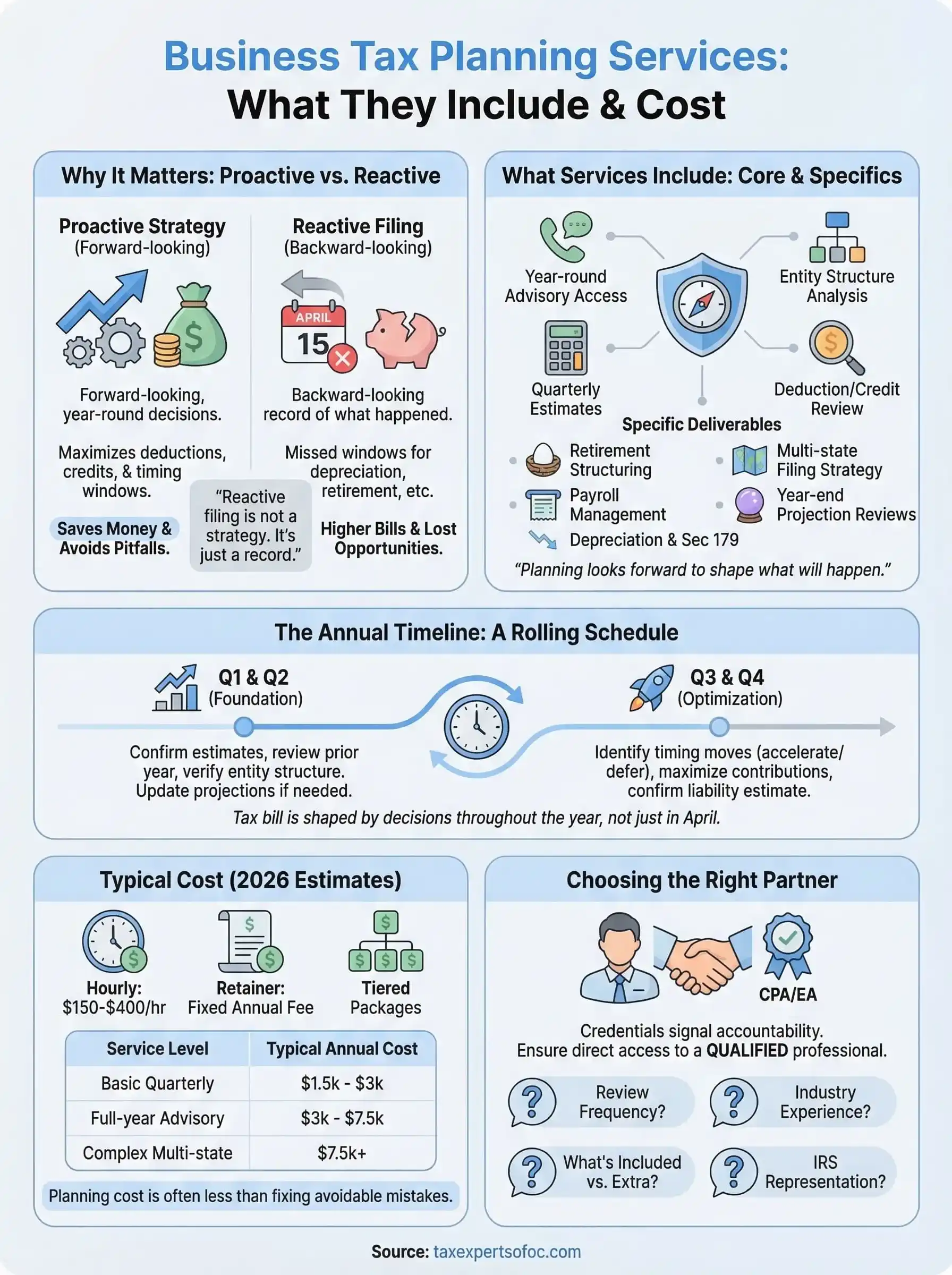
Reactive tax filing is not a strategy. It's just a record of what already happened.
How tax planning directly affects your bottom line
Effective tax planning does more than reduce your bill in April. It shapes your cash flow, your ability to reinvest in the business, and how you handle compensation, benefits, and large purchases throughout the year. If you operate as a corporation, LLC, or partnership, your entity structure alone can create a difference of thousands of dollars in self-employment and income tax annually. A qualified tax professional reviews your numbers and adjusts the approach as your revenue and business model evolve, rather than applying a one-size-fits-all template year after year.
What business tax planning services include
Business tax planning services cover far more than preparing your annual return. The goal is to build a forward-looking strategy that reduces your tax exposure legally and keeps you compliant throughout the year, not just at filing time.

Core services you can expect
Most providers offer a defined set of deliverables that work together. Year-round advisory access lets you consult a professional before major decisions, such as purchasing equipment or adding a business partner. You also typically receive entity structure analysis, quarterly estimated tax calculations, deduction identification, and credits review.
- Retirement plan structuring
- Payroll tax management
- Depreciation and Section 179 elections
- Multi-state filing strategy
- Year-end tax projection reviews
What separates planning from preparation
Tax preparation looks backward at what already happened. Tax planning looks forward to shape what will happen. A strong planning engagement means your advisor reviews your financials regularly and adjusts your approach as your revenue shifts.
The most valuable tax advice is the kind you receive before the decision is made, not after.
A qualified advisor also adapts your strategy as your business grows. If revenue increases sharply or you bring on employees, your tax position needs to reflect those changes before they create unexpected liability.
How business tax planning works through the year
Business tax planning isn't a single meeting in December. It runs on a rolling schedule tied to your financial activity, IRS deadlines, and changes in tax law. Your advisor structures the year into defined checkpoints so every major financial decision gets evaluated before it locks in.
Your tax bill is shaped by decisions made throughout the year, not just the ones made in April.
The first half of the year
Q1 and Q2 are about building a solid foundation. You confirm your estimated tax payment schedule, review prior-year results, and verify that your entity structure still matches your current revenue and business goals.
If your business made significant changes heading into the year, such as adding employees or taking on new contracts, your advisor folds those changes into an updated projection that reflects your actual situation going forward.
The second half of the year
Q3 and Q4 focus on year-end optimization. Your advisor compares actual revenue against earlier projections and identifies timing moves you can still make, such as accelerating deductions, maximizing retirement contributions, or deferring income into the next tax year.
By late Q4, you should have a confirmed liability estimate and a clear reduction plan before the calendar year closes.
What business tax planning services cost in 2026
Pricing for business tax planning services varies based on your business size, complexity, and how much ongoing access you need. Most firms structure fees in one of three ways: flat annual retainers, hourly billing, or tiered service packages. Understanding the model upfront helps you compare providers without hidden surprises.

What you pay for planning is almost always less than what you pay for fixing avoidable mistakes.
Typical pricing ranges
Hourly rates for a CPA or Enrolled Agent typically run between $150 and $400 per hour in 2026, depending on experience and location. Annual retainer packages for small to mid-sized businesses generally range from $1,500 to $10,000 or more per year, depending on the scope of services included.
| Service Level | Typical Annual Cost |
|---|---|
| Basic quarterly reviews | $1,500 - $3,000 |
| Full-year advisory + filing | $3,000 - $7,500 |
| Complex multi-state planning | $7,500+ |
Businesses with multiple entities, payroll obligations, or multi-state exposure should expect to pay toward the higher end of these ranges. The right package depends on your revenue, your filing complexity, and how frequently you need direct advisor access throughout the year.
How to choose the right tax planning partner
Not every firm that offers business tax planning services delivers the same level of expertise. Before you sign an engagement letter, you need to evaluate the provider's qualifications, their process, and how much direct access you'll actually have to a qualified professional.
The person reviewing your strategy matters as much as the strategy itself.
Credentials and access
Credentials signal accountability. A CPA or Enrolled Agent holds a legal and ethical obligation to their clients, which matters when you need someone to represent you before the IRS or defend a position on your return. Ask specifically who will handle your account day-to-day, not just who signs off on filings. Direct access to a qualified professional throughout the year is what separates a real planning relationship from a transactional filing service.
Questions to ask before you hire
Before you commit, ask the right questions to confirm the provider fits your business. Scope and communication expectations should be clear from the first conversation.
- How often will we review my tax position?
- Do you have experience with my industry or entity type?
- What's included in the annual fee versus billed separately?
- Can you represent me if the IRS contacts me?
Next steps
Business tax planning services work best when you start before the pressure builds. If you're waiting until filing season to think about your tax position, you're already behind on the decisions that could have reduced your liability. The earlier you engage a qualified professional, the more options you have to structure your finances in a way that actually benefits you.
Review where your business stands right now. Check whether your entity structure still matches your revenue, confirm your estimated payments are on track, and identify any major purchases or compensation changes coming later this year. Each of those decisions carries a tax consequence that a qualified advisor can help you manage before the window closes.
If you're ready to stop reacting and start planning, Tax Experts of OC works with business owners across all 50 states to build strategies tied to their actual numbers. Schedule your free 30-minute consultation and get a clear picture of where you stand.