
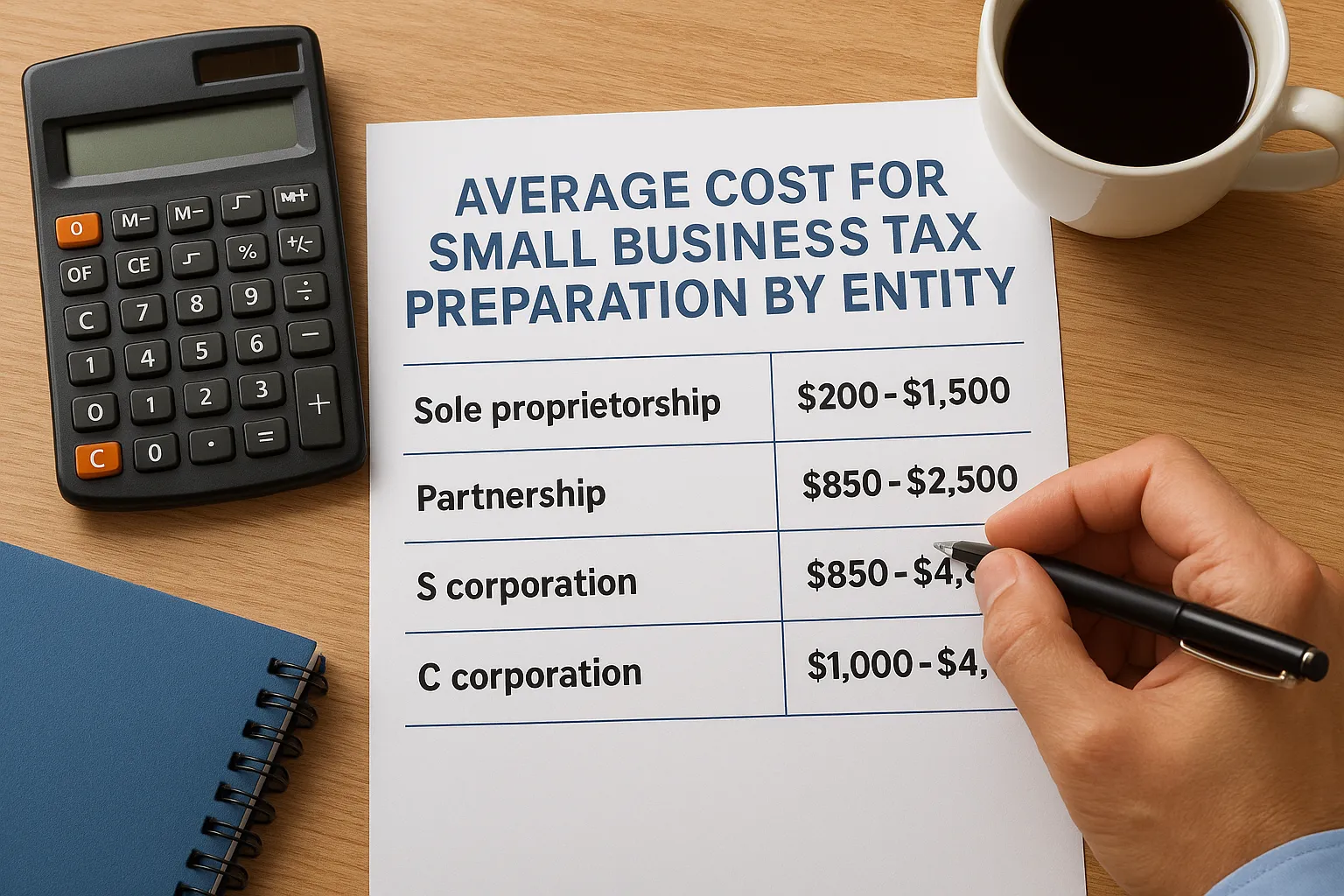
The average cost for small business tax preparation is about $640 for a simple sole proprietorship and $850 to $1,300 for a typical S corporation or partnership. Most CPA-prepared returns land between $500 and $2,500. Complex returns with several owners, payroll, or multiple states can reach $2,000 to $4,000 or more. Your entity type, the state of your books, and who prepares the return decide where you fall.
Business tax preparation is the work of turning your records into a finished return. The preparer totals income and expenses, applies deductions and credits, calculates the tax, and files the federal and state forms. The fee covers that work only. It does not cover the tax you owe, ongoing bookkeeping, or year-round planning, which most firms price separately.
This guide shows what the cost of tax preparation for a small business looks like by entity type, how CPAs compare with other preparers, what raises or lowers a quote, and how to test whether an offer is fair. Our team at Tax Experts of OC includes a CPA and an Enrolled Agent, and we prepare business returns for clients in all 50 states, so these are the questions we answer every filing season.
Why the average cost matters before you accept a quote
An average gives you a benchmark, and a benchmark is the fastest way to spot a quote that is too low to be complete or too high to be fair. Without one, you negotiate blind.
What a single average hides
A national average blends simple and complex returns, so treat it as a midpoint rather than a price. One 2026 survey of 45 U.S. firms found a $640 average for a Schedule C return, while other published ranges for the same return run from $200 to $1,500. Both can be right, because scope and record quality move the price more than the form name does.
Pricing is also hard to compare. Roughly two-thirds of firms require a consultation before they disclose fees, and fewer than half post price lists. That makes it easy to accept the first number you hear, so you need your own reference point.
An average is not a price. It is the yardstick you hold a quote against.
What the fee should include
When you ask how much business tax preparation costs, make sure every quote covers the same core work:
- Compiling income and expenses from your books
- Applying business deductions and credits
- Calculating federal taxable income and tax
- Preparing federal and state returns with supporting schedules
- Filing the returns electronically
Anything beyond that is an add-on. Bookkeeping cleanup, payroll filings, and audit support are usually priced separately, and bookkeeping costs alone can run $300 to $2,000 a month depending on volume. Fees also rise about 6% to 8% a year, so last year's invoice understates this year's price.
Small business tax preparation cost by business type
Expect roughly $200 to $1,500 for a sole proprietor, $850 to $2,500 for a partnership, $850 to $4,000 for an S corporation, and $1,000 to $4,000 or more for a C corporation.
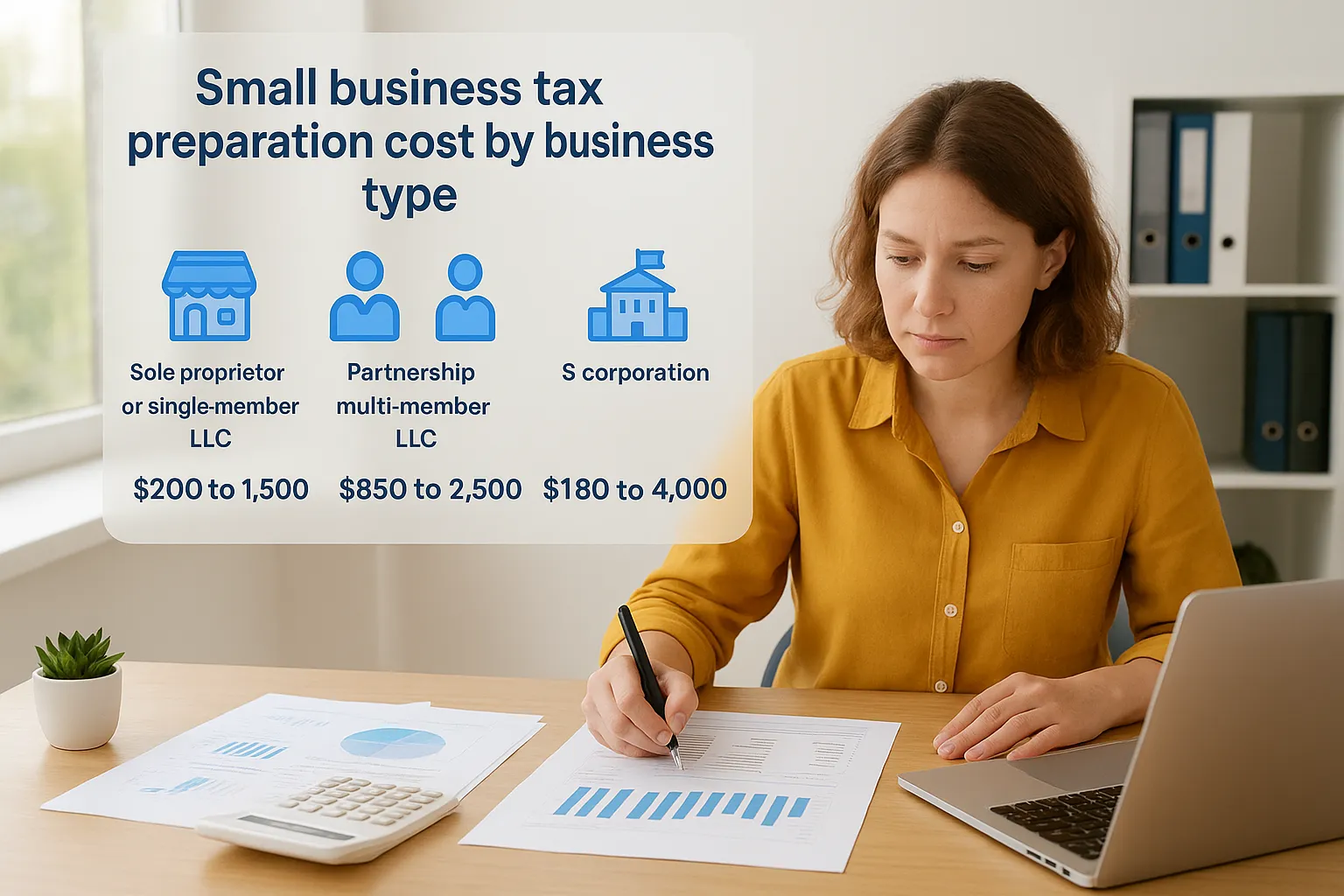
Typical ranges by entity
The ranges below combine published figures from several firms and surveys. Your own quote will depend on the factors in the later sections.
| Business type | Federal return | Typical fee | What pushes it higher |
|---|---|---|---|
| Sole proprietor or single-member LLC | Schedule C with Form 1040 | $200 to $1,500 (national average about $640) | Several income streams, many assets |
| Partnership or multi-member LLC | Form 1065 with K-1s | $850 to $2,500 | Number of partners, K-1 detail |
| S corporation | Form 1120-S with K-1s | $850 to $4,000 | Payroll, first-year setup, multiple states |
| C corporation | Form 1120 | $1,000 to $4,000 or more | Revenue above $1M, multiple entities |
In one survey, S corporation fees ran about 15% above partnership fees, and the gap widened above $500,000 in revenue. C corporations with $1 million to $2 million in revenue showed the widest spread, from $4,000 to $6,000, mostly because of record quality and multi-entity complexity. A sole proprietor files on IRS Schedule C, which is why that return is the cheapest.
Entity type sets the starting price. Revenue and record quality move it from there.
How LLCs fit, with a worked example
An LLC is a legal structure, not a tax return, so its fee follows how it is taxed. A single-member LLC files Schedule C by default and prices like a sole proprietor. A multi-member LLC files as a partnership. Either one can elect S corporation treatment, and then the S corporation range applies.
Take a single-member LLC with $180,000 in revenue and clean books. Filed on Schedule C, expect about $640. If the owner elects S corporation status, the midpoint of the S corporation survey range is about $1,075. File that first S corporation return late with disorganized records, and one survey puts the surcharge at 60% to 70%, which lifts the bill to roughly $1,720 to $1,830. The election can still pay for itself if it cuts self-employment tax, but that is a planning question, not a preparation one.
CPA versus other preparers and how each one bills
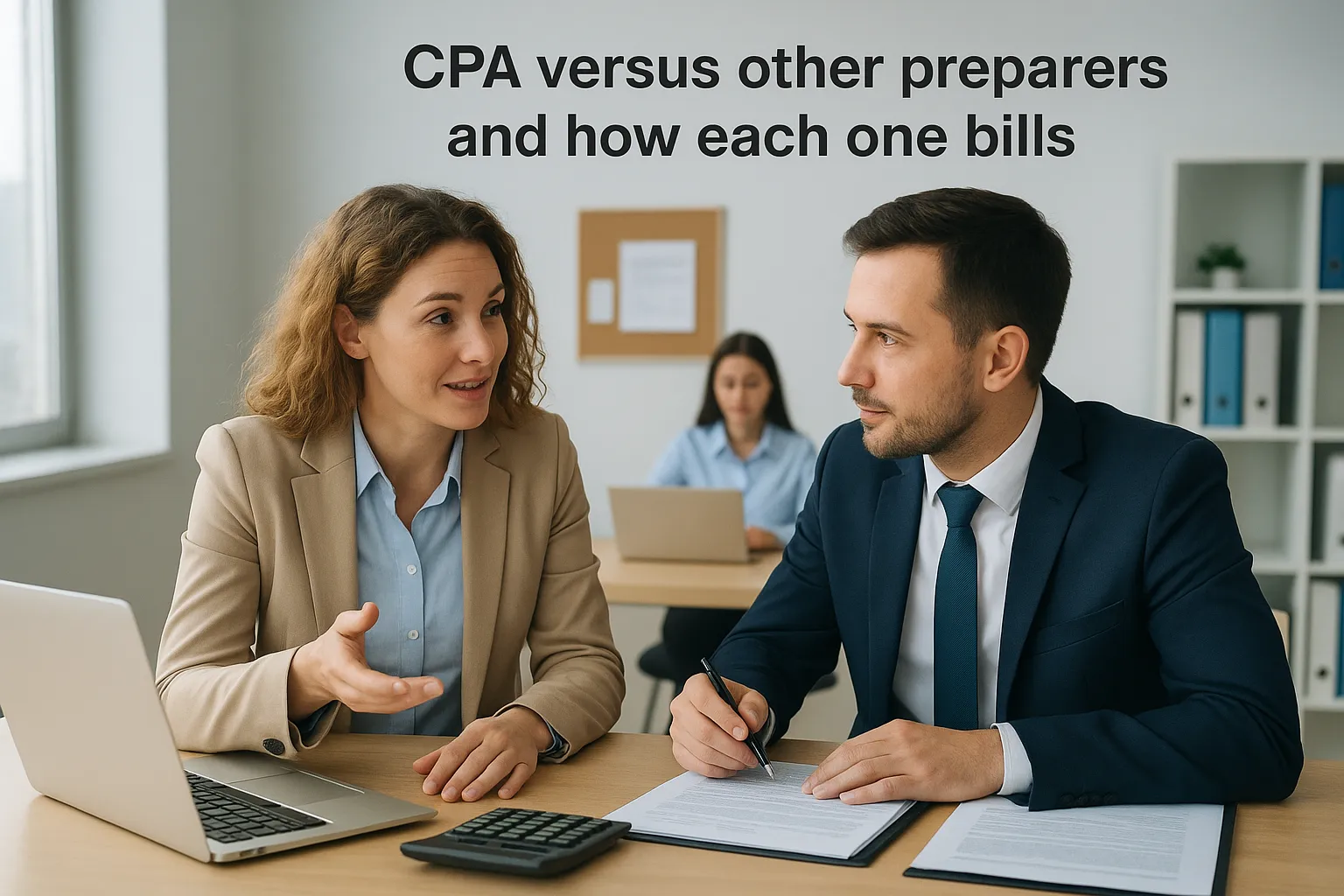
CPAs typically bill $150 to $500 an hour, or a flat $500 to $2,500 for a small business return, and they usually cost more than unlicensed preparers or software.
Billing models side by side
How a firm bills changes your risk as much as the number does.
| Model | Typical range | Best for |
|---|---|---|
| Flat fee per return | $500 to $2,500 | Predictable budgeting with organized records |
| Hourly | $150 to $500 per hour | Simple returns and one-off questions |
| Monthly retainer | $200 to $6,000 per month, depending on scope | Year-round planning, bookkeeping, and payroll |
Experience drives the hourly spread. A newer CPA might charge about $200 an hour, while a seasoned one charges $500 or more, but the experienced preparer often works faster and finds more deductions. A flat fee protects you from surprises, while hourly billing rewards organized records.
CPA, enrolled agent, or software
Is a CPA worth it for a small business? Yes when you run an S corporation, a partnership, payroll, or several states, or when you have IRS notices. CPAs and enrolled agents can both represent you before the IRS on any matter, which matters if a return is questioned.
A sole proprietor with clean books, no employees, and one state can often use software or a lower-cost preparer and save several hundred dollars. A good CPA also finds savings through tax planning, though how much depends on your situation, so ask what the firm would look at beyond the return itself.
Pay for a CPA when the return is complex or the IRS might ask questions. Skip the premium when it is not.
What pushes your business tax preparation fees up or down
Business tax preparation fees rise with complexity, disorganized records, and last-minute filing, and fall when your books are clean and your documents arrive early.
Complexity and record quality
These factors raise a quote most often:
- Disorganized books add roughly $500 to $1,000, and one survey found they affect about 40% of clients.
- Payroll and many employees mean more W-2 and payroll forms.
- Multiple states can multiply the base fee several times, and each added state steepens the curve.
- Specialized industries such as healthcare, real estate, and construction need extra forms and knowledge.
- Foreign activity, tax elections, and open audits add review time.
Disorganized records are the only item on that list you fully control. Monthly bookkeeping removes the surcharge before the preparer ever sees your file.
Clean books are the one cost driver you control completely.
Timing, location, and add-ons
Timing matters because firms are busiest near the deadline. Many add a surcharge of up to 20% for information that arrives at the last minute, so send documents early.
Location moves the price too. For the same business profile, one survey found the Northeast about 35% above the national average and the Midwest about 25% below it. A remote firm can file in any state, so you are not limited to your local market. Add-ons also change the total: a personal return typically adds $200 to $500 or more, and financial statements run $500 to $1,500. Bundling these with the business return often costs less than buying them separately.
How to judge whether a quote is fair
A quote is fair when it falls inside the range for your entity type and spells out exactly what it includes. Run through the steps below before you sign.
Five steps to test a quote
- Match your entity type and revenue to the table above and note the range.
- Ask whether the fee is flat or hourly, and what triggers extra charges.
- Confirm that state returns, K-1s, and electronic filing are included.
- Collect three to five written quotes so you compare the same scope.
- Send prior-year returns and organized records up front, so the preparer prices the real job.
Written quotes matter most. Verbal ranges tend to drift upward once the preparer sees your files.
Signs a quote is too low or too high
A quote far below your range usually leaves something out, such as the state return, a review of your books, or support if you get an IRS notice. Ask what is excluded before you celebrate. A quote far above the range deserves an itemized breakdown, because it may bundle bookkeeping or planning you did not request.
For most small businesses with organized books, a reasonable amount to pay a tax preparer is somewhere between $500 and $2,500 for the return itself. Simple Schedule C filers can pay less, and multi-owner or multi-state businesses can pay more.
A fair quote names the return, the scope, and the trigger for any extra charge.
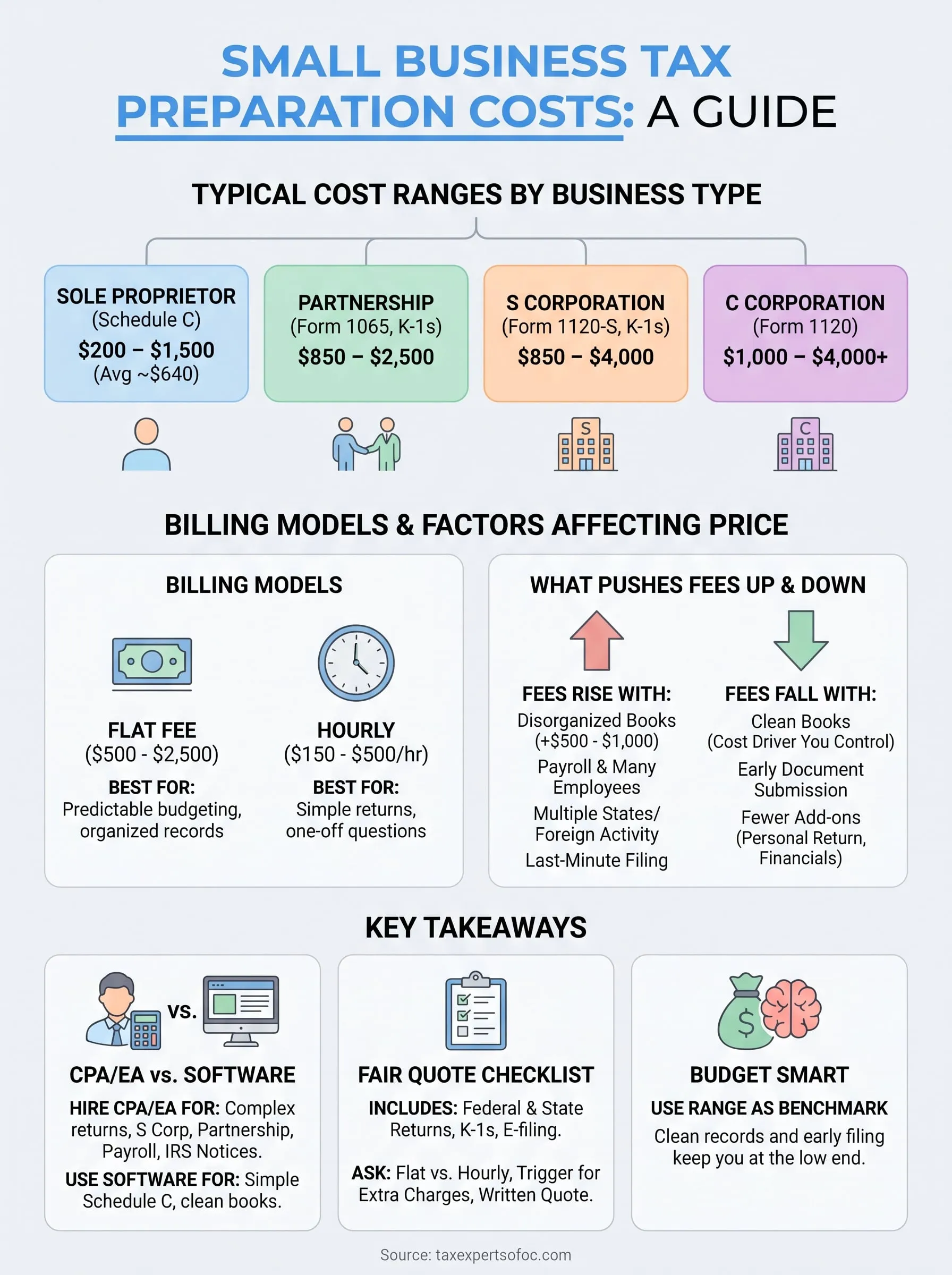
Budget with a range, then get a written quote
The average cost for small business tax preparation is a starting point, not a price tag. Sole proprietors typically pay $200 to $1,500, partnerships $850 to $2,500, and S and C corporations $850 to $4,000 or more. Clean records, early filing, and a clear scope keep you near the low end of your range.
Use the range to question a quote, then compare written offers that cover the same work. Choose a CPA or Enrolled Agent when your return is complex or audit risk matters, and a lower-cost option when it is not.
If you want a number for your own business, get a free consultation on business tax return services with Tax Experts of OC. We will review your entity type and records and explain what the return should cost before any work starts.