

Hiring someone to handle your books is one of the smartest moves a small business owner can make, but figuring out the actual bookkeeping services cost before signing anything? That part trips people up. Rates vary widely depending on whether you hire a freelancer, use software, or work with a full-service firm, and the quotes you get can feel impossible to compare.
We deal with this question constantly at Tax Experts of OC. Our clients, many of them small business owners across Orange County and nationwide, come to us for bookkeeping, accounting, and tax services, and one of the first things they want to know is what they should expect to pay. It's a fair question, and the answer depends on more variables than most online calculators account for.
This guide breaks down monthly and hourly bookkeeping rates for 2026, covering every major pricing model: DIY software, independent bookkeepers, and professional accounting firms. You'll also learn which factors drive costs up or down, like transaction volume, industry complexity, and whether your books need cleanup before ongoing work can even start. By the end, you'll have a clear framework to evaluate what you're actually getting for the price, so you can make a decision that fits both your budget and your business.
Why bookkeeping costs matter for small businesses
Most small business owners focus on revenue, not record-keeping. That focus is understandable, but ignoring what you pay for bookkeeping or skipping it entirely creates financial risk that compounds over time. Understanding the bookkeeping services cost before you commit to any provider isn't just about saving money. It's about knowing what you're buying, what you're skipping, and what that decision costs you down the road.
The hidden cost of doing it yourself
Many business owners start out handling their own books to cut expenses. A spreadsheet or entry-level software can cover the basics early on, but as transaction volume grows and your business adds employees, contractors, or multiple revenue streams, the time you spend reconciling accounts each month becomes significant. Time you spend on bookkeeping is time you're not spending on your business, and that trade-off stops making sense past a certain point.
There's also the error factor. When you reconcile your own accounts, you work with your own blind spots. A misclassified expense or a missed deduction doesn't announce itself. It sits quietly until tax season, or worse, until an IRS notice arrives in your mailbox. At that point, fixing the problem costs far more than preventing it would have.
The cost of a bookkeeping error often exceeds the cost of hiring a professional to prevent it in the first place.
What disorganized records do to your tax bill
Your tax return is only as accurate as the records behind it. Misclassified transactions can result in overpaying taxes because deductions you're entitled to never make it onto the return. Errors in the other direction, claiming expenses you can't substantiate, create audit exposure that puts your entire return under scrutiny.
A professional bookkeeper creates a clean, categorized record that your CPA or tax preparer can work from directly. That reduces preparation time, which typically reduces your tax preparation fee as well. When your books are disorganized, your tax professional spends billable hours cleaning them up before they can even begin the return. That cleanup cost shows up on your invoice whether you expected it or not, and it stacks on top of standard preparation fees.
Your cash flow picture also suffers without clean books. Without accurate monthly records, you can't reliably tell whether your business is profitable, which clients owe you money, or whether a large expense is coming. Business decisions made on incomplete financial data tend to cost more than the bookkeeping would have.
Why understanding pricing protects you as a buyer
When you understand what bookkeeping services typically cost, you're in a much stronger position to evaluate proposals from providers. Quotes that seem unusually low often exclude bank reconciliations, payroll entries, or monthly reporting. Quotes that seem high may simply reflect a firm's overhead rather than any measurable difference in service quality.
Knowing the market rate also helps you ask better questions before you sign. You can push back on vague pricing, request itemized breakdowns, and ask whether a provider charges separately for cleanup work on your existing records. Many businesses find their first bookkeeping bill is higher than expected because the provider had to correct months or years of disorganized entries before setting up a clean ongoing baseline.
That initial cleanup fee is legitimate, but it's also something you can anticipate and plan for if you know to ask about it upfront. Providers who omit that detail until after you've signed are not giving you an accurate picture of your total cost. Understanding what to look for keeps you in control of the conversation from the start.
What bookkeeping services include and what they do not
Before you evaluate any bookkeeping services cost, you need a clear picture of what actually falls inside the service and what requires a separate engagement. Bookkeeping is a specific set of tasks, and providers define its scope differently. Assuming your provider handles something they don't is one of the most common reasons business owners end up with surprise fees or gaps in their financial records.
What standard bookkeeping covers
Most bookkeeping engagements center on the same core functions: recording income and expenses, categorizing transactions by type, reconciling bank and credit card accounts, and maintaining a general ledger. Reconciliation is the process of matching your internal records to your actual bank statements, and it's the task that catches errors, fraud, and missing entries before they compound.
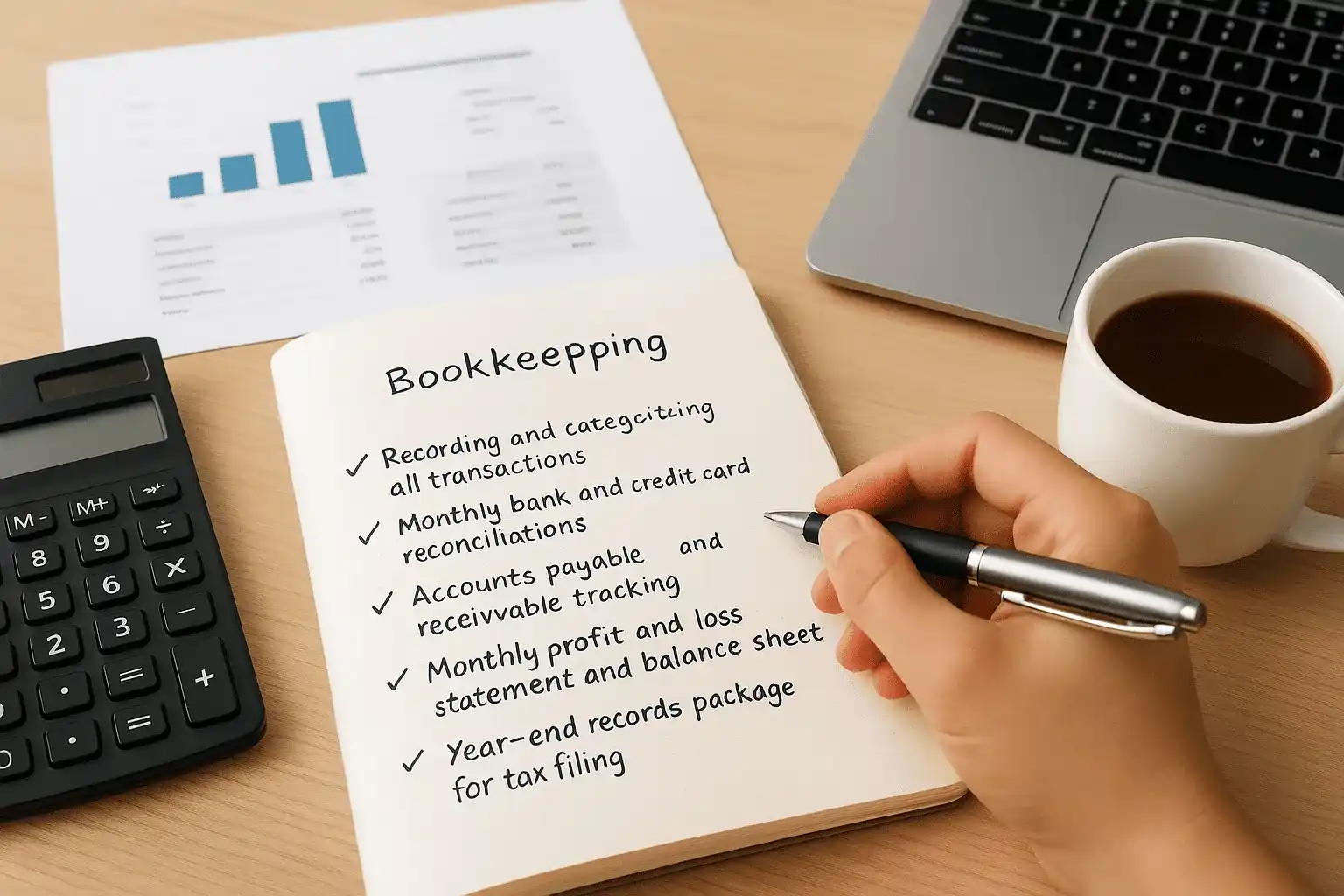
If a provider's proposal doesn't explicitly mention monthly bank reconciliations, ask whether they're included or priced separately.
Beyond reconciliation, a standard monthly bookkeeping package typically includes accounts payable and accounts receivable tracking, generation of basic financial statements like your profit and loss report and balance sheet, and preparation of records for your tax preparer at year-end. Some providers also include payroll entry into their standard package, while others treat it as a separate line item. Always confirm which financial statements are included and how frequently you receive them.
Here's a quick breakdown of tasks that typically fall inside a standard bookkeeping engagement:
- Recording and categorizing all transactions
- Monthly bank and credit card reconciliations
- Accounts payable and receivable tracking
- Monthly profit and loss statement and balance sheet
- Year-end records package for tax filing
What bookkeeping does not include
Bookkeeping and accounting are related but not the same service. A bookkeeper maintains your financial records, while a CPA or accountant interprets them, applies tax law, and provides strategic guidance. Tax preparation, audit representation, financial forecasting, and business advisory work generally fall outside a standard bookkeeping engagement.
Payroll processing is another area that varies by provider. Some firms bundle payroll as part of their monthly bookkeeping fee, while others charge a separate monthly rate per employee. If you have W-2 employees, confirm before you sign whether payroll is included or quoted separately.
Catch-up work on prior periods is almost never included in a standard monthly rate. If your records are behind by several months or years, expect a one-time cleanup fee on top of your ongoing monthly cost. That fee can range from a few hundred dollars to several thousand depending on the volume and condition of your existing records.
Average bookkeeping costs in 2026
Bookkeeping services cost ranges widely in 2026 depending on the provider type, your transaction volume, and the scope of work you need. That said, there are reliable benchmarks you can use to quickly tell whether a quote you receive falls in a reasonable range or sits noticeably outside it. The numbers below reflect current market rates for small business bookkeeping across the United States.
Monthly rates for small businesses
Most small businesses pay a fixed monthly retainer for ongoing bookkeeping services. The size of that retainer depends primarily on how many monthly transactions your accounts generate. A business with 50 or fewer monthly transactions sits at the lower end of the market, while a business processing 200 or more transactions per month pays significantly more.

Here is a general breakdown of monthly bookkeeping rates by transaction volume in 2026:
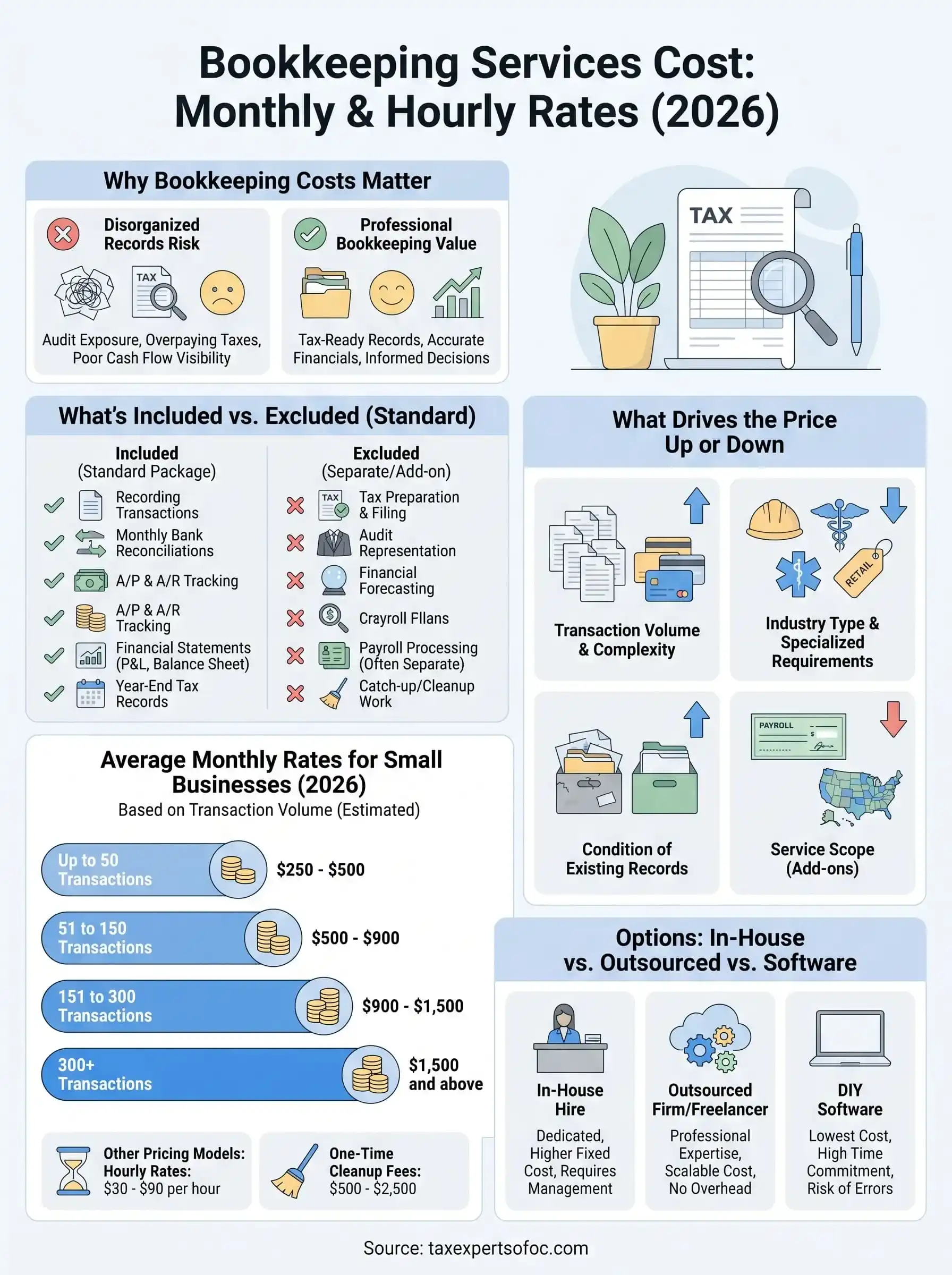
| Monthly Transactions | Estimated Monthly Cost |
|---|---|
| Up to 50 | $250 to $500 |
| 51 to 150 | $500 to $900 |
| 151 to 300 | $900 to $1,500 |
| 300+ | $1,500 and above |
These figures assume a standard engagement that covers transaction categorization, bank reconciliations, and basic monthly financial statements. Payroll, sales tax filing, and CFO-level reporting typically cost more and are usually quoted as add-ons.
The cheapest monthly rate rarely covers everything a growing business actually needs, so always confirm exactly what is included before you compare quotes.
Hourly rates and when they apply
Some providers, particularly independent bookkeepers and freelancers, charge by the hour rather than a flat monthly fee. Hourly bookkeeping rates in 2026 generally run between $30 and $90 per hour depending on the bookkeeper's credentials, location, and experience. Bookkeepers with advanced certifications or specialized industry knowledge tend to sit at the higher end of that range.
Hourly billing works well for occasional or project-based work, such as quarterly reviews or short-term catch-up assignments. For ongoing monthly bookkeeping, a flat monthly retainer is usually more predictable and cost-effective than paying by the hour, because the provider has an incentive to work efficiently rather than log more time.
One-time cleanup and setup fees
If your records are behind or disorganized, most providers charge a one-time cleanup fee before starting regular monthly work. This fee covers the labor required to sort, categorize, and reconcile prior months so the provider has a clean baseline to maintain going forward.
Cleanup fees typically range from $500 to $2,500 for small businesses with less than a year of backlog. Larger backlogs or more complex records can push that figure higher. Asking about this fee upfront prevents the first invoice from coming as a surprise.
Common pricing models and how they work
Providers don't all charge for bookkeeping the same way, and the pricing model a provider uses affects your total bookkeeping services cost just as much as the hourly or monthly rate does. Understanding how each model works helps you compare proposals that look very different on paper and choose the structure that fits how your business actually operates.
Flat monthly retainer
The flat monthly retainer is the most common pricing model for ongoing bookkeeping, particularly with accounting firms and virtual bookkeeping services. You pay a fixed amount each month in exchange for a defined set of tasks, usually transaction categorization, bank reconciliations, and a standard financial statement package. The main advantage is predictability: you know exactly what you'll pay each month, which makes budgeting straightforward.
The risk with flat retainers is scope creep. If your transaction volume increases significantly or you add payroll and sales tax tracking, many providers will reprice your engagement. Before signing, ask specifically how the provider handles growth in your account and whether rate adjustments require a new contract.
Always get a written scope of work with your retainer agreement so you know exactly which tasks are covered at the quoted price.
Hourly billing
Hourly billing is most common with independent freelance bookkeepers and is also how many firms charge for project work like cleanups or one-time reconciliations. You pay only for the time the bookkeeper spends on your account, which can feel more flexible than a flat retainer.
The downside is that your monthly cost becomes unpredictable, especially if your transaction volume fluctuates or if the bookkeeper runs into issues that take longer to resolve. A month with a high number of transactions, several accounts to reconcile, or a discrepancy that takes time to trace can result in a bill that's significantly higher than the previous month. Hourly billing works better for short-term projects than for managing your finances month after month.
Tiered pricing based on transaction volume
Many bookkeeping firms use a tiered pricing structure that scales with your monthly transaction count. You're placed into a tier based on volume, and you pay the corresponding monthly rate. If your transactions grow enough to move you into the next tier, your rate increases automatically.
This model is transparent and relatively easy to understand, but you should confirm how your provider defines a transaction before you agree to any tier. Some providers count each line item in a bank statement, while others count each invoice or expense report. That definition can place you in a higher tier than you expect.
What drives the price up or down
Several specific factors determine where your bookkeeping services cost lands within any given pricing tier or hourly range. Two businesses in the same industry and at the same revenue level can receive quotes that differ by hundreds of dollars per month simply because their situations differ in ways that affect how much work is involved. Knowing which variables carry the most weight lets you anticipate where your own quote will likely fall before you contact a single provider.
Transaction volume and account complexity
Transaction volume is the single biggest driver of bookkeeping cost. A business that runs 30 transactions per month through one checking account takes far less time to maintain than a business running 300 transactions across multiple bank accounts, credit cards, and payment platforms. More transactions mean more categorization, more reconciliation, and more room for discrepancies that need to be traced and corrected.
The number of accounts you hold also matters. Each additional bank account, credit card, or merchant account requires its own monthly reconciliation, and that labor adds up. If you accept payments through multiple processors or operate across multiple locations, expect providers to price your account at a higher tier than a simpler single-account business would receive.
Industry type and specialized requirements
Some industries require bookkeeping knowledge that goes beyond general transaction management. Contractors who need job costing, retail businesses tracking inventory, and medical practices managing insurance reimbursements all require more specialized handling than a straightforward service business. Providers with that specialized knowledge charge more for it, and that premium is usually justified by the reduced risk of errors in complex areas.
If your industry has specific regulatory or reporting requirements, confirm upfront whether your provider has direct experience with them, because a general bookkeeper may miss details that affect your tax position.
Sales tax obligations also raise the complexity of your engagement if you operate in multiple states or sell products subject to different tax rates. Multi-state sales tax tracking requires ongoing attention and specific knowledge of each jurisdiction's rules, and providers typically charge more for that work than for a single-state business.
The condition of your existing records
Providers price their ongoing monthly fee based on maintaining clean, organized records, not on fixing disorganized ones. If your records are behind by several months or contain misclassified transactions, a provider must perform cleanup work before your account reaches a maintainable baseline. That condition directly increases your total cost through an upfront cleanup fee, and in some cases it also affects your ongoing monthly rate if the cleanup reveals structural issues with how your accounts were set up.
Switching platforms or migrating from one accounting system to another also adds to your initial setup cost, as the provider needs to verify that your historical data transferred accurately before taking over ongoing maintenance.
In-house vs outsourced vs software options
The three main ways to handle your books each carry a different bookkeeping services cost profile, and the right choice depends on your transaction volume, your tolerance for managing another employee, and how much hands-on financial visibility you want each month. Before you request a single quote, it helps to understand what each option actually involves and where the costs tend to land.

Hiring an in-house bookkeeper
Bringing a bookkeeper onto your payroll gives you dedicated, on-site support, but the total cost runs much higher than most business owners initially expect. A full-time bookkeeper in the United States earns between $45,000 and $60,000 per year in base salary, and that figure doesn't include payroll taxes, benefits, paid time off, or the cost of accounting software licenses. Part-time in-house bookkeepers reduce the salary cost but still require employer tax contributions and consistent management attention.
In-house bookkeeping only makes financial sense once your transaction volume and internal complexity are high enough to justify a dedicated salary, which for most small businesses means waiting longer than they think.
For most small businesses, an in-house hire is the most expensive option per dollar of value received, particularly in the early stages when full-time hours aren't actually needed.
Outsourcing to a firm or freelancer
Outsourcing your bookkeeping to an accounting firm or a certified freelancer gives you professional expertise without the overhead of a full-time employee. You pay only for the work your account requires, whether that's a flat monthly retainer or hourly billing for project work. Firms that bundle bookkeeping with tax preparation can also reduce your total year-end costs because your records arrive at tax time in clean, usable condition rather than requiring hours of prep work before filing can begin.
The tradeoff is that you have less direct control over turnaround time, and the quality gap between providers varies widely. Vetting credentials and asking specific questions about experience with your industry matters before you commit.
Using bookkeeping software
DIY software like QuickBooks or Xero costs significantly less per month than any human provider, with most plans running between $30 and $100 per month. That low price makes sense for sole proprietors with simple finances who have time to manage their own records accurately.
For businesses with multiple accounts, employees, or industry-specific requirements, software alone creates more risk than it eliminates. The platform records what you tell it to record, so misclassifications and missed entries go undetected until they show up as errors on your tax return or in a lender's review of your financials.
How to estimate your monthly bookkeeping cost
Getting a realistic number before you contact any provider gives you a clear starting point for evaluating quotes. Estimating your bookkeeping services cost doesn't require a deep accounting background, but it does require honest answers to a few specific questions about your business. Walk through these steps, and you'll arrive at a ballpark figure that reflects your actual situation rather than a generic online average.
Start with your transaction volume
Your monthly transaction count is the most reliable baseline for estimating what you'll pay. Pull up your last two or three bank and credit card statements, count every line item across all accounts, and average those totals. That number tells you which pricing tier you fall into and gives providers enough information to quote you accurately rather than offer a vague range.
Here's a simple reference to connect your transaction volume to an estimated monthly cost:
| Monthly Transactions | Estimated Monthly Cost |
|---|---|
| Under 50 | $250 to $500 |
| 50 to 150 | $500 to $900 |
| 150 to 300 | $900 to $1,500 |
| Over 300 | $1,500 and above |
Use the average of your last three months rather than a single month, because seasonal spikes in transaction volume can push your estimate higher than your typical baseline.
Factor in your service scope
Once you have a transaction volume baseline, add the specific services your business actually needs beyond basic categorization and reconciliation. Payroll processing, sales tax filing, and multi-state compliance each carry additional costs that most flat monthly rates don't include by default. List every task you need handled, then confirm with each provider whether those tasks sit inside or outside their quoted rate.
Industry-specific requirements also affect your estimate. If your business tracks inventory, manages job costing, or handles insurance reimbursements, you'll typically pay more than a straightforward service business at the same transaction volume. Building that premium into your estimate upfront prevents you from choosing a provider based on a quote that doesn't reflect what you actually need.
Account for cleanup if your records are behind
If your books are more than a month or two behind, add a one-time cleanup fee to your first-year cost estimate. Most providers charge between $500 and $2,500 to bring disorganized or overdue records up to a clean baseline, and that fee is separate from your ongoing monthly rate. Divide that cleanup cost across 12 months and add it to your monthly estimate so you're comparing providers on your true first-year cost, not just the recurring rate.
How to compare providers and avoid pricing traps
Comparing bookkeeping proposals is harder than it looks because providers don't all define their services the same way. Two quotes for the same bookkeeping services cost can look identical on paper while covering completely different tasks. Your job before signing anything is to make sure you're comparing actual service scope, not just monthly rates.
Ask for an itemized scope of work
Every proposal you receive should list exactly which tasks are covered at the quoted price. A vague proposal that only mentions "monthly bookkeeping" without specifics is a warning sign that the provider is leaving room to bill separately for work you assumed was included. Before you commit, ask each provider to confirm in writing whether the following are included in their rate:
- Monthly bank and credit card reconciliations for all accounts
- Accounts payable and receivable tracking
- Profit and loss statement and balance sheet delivery
- Payroll entry or processing
- Sales tax tracking and filing
- Year-end records package for tax filing
If a provider hesitates to itemize their scope, that hesitation tells you something important about how disputes will be handled later.
Getting this list in writing protects you if a provider later claims that a task you expected falls outside the engagement. It also gives you a direct basis for comparison across multiple proposals.
Watch for these common pricing traps
Several patterns come up repeatedly when businesses review their first bookkeeping invoices and find them higher than expected. The most frequent issue is the undisclosed cleanup fee, where a provider quotes a low monthly rate but fails to mention that your current records require a significant amount of correction before ongoing work can begin. Ask every provider upfront whether your records will require cleanup and what that work costs separately.

Tiered pricing structures can also create unexpected increases if your transaction volume crosses into a higher tier mid-year. Some providers reprice automatically when you hit a volume threshold; others notify you first. Confirm how your provider handles this before you sign, so a busy quarter doesn't result in a rate increase you didn't see coming.
Watch for proposals that bundle services without breaking them out individually. A "complete accounting package" that includes tax preparation, payroll, and bookkeeping as a single monthly fee can look like strong value, but if you already have a tax preparer you trust, you may be paying for services you don't need. Always ask what the individual components cost so you can evaluate whether the bundle actually saves you money or simply obscures the pricing structure.
Bookkeeping cost questions people ask most
Before committing to a provider or a pricing model, most business owners have a few specific questions that didn't get answered in the general research process. The questions below cover the most common gaps people run into when evaluating bookkeeping services cost for the first time, and each answer gives you a direct, usable response rather than a vague one.
Is bookkeeping tax deductible for a small business?
Yes, bookkeeping fees are a deductible business expense under IRS guidelines, which means the cost of your monthly bookkeeping engagement reduces your taxable income for the year. This applies whether you pay a flat monthly retainer to a firm, hourly fees to a freelancer, or a subscription fee for professional bookkeeping software used for your business. Keep your invoices and payment records organized throughout the year so your tax preparer can include these expenses accurately without having to reconstruct them from memory at filing time.
Your bookkeeping cost is one of the few expenses that directly reduces what you owe in taxes while also improving the accuracy of your entire return.
What is the difference between a bookkeeper and an accountant?
A bookkeeper records and organizes your financial transactions on an ongoing basis, maintaining the ledger, reconciling accounts, and producing basic reports. An accountant, particularly a CPA, interprets those records, applies tax law, and provides strategic financial guidance. Bookkeeping is the foundation; accounting is what gets built on top of it. Many small businesses use both: a bookkeeper for monthly maintenance and a CPA for tax planning, filing, and advisory work.
How often should a small business reconcile its accounts?
Monthly reconciliation is the standard for most small businesses, and it's what nearly all professional bookkeeping packages include. Reconciling monthly keeps discrepancies small and catchable before they compound. Businesses with high transaction volume or multiple accounts benefit from the same monthly cadence, though some choose to reconcile more frequently during busy seasons. Waiting until the end of the year to reconcile is the single most common reason businesses end up paying large cleanup fees before tax season.
Can I switch bookkeeping providers without losing my data?
Switching providers is entirely feasible if your records are stored in a widely used platform like QuickBooks Online or Xero, because your new provider can access the same file your previous one worked from. Ask your current provider before you cancel to confirm who owns the account login and how your data transfers, because some firms set up accounts under their own credentials rather than yours. Verifying account ownership before you start any engagement protects you from losing access to your own financial records if the relationship ends.
Conclusion
Bookkeeping services cost anywhere from $250 per month for a simple operation to well over $1,500 for a business with high transaction volume, multiple accounts, and specialized requirements. The rate you pay depends on your transaction count, the scope of services you actually need, and whether your existing records require cleanup before ongoing work can start. Understanding these variables before you request any quotes puts you in a stronger position to evaluate what you're actually getting rather than just comparing numbers on paper.
Your books directly affect your tax liability, your cash flow visibility, and your ability to make sound financial decisions. Leaving them disorganized or choosing a provider based on price alone creates problems that cost more to fix than prevent. If you want professional bookkeeping handled alongside your tax planning and preparation, our team at Tax Experts of OC works with small businesses nationwide. Schedule your free consultation and get a clear picture of what your books actually need.