
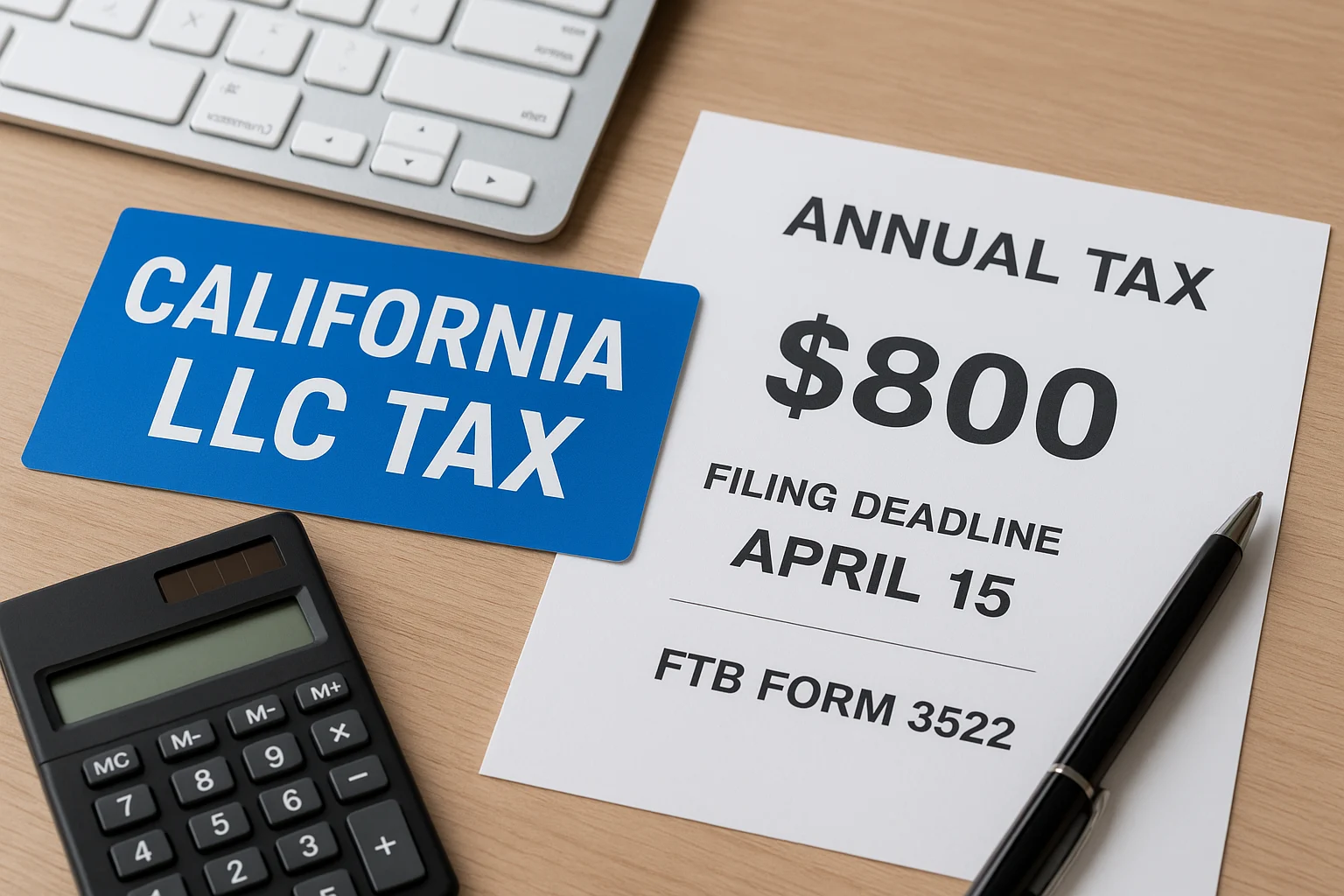
If you own an LLC in California, you owe the state money every year, whether your business turns a profit or not. The California LLC tax starts with a flat $800 annual franchise tax paid to the Franchise Tax Board, and depending on your revenue, you could owe even more on top of that.
Missing a deadline or underpaying doesn't just trigger penalties. It can put your LLC's good standing at risk, which affects everything from contracts to bank accounts. At Tax Experts of OC, we help LLC owners across California and all 50 states stay ahead of these obligations, and step in when things go sideways with the FTB or IRS.
This article breaks down exactly what your California LLC owes, how the additional gross income fee works, when each payment is due, and what happens if you fall behind. Everything you need to stay compliant, in one place.
Why California LLC tax compliance matters
The California LLC tax system is not optional, and the Franchise Tax Board enforces it aggressively. If you miss a payment or file late, the FTB does not send a polite reminder. They assess penalties and interest automatically, and those balances grow fast. Most LLC owners don't realize how quickly a missed $800 payment can become a much larger problem.
What the FTB can do if you fall behind
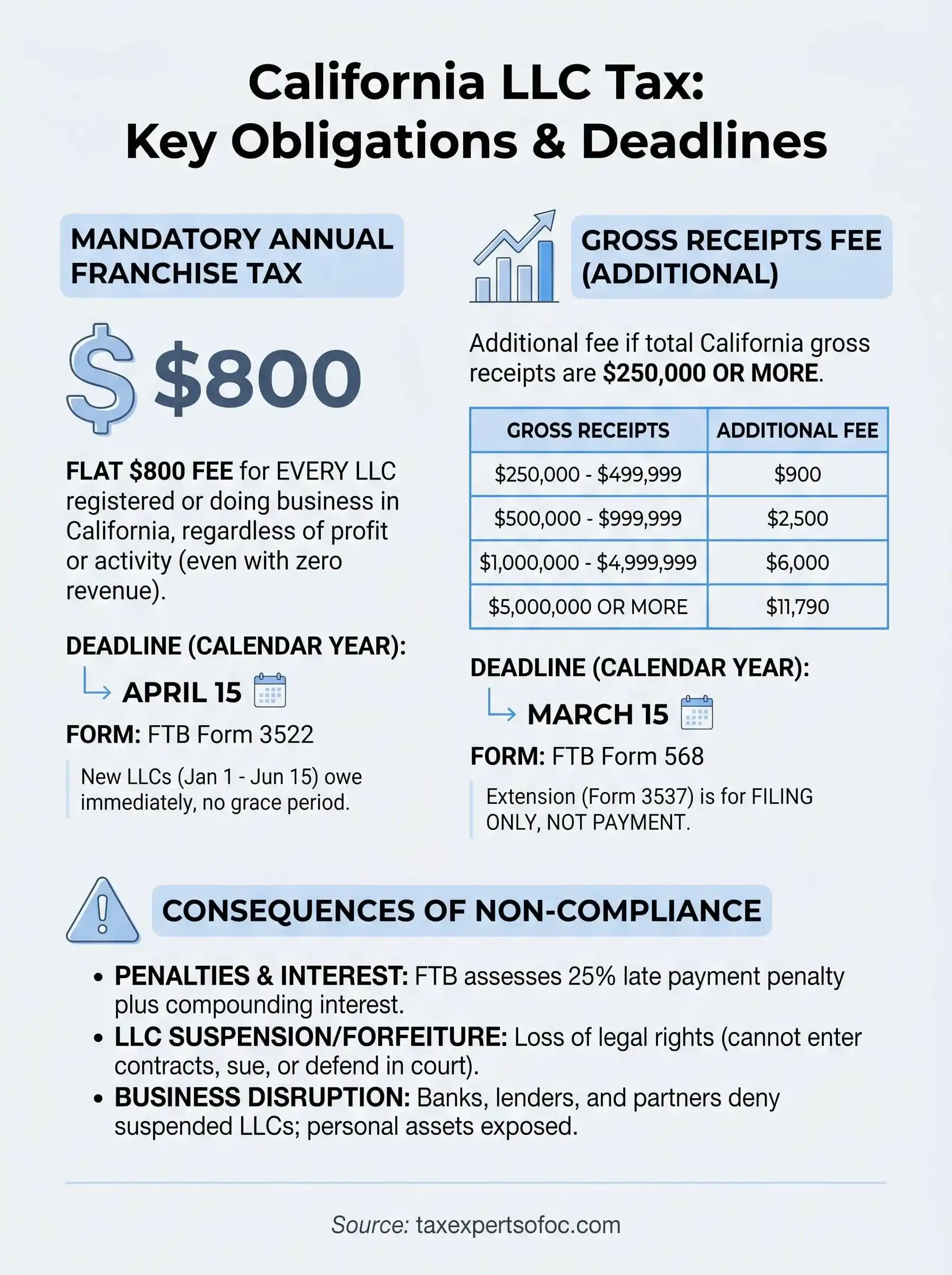
Your LLC faces real consequences the moment you miss a deadline. The FTB can assess a 25% late payment penalty on top of whatever you owe, plus monthly interest that compounds over time. If the balance stays unpaid long enough, the FTB will suspend or forfeit your LLC, which strips the business of its legal rights in California.
A suspended LLC cannot legally enter contracts, sue, or be sued in California courts, leaving your personal assets more exposed in any business dispute.
Reinstating a suspended LLC requires paying the full outstanding balance, including penalties, and filing reinstatement paperwork with both the FTB and the California Secretary of State. That process takes time and costs more money than simply staying current in the first place.
How non-compliance affects your day-to-day operations
Staying compliant protects more than your legal standing. Banks and lenders check your LLC's status before approving business loans or lines of credit, and a suspended LLC gets denied. If you're trying to sign a commercial lease, bring in investors, or bid on a contract, the other party will likely verify your business status directly with the state.
Personal liability is another real risk. California can, under certain circumstances, hold members or managers responsible for unpaid LLC taxes and fees. Keeping your payments current is the most straightforward way to preserve the liability protection that your LLC structure was designed to provide and keep your business operating without interruption.
What California LLC taxes and fees you may owe
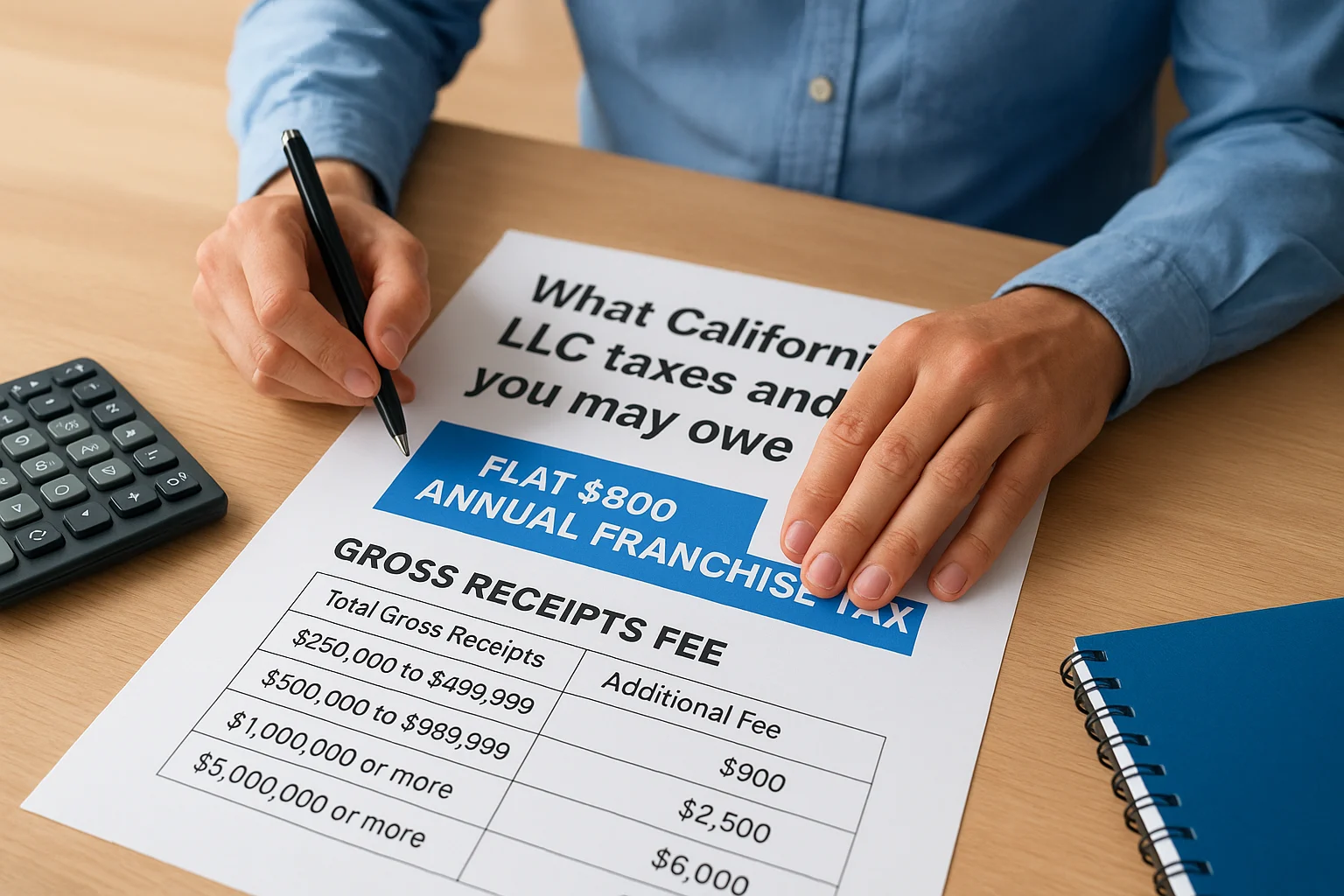
Your California LLC tax obligation breaks down into two separate charges: the flat $800 annual franchise tax and an additional gross receipts fee tied to your total revenue. Every LLC registered or actively doing business in California owes the $800 minimum, regardless of whether the business made any money during the year.
The $800 annual franchise tax
California charges every LLC the $800 minimum franchise tax each year. You owe it even if your business had zero revenue, operated at a loss, or conducted no activity at all. The Franchise Tax Board views this as a baseline cost of maintaining your business's legal right to operate in the state.
New LLCs that form between January 1 and June 15 owe the $800 for the first tax year immediately, with no grace period on that initial payment.
The gross receipts fee
If your LLC earns $250,000 or more in total California gross receipts, the FTB adds a separate fee on top of the $800. The fee scales with revenue:
| Total Gross Receipts | Additional Fee |
|---|---|
| $250,000 to $499,999 | $900 |
| $500,000 to $999,999 | $2,500 |
| $1,000,000 to $4,999,999 | $6,000 |
| $5,000,000 or more | $11,790 |
Both charges are due separately, meaning a high-revenue LLC could owe $12,590 or more in California fees alone before any federal tax obligations come into play.
Key California LLC deadlines and required forms
The California LLC tax schedule has multiple moving parts, and missing any one deadline can trigger penalties that stack fast. Knowing which forms to file and when keeps your LLC in good standing with the Franchise Tax Board without any surprises.
Annual franchise tax deadline
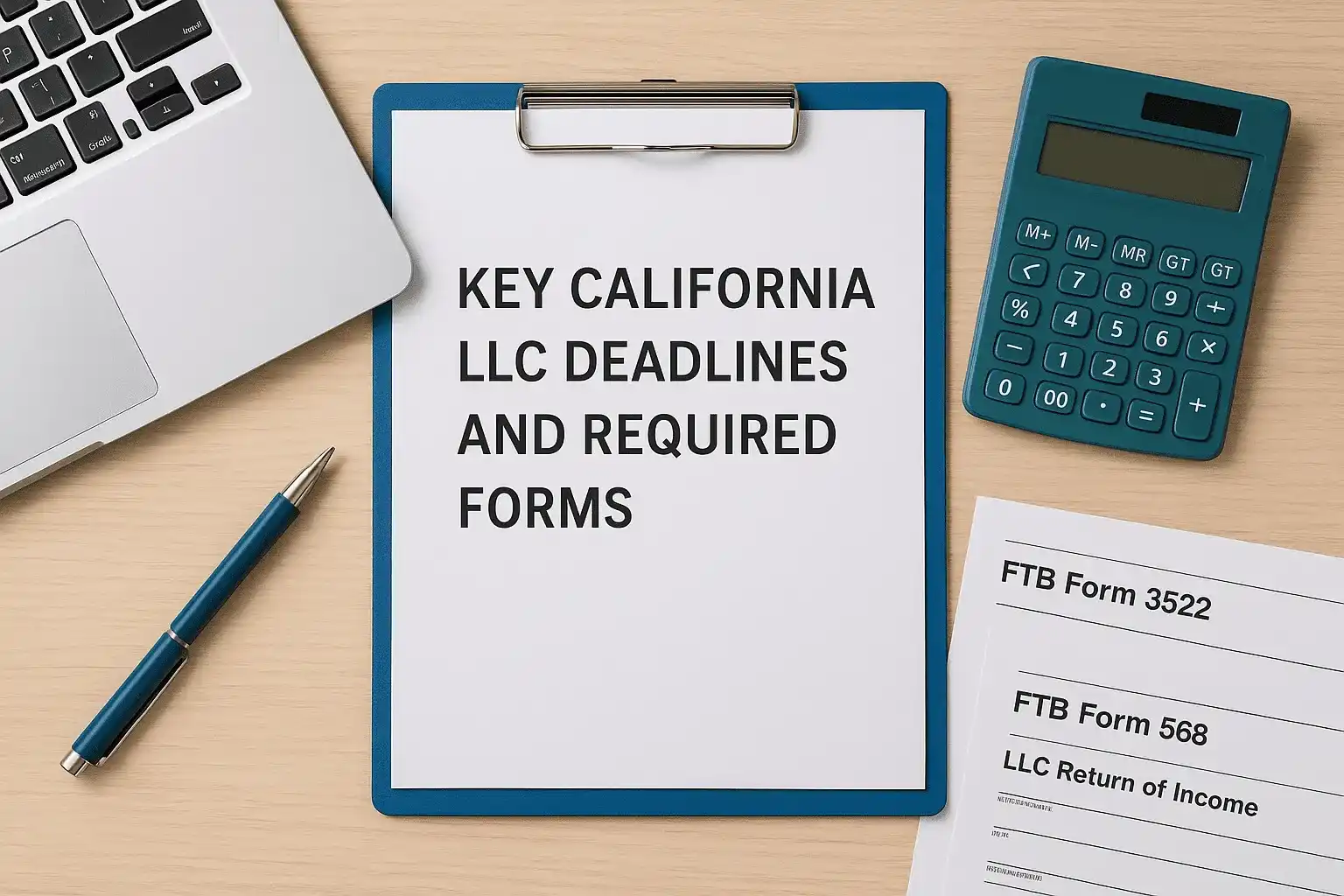
Your $800 annual franchise tax is due by the 15th day of the fourth month after your tax year begins. For most calendar-year LLCs, that means the payment lands on April 15. You submit it using FTB Form 3522, the LLC Tax Voucher, which is a separate filing from your LLC's income return.
If your LLC forms between January 1 and June 15, your first-year $800 payment is due immediately, and the FTB does not allow an extension on that initial amount.
Gross receipts fee and return deadlines
Your gross receipts fee is reported and paid when you file FTB Form 568, the LLC Return of Income. That return is due by the 15th day of the third month after your tax year closes, which is March 15 for calendar-year LLCs. You can file for a six-month extension using FTB Form 3537, but the extension applies only to the return itself. Any tax or fee balance you owe must still be paid by the original deadline to avoid late payment penalties from the FTB.
| Form | Purpose | Deadline (Calendar Year) |
|---|---|---|
| FTB Form 3522 | Annual $800 franchise tax | April 15 |
| FTB Form 568 | LLC Return of Income | March 15 |
| FTB Form 3537 | Extension request | March 15 |
How to pay California LLC tax and file correctly
Your california llc tax payments go directly to the Franchise Tax Board, which accepts online payments through its Web Pay system at ftb.ca.gov. You can pay from a bank account, schedule future payments, and receive instant confirmation of each transaction, making it the most reliable method available.
Using FTB Web Pay
FTB Web Pay lets you submit your $800 franchise tax and any gross receipts fee at no cost directly from your bank account. Save the confirmation number you receive after each payment, because that record is your proof if the FTB ever disputes receipt of a transaction.
Before you log in, have the following ready:
- Your LLC's 12-digit Secretary of State file number
- Your Federal Employer Identification Number (EIN)
- Your bank account and routing number
Schedule your payment several business days before the actual deadline to give the transaction time to post correctly.
Filing Form 568 without errors
When you file FTB Form 568, you report your total California gross receipts and calculate any additional fee owed beyond the flat $800 franchise tax. The FTB cross-references your gross receipts against other state filings, so errors or inconsistencies can trigger a review.
Schedule IW, the worksheet attached to Form 568, is where you calculate your gross receipts fee tier. Work through it completely before transferring figures to the main return to avoid mistakes that require an amended filing later.
Common mistakes that trigger penalties or suspension
Most California LLC tax problems trace back to a few avoidable errors that catch LLC owners off guard. Understanding where others go wrong gives you a clear map of what to avoid.
Assuming zero revenue means zero tax
Many LLC owners skip the $800 annual franchise tax in years when the business earns nothing. That assumption is wrong. The FTB charges the fee regardless of revenue, inactivity, or operational status. Skipping the payment starts the penalty clock immediately, and by the time the FTB sends a notice, you already owe more than the original $800.
Paying the $800 on time every year, even in a slow or inactive year, costs far less than any reinstatement process.
Confusing extension deadlines with payment deadlines
Filing for an extension on FTB Form 3537 gives you more time to submit your return, not more time to pay what you owe. Many LLC owners file the extension and hold off on payment, then receive a late payment penalty for the full balance. The FTB expects your estimated payment by the original deadline regardless of any extension.
Your gross receipts fee calculation also trips up LLCs that fail to track total California revenue throughout the year. Waiting until March to reconstruct annual receipts leads to math errors, missed fee tiers, and amended filings that attract extra scrutiny from the FTB.
A simple plan to stay in good standing
Managing your california llc tax obligations comes down to three consistent habits: pay the $800 on time every year, track your gross receipts throughout the year so you know which fee tier you land in, and file Form 568 by March 15 with the correct figures. None of these steps require last-minute scrambling if you stay organized from the start.
Setting up calendar reminders for both the April 15 franchise tax payment and the March 15 return deadline eliminates most of the risk. Keep a running quarterly total of your California gross receipts so you are never estimating at filing time, and store your FTB payment confirmation numbers somewhere easy to find.
When the math gets complicated or you fall behind, working with a professional saves you more than it costs. Tax Experts of OC helps LLC owners resolve FTB issues, catch up on missed filings, and build a compliance routine that holds up year after year.