
An IRS notice hits your mailbox, and suddenly you're staring at a number that doesn't feel real. Back taxes, penalties, interest, it compounds fast. If you're searching for help with IRS tax problems, you're likely past the point of hoping it resolves itself. You need a clear path forward, and you need to know who can actually fix this.
The good news: you have options. The IRS Taxpayer Advocate Service (TAS) exists specifically to help when normal channels fail. And when the situation calls for someone who can negotiate directly with the IRS on your behalf, a CPA or Enrolled Agent can step in with the authority and expertise to do exactly that. At Tax Experts of OC, we handle these cases daily, from wage garnishments and audits to years of unfiled returns, for clients across all 50 states.
This guide breaks down when to contact TAS, when to hire a tax professional, and how to decide which route makes the most sense for your situation. No guesswork, just the information you need to take your next step.
Know your options before you call anyone
Before you pick up the phone, understand who does what and when each option applies. Most people default to calling the IRS directly, but that's rarely the fastest path to resolution. Two specific resources exist for serious tax problems: the Taxpayer Advocate Service and a licensed tax professional such as a CPA or Enrolled Agent.

The option you choose should match the type of problem you have, not just how urgent it feels.
The Taxpayer Advocate Service (TAS)
TAS is a free, independent office within the IRS that steps in when the standard IRS process has broken down or caused serious financial hardship. If you need help with IRS tax problems involving a frozen bank account, a blocked refund, or a collection action that threatens basic living expenses, TAS can intervene. They stop collections in progress, cut through processing delays, and hold the IRS accountable to its own procedures.
Resolving your actual tax debt falls outside TAS's scope. They won't reduce what you owe or negotiate a settlement. Their role is strictly procedural: correcting breakdowns and protecting your rights throughout the IRS process.
A CPA or Enrolled Agent
A licensed CPA or Enrolled Agent (EA) holds official authority to represent you directly before the IRS under IRS Power of Attorney Form 2848. This is the right option when you need to resolve tax debt, respond to an audit, file delinquent returns, or negotiate an installment agreement or offer in compromise. A professional advocates for your specific financial outcome, not just fair treatment.
You should hire a professional when the amount owed is substantial, when multiple tax years are involved, or when you've already attempted to resolve the issue directly with the IRS and gotten nowhere.
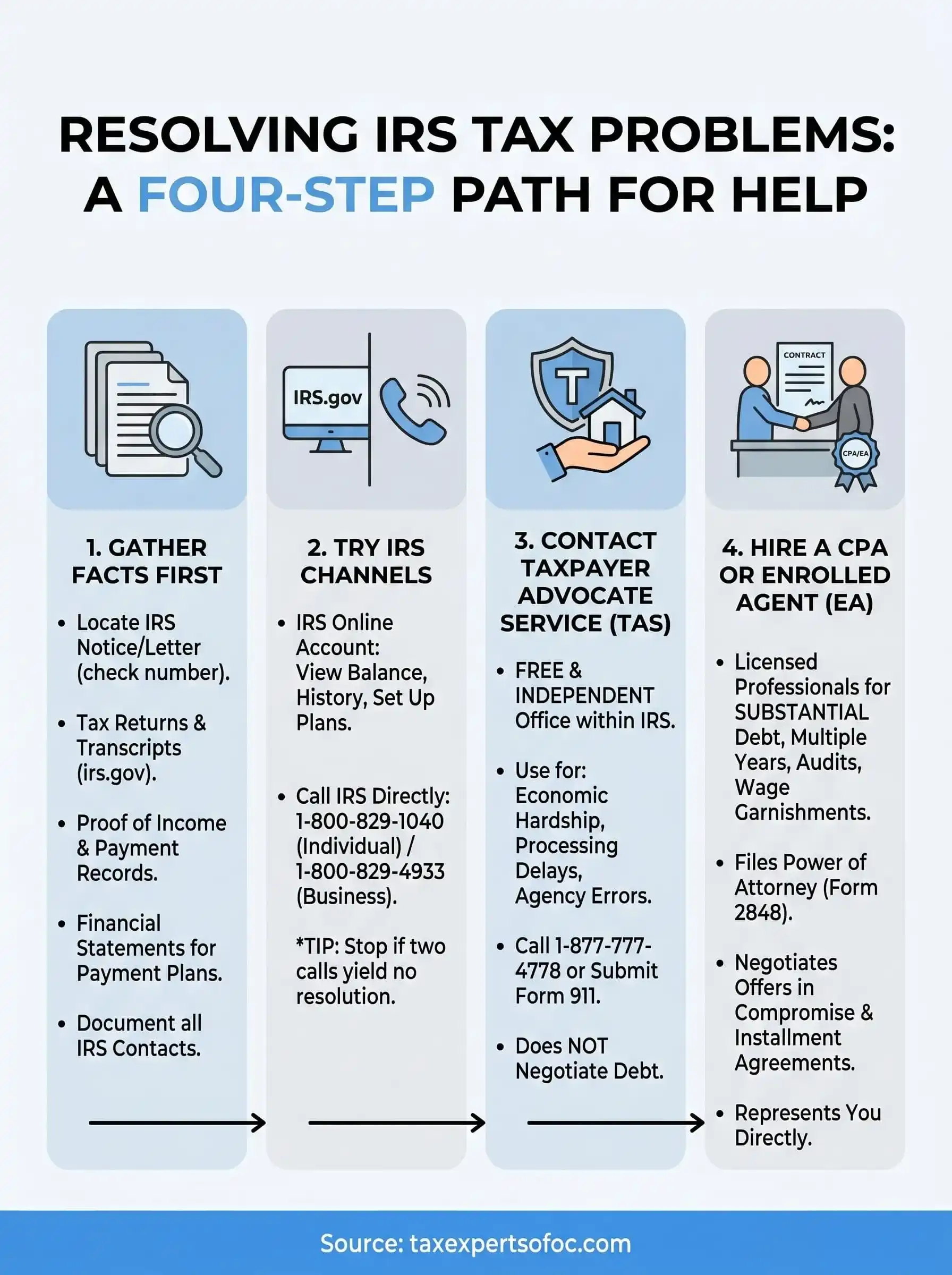
Step 1. Gather the facts the IRS will ask for
Whether you contact TAS or a tax professional for help with IRS tax problems, you need to walk in with the right information. Without it, every call turns into a callback, every form goes back for revision, and your problem takes longer to resolve than it should.
Having your documents ready before your first contact saves weeks of back-and-forth.
What to pull together before you make contact
Start by locating the IRS notice or letter that triggered your concern. The notice number printed in the upper right corner tells you exactly what the IRS is claiming and what it expects from you. Beyond that, gather the following:

- Tax returns for every year in question
- IRS transcripts (request free copies at irs.gov)
- Proof of income: W-2s, 1099s, or bank statements
- Records of any prior payments made toward the balance
- Financial statements if you plan to request an installment agreement or offer in compromise
If you owe across multiple tax years, write down each year and the balance shown on your most recent IRS correspondence. A tax professional uses this list to map out your full exposure before contacting the IRS on your behalf.
Step 2. Try the fastest IRS channels first
Before escalating to TAS or hiring a professional, run through the IRS's own tools first. Some problems, like setting up a payment plan for a manageable balance, resolve faster through direct IRS channels than through a third party. Skipping this step wastes time when a simple online action could close the issue.
IRS Online Account
Your first stop should be IRS.gov, where you can view your balance and payment history, set up an installment agreement, and respond to certain notices online. This takes minutes and requires no hold time on the phone.
Call the IRS Directly
If your issue requires a live conversation, call 1-800-829-1040 for individuals or 1-800-829-4933 for businesses. Call early on a Tuesday, Wednesday, or Thursday to minimize wait times. Have your Social Security number, the relevant tax year, and your IRS notice number ready before the agent picks up.
If two separate calls produce no resolution, stop. That is the signal to seek professional help with IRS tax problems.
Keep a written log of every IRS contact, including the date, the agent's ID number, and a summary of what was discussed. This record becomes important evidence if your dispute escalates.
Step 3. Contact the Taxpayer Advocate Service
When direct IRS channels haven't resolved your issue or a collection action threatens your ability to cover basic living expenses, TAS is your next call. Before contacting them, confirm your situation qualifies. TAS takes cases involving economic hardship, IRS processing delays beyond standard timeframes, or agency errors that normal procedures have failed to fix.
If the IRS has levied your paycheck or frozen your bank account without resolution, TAS has the authority to stop that collection while your case is reviewed.
How to Reach TAS
You can get help with IRS tax problems through TAS by calling their toll-free line at 1-877-777-4778, Monday through Friday, 7 a.m. to 7 p.m. local time. Alternatively, locate your nearest local TAS office through the IRS website directory and submit Form 911 (Request for Taxpayer Advocate Service Assistance) either in person or by fax.
Prepare a brief written summary before you call. Include the specific IRS action causing harm, every step you already took to resolve it, and the direct financial impact on your household or business. A factual, organized summary gets your case assigned to an advocate faster than a general complaint ever will.
Step 4. Hire a CPA or Enrolled Agent for resolution
When TAS can't reduce your balance or negotiate a settlement, a licensed CPA or Enrolled Agent can. This is the right step when your debt is substantial, multiple tax years are involved, or collection actions are already in motion. A qualified professional files a Form 2848 Power of Attorney with the IRS so that all future IRS communication routes through them, removing you from direct contact with the agency.
Once a professional holds your Power of Attorney, you are no longer required to speak with the IRS directly.
When to Make This Call
Hire a CPA or EA if your situation includes any of the following:
- Back taxes across multiple years with accumulated penalties and interest
- A wage garnishment or bank levy already in progress
- An IRS audit requiring documentation and a formal written response
- Unfiled returns that must be prepared before any negotiation can begin
- A proposed Offer in Compromise or installment agreement requiring detailed financial analysis
What Happens After You Hire
Your professional pulls your IRS transcripts and full tax history, then builds a resolution strategy around your actual financial picture. For help with IRS tax problems involving significant debt, this typically means negotiating a structured repayment plan or preparing an Offer in Compromise with documented supporting financials submitted directly to the IRS.
Your next steps
You now have a clear framework for getting help with IRS tax problems: gather your documents, try direct IRS channels, escalate to TAS if collections are causing hardship, and bring in a licensed CPA or Enrolled Agent when you need someone who can negotiate a real resolution. Each step builds on the last, so skip the one that does not apply to your situation and move to what does.
Act on this now rather than waiting for the problem to grow. Penalties and interest accrue daily, and collection actions escalate without warning. If your situation involves back taxes, an audit, unfiled returns, or a wage garnishment, a qualified professional can stop the clock and build a path forward that the IRS will accept. Tax Experts of OC offers a free 30-minute consultation with a CPA or Enrolled Agent. Schedule your consultation today and get a straight answer about where you stand.