

Getting a letter from the IRS can stop you in your tracks. Whether it's an audit notification, a collections notice, or a proposed change to your return, the pressure to respond correctly, and quickly, is real. Most people aren't sure what to say, what to sign, or what rights they even have. That's exactly where IRS representation services come in. A qualified professional steps in on your behalf, communicates directly with the IRS, and works to protect your interests so you don't have to navigate the process alone.
At Tax Experts of OC, our CPA and Enrolled Agent represent individuals and business owners before the IRS every day. We handle audits, respond to notices, negotiate settlements, and resolve disputes, both locally in Orange County and for clients across all 50 states through secure virtual consultations. We've seen firsthand how proper representation changes outcomes, turning a stressful IRS situation into a manageable, structured process with a clear path forward.
This article breaks down what IRS representation actually involves, who can legally represent you, and how these services work when you're dealing with audits, notices, or unresolved tax debt. If you're facing an IRS issue right now, or trying to prepare before one escalates, this guide will give you a solid understanding of your options.
What IRS representation services include
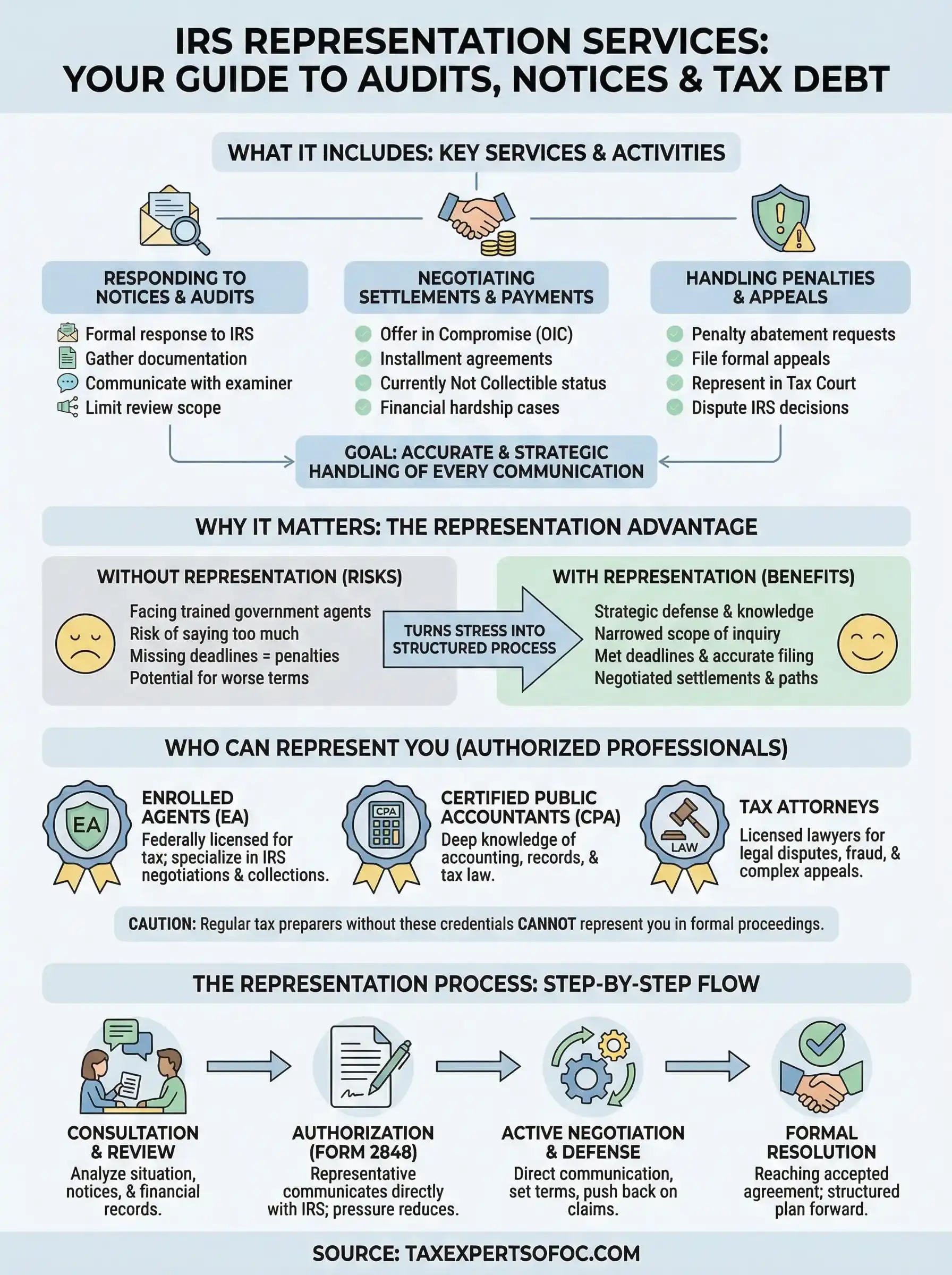
IRS representation services cover a wide range of activities, all centered on one goal: putting a qualified professional between you and the IRS so that every communication, negotiation, and decision is handled with accuracy and strategy. The scope of what a representative handles depends on your specific situation and the type of IRS action involved, but several core areas come up most often across audits, collections, and unresolved disputes.
Responding to IRS notices and audits
When the IRS sends you a notice, it typically requires a timely, specific response that addresses their concerns directly. A representative reads the notice, identifies exactly what the IRS is requesting, and prepares a formal response on your behalf. For audits, they gather the relevant documentation and evidence, communicate with the IRS examiner, and work to limit the scope of the review so you don't expose yourself to issues beyond what triggered the audit in the first place.

Common IRS notices a representative handles include:
- CP2000: proposed changes to your return based on income discrepancies
- CP503 and CP504: balance due reminders and final notices before levy
- LT11 and Letter 1058: final notices of intent to levy
- CP90: notice of intent to seize assets
Getting the response right the first time matters. A poorly worded or incomplete reply can extend an audit or trigger additional scrutiny that a correct initial response would have avoided.
Negotiating settlements and payment arrangements
If you owe more than you can pay in full, your representative can negotiate options like an Offer in Compromise, which lets you settle your debt for less than the full amount owed, or an installment agreement that spreads payments over time. They can also request Currently Not Collectible status if you're facing genuine financial hardship, which temporarily pauses IRS collection activity.
Each of these options has specific eligibility requirements, and your representative knows which one fits your situation and how to build the strongest possible case for IRS approval.
Handling penalty abatements and appeals
The IRS applies penalties for late filing, late payment, and other violations, but many of those penalties can be reduced or removed entirely through a formal penalty abatement request. If you disagree with an IRS decision, your representative can file an appeal and argue your case before the IRS Office of Appeals.
They can also represent you in Tax Court if the dispute escalates to that level, though most cases resolve before reaching that point through negotiation and documented evidence.
Why IRS representation matters
The IRS operates with experienced agents and examiners who know exactly what they're looking for when they audit a return or pursue collections. Going into that process without someone equally qualified in your corner puts you at a serious disadvantage. IRS representation services exist because the rules, deadlines, and negotiation levers involved are complex enough that a wrong step can turn a manageable problem into a significantly worse one.
The IRS does not work in your favor
Facing the IRS without a representative means dealing with trained government agents whose primary objective is collecting what they determine you owe. They know how to find unreported income, disallow deductions, and move fast through collections if you don't respond on time. When you go in alone, you may inadvertently say something that opens new areas of scrutiny or agree to terms that are worse than what a qualified professional could have negotiated.
A representative knows which information to provide and, just as importantly, which information to withhold, keeping the scope of an IRS inquiry as narrow as possible.
Deadlines and errors carry real consequences
Missing a response deadline or submitting an incomplete reply to an IRS notice can trigger automatic penalties, additional interest, or accelerated collection actions like wage garnishments and bank levies. These are not hypothetical risks. They happen regularly to people who handle IRS matters on their own without fully understanding the process. A qualified representative tracks every deadline, prepares accurate documentation, and ensures your responses meet the IRS's specific procedural requirements from the start.
Who can represent you before the IRS
Not everyone can walk into an IRS proceeding and speak on your behalf. The IRS limits authorized representation to specific licensed professionals, and knowing who qualifies helps you make a smarter choice when you need irs representation services that actually hold weight in a formal proceeding.
CPAs and Enrolled Agents
Certified Public Accountants (CPAs) and Enrolled Agents are two of the most common professionals you'll work with for IRS matters. Enrolled Agents hold a federally issued license specifically for tax representation and are authorized to represent taxpayers before all divisions of the IRS. CPAs bring deep knowledge of accounting, financial records, and tax law, making them well-suited for audits that require detailed documentation and analysis.
An Enrolled Agent's entire focus is tax, which makes them especially effective in IRS negotiations, collections cases, and penalty abatement requests.
Tax Attorneys
Tax attorneys are licensed lawyers who specialize in tax law and can represent you in situations where legal disputes or criminal tax matters are involved. If your case involves potential fraud allegations, significant back taxes tied to business operations, or complex appeals, a tax attorney brings legal authority that goes beyond what most accountants offer.
What about non-credentialed preparers?
Your regular tax preparer, the one who files your return each year, cannot represent you before the IRS unless they hold one of the credentials above or are a registered return preparer with limited rights. Make sure whoever you hire to represent you holds valid credentials before you hand over any IRS correspondence.
How the IRS representation process works
Understanding the steps involved helps you know what to expect and how to prepare. When you engage IRS representation services, the process follows a structured path from the first conversation to the final resolution, and your representative guides you through each stage with a clear plan of action.
Starting with a consultation
The process begins with a detailed review of your tax situation and IRS correspondence. Your representative needs to understand the full picture before taking any action, which means reviewing your returns, notices, and relevant financial records. During this phase, they identify what the IRS is claiming, what documentation supports your position, and which resolution options are available to you.

After the initial review, your representative files IRS Form 2848, the Power of Attorney, which authorizes them to communicate directly with the IRS on your behalf. Once that form is on file, the IRS contacts your representative instead of you, which immediately reduces the pressure you're under.
What happens during active representation
With authorization in place, your representative begins direct communication with the IRS, whether that means responding to a notice, engaging with an examiner during an audit, or negotiating a settlement arrangement. They set the terms of engagement, control the flow of information, and push back on any IRS positions that aren't supported by the facts or the tax code.
The IRS moves on its own timeline, but a representative who knows the process can apply pressure at the right moments and prevent unnecessary delays from adding to your liability.
Your case stays active and monitored until a formal resolution is reached and accepted by both parties.
How to choose the right representative
Choosing the right professional for IRS representation services is one of the most important decisions you'll make when dealing with a tax issue. Not every tax professional has the same credentials, experience, or focus, and the person who files your annual return may not be the right fit for an audit or collections case.
Verify credentials and IRS authorization
The first thing you should confirm is whether the professional holds a recognized credential that authorizes full representation before the IRS. CPAs, Enrolled Agents, and tax attorneys all qualify. Anyone else has limited or no authority to speak on your behalf in a formal IRS proceeding. Ask to see their license or check their standing directly through the official IRS directory at irs.gov.
A credential tells you the professional met a minimum standard of knowledge, but their specific experience with cases like yours matters just as much.
Ask the right questions before you commit
Before signing any agreement, ask the professional how many IRS cases they handle regularly and whether they have specific experience with your type of issue, whether that's an audit, a penalty dispute, or a collections matter. You should also ask about fees and how they're structured upfront so there are no surprises after representation begins.
Look for someone who gives you clear, direct answers and explains your options without pressure. The right representative communicates plainly, tells you what they can realistically achieve, and keeps you informed throughout the process so you always understand exactly where your case stands.
Where to go from here
If you're dealing with an IRS audit, a collections notice, or unresolved tax debt, the worst move you can make is waiting. Every day you delay gives the IRS more time to escalate the situation through penalties, interest, and collection actions that become harder to reverse. The good news is that qualified irs representation services exist specifically to stop that cycle and put a structured resolution plan in place.
Tax Experts of OC works with individuals and business owners across the country to handle exactly these situations. Our CPA and Enrolled Agent communicate directly with the IRS on your behalf, protect your rights throughout the process, and negotiate the best resolution your situation allows. You don't need to figure this out on your own. Schedule a free 30-minute consultation with Tax Experts of OC and get a clear picture of where you stand and what your next step should be.