
Searching for a local CPA usually turns up a wall of directories, ads, and star ratings that all look the same. You want someone qualified, fairly priced, and easy to reach. Picking the wrong one costs you in missed deductions, late filings, or an IRS notice nobody knows how to answer.
Here is the short answer. Start with credentials, not proximity. Verify the license with your state board of accountancy, then check reviews and ask what they handle day to day. Many people now find that a remote CPA beats a storefront down the street, since filing, notices, and bookkeeping all work by phone, email, and secure portal.
At Tax Experts of OC, we work with clients across all 50 states from Orange County, so we know what separates a good fit from a bad one. Below are seven practical ways to find, vet, and hire a CPA, including the questions to ask on the first call and the red flags that should end the conversation early.
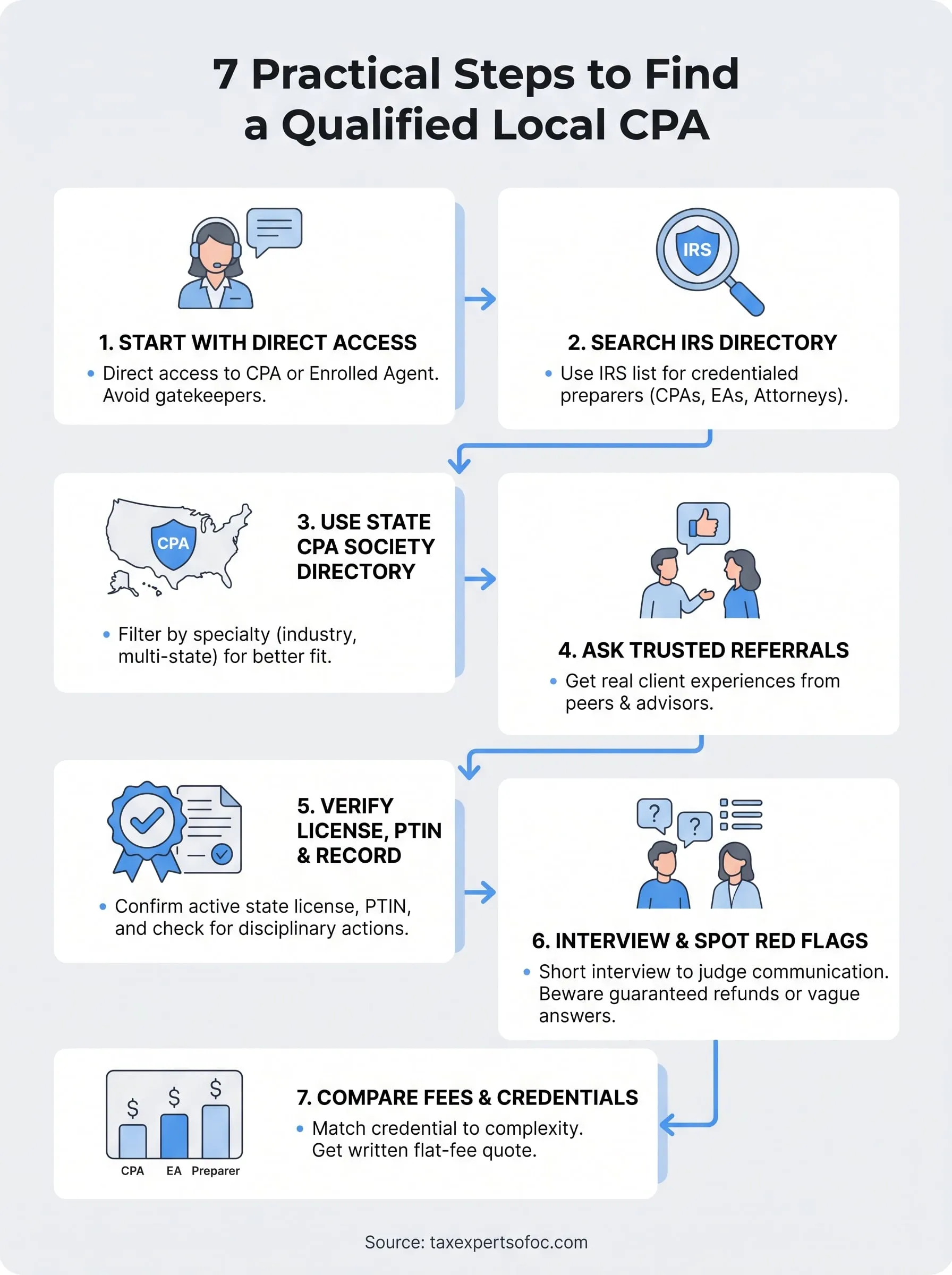
1. Start with a firm that offers direct access to a CPA
How this approach works
Many firms put a receptionist or junior preparer between you and the credentialed professional. The first step in finding a good local CPA is to screen for the opposite: a firm where the CPA or Enrolled Agent answers your questions personally. Ask who will prepare your return and who will sign it. If the answer is "our team," keep looking.
Direct access matters most when something goes wrong. An IRS notice, a payroll error, or an audit letter needs a decision from someone with the authority to act, not a ticket in a queue. At Tax Experts of OC, you speak with our CPA and Enrolled Agent directly, and we serve clients in all 50 states by phone, email, and secure portal.
The person who signs your return should be the person who answers your questions.
Who it suits best
This approach fits anyone whose finances have moving parts that software cannot judge. A basic W-2 return rarely needs a senior professional, but the situations below usually do:
- Business owners with LLCs, S corporations, or partnerships
- Taxpayers dealing with back taxes, unfiled returns, or collection notices
- Filers with income in more than one state
What to check before hiring
Before you sign an engagement letter, confirm who does the work and how reachable they are. A quick call will tell you most of what you need:
- Who will prepare my return, and who will review and sign it?
- Will I talk to the CPA or EA, or to staff?
- How fast do you return calls and emails?
- What happens if I get an IRS notice after filing? Is representation included or billed separately?
A firm that answers these plainly, with names and timeframes, has earned a second conversation.
2. Search the IRS directory of federal tax preparers
How this approach works
The IRS publishes a searchable Directory of Federal Tax Return Preparers that lists preparers with professional credentials or an Annual Filing Season Program record. You can search by location and credential type, so finding a local CPA, Enrolled Agent, or tax attorney takes a couple of minutes.
Treat it as a starting list, not a ranking. Listings carry no reviews and no fee information, and a name in the directory does not mean that person fits your situation.
The IRS directory confirms that a credential exists. It does not tell you whether the preparer is any good.
Who it suits best
This route works for people who want a neutral, government-run source instead of ads or sponsored placements. It also helps if a friend gave you a name and you want a quick independent check before calling.
Skip it as your only method if you want service-level detail. You will still need reviews and a conversation to judge responsiveness and specialty.
What to check before hiring
Once you have two or three names, match each credential to your needs and confirm the details are current. Look at these points:
- The credential type listed: CPA, EA, or attorney
- Whether the location and contact details match the firm's website
- Whether that named person is the one who would actually handle your return
A CPA or EA can represent you before the IRS on any tax matter. Other listed preparers have more limited rights, which matters if you ever receive a notice.
3. Use your state CPA society's Find a CPA directory
How this approach works
Every state has a professional society for CPAs, such as CalCPA in California, and many run a searchable Find a CPA directory. You filter by city, industry, and service, which helps you build a shortlist of a local CPA who already works with clients like you.
Membership is voluntary, so the directory does not list every licensed CPA. Members typically commit to a professional code of conduct and ongoing education, which is a useful signal.
A society listing shows a CPA is active in the profession, not that the license is in good standing.
Who it suits best
Use this route when you need a specialty match, such as nonprofit accounting, real estate, or multi-state business returns. Industry filters do that job better than a general web search.
People who want a credentialed CPA rather than a general preparer also benefit, since every listing is a CPA. Remote-first clients can search other cities too, because many firms serve clients by phone and secure portal.
What to check before hiring
Listings are self-reported, so verify the license with your state board of accountancy before you call. Then compare the profile against these points:
- The listed specialties match your return type
- The firm is accepting new clients
- The contact details match the firm's own website
A profile that is outdated or vague is a small warning sign about how the firm handles details.
4. Ask for referrals from people and institutions you trust
How this approach works
Referrals put a real client's experience behind a name before you pick up the phone. Ask a business owner you respect, your banker, your attorney, or your financial advisor who handles their taxes and why they stay. Professionals who work beside CPAs every day know who returns calls and who misses deadlines.
Try a specific question instead of "Know any good accountants?" Ask, "Who do you use, how fast do they respond, and would you hire them again?" That gets you to a local CPA or tax accountant near you who has already earned someone's trust.
A referral shows how a CPA treats clients, which no directory listing can.
Who it suits best
People who value responsiveness and clear communication get the most from referrals, especially when they know someone in a similar situation. A restaurant owner asking another restaurant owner will hear better advice than any generic review offers.
New business founders benefit too. You may not yet know what to search for, so a trusted peer's recommendation saves weeks of guessing.
What to check before hiring
Treat every referral as a lead, not a verdict. A friend's happy experience with a simple return says little about how a firm handles an audit or a multi-state filing.
- Confirm the referrer's tax situation resembles yours
- Ask which services they actually used
- Ask about fees and surprises on the final bill
- Verify the license yourself, as step 5 explains
A warm recommendation earns the firm a call, not your signature.
5. Verify the license, PTIN, and disciplinary record
How this approach works

Verification takes about ten minutes and screens out more bad hires than any other step. Search the name on your state board of accountancy's website to confirm the license is active and in good standing. The same lookup shows public discipline, such as suspensions, fines, or revocations. Then ask for the preparer's PTIN, since anyone paid to prepare a federal return must have one.
Never hire a local CPA you have not looked up yourself.
Enrolled Agents hold a federal credential, so confirm their status through the IRS rather than a state board. Either way, check the record yourself instead of trusting a website badge.
Who it suits best
Everyone should do this, but it matters most when the stakes are high: IRS debt, an audit, payroll, or a business return. It also suits anyone who found a name through an ad, a social post, or a cold call, where nobody has vouched for the person yet.
What to check before hiring
Before you sign anything, match the name on the license to the person who will handle your file. Run through this list:
- License status is active, not expired, suspended, or revoked
- No disciplinary actions on the state board record
- A valid PTIN, and the preparer signs your return
- EA status confirmed with the IRS, if the person is not a CPA
- The firm name and address match the license record
A refusal to share a license number or PTIN is reason enough to walk away. At Tax Experts of OC, we give clients our credentials on the first call.
6. Interview candidates and spot the red flags
How this approach works
Treat the first call as a short job interview where you are the employer. Book 15 to 30 minutes with two or three finalists and ask each one the same questions, so you can compare answers fairly. Many firms, including ours, offer a free 30-minute consultation for exactly this.
Listen to how they answer, not just what they say. Plain, specific answers suggest a firm that will explain your return later. Vague replies and heavy jargon usually mean the same treatment after you pay.
The first call shows you how a CPA will treat you once you are a client.
Who it suits best
Anyone with a shortlist should do this, but it matters most if you have tax debt, a business, or income in several states. Those situations punish a poor fit.
Remote clients gain the most. When you hire a local CPA who works by phone and secure portal, the interview is your only chance to judge communication before money changes hands.
What to check before hiring
Bring your own questions, and write down the answers so you can compare firms afterward. Ask about experience with your situation, who does the work, and what the total fee covers. Then watch for these red flags:
- Guaranteed refunds, or promises to "erase" your tax debt
- Fees calculated as a percentage of your refund
- Refusal to sign the return or share a PTIN
- Pressure to commit on the spot
- Direct deposit of your refund into the preparer's account
Any one of these is reason to end the call. Honest professionals can promise good work, but they cannot promise an outcome the IRS controls.
7. Compare fees and decide between a CPA, EA, or preparer
How this approach works
Price and credential go together, so weigh them side by side. A CPA is licensed by a state board and covers accounting, audits, and tax. An Enrolled Agent holds a federal license focused only on tax. A PTIN-holding preparer may have limited or no IRS representation rights.
| Type | Licensed by | Represents you before the IRS |
|---|---|---|
| CPA | State board of accountancy | Yes, on any tax matter |
| Enrolled Agent | IRS | Yes, on any tax matter |
| Preparer with PTIN | Registers with IRS | Limited, if at all |
Tax preparation fees depend on complexity more than title. Ask for a written quote that states whether the price is flat or hourly. A flat fee for a defined scope beats an open-ended estimate.
Pay for the credential your situation requires, not the longest title on the business card.
Who it suits best
Match the professional to the problem. A simple W-2 return can go to a preparer or EA, while business returns, multi-state filings, and payroll point to a local CPA.
- IRS debt or audits: a CPA or EA, since both can represent you
- Business owners needing bookkeeping and tax planning: a CPA
- Basic individual returns: any credentialed preparer
What to check before hiring
Get the full scope in writing before you pay. Ask what the fee includes and what triggers extra charges, such as amended returns or notice responses. We quote upfront and offer flexible payment options for clients in financial hardship.
- Flat fee or hourly rate, and the estimated total
- Whether IRS representation is included
- Payment terms and any retainer
- Charges for extensions, amendments, or extra states
Choosing the right CPA for your situation
The best local CPA is the one whose credentials check out and whose experience matches your problem. Use any of the seven routes to build a shortlist, whether that is the IRS directory, your state society, or a trusted referral. Then verify the license, interview two or three finalists, and get the fee in writing.
Your situation sets the bar. A simple return needs a credentialed preparer. Back taxes, payroll, or multi-state income call for direct access to a CPA or Enrolled Agent who can act for you. Distance matters far less than responsiveness, since good work now happens by phone and secure portal.
If you want to see what that looks like, book a free 30-minute consultation with Tax Experts of OC. You will speak with our CPA and Enrolled Agent directly, get upfront pricing, and leave the call knowing your next step.