

If you're dealing with an IRS audit, back taxes, or a collections notice, you probably don't want to face the agency alone. That raises a practical question: can a CPA represent you before the IRS, or do you need to hire a tax attorney? The short answer is yes, CPAs hold what the IRS calls "unlimited representation rights," which means they can speak, negotiate, and advocate on your behalf in nearly every situation.
But not every tax professional carries the same authority. The type of credential behind your representative determines what they're actually allowed to do for you. Understanding the difference matters, especially when money and penalties are on the line. At Tax Experts of OC, our CPA and Enrolled Agent handle IRS representation for clients nationwide, from straightforward audits to complex resolution cases. We deal with these situations daily, so we know exactly where the boundaries are, and how to work within them to protect our clients.
This article breaks down the specific rights a CPA holds before the IRS, how those rights compare to other tax professionals, and what to look for when choosing someone to represent you.
Why CPA representation matters with the IRS
When the IRS contacts you, the clock starts ticking immediately. Response deadlines, penalty calculations, and collection timelines move forward whether you respond or not. Having a qualified CPA step in early puts someone in your corner who knows the rules, speaks the agency's language, and can slow down or stop harmful actions before they escalate. That advantage can be the difference between resolving a tax problem quickly and letting it spiral into something far more serious.
The IRS is not a neutral party
The IRS is a collections agency with broad legal authority to garnish your wages, seize assets, and place liens on your property. Its agents follow internal guidelines designed to collect as much as possible, as fast as possible. When you negotiate on your own, you may unknowingly agree to payment terms that are harder to meet than necessary, or share information that weakens your case.
A CPA who regularly handles IRS cases knows which options to request, what documentation to present, and where there is room to push back.
What's at stake when you go it alone
Deciding whether a CPA can represent you before the IRS is really a question about how much risk you're willing to carry. Taxpayers who handle IRS disputes without professional help frequently miss appeals windows, accept the first offer on the table, or fail to challenge incorrect assessments that a trained professional would catch immediately.
Your financial exposure grows with every month you wait. The IRS charges compounding interest and failure-to-pay penalties, meaning each delay costs you more money. A CPA can review your full tax history, identify errors or credits you may have missed, and build a response strategy based on your actual financial situation rather than the IRS's opening position.
Who can legally represent you before the IRS
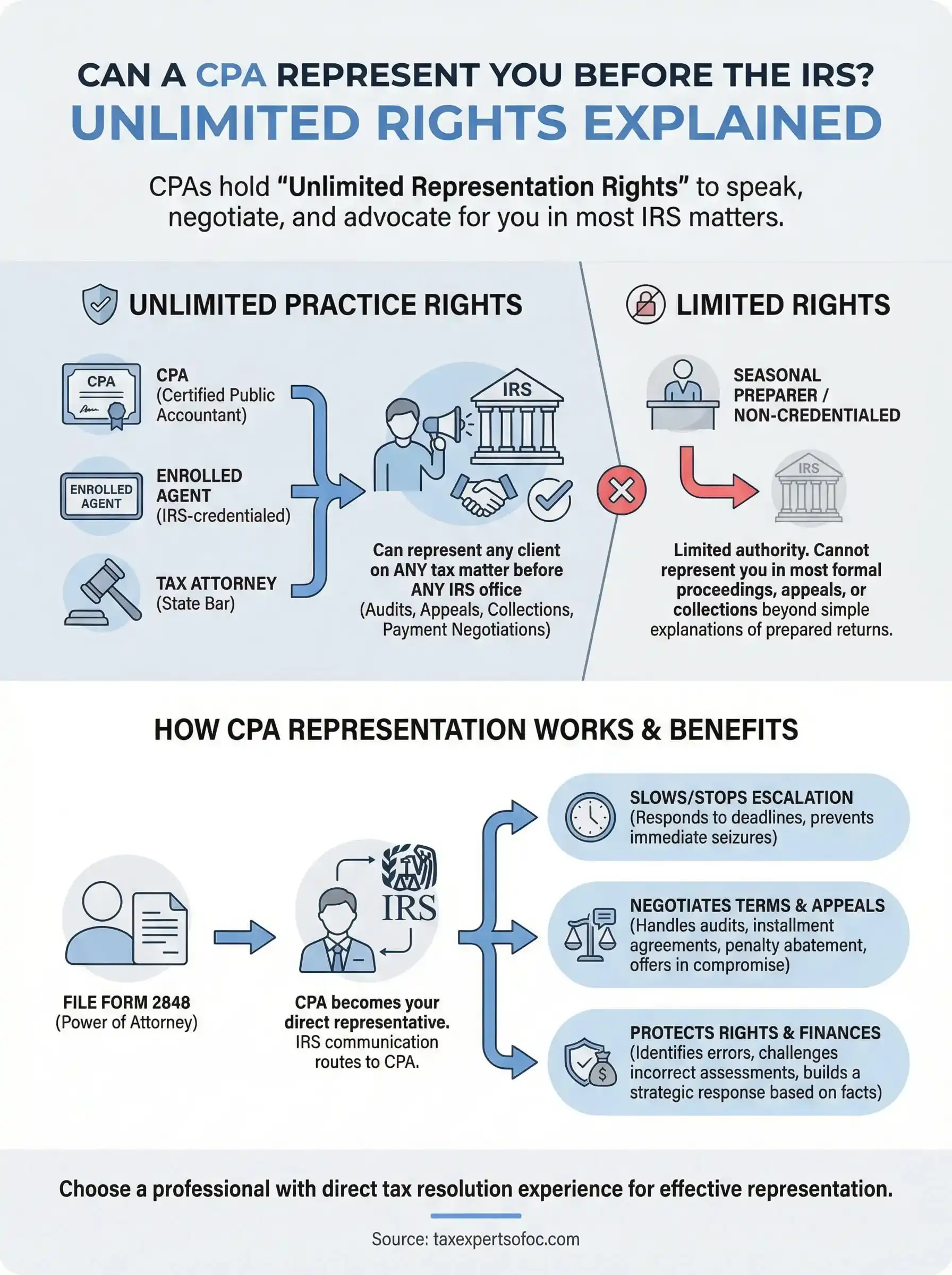
The IRS draws a clear line between tax professionals who hold unlimited practice rights and those who don't. Only three credential types qualify: CPAs, Enrolled Agents, and tax attorneys. Each of these allows the holder to represent any client on any tax matter before any IRS office, regardless of who prepared the original return.
The three credentials that carry full authority
Knowing who can represent you before the IRS determines how protected you are when a dispute gets serious. Unlimited representation rights give your representative access to audits, appeals, collections cases, and payment negotiations on your behalf. Here's how the three credentials compare:

| Credential | Granted By | Representation Rights |
|---|---|---|
| CPA | State Board of Accountancy | Unlimited |
| Enrolled Agent | IRS | Unlimited |
| Tax Attorney | State Bar | Unlimited |
Picking a professional outside this group means accepting a hard cap on what they can do for you mid-dispute.
Seasonal preparers and non-credentialed filers carry only limited rights and cannot represent you in most formal IRS proceedings. Choosing a fully credentialed professional from the start protects you from losing your representative at the moment you need them most.
CPA representation rights explained
When you ask can a CPA represent you before the IRS, the answer hinges on one specific designation: unlimited representation rights. The IRS grants this status to CPAs, Enrolled Agents, and tax attorneys. It means your CPA can appear before any IRS office, handle any tax matter, and act on your behalf without restriction on the type of case or the stage of the process.
What "unlimited representation rights" actually means
Unlimited representation rights give your CPA the legal authority to communicate directly with the IRS on your behalf once you file a Form 2848 Power of Attorney. The IRS then directs all contact to your representative instead of to you.
This authority covers audits, collections, appeals, and penalty abatement requests, giving your CPA room to work across the full scope of your case.
Your CPA can negotiate payment terms, respond to IRS notices, and argue your position at every level of the process without you needing to be present or speak directly with the agency.
The scope of what a CPA can handle
Your CPA can represent you in examination proceedings, which includes audits, as well as collection matters like installment agreements and offers in compromise. They can also file appeals if you disagree with an IRS decision, giving you full coverage from the earliest notice through final resolution.
How to authorize a CPA and what they can do
Authorizing a CPA to represent you before the IRS requires one specific document. Form 2848, Power of Attorney and Declaration of Representative, is the official authorization that grants your CPA the legal right to act on your behalf. Once the IRS processes it, all agency correspondence routes directly to your CPA, and you no longer need to handle calls or letters from the agency on your own.

What Form 2848 allows your CPA to do
Filing Form 2848 officially establishes that a CPA can represent you before the IRS for a defined set of matters. The form specifies the exact tax years and issue types covered, which means you control precisely what authority you're granting. Your CPA can then take the following actions on your behalf:
Once Form 2848 is on file, your CPA becomes your direct representative and handles all IRS contact, removing you from the negotiation entirely.
- Respond to IRS audits and examination notices
- Negotiate installment agreements or offers in compromise
- Request penalty abatement based on reasonable cause
- File appeals against IRS determinations you disagree with
How to choose the right CPA for IRS problems
Not every CPA handles IRS disputes regularly. When you need someone who can represent you before the IRS, look specifically for a CPA with direct experience in tax resolution, not just tax preparation. General accounting work and IRS negotiation require very different skill sets.
Look for IRS-specific experience
A CPA who works primarily on bookkeeping or annual returns may not have the practical knowledge to navigate collections cases or audit appeals. Ask directly how many IRS representation cases they handle each year and what types of cases they typically resolve.
Experience with the specific IRS issue you're facing matters far more than general credentials alone.
Ask the right questions before you commit
Before you sign anything, run through a few direct questions to confirm the CPA is the right fit for your situation:
- Do you hold active CPA licensure in good standing?
- Have you filed Form 2848 on behalf of clients with similar cases?
- What is your fee structure, and do you offer payment plans?
- How do you communicate with clients during an active IRS case?
Getting clear answers upfront protects you from surprises once your case is underway.
Next steps
Now that you understand can a CPA represent you before the IRS, the question becomes whether you have the right professional in your corner. If you're dealing with an audit, a collections notice, back taxes, or unfiled returns, the sooner you bring in qualified representation, the more options you have. Waiting narrows your choices and lets penalties and interest accumulate.
Tax resolution is not a process you want to navigate with someone who handles it occasionally. You need a licensed CPA or Enrolled Agent with direct, hands-on experience negotiating with the IRS across a range of case types. At Tax Experts of OC, our team works IRS cases every day, so we know what works and what doesn't.
Start with a free 30-minute consultation to review your situation and understand your options. Reach out to Tax Experts of OC today and get a clear plan in place before your next IRS deadline.