

Missing the April tax deadline doesn't mean you're out of options. A tax extension gives you an additional six months to file your federal return, but it doesn't give you more time to pay what you owe. That distinction catches a lot of taxpayers off guard and can lead to unnecessary penalties and interest if you're not careful.
Filing for extra time is straightforward when you know the steps, but the rules around Form 4868, state-level extensions, and estimated payments can get confusing fast. Whether you're an individual who needs a few more weeks to gather documents or a business owner juggling multiple entity filings, understanding exactly what an extension does and doesn't cover is critical to staying on the right side of the IRS.
In this guide, we break down how to file Form 4868, the key deadlines you need to track, and what happens if you still owe taxes when you request more time. At Tax Experts of OC, our CPAs and Enrolled Agents help clients across all 50 states navigate extensions, back taxes, and IRS compliance every day, so the advice here comes from real-world experience resolving these exact situations.
What a tax extension covers and what it does not
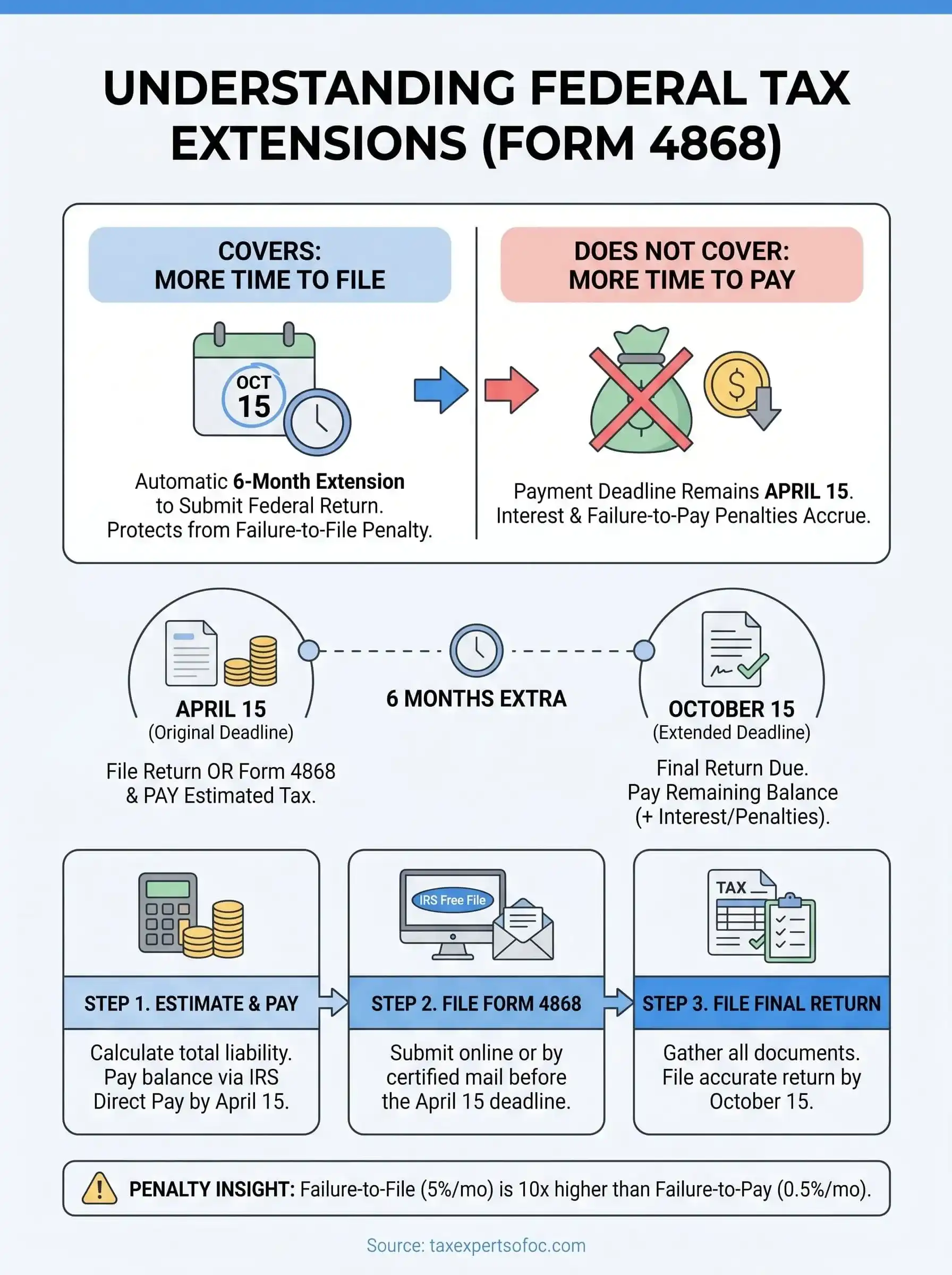
When you file Form 4868, the IRS grants you an automatic six-month extension to submit your federal income tax return. For most individual taxpayers, that shifts the filing deadline from April 15 to October 15. You do not need to explain why you need more time, and the IRS does not review or approve the request individually. Submit the form by the original deadline, and the extension is granted automatically. That simplicity is useful, but it leads many taxpayers to assume the extension covers more than it actually does.
What a tax extension actually covers
A tax extension gives you more time to complete and submit your return, and nothing more. The IRS designed this provision to reduce errors that come from rushing. If you are missing W-2s, still waiting on K-1s from a partnership, dealing with a complex estate, or managing multiple income sources across states, extra filing time lets you gather the right documents and produce an accurate return rather than an amended one later.
Here is a clear breakdown of what a federal filing extension covers:
| What it covers | Details |
|---|---|
| Individual filing deadline | Moves from April 15 to October 15 |
| Federal return types covered | Form 1040, 1040-SR, 1040-NR |
| Approval process | Automatic, no IRS review required |
| Business entities | Separate Form 7004 applies for corporations, partnerships, and S-corps |
| Penalty protection | Protects against the failure-to-file penalty only |
Business owners should note that the 6-month extension for business entities works differently. Corporations and partnerships file Form 7004 instead of Form 4868, and the extended deadlines vary depending on the entity type and fiscal year.
What a tax extension does not cover
This is the part that trips up a significant number of taxpayers. Filing a tax extension does not extend your deadline to pay any taxes you owe. The IRS expects full payment of your estimated liability by the original April 15 deadline, regardless of whether you submitted Form 4868. If you skip that payment, the IRS charges a failure-to-pay penalty of 0.5% of the unpaid balance per month, plus interest that compounds daily.

Filing for an extension without paying what you owe is one of the most avoidable tax mistakes. The extension protects you from the failure-to-file penalty, which is ten times steeper at 5% per month, but it does not stop interest and failure-to-pay penalties from building on any outstanding balance.
Several other things fall outside what a tax extension covers. It does not apply automatically to state income tax returns. Each state sets its own rules, and some require a separate extension request even if you have already filed Form 4868 with the IRS. California, for example, grants an automatic state extension but only under specific conditions. Your extension also does not shield you from IRS collection activity if you already carry an unpaid balance from a prior year. The extension is a filing accommodation only, not a pause on any other compliance obligation you currently have.
Key deadlines and automatic extra time
Knowing exact dates before you request a tax extension saves you from missing the window entirely. The IRS sets firm deadlines for both the extension request and the final return, and state governments layer their own schedules on top of those federal dates. Treating all of these as separate obligations helps you avoid a situation where your federal extension is in place but your state return is still overdue.
Federal deadlines for individuals and businesses
For individual taxpayers, the standard filing deadline is April 15 each year. Filing Form 4868 by that date automatically pushes your return deadline to October 15, giving you six full months to complete your return. If April 15 falls on a weekend or a federal holiday, the deadline moves to the next business day.
Business entities follow a different calendar. Partnerships and S-corporations use Form 7004 and face an original deadline of March 15, with an extended deadline of September 15. C-corporations have an April 15 original deadline that extends to October 15. The table below lays out the key dates at a glance:
| Entity Type | Original Deadline | Extended Deadline |
|---|---|---|
| Individuals (Form 1040) | April 15 | October 15 |
| Partnerships and S-corps | March 15 | September 15 |
| C-corporations | April 15 | October 15 |
Automatic extra time without filing Form 4868
Certain taxpayers receive additional time automatically without needing to submit any extension form. U.S. citizens and resident aliens living abroad on the original due date get an automatic two-month extension to June 15, though interest still accrues on any unpaid balance from April 15 forward. Members of the military serving in combat zones receive extended deadlines that can stretch well beyond the standard six months.
If your area receives a federally declared disaster designation, the IRS typically grants automatic filing and payment relief, which can override the standard extension deadlines entirely.
You can verify whether your area qualifies for disaster relief on the IRS website. Check this before filing a separate extension request, since disaster relief often provides more favorable terms than a standard extension.
Step 1. Estimate your tax and pay what you can
Before you submit Form 4868, you need to estimate what you owe the IRS for the tax year. This step matters because a tax extension only delays your filing deadline, not your payment deadline. If you skip this step and send in the form without paying, the IRS will charge you failure-to-pay penalties starting April 15, regardless of whether your extension request goes through.
How to calculate your estimated tax liability
You do not need a completed return to get a reasonable estimate. Pull together your W-2s, 1099s, and any other income documents you have on hand and use them to approximate your total gross income for the year. Then subtract your standard deduction or any known itemized deductions, apply the tax rate for your bracket, and subtract any withholding or quarterly estimated payments you already submitted during the year.
Here is a straightforward framework to guide your calculation:
- Add up all income sources: wages, freelance income, dividends, and rental income
- Subtract your deductions (standard or itemized, whichever applies)
- Apply the applicable federal tax rate for your income bracket
- Subtract taxes already withheld from paychecks or paid through quarterly estimates
- The remaining balance is your estimated amount due
If your estimate runs slightly short, the IRS will not penalize you heavily, but underpaying by a significant amount while requesting a tax extension will result in daily interest charges on the unpaid balance from April 15 forward.
How to submit your payment to the IRS
Once you have your estimate, pay as much as you can through the IRS Direct Pay tool at IRS.gov. This free service lets you schedule a payment directly from your bank account with no registration required. You can also pay by debit card, credit card, or through the Electronic Federal Tax Payment System. When submitting, select "Extension" as the payment reason and apply it to the correct tax year, then save your confirmation number as proof.
Step 2. File Form 4868 online or by mail
Once you have your estimated payment ready, submitting your tax extension request takes less time than you might expect. The IRS gives you two main options: file electronically or mail a paper form. Electronic filing is faster, gives you immediate confirmation, and eliminates the risk of a lost envelope arriving too late to count.
File online through IRS Free File
The IRS Free File program at IRS.gov lets you submit Form 4868 electronically at no cost, regardless of your income level. Navigate to the Free File section, select the Form 4868 option, and complete the short form with your name, address, Social Security Number, and estimated tax liability. When you submit, you receive an electronic acknowledgment as proof that your request went through before the deadline.

Save that acknowledgment confirmation number in a secure place. It is your proof that you filed on time if the IRS ever questions whether your extension was received.
File by mail with a paper Form 4868
If you prefer to file on paper, download Form 4868 directly from IRS.gov and mail it to the correct IRS address for your state. The form's instruction page lists state-specific mailing addresses, so use those rather than a general IRS address. Send your envelope by certified mail with return receipt so you have documented proof of the postmark date in case any dispute arises.
Complete all required lines accurately before you mail the form. Leaving fields blank or entering incorrect numbers can delay processing. Here is what each key line requires:
| Field | What to enter |
|---|---|
| Line 1 | Your name and current address |
| Line 2 | Your Social Security Number |
| Line 4 | Total estimated tax liability for the year |
| Line 5 | Taxes already paid through withholding or quarterly estimates |
| Line 6 | Balance due (Line 4 minus Line 5) |
| Line 7 | Amount you are paying with this form |
Step 3. File your return after you extend
Once your extension is in place, October 15 becomes your new filing deadline. Your tax extension bought you time, but that date is firm. The IRS does not grant additional extensions for individual returns after October 15, so use the extra months to gather documents, reconcile records, and prepare an accurate return rather than waiting until the final week.
What to have ready before you file
Before you complete your return, confirm you have every document your return requires. Missing items at this stage are what caused you to extend in the first place, so a quick document review prevents the same problem from recurring. Gather the following before you start:
- All W-2s and 1099 forms covering wages, freelance income, interest, and dividends
- K-1 forms from any partnerships, S-corporations, or trusts you are involved in
- Records of quarterly estimated tax payments you made during the year
- Receipts or statements supporting any deductions you plan to claim
- Your prior-year return for reference on carryovers and depreciation schedules
Waiting until October to discover a missing K-1 or brokerage statement leaves you almost no time to request corrections from the issuer, so chase down outstanding documents well before September.
What to do if you still owe when you file
If your final return shows a remaining balance beyond what you paid in April, pay that amount when you submit your return. Interest and failure-to-pay penalties have been building since April 15, so the sooner you file and pay, the smaller that additional cost becomes. You can submit your payment through IRS Direct Pay on the same day you file your return.
If your return shows you overpaid, the IRS will issue a refund or apply the credit toward next year's taxes based on your instruction on the return. Filing a week or two early before October 15 also reduces your exposure to last-minute technical issues with electronic submission systems.
Quick wrap-up
A tax extension gives you six months of additional filing time, but it does not delay your payment deadline by a single day. File Form 4868 by April 15, pay your estimated balance through IRS Direct Pay, and use the extra time to build an accurate return rather than a rushed one. Keep your electronic acknowledgment as proof of submission, track your state's separate extension rules, and file your completed return well before October 15.
Getting these steps right protects you from failure-to-file penalties, which are ten times steeper than failure-to-pay penalties. Most people can handle a straightforward extension on their own, but if you carry unpaid balances from prior years, received an IRS notice, or deal with multiple income sources across states, working with a professional makes a real difference. Talk to a CPA or Enrolled Agent at Tax Experts of OC for a free 30-minute consultation before your deadline arrives.