

Tax season brings one question that almost everyone asks: how long does tax preparation take? The answer depends on several factors, whether you're filing a straightforward W-2 return, managing a small business with multiple income streams, or sorting through years of unfiled paperwork. A simple individual return might take an hour. A complex business filing could stretch across several weeks of back-and-forth between you and your preparer.
Knowing what to expect helps you plan ahead, avoid last-minute stress, and pick the right filing method for your situation. There's a real difference between dragging yourself through tax software at midnight and handing your documents to a CPA or Enrolled Agent who does this work every day. Each approach comes with its own timeline, and understanding those timelines puts you in control of your filing season, not the other way around.
At Tax Experts of OC, we prepare returns for individuals, families, and businesses across all 50 states, and one of the most common things clients ask during their free 30-minute consultation is how long the whole process will take. This article breaks down realistic timelines for DIY filing, in-person appointments, and professional tax preparation services so you can set expectations and move forward with confidence.
Why tax preparation time varies
No two tax returns take the same amount of time, and that's not a vague answer. How long does tax preparation take depends on a combination of factors tied directly to your financial life. Before you can estimate your own timeline, you need to understand what actually drives preparation time up or down.
Your income sources and financial complexity
A single W-2 from one employer is the simplest possible scenario. If that describes your tax year, you can often finish a return in under an hour using software. However, most people's situations are more layered than that, and complexity adds time fast.
When your income comes from multiple sources, such as freelance work, rental properties, stock sales, cryptocurrency transactions, retirement distributions, or business ownership, each one requires separate documentation, specific forms, and additional calculations. A self-employed person filing a Schedule C needs to account for every business expense, calculate self-employment tax, and potentially handle estimated tax payments. A landlord has depreciation schedules to manage. An investor with capital gains needs to separate short-term from long-term positions. Each layer adds real time to the process, whether you're doing it yourself or working with a professional.
The more income streams you have, the more forms, records, and review time your return requires.
Life changes during the year also affect complexity in ways people often overlook. Getting married, having a child, buying or selling a home, starting a business, or receiving an inheritance all introduce new tax rules and new paperwork that weren't part of your return the year before.
Whether you have all your documents ready
Document readiness is often the biggest variable in how quickly any tax return gets finished. A professional can only move as fast as the information you provide, and delays in gathering your records directly delay your filing timeline.
Before preparation begins, you typically need to pull together W-2s and 1099s, investment account statements, receipts for deductible expenses, mortgage interest statements, property tax records, health insurance information, and prior-year tax returns. If you're self-employed or run a business, you also need organized records of income and expenses, payroll summaries, and potentially mileage logs.
Many clients underestimate how long it takes to track down every document, particularly if they've changed employers, opened new accounts, or had a financially active year. The IRS typically requires employers and financial institutions to send tax forms by the end of January, but some forms, like Schedule K-1 from partnerships or S corporations, can arrive much later, sometimes in March or even April. Waiting on a single missing form can hold up an entire return.
The filing method you choose
Your preparation method shapes your timeline in a fundamental way. DIY software puts the pace entirely in your hands. You can start and stop across multiple sessions, but that also means the return might sit unfinished for days or weeks if you run into questions or get busy with other things.
When you hire a professional tax preparer, the timeline shifts. You still control how quickly you deliver your documents, but once your information is in their hands, their workload and scheduling affect how fast your return gets completed. During peak season, which typically runs from late January through mid-April, most firms are handling a high volume of returns at once.
Outsourcing to a CPA or Enrolled Agent generally adds some turnaround time compared to submitting your own return the same evening, but the tradeoff is accuracy, strategy, and professional review. For straightforward returns filed early in the season, turnaround can be just a few business days. For complex returns or those submitted during the busiest weeks in March and April, expect a longer wait unless you've established a clear communication process with your preparer.
Average timelines for DIY tax filing
If you're wondering how long does tax preparation take when you handle it yourself, the honest answer is anywhere from 30 minutes to several hours, and that range is wide for a reason. Your specific financial situation, your familiarity with tax software, and how prepared you are before you sit down all determine where your return lands on that spectrum.
Simple returns with a single W-2
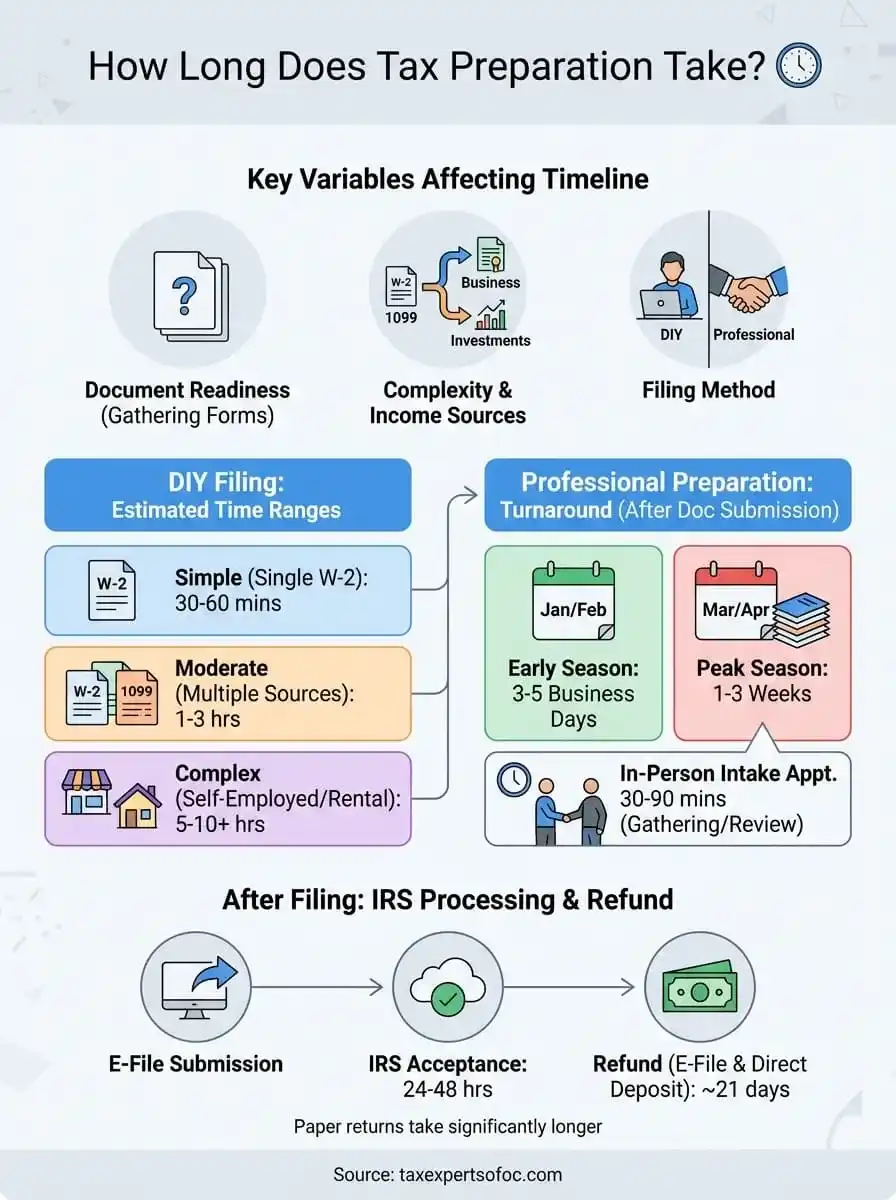
When your income comes from one employer, you claim the standard deduction, and you have no significant life changes to account for, a DIY return can take as little as 30 to 60 minutes from start to finish. Tax software walks you through each field, imports your W-2 directly from many employers, and handles the math automatically. You answer a set of guided questions, review the output, and submit electronically.
If your situation is genuinely this clean, filing digitally yourself on a weeknight is a reasonable choice, and you can often wrap it up in less time than it takes to watch a movie.
Most people who finish that quickly have all their documents ready before they open the software. Sitting down without your W-2, Social Security number, or bank routing information for direct deposit adds time, sometimes more than you'd expect.
Returns with multiple income sources or deductions
Once you introduce freelance income, investment gains, rental income, or itemized deductions, the timeline stretches considerably. The IRS notes that taxpayers with self-employment income spend an average of roughly 24 hours on their federal return when you factor in recordkeeping, form preparation, and submission. That number reflects time spread across multiple sessions, not a single sitting.

Here is a rough breakdown of typical DIY time ranges by return type:
| Return type | Estimated DIY time |
|---|---|
| Single W-2, standard deduction | 30 to 60 minutes |
| Multiple W-2s or 1099s | 1 to 3 hours |
| Self-employed with Schedule C | 5 to 10+ hours |
| Rental property or investment activity | 3 to 8 hours |
| Multi-state or business returns | 10 to 20+ hours |
Unfamiliarity with tax rules also adds time in ways that are hard to predict. You might spend 20 minutes reading IRS instructions for a single line item, only to discover you need a form you haven't started yet. For returns beyond the basic level, many filers find that what looked like a one-evening project stretches into multiple sessions spread across several days.
Typical turnaround when you hire a tax professional
When people ask how long does tax preparation take with a professional, they often expect a single answer. The real answer depends on two main variables: when you submit your documents and how complex your return is. Understanding that range helps you set realistic expectations and avoid frustration if your return isn't back in 24 hours.
Early season vs. peak season filing
If you get your documents to a CPA or Enrolled Agent in late January or early February, you're working ahead of the rush. During that window, most preparers have capacity to turn around a straightforward individual return in three to five business days. A more involved return with business income, investment activity, or multiple states might take seven to ten business days, but the process still moves efficiently because your preparer isn't buried under a pile of other clients' files.

Filing early is one of the simplest moves you can make to get a faster turnaround from any professional preparer.
Once you reach March and the first two weeks of April, the timeline shifts. Most firms are running at full capacity, which means your return joins a queue. A simple return might still come back within a week, but complex returns submitted during peak season can take two to three weeks before your preparer can give them focused attention. This isn't a reflection of the preparer's skill. It's the math of a concentrated filing season with a fixed number of hours in the day.
What affects a professional's turnaround time
Beyond the calendar, a few other factors directly affect how quickly your preparer can finish your return. The most common one is incomplete document delivery. If you send over your W-2s but forget to include your 1099-B for stock sales, your preparer has to pause, reach out to you, and wait. That back-and-forth can add several days or more to the overall timeline, especially if you're slow to respond during a busy week.
The complexity of your financial picture also matters. A single-page W-2 return takes a fraction of the review time that a return with depreciation schedules, multi-state income, and a home office deduction requires. Providing organized, complete records from the start, along with any notes about major life changes during the year, gives your preparer everything they need to move through your return without interruption. Clear communication upfront is the single most reliable way to keep your professional's turnaround time as short as possible.
How long an in-person tax appointment takes
When you sit down with a tax professional in person, the appointment itself is a separate event from the full preparation timeline. The meeting is typically a document intake session, not the moment your return gets finished. Understanding what that appointment covers, and how long it actually runs, helps you block the right amount of time in your schedule and show up prepared.
Most in-person appointments run anywhere from 30 minutes to 90 minutes, depending on how complex your situation is and how organized your records are when you arrive. A straightforward individual return with one employer and no significant life changes can often be handled in half an hour. If you're a business owner, have multiple income sources, or experienced a major financial event during the year, the intake process takes longer because your preparer needs to ask more questions and review more documents before they can begin the actual return.
The appointment is rarely where the return gets finished. It's where your preparer gathers everything they need to finish it accurately.
What happens during the appointment
Your preparer uses the in-person session to collect your documents, confirm your personal information, and identify anything unusual about your tax year that requires extra attention. They'll ask about life changes like marriage, dependents, home purchases, or new business activity because those details shape which forms apply to your return.
This is also the time when your preparer flags missing documents or potential issues before they start working. A quick conversation at intake can prevent the back-and-forth that extends turnaround time later. If you're asking yourself how long does tax preparation take overall, this intake appointment is just one part of the timeline, and it usually does not represent the bulk of the work being done on your behalf.
What to bring to keep the appointment moving
Arriving with complete and organized documents is the single most effective way to shorten your appointment and give your preparer a clean start. A disorganized pile of papers slows the intake process and increases the chance something gets missed.
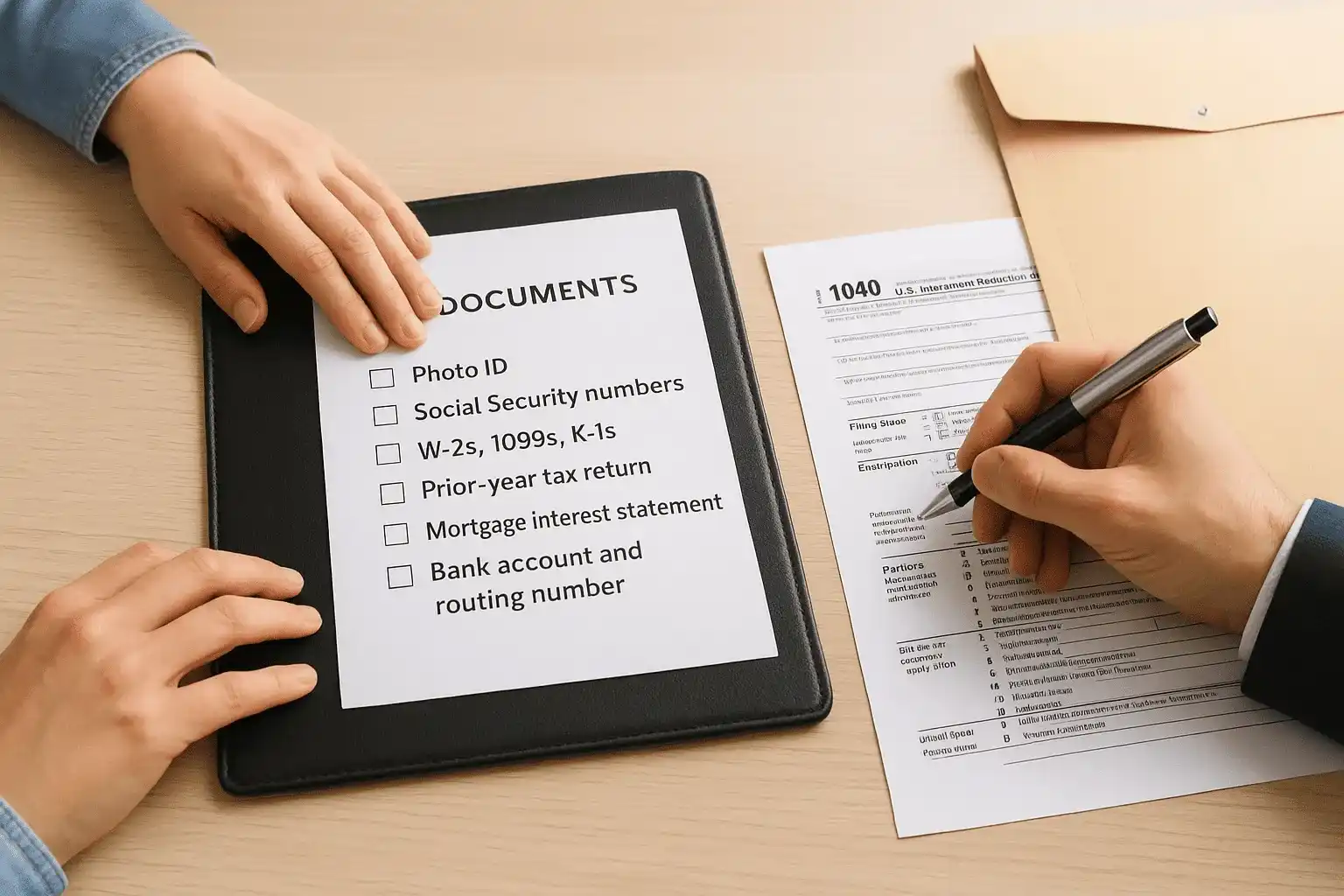
Here is what most preparers expect you to bring to a first appointment:
- Photo ID and Social Security numbers for yourself and any dependents
- All W-2s, 1099s, and K-1s from the tax year
- Prior-year tax return, if available
- Mortgage interest statements, property tax records, and charitable donation receipts
- Any IRS notices you received during the year
- Bank account and routing numbers for direct deposit
Bringing everything in one organized folder keeps your appointment focused, reduces follow-up calls, and gets your return into the preparation queue faster.
Tax prep time vs IRS acceptance and refund timing
Many people conflate how long does tax preparation take with how long it takes to receive a refund. These are two separate phases of the filing process, and mixing them up leads to unrealistic expectations on both ends. Preparation covers gathering your documents, completing your return, and submitting it. Everything after submission, including IRS acceptance and refund processing, runs on an entirely different timeline that you have no control over.
How long the IRS takes to accept your return
Once your return is transmitted electronically, the IRS typically acknowledges receipt within 24 to 48 hours. That acknowledgment confirms your return entered their system, not that it has been reviewed or approved. If the IRS rejects your return due to a mismatched Social Security number or duplicate filing, you'll receive a rejection notice quickly, usually within the same 24-to-48-hour window, and you'll need to correct and resubmit.
Electronic filing is far faster than mailing a paper return, which the IRS can take four to eight weeks just to process into their system.
Paper returns create a dramatically longer wait at every stage. Processing can take six to eight weeks or more, and if there are any errors or missing information, the IRS handles corrections by mail, which adds additional weeks to the process. For most filers, electronic submission is the only rational choice if speed matters.
When to expect your refund after filing
Refund timing depends on how you file and how you choose to receive your money. The IRS issues most electronic refunds within 21 calendar days of accepting your return, provided you requested direct deposit and there are no errors or review flags on the return. Refunds sent by paper check take longer, typically four to six weeks after acceptance.
Certain credits also affect timing. Returns that claim the Earned Income Tax Credit or the Additional Child Tax Credit are subject to a legal hold, and the IRS cannot issue those refunds before mid-February regardless of when you filed. You can track your refund status using the IRS "Where's My Refund" tool, which updates once per day and reflects the most current status of your payment.
Filing early, choosing direct deposit, and submitting an accurate and complete return are the three factors within your control that produce the fastest possible refund timeline. Everything else is determined by IRS processing capacity, which varies throughout the season.
How to speed things up and avoid last-minute problems
The single most effective thing you can do to control how long does tax preparation take for your own return is to act before the rush starts. Most delays in the filing process are not caused by the IRS or your preparer. They come from disorganized records, missing documents, and decisions made too late in the season to leave any margin for error.
Start gathering documents before January ends
Tax forms arrive on different schedules, and waiting until you have every last one before you do anything else costs you time. Instead, create a checklist in early January and start collecting documents as they arrive. W-2s and most 1099s must be sent to you by January 31. Bank and brokerage statements typically follow within the first two weeks of February. K-1s from partnerships or S corporations may not arrive until March, but knowing that ahead of time lets you plan around the gap rather than being caught off guard.
Building a dedicated folder, physical or digital, where you drop every document as it arrives prevents the frantic last-minute search that pushes so many returns into extension territory.
Here is a simple checklist to start with:
- W-2s from every employer during the tax year
- 1099s for freelance income, dividends, interest, and retirement distributions
- Investment account statements showing any sales or transactions
- Mortgage interest and property tax statements
- Records of charitable donations and major deductible expenses
- Prior-year tax return and any IRS correspondence received during the year
Set a hard deadline for yourself
Waiting until April to start creates a compounding problem. Your preparer's schedule fills up, your own schedule gets busier, and there is no buffer if something unexpected surfaces in your records. Setting a personal deadline to have all your documents ready by early to mid-February keeps your return on a timeline that allows for back-and-forth without panic.
Treat that deadline the same way you would treat a work deadline with external consequences. Put it on your calendar, block time to gather what you need, and commit to it.
Communicate clearly with your preparer
If you are working with a CPA or Enrolled Agent, clear and complete communication from the start eliminates most of the delays that slow professional turnarounds. When you deliver your documents, include a brief note about any significant financial changes from the prior year, such as a new business, a home sale, or a large retirement withdrawal. Your preparer can address those items proactively rather than discovering them mid-review and circling back to you with questions.
Next steps for a smoother tax season
Now that you understand how long does tax preparation take at every stage, the next move is simple: start earlier than you think you need to. Gather your documents in January, set a personal deadline before the April rush, and decide whether you're handling this yourself or handing it to a professional. Most filing problems come down to waiting too long and then scrambling to catch up.
If your return involves business income, multiple states, IRS notices, or years of unfiled returns, working with a qualified CPA or Enrolled Agent is the most reliable way to get it done accurately and on time. Tax Experts of OC serves clients across all 50 states with transparent pricing and no pressure. You can start with a free 30-minute tax consultation to walk through your situation and get a clear sense of what your return actually requires.