

An IRS notice hits your mailbox, and suddenly you're dealing with back taxes, penalties, or a full-blown audit. You know you need help, but a regular accountant isn't built for this kind of fight. That's where tax resolution professionals come in, licensed specialists who step between you and the IRS to negotiate settlements, stop collections, and get your tax situation under control. If you've been searching for someone who actually knows how to handle IRS disputes, you're in the right place.
At Tax Experts of OC, our CPAs and Enrolled Agents work directly with clients across all 50 states to resolve exactly these kinds of problems, from wage garnishments and liens to years of unfiled returns. We built this firm around tax resolution and representation, not generic tax prep. That hands-on experience shapes everything in this guide, and it's why we can speak to what actually matters when choosing the right professional for your situation.
This article breaks down what tax resolution professionals do, the credentials that separate qualified experts from pretenders, and the specific situations where hiring one can save you real money and stress. Whether you're facing an IRS notice for the first time or you've been putting off a growing tax debt, you'll walk away knowing exactly what to look for and when it's time to pick up the phone and get professional help.
What tax resolution professionals are
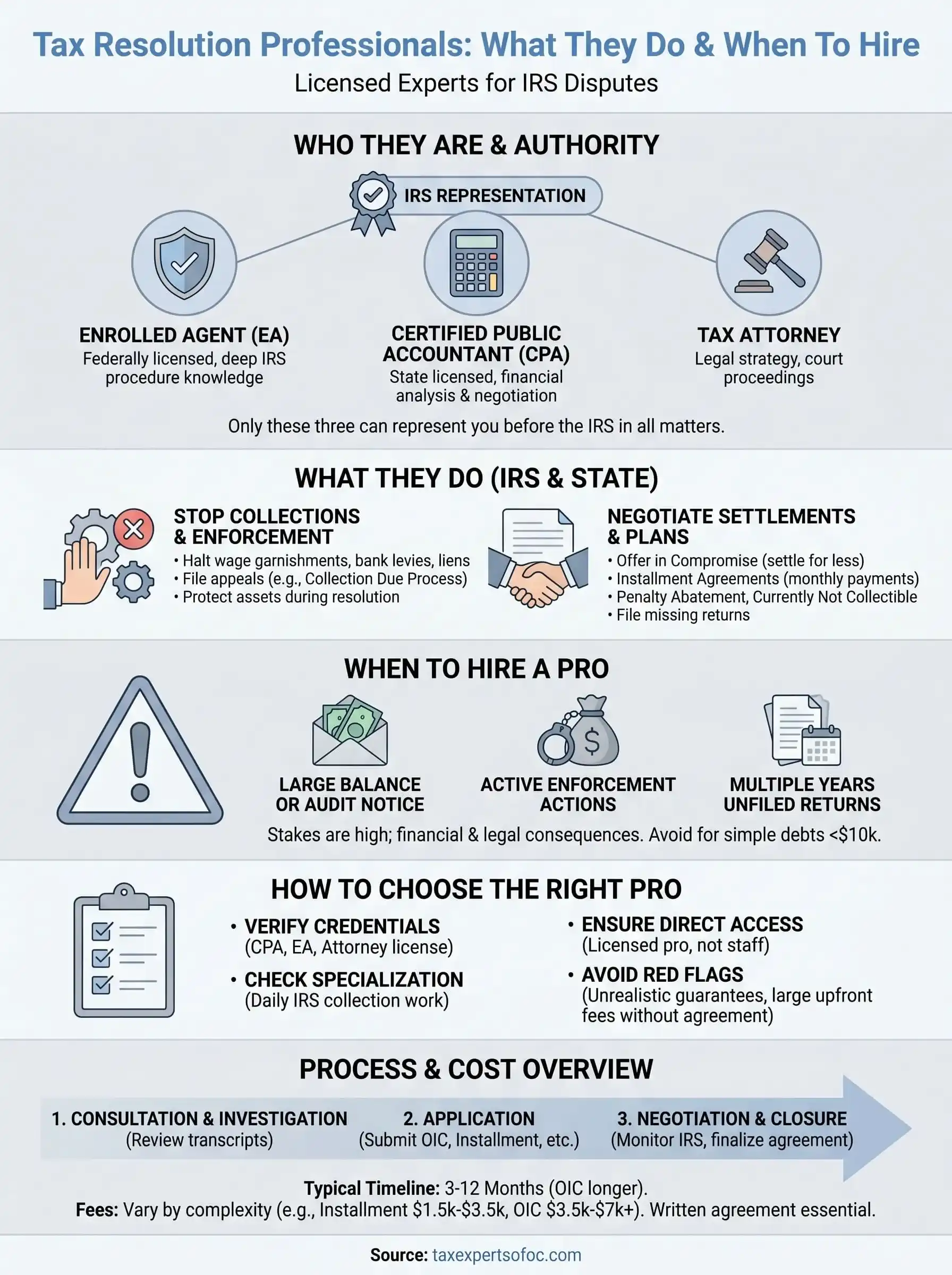
Tax resolution professionals are licensed specialists who help taxpayers negotiate with the IRS or state tax agencies to settle debt, stop enforcement actions, and correct compliance problems. Not every tax pro qualifies for this role. Only three types of professionals hold the legal authority to represent you before the IRS in all matters: Certified Public Accountants (CPAs), Enrolled Agents (EAs), and tax attorneys. These credentials, granted by the IRS or state licensing boards, are what separate a true resolution specialist from a general preparer who files returns but cannot stand in your corner during a dispute.
Your representative's credentials directly determine what they can do on your behalf with the IRS, so verifying them before signing anything is essential.
The three licensed designations
Enrolled Agents are federally licensed by the IRS specifically for tax representation, and they typically carry the deepest technical knowledge of IRS procedures, collection policies, and resolution programs. CPAs are state-licensed accounting professionals who, when they specialize in tax resolution, combine financial analysis skills with IRS negotiation experience. Tax attorneys step in when your case involves legal strategy, formal court proceedings, or potential criminal tax exposure. Each designation has its strengths, and the right fit depends on the nature and severity of your specific situation.

How they differ from regular tax preparers
A standard tax preparer files your returns and may catch deductions you missed, which is a useful service. That service stops well short of what an active IRS dispute demands. When you're facing a bank levy, a wage garnishment, or a growing tax debt, you need someone who can contact IRS collection officers directly, file formal appeals, and negotiate binding agreements such as an Offer in Compromise or an Installment Agreement. Tax resolution professionals build their entire practice around these IRS programs, making their skill set fundamentally different from what a general preparer offers during filing season.
What they do for IRS and state tax problems
Tax resolution professionals handle the full range of IRS enforcement actions and unresolved tax debt, from the moment a collection officer gets involved to the final agreement that closes your case. Their work spans both stopping active collections and negotiating the terms that settle what you actually owe.
Stopping collections and enforcement
When the IRS issues a levy, lien, or wage garnishment, your specialist acts immediately. They contact the assigned collection officer directly, file for a Collection Due Process hearing if warranted, and move your account into a protected status while they build your resolution strategy. This shields your income and assets from further IRS action during the process.
State tax agencies run similar enforcement programs, and your representative handles both simultaneously. They know the correct deadlines, forms, and contacts at each agency, which prevents procedural mistakes from making your situation harder to resolve.
Negotiating settlements and payment plans
Once enforcement is paused, your professional works through the IRS's formal programs to address the underlying debt. The two most common tools are Installment Agreements, which spread your payments over time, and an Offer in Compromise, which can reduce your total balance to an amount the IRS agrees you can reasonably pay.
The IRS has more resolution options than most people realize, but reaching the right one requires precise documentation and correct filing procedures, which is exactly where a licensed professional earns their fee.
Beyond those programs, your representative also files missing returns, requests penalty abatements, and negotiates currently-not-collectible status when you face genuine financial hardship.
When to hire one and when you may not need one
The size and complexity of your tax problem determines whether you need a specialist. Small, routine issues can often resolve without professional help, but the moment the IRS begins enforcing collections or proposing a significant balance, the stakes shift quickly. Knowing where that line sits saves you both money and unnecessary stress.
Signs you need professional help
Hire tax resolution professionals when your situation includes any of the following:

- An IRS notice proposing a large balance due or an audit requiring document production
- Active enforcement actions, including liens, levies, or wage garnishments
- Multiple years of unfiled returns that need to be reconstructed and filed
These situations carry real financial and legal consequences that demand someone who negotiates with the IRS daily, not someone who only files returns during tax season.
If the IRS has assigned a revenue officer to your case, that is a clear signal you need licensed representation immediately.
When you may not need one
Simple tax debts below $10,000 that you can pay in full within 120 days typically do not require a specialist. The IRS offers a short-term payment plan you can set up directly through their online portal without any representation. A single amended return with a small balance due falls into this same low-risk category and usually needs nothing more than careful attention to the correction itself.
How to choose a reputable tax resolution pro
Choosing the right professional starts with verifiable credentials. Confirm that your candidate holds a current CPA license, EA designation, or law license, and check their standing with the IRS Directory of Federal Tax Return Preparers before sharing any financial documents. Anyone who cannot point you to a verifiable license has no business representing you before the IRS.
Check for specialization and direct access
Not every licensed CPA or EA focuses on tax resolution work daily. Ask whether the firm handles IRS collection cases regularly, and confirm that a licensed professional, not a general staff member, will contact the IRS on your behalf. Tax resolution professionals who specialize in this area answer these questions directly and without hesitation.
A firm that cannot clearly explain which licensed professional will handle your case is one worth walking away from.
Watch for red flags
Unrealistic guarantees are the most common warning sign in this field. No legitimate professional promises a specific settlement amount before reviewing your full financial picture. Watch for these additional concerns:
- Large upfront fees without a written engagement agreement
- No named professional assigned to your case
- Vague contracts that list fees without specifying services
What the process and costs usually look like
Working with tax resolution professionals follows a predictable sequence, even if your specific case has unique complications. Most firms begin with a free or low-cost consultation where they review your IRS transcripts, outstanding balances, and filing history to assess which resolution programs apply to you.
The typical case timeline
Your case moves through three distinct phases after you sign an engagement agreement:
- Investigation: Your representative requests IRS transcripts and account records to build a complete picture of what you owe and why.
- Application: They prepare and submit the appropriate program, whether an Installment Agreement, Offer in Compromise, or another qualifying option.
- Negotiation and closure: They monitor the IRS response and push back until your case reaches a formal, binding resolution.
This process typically takes three to twelve months depending on which program applies and how quickly the IRS processes your submission.
Offer in Compromise cases average six to twelve months because the IRS conducts a thorough financial review before accepting any settlement.
What fees look like
Resolution fees vary based on case complexity. Simple installment agreements typically run between $1,500 and $3,500. Offer in Compromise cases often range from $3,500 to $7,000 or higher because they require detailed financial documentation and extended negotiation.
Reputable firms provide written fee agreements before any work begins. This protects you from hidden charges and ensures you know exactly what services your payment covers.
Next steps if you have an IRS problem
If you're sitting on an unresolved IRS notice or a growing tax debt, the worst move is waiting. The IRS charges compounding penalties and interest every month your balance stays open, and enforcement actions like levies and garnishments escalate without warning. Acting now keeps your options wider and your costs lower.
Start by pulling your IRS transcripts, which you can access through the IRS online account portal. Knowing exactly what the IRS shows on your account gives any professional a clear starting point. Then schedule a consultation with qualified tax resolution professionals who hold verifiable credentials and handle these cases daily.
Tax Experts of OC offers a free 30-minute consultation with a licensed CPA or Enrolled Agent, not general staff. If you're ready to stop the clock on IRS collections and work toward a binding resolution, contact Tax Experts of OC today to get started.