

When the IRS isn't resolving your case, or worse, isn't responding at all, you have the right to escalate. The Taxpayer Advocate Service (TAS) is an independent organization within the IRS that exists specifically to help people stuck in bureaucratic limbo. But finding the right taxpayer advocate service contact information shouldn't feel like another runaround. You need a direct path to a real person who can intervene on your behalf.
At Tax Experts of OC, we regularly help clients across all 50 states navigate IRS disputes, and we know firsthand when bringing TAS into the picture makes sense. Our CPAs and Enrolled Agents work alongside clients to determine whether a TAS case is the right move, and if it is, how to present it effectively. Sometimes, though, you just need the phone number, the fax, or the right form. That's exactly what this guide covers.
Below, you'll find every contact method available to reach TAS, from the national toll-free hotline to local office directories, online intake options, and the specific forms you'll need to formally request assistance. We've organized it so you can find what you need quickly and take action without wasting another day waiting on hold with the IRS.
When TAS is the right next step
TAS is not a general complaint line or a substitute for calling the IRS directly. It exists for taxpayers who are stuck in a real hardship or whose cases have fallen through the cracks. Before you use any taxpayer advocate service contact method, confirm that your situation actually qualifies, because TAS will close cases that don't meet their intake criteria. Acting without that understanding wastes time you likely don't have.
Situations TAS is designed to handle
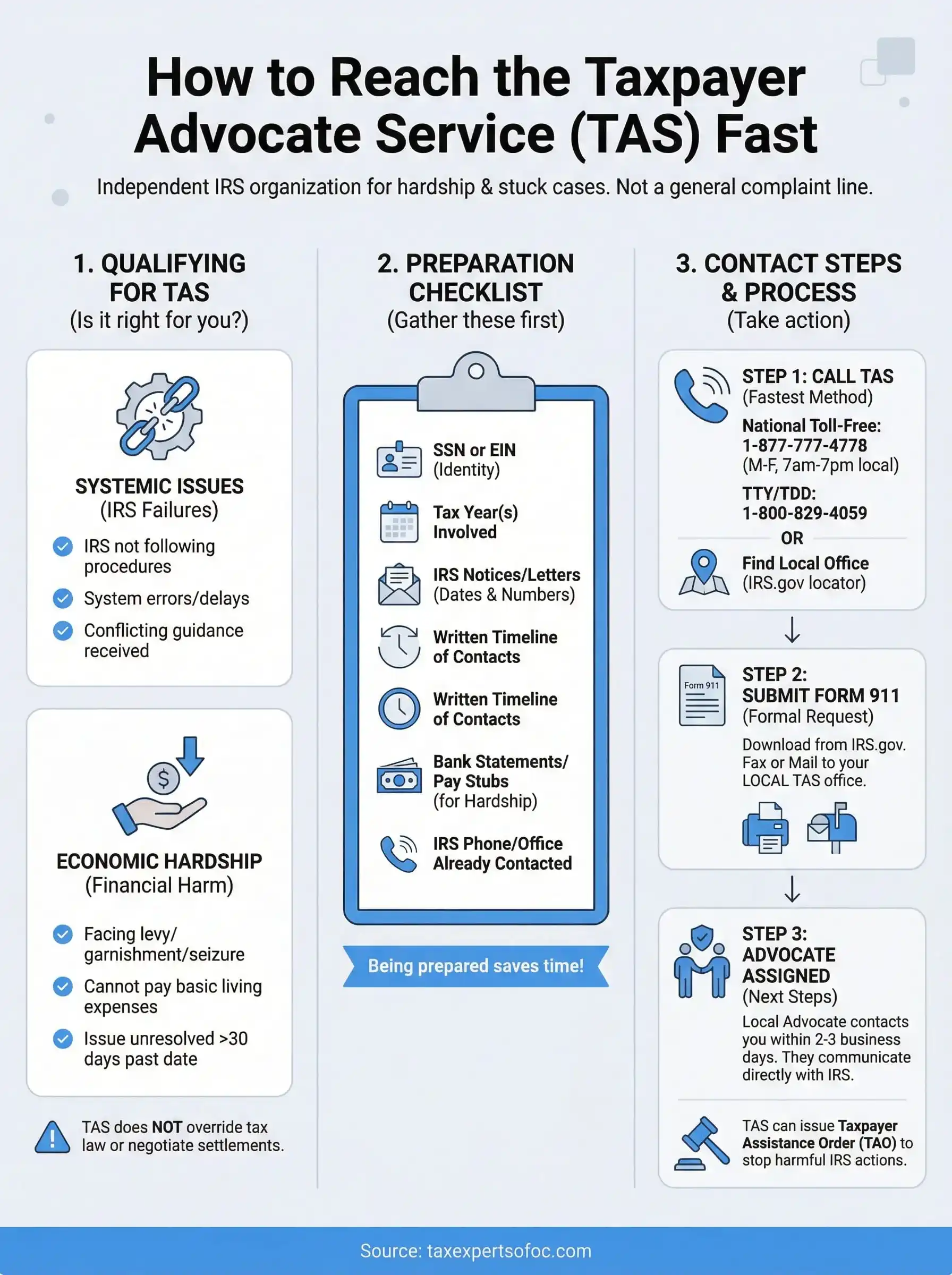
TAS accepts cases that meet at least one of two types of criteria: systemic issues where the IRS isn't following its own procedures, or economic hardship cases where IRS inaction is causing you immediate financial harm. If neither applies, TAS will likely redirect you back to standard IRS channels.
Your situation qualifies for TAS assistance if it fits one of these categories:
- You're facing a levy, wage garnishment, or bank account seizure that requires immediate intervention
- The IRS has not resolved your issue within the normal timeframe, typically 30 days past the promised resolution date
- You're experiencing economic hardship, meaning you cannot pay for basic living expenses because of IRS action or inaction
- An IRS system is not processing your account correctly, causing errors or unexplained delays
- You've received conflicting guidance from multiple IRS representatives and cannot get a consistent resolution
TAS is most effective when you have a clear, documented problem that hasn't moved forward despite your direct efforts with the IRS.
What TAS cannot do for you
TAS does not override tax law or negotiate settlements independently. They also won't get involved if you simply disagree with a properly issued IRS decision. Their role is specifically to remove procedural barriers and hold the IRS accountable to its own timelines and rules. If your goal is to settle a tax debt or challenge a legal determination, that requires a different approach, such as working with a CPA or Enrolled Agent on formal resolution options.
Step 1. Get your details and documents ready
Before you use any taxpayer advocate service contact method, gather everything TAS will ask for upfront. Walking in prepared saves time and prevents your case from stalling on the first call.
What to collect before you reach out
TAS will need to verify your identity and understand your situation quickly. Have these items ready before you make contact:

- Your Social Security Number (SSN) or Employer Identification Number (EIN)
- The tax year(s) involved in your issue
- Any IRS notices or letters you've received, including notice numbers and dates
- A written timeline of your contacts with the IRS, including dates and representative names
- Bank statements or pay stubs if you're claiming economic hardship
- The IRS phone number or office you already contacted
The more specific your documentation, the faster TAS can assess your case and act on it.
Why this preparation matters
Showing up with complete records tells TAS you have a legitimate, documented problem, not just a vague complaint. It also gives your assigned Local Taxpayer Advocate the evidence they need to intervene with the IRS on your behalf without delay.
Step 2. Contact TAS by phone or local office
Once you have your documents ready, your fastest taxpayer advocate service contact option is the phone. TAS maintains two main contact points: a national toll-free number and a network of local offices in every state. Knowing which one to use first can save you significant time.
National toll-free number
Call 1-877-777-4778 to reach TAS directly. Lines are open Monday through Friday, 7 a.m. to 7 p.m. local time. When you call, state your issue clearly and have your SSN or EIN, the relevant tax years, and any IRS notice numbers ready from Step 1.
If you are deaf or hard of hearing, use the TTY/TDD line at 1-800-829-4059 to reach TAS.
Find your local TAS office
Your local Taxpayer Advocate office handles cases within your state and often resolves issues faster than the national line. You can locate your nearest office by visiting the IRS TAS office locator on IRS.gov.
Each local office accepts walk-in visits and fax submissions in addition to phone calls. Contact details vary by location, but the IRS.gov locator provides the direct phone number, fax number, and mailing address for every office nationwide.
Step 3. Submit Form 911 when you need a case
If you want TAS to formally open a case on your behalf, you need to submit Form 911, Request for Taxpayer Advocate Service Assistance. You can use this form as a standalone submission or as a follow-up after your initial taxpayer advocate service contact by phone.
Download Form 911 directly from IRS.gov before you start, since you'll need to fill it out with specific IRS and case details.
How to complete Form 911
Form 911 is two pages and asks for straightforward information. Fill in every field accurately to avoid delays in intake.

| Section | What to include |
|---|---|
| Part I | Your name, SSN or EIN, address, and phone number |
| Part II | Description of your tax issue and the IRS actions taken so far |
| Part III | The relief you are requesting from TAS |
| Signature | Your signature and date, or your authorized representative's |
Where to send the form
Fax or mail your completed Form 911 directly to your local TAS office using the contact details from the IRS.gov office locator. Faxing gets your form in front of a Taxpayer Advocate faster than mailing it. Keep a copy of everything you submit for your own records.
What happens after you contact TAS
After your taxpayer advocate service contact is complete and TAS accepts your case, the process moves into a structured intake phase. TAS will assign your case to a Local Taxpayer Advocate in your state, who becomes your main point of contact going forward.
Your assigned advocate takes over
Your Local Taxpayer Advocate will review everything you submitted and contact you within two to three business days to confirm your case is open. From that point, they communicate directly with the IRS on your behalf. You do not need to keep calling the IRS separately once TAS is involved.
Once TAS opens your case, direct all follow-up questions to your assigned advocate, not to general IRS lines.
What TAS can require from the IRS
Your advocate has real authority. TAS can issue a Taxpayer Assistance Order (TAO), which legally requires the IRS to take or stop a specific action. This tool is not used in every case, but it exists specifically for situations where the IRS is causing irreversible harm or ignoring established procedures. Knowing this option exists gives you leverage throughout the resolution process.
Keep your case moving
Once TAS accepts your case, your job is not finished. Check in with your assigned advocate every five to seven business days if you have not heard back, and keep a dated log of every conversation. Document the name of the person you spoke with, what they told you, and any promised next steps. If the issue involves an upcoming levy or wage garnishment deadline, make sure your advocate knows the exact date so they can prioritize accordingly.
Even with TAS involved, some situations require professional tax representation to fully resolve, especially when the underlying debt or dispute is complex. Your taxpayer advocate service contact gets you past the procedural blockage, but settling the actual tax liability often takes more. If you are dealing with back taxes, IRS collections, or unresolved audits, the tax resolution specialists at Tax Experts of OC can work alongside TAS or handle the full resolution for you.