You elected S corporation status to avoid double taxation, then found out California does not fully go along with it. That surprise is common. California S corp taxes work differently from federal rules, and many owners learn this only when the $800 bill or a Form 100S notice arrives.
Here is the short answer. California charges an S corporation a 1.5% franchise tax on net income, with a minimum of $800 per year, whichever is higher. Newly incorporated S corps are generally exempt from the $800 minimum for their first year, but only if they meet specific conditions. Profits still pass through to shareholders, who pay personal income tax on their share at California's regular individual rates.
Below, we break down how the 1.5% tax is calculated, when the $800 minimum applies, how the first-year exemption works, and what you owe at the shareholder level. Our CPA and Enrolled Agent handle these filings for S corps every year, so the examples reflect what we see in real returns. Know the rules before your next filing deadline.
Why California taxes S corps differently
A federal pass-through with a state-level tax
At the federal level, an S corporation is a pass-through entity. The corporation generally pays no income tax, and profits flow to shareholders on Schedule K-1. California honors your federal S election, so you do not file a separate state election. The state still does not treat you as a pure pass-through.
California views your S corp as a corporation and charges it a franchise tax, which is a levy on the privilege of doing business in the state. A C corporation pays 8.84% of net income. An S corporation pays a reduced 1.5% of net income, or 3.5% for financial institutions. That is the core of California S corp taxes: one layer at the entity and another at the shareholder.
California accepts your S election for pass-through treatment, but it still taxes the corporation itself.
Who has to pay it
The tax applies if your S corp is incorporated in California, registered to do business here, or actually doing business here. Being headquartered elsewhere does not automatically protect you. An S corp based in Nevada with California employees, offices, or substantial sales can owe S corp taxes in California just like a local company.
Owners often miss this when they move out of state or run the business remotely. If you still have customers, property, or payroll in California, expect the FTB to ask for Form 100S and the minimum tax.
How the layers fit together
Three separate taxes can touch the same dollar of profit. This table shows who pays what.

| Level | Who pays | Rate | Form |
|---|---|---|---|
| Federal | Shareholders | Individual income tax rates | 1120-S and K-1 |
| California entity | The S corp | 1.5% of net income, $800 minimum | 100S |
| California shareholder | Each shareholder | 1% to 12.3%, plus 1% over $1 million | 540 |
In practice, the entity-level tax is far smaller than what a C corp pays, but it is never zero. Even in a loss year, you still owe the $800 minimum unless an exemption applies.
How to calculate the 1.5% tax and $800 minimum
The formula in three steps
Your tax is the greater of 1.5% of net income or $800. Net income comes from Form 100S. It starts with your federal ordinary income, then adjusts for California differences and apportions to California if you operate in several states.
- Take your California net income from Form 100S.
- Multiply it by 0.015.
- Compare the result to $800 and pay the higher number.
You never pay less than $800, and you pay 1.5% only once net income passes about $53,333.
Worked examples
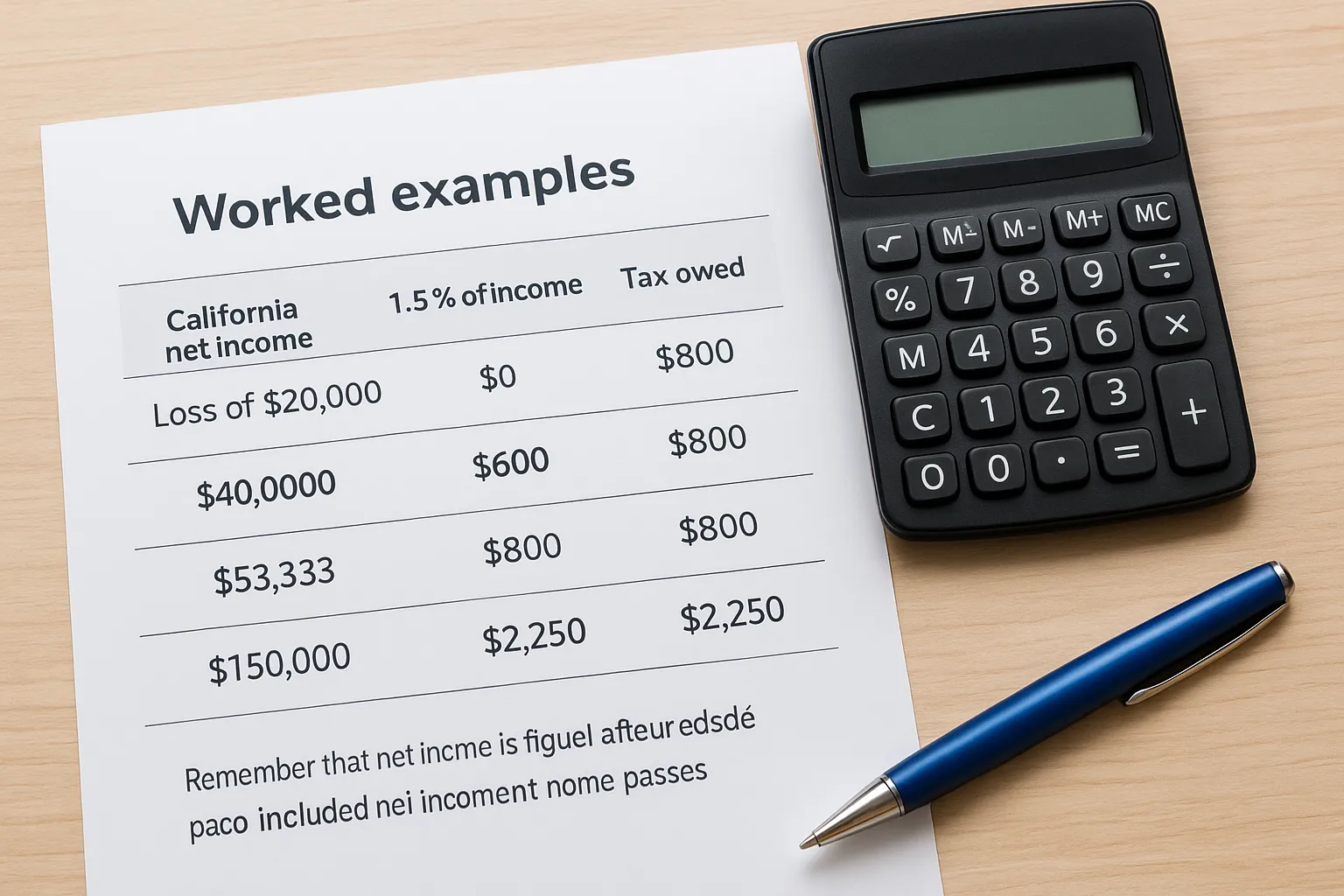
Three situations show how S corp taxes California owners face play out. The break-even point is $53,333 of net income, because $800 divided by 0.015 equals that figure. Below it, the minimum controls. Above it, the percentage does.
| California net income | 1.5% of income | Tax owed |
|---|---|---|
| Loss of $20,000 | $0 | $800 |
| $40,000 | $600 | $800 |
| $53,333 | $800 | $800 |
| $150,000 | $2,250 | $2,250 |
Remember that net income is figured after deductions. That includes reasonable shareholder wages, rent, and payroll taxes, so a higher owner salary lowers the entity tax base. The IRS expects that salary to match what you would pay someone to do your job, so do not shrink your reasonable S corp salary just to cut the 1.5%. Also note that the entity tax is itself deductible on the federal return, which softens the real cost.
How to handle the first-year $800 exemption
Who qualifies
California can waive the $800 minimum for a corporation's first taxable year. The company must be newly incorporated or qualified in California, not an existing business moved into a new shell. The exemption has been enacted for limited periods, so check the current Form 100S instructions for your formation date before you count on it. Run through this list:
- You incorporated or registered with the California Secretary of State this year.
- The entity is genuinely new, not a successor to a prior business.
- Your formation date falls in a period the exemption covers.
What the exemption does not cover
Many owners assume "exempt" means "no tax." It does not. The exemption removes only the $800 minimum. If your first-year net income produces a 1.5% charge above $800, you owe the percentage. A new S corp that earns $100,000 in its first year still owes $1,500, while one that loses money may owe nothing. You also still have to file Form 100S for that first year.
The first-year exemption waives the $800 minimum, not the 1.5% tax on net income or your filing duty.
Plan for year two
Year two is where owners get caught. The next minimum is due by the 15th day of the fourth month of the second tax year. Say you incorporate in March 2026 and use a calendar year. Your first year is exempt, but $800 is due by April 15, 2027, before you have even closed that year's books. Put that date on your calendar now, and set aside about $67 a month so the payment never surprises you. Planning for S corp taxes California requires from year two onward is much easier when the cash is already in a separate account.
How to report and pay your California S corp taxes
File Form 100S on time
Every California S corp files Form 100S, due by the 15th day of the third month after year end. That is March 15 for calendar-year companies. File even in a loss year, because the minimum still applies. Late returns cost $18 per shareholder per month, up to 12 months, so a three-owner company can rack up $648 in penalties before the tax itself is counted.
Pay through estimates, not just at filing
Paying runs on a separate track from filing. You make estimated payments with Form 100-ES, and the easiest route is FTB Web Pay for Businesses. Handling your s corp taxes California bills this way keeps cash flow predictable. Here is the usual rhythm for a calendar-year company:
- April 15: first installment, which must cover at least the $800 minimum.
- June 15 and December 15: further installments. The split is 30%, 40%, 0%, and 30% across the four dates.
- With the return: any remaining balance after your estimates.
An extension fixes the filing date only. Extensions do not extend payment, so interest and late-payment penalties start running on any unpaid tax from the original due date.
An extension gives you more time to file, never more time to pay.
If you cannot estimate the year yet, pay the $800 on time and true up the balance when the return is done. That small habit keeps your account clean and avoids the FTB notices we see most often.
How shareholder-level tax works on K-1 income
You pay on profit, not on cash taken out
Each shareholder receives a Schedule K-1 (100S) showing their share of the corporation's income. You owe California income tax on that share even if the corporation keeps the cash. You report it on Form 540, using Schedule CA (540) to adjust for differences from federal rules.
Rates run from 1% to 12.3%, plus a 1% mental health services tax on taxable income above $1 million. The entity's 1.5% does not replace this layer. Understanding s-corp taxes California charges means seeing both layers at once.
Shareholders pay California tax on their share of profit, not on the cash they take out.
Distributions, basis, and nonresident owners
Distributions are generally not taxed a second time, as long as they stay within your stock basis. Income increases your basis and distributions reduce it. Track it every year, because taking out more than your basis can create a taxable gain.
Nonresident shareholders are not off the hook. You owe tax on California-source income through Form 540NR, and the S corp generally must withhold 7% on distributions of that income. Here is how the main cases compare:
| Shareholder | What California taxes | Form |
|---|---|---|
| Resident | All K-1 income | 540 |
| Nonresident | California-source K-1 income | 540NR |
California S corp taxes also reach owners who live elsewhere, so confirm your sourcing before you file taxes with multiple states.
What to do next with your S corp taxes
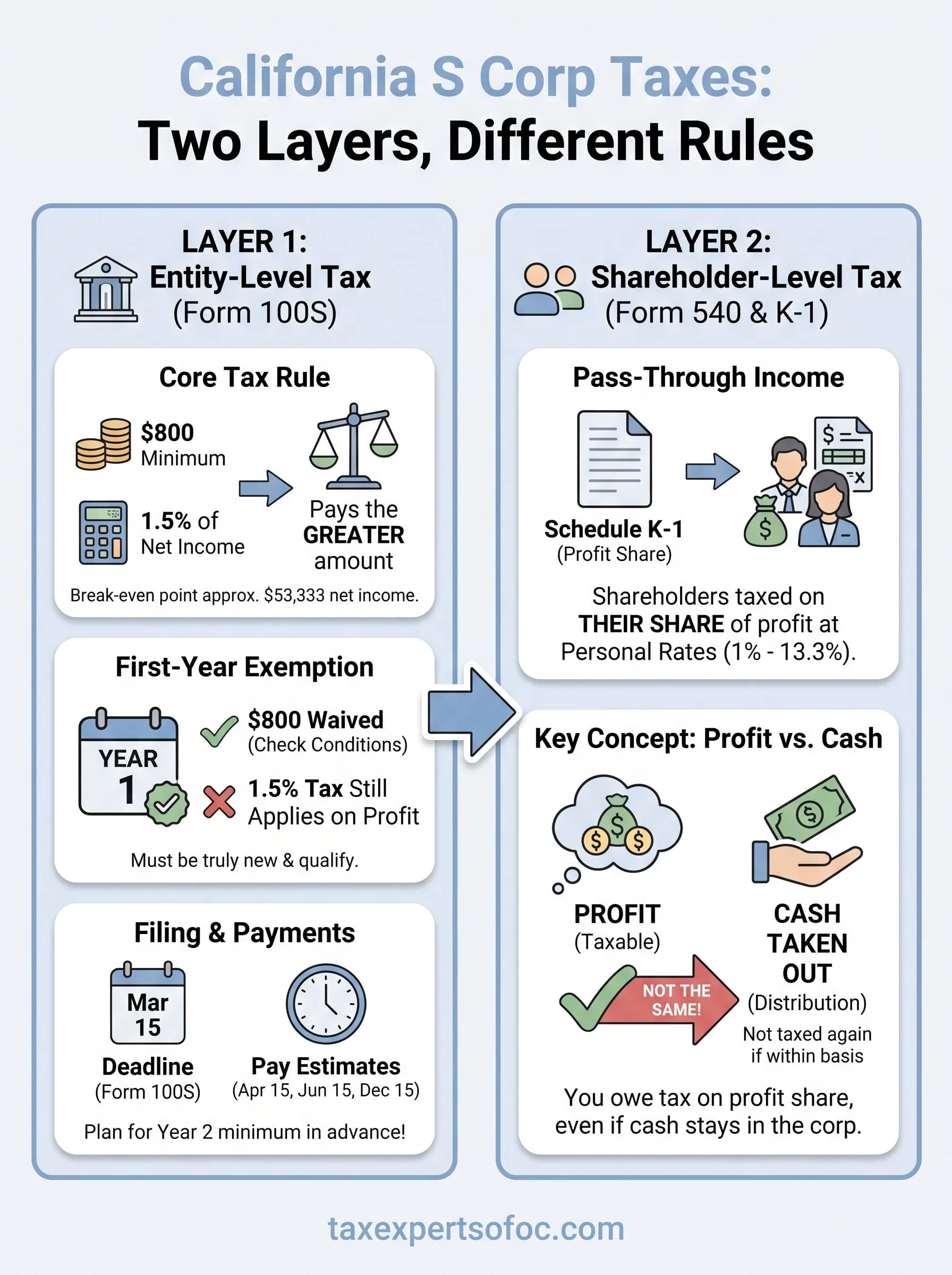
California S corp taxes come down to two layers. The corporation pays the greater of 1.5% of net income or $800, and each shareholder pays personal income tax on their share of K-1 profit, whether or not cash leaves the company.
Your next steps are simple. File Form 100S on time, make estimated payments through the year, and mark the date your first-year exemption ends so the second-year $800 never catches you off guard. Keep your stock basis updated too.
If you want a CPA or Enrolled Agent to check your numbers, book a free 30-minute consultation with Tax Experts of OC for CPA-led S corp tax preparation. We work with S corps in all 50 states by phone and email, and we will tell you upfront what your filing will cost.