

If you run an S corp and pay yourself nothing but distributions, you're carrying real audit risk. The IRS requires every S corp owner who works in the business to take a s corp reasonable salary before any profits get distributed, and getting this number wrong is one of the most common triggers for IRS scrutiny and back taxes. Plenty of owners guess at a figure or copy what a friend does, and that's how six-figure payroll tax bills happen.
So how do you actually land on the right number? The IRS doesn't publish a simple formula, but it does look at factors like your industry pay standards, the time you devote to the business, your training and experience, and what similar businesses pay for comparable work. Getting this balance right means enough salary to satisfy the IRS while still taking advantage of the distribution tax savings that make the S corp structure worthwhile in the first place.
In this guide, we'll walk through exactly how the IRS evaluates reasonable compensation, the factors that matter most, and a practical process for setting a defensible salary for your own S corp. If you're unsure whether your current setup would hold up under an audit, our CPAs and Enrolled Agents can review it during a free consultation.
Why reasonable salary matters for S-corp owners
The entire appeal of the S corp structure rests on one distinction: salary gets hit with payroll taxes, distributions don't. Self-employment tax savings are the reason so many freelancers and small business owners elect S corp status in the first place, but that savings only exists because the IRS lets you split income into two buckets. Skip the salary or set it too low, and you're not saving money, you're avoiding a tax you legally owe.
Understanding the mechanics helps explain why the IRS treats this issue so seriously. Payroll tax obligations on wages include 15.3% for Social Security and Medicare, split between employer and employee, while S corp distributions carry no such tax at all. That gap creates a powerful incentive to shift as much income as possible into distributions and as little as possible into salary. The IRS knows this, which is exactly why reasonable compensation rules exist.
The payroll tax math behind S corp savings
Here's a simplified comparison showing why the IRS pays close attention to how S corp owners split their income:
| Structure | Income Type | Payroll Tax Owed |
|---|---|---|
| Sole proprietor | $100,000 net profit | ~$14,130 self-employment tax |
| S corp owner | $50,000 salary + $50,000 distribution | ~$7,650 payroll tax on salary only |
| S corp owner (underpaying) | $10,000 salary + $90,000 distribution | ~$1,530 payroll tax, high audit risk |
That third row is where owners get themselves in trouble. Dropping salary to a token amount looks great on paper until an examiner recalculates what you should have paid and adds penalties on top.
Why the IRS scrutinizes salary decisions
Agents reviewing S corp returns aren't guessing about motive. IRS enforcement priorities have specifically named unreasonably low officer compensation as a compliance target for years, and the agency has won the majority of court cases where owners paid themselves little or nothing while taking large distributions. Courts have consistently sided with the IRS in cases like Watson v. Commissioner, where a CPA who paid himself $24,000 while taking $175,000 in distributions was reassessed with a salary closer to $91,000.
The IRS doesn't need you to underpay by much before it becomes worth their time to recalculate your entire payroll history.
Because the stakes are that high, the agency has published specific guidance on how it evaluates compensation for shareholder-employees, available directly on the IRS website. Reading that guidance makes clear this isn't a gray area the IRS is willing to let slide as an oversight.
The real cost of an incorrect salary
Getting this wrong doesn't just cost you the unpaid payroll tax. Back tax liability on reclassified distributions comes with interest that compounds from the original filing date, plus penalties for late payroll tax deposits that can run 10% to 15% of the unpaid amount. If the IRS decides the underpayment was intentional rather than a mistake, you're looking at accuracy-related penalties on top of that, sometimes reaching 20% of the underpayment.
Owners who overcorrect face a different problem. Setting salary too high erases the tax benefit that made the S corp election worthwhile, pushing payroll taxes higher than necessary and leaving less room for the qualified business income deduction, which only applies to pass-through profit, not wages. Either mistake, too low or too high, costs you money over time.
Small businesses that treat this as a one-time decision at formation tend to run into trouble down the road. Profit changes, roles change, and a salary that looked reasonable in year one can look glaringly low by year three if the business has grown and your compensation hasn't kept pace. Reasonable salary isn't a box you check once. It's a number you have to actively manage, and getting it right protects both your tax savings and your ability to defend that number if the IRS ever asks.
How to calculate your S-corp reasonable salary
Calculating a defensible number starts with treating it like a hiring decision, not a tax strategy. Ask yourself what you'd pay a stranger to do your job, with your training, your hours, and your responsibilities, and you've got the starting point the IRS expects you to use. The market rate approach is the method courts and revenue agents rely on most often, because it mirrors how compensation gets set everywhere else in the economy.
Three methods the IRS recognizes
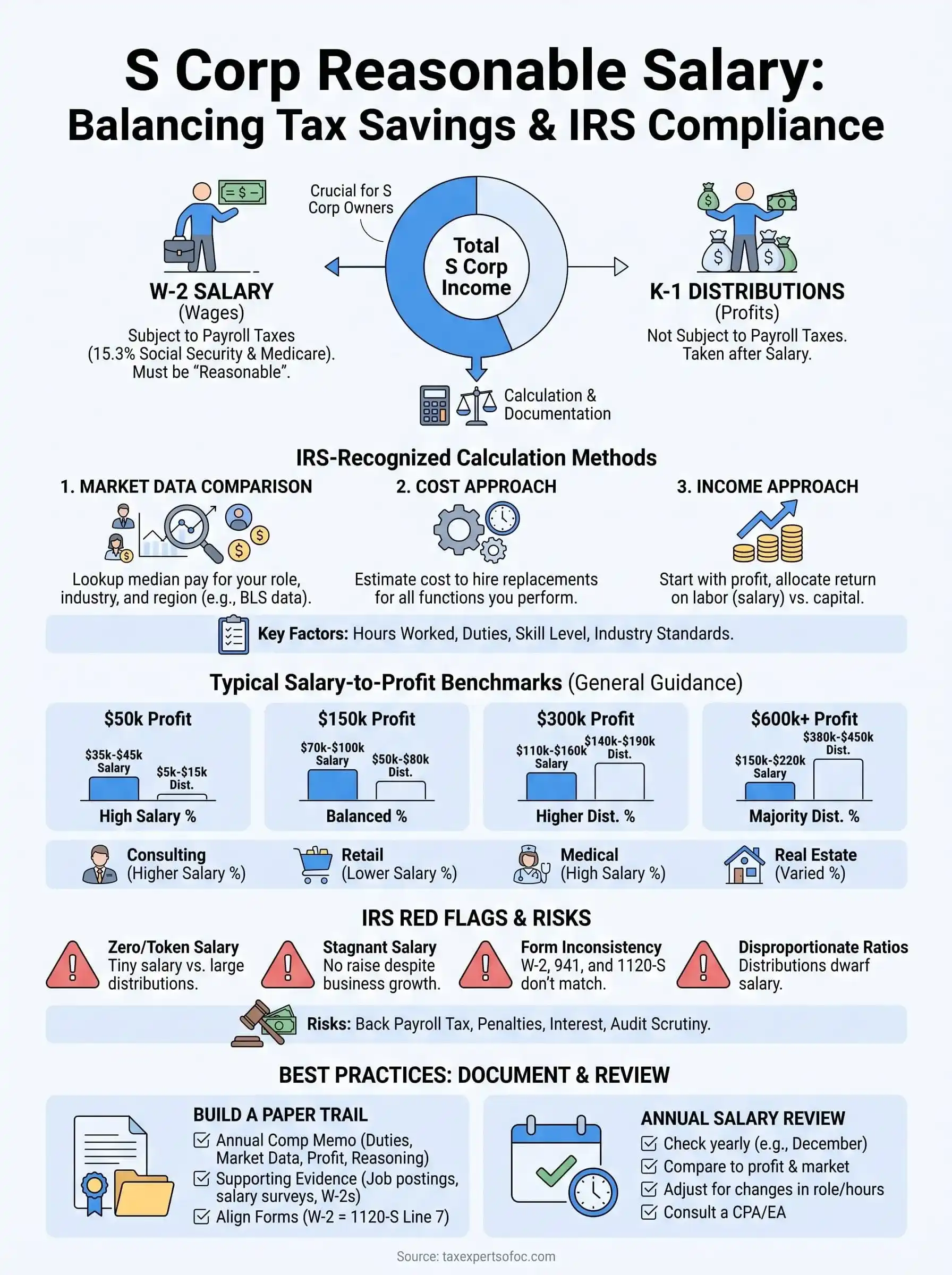
The IRS doesn't mandate a single calculation, but three approaches show up consistently in court cases and revenue rulings tied to shareholder compensation:
- Market data comparison: Look up median pay for your role and industry using sources like the Bureau of Labor Statistics, then adjust for your region and company size.
- Cost approach: Estimate what it would cost to hire someone else to replace every function you personally perform, then total those roles into a single salary figure.
- Income approach: Work backward from your S corp's profit, treating salary as the return on your labor and distributions as the return on capital and business risk.
Most tax professionals blend all three rather than picking one in isolation, since an examiner will likely check your number against more than one method too.
Weighing hours, duties, and skill level
Beyond raw market data, the IRS specifically looks at hours worked and the skill required to perform them. A part-time owner working 15 hours a week doing basic bookkeeping shouldn't draw the same salary as a full-time owner running sales, operations, and client work simultaneously. Breaking your role into its actual components, sales, management, technical delivery, administration, and pricing each one separately before adding them together holds up far better under scrutiny than a single round number pulled from a gut feeling. Skill level and training matter here too: a licensed professional performing specialized work commands a higher rate than an owner handling routine tasks anyone could learn quickly.
Running the numbers yourself
A simple worksheet can get you most of the way to a defensible figure before you ever talk to a professional:
Step 1: List every function you perform (sales, ops, technical work, admin)
Step 2: Estimate hours per week for each function
Step 3: Find market pay rate for each function (hourly or annual)
Step 4: Multiply hours x rate, sum across all functions
Step 5: Compare total to your S corp's net profit
Step 6: Adjust downward only if profit can't support the full figure
Your reasonable salary should reflect what the work is worth, not what's left over after you've decided how much you want to keep as distributions.
Once you've run the worksheet, treat the resulting figure as a floor rather than a ceiling. Profitable years give you room to be generous with salary and still take healthy distributions, while lean years may require lowering distributions first to protect the salary number that keeps you compliant.
Reasonable salary benchmarks by industry and profit
No single percentage works for every S corp, but patterns do emerge once you look across thousands of court cases, revenue rulings, and payroll studies. Industry benchmarks give you a sanity check before you commit to a number, even though your specific role, hours, and market still carry more weight than any general rule. Owners in service-based fields with lower overhead tend to land in a different range than owners running capital-intensive businesses with equipment, inventory, or large teams.
Typical salary-to-distribution ratios by profit level
Tax professionals often reference the general guidance that salary should represent somewhere between 60% and 90% of an S corp's profit for owner-operators who work full-time in the business, though profit-to-salary ratios shift as net income grows. Very small S corps with modest profit usually need salary to cover nearly all of that profit, simply because there isn't much left to split. Larger, more profitable S corps can push salary toward the lower end of that range because the owner's labor represents a smaller share of what's driving total earnings.
| Annual Net Profit | Typical Salary Range | Approximate Distribution |
|---|---|---|
| $50,000 | $35,000-$45,000 | $5,000-$15,000 |
| $150,000 | $70,000-$100,000 | $50,000-$80,000 |
| $300,000 | $110,000-$160,000 | $140,000-$190,000 |
| $600,000+ | $150,000-$220,000 | $380,000-$450,000 |
The higher your profit climbs above what one person's labor could reasonably generate, the more that surplus belongs to distributions rather than salary.
Industry benchmarks worth knowing
Different industries carry different labor costs, so industry-specific pay data matters more than a flat percentage rule. A solo consultant billing at $150 an hour builds a very different salary case than a general contractor overseeing subcontracted crews. Rough starting points that tax professionals commonly reference include:
- Consulting and professional services: salary often runs 65% to 80% of profit, reflecting how directly the owner's expertise drives revenue.
- Retail and e-commerce with employees: salary can run lower, often 40% to 60% of profit, since staff and inventory do more of the revenue-generating work.
- Medical and dental practices: salary tends to sit high, frequently above 70% of profit, because licensed clinical work is difficult to separate from ownership.
- Real estate and construction: salary varies widely depending on how much work gets subcontracted versus performed directly by the owner.
When benchmarks don't fit your situation
Sometimes your business simply doesn't match any of these patterns, and that's fine as long as you can explain why. Multiple owners splitting duties, part-time involvement, or a business that's mostly passive investment income all justify departing from typical ratios. Whatever number you land on, keep a written record of the reasoning, because an examiner comparing your S corp to industry norms will want to see why yours looks different, not just that it does.
Red flags that trigger IRS scrutiny
Some patterns catch an examiner's attention faster than others, and knowing what they are lets you avoid triggering an audit in the first place. IRS audit triggers for S corp compensation tend to cluster around a handful of predictable behaviors, and most of them involve a mismatch between what the numbers show and what common sense would expect. If your S corp's tax return contains any of these patterns, expect the reasonable salary question to come up eventually, even if nothing else on the return looks unusual.
Zero or token salary next to large distributions
Nothing draws attention faster than an officer who reports zero salary on Form 1120-S while pulling six figures in distributions on Schedule K-1. Even a small salary, say $5,000 or $10,000 a year, next to $150,000 in distributions reads as an obvious attempt to dodge payroll tax rather than a considered compensation decision. Examiners flag this combination almost automatically because it's the exact scenario the IRS guidance on shareholder compensation was written to address.
Paying yourself nothing while the business pays out large distributions isn't a gray area, it's the single clearest signal the IRS looks for.
Salary that doesn't track business growth
Growth without a corresponding raise looks suspicious over time. Stagnant compensation while revenue and profit climb year over year suggests the owner is quietly shifting more income into distributions as the business scales, rather than adjusting salary to reflect a bigger role and more valuable work. A business that tripled its profit over five years but kept the owner's salary flat gives an examiner an easy comparison to make.
Distributions that exceed reasonable limits relative to salary
Ratios matter here too. Disproportionate distribution amounts relative to salary, especially when distributions run five or ten times higher than wages, invite closer review even without any other red flag present. A few common triggers worth knowing:
- Officer compensation reported as $0 on Form 1120-S line 7 or 8
- A sharp year-over-year drop in salary with no change in duties
- Distributions that dwarf salary by a wide margin in a profitable year
- A sole owner performing substantial full-time work with minimal reported wages
- Salary that sits well below published industry wage data for the same role
Inconsistent filings across payroll and tax forms
Mismatches between forms create their own problems. Payroll form discrepancies between what's reported on Form 941, the annual W-2, and the S corp's own 1120-S give the IRS an easy paper trail to follow, since these documents cross-reference each other automatically in the agency's systems. A W-2 that shows one figure while the 1120-S reports something different isn't just sloppy bookkeeping, it's the kind of inconsistency that can trigger a broader review of your entire filing history, not just the salary question. Keeping every form aligned before you file protects you from an audit that starts over a clerical mismatch and expands from there.
What happens if your salary is too low or too high
Getting the number wrong in either direction carries real financial consequences, not just a slap on the wrist. Salary miscalculation penalties on the low end can include years of back payroll tax, interest, and accuracy penalties, while overpaying yourself quietly erodes the exact s corp reasonable salary advantage you elected this structure to capture. Neither mistake fixes itself, and both tend to compound the longer they go unaddressed.
The cost of paying yourself too little
Underpaying triggers a chain reaction that starts with reclassification. Once an examiner decides your salary was too low, the IRS treats a portion of your distributions as wages retroactively, and that reclassification pulls interest and penalties along with it.
| Consequence | Typical Impact |
|---|---|
| Reclassified distributions | Treated as W-2 wages for the audited years |
| Back payroll tax | 15.3% on the reclassified amount, split employer/employee |
| Failure-to-deposit penalty | Up to 15% of unpaid payroll tax |
| Accuracy-related penalty | Up to 20% if underpayment is deemed negligent |
| Interest | Compounds daily from the original due date |
A salary that's too low doesn't just cost you back taxes, it costs you back taxes plus interest plus penalties, all calculated on money you already spent.
Beyond the dollar figures, an underpaid salary often invites the IRS to look further back than the single year under review, since retroactive reclassification frequently extends to prior open tax years once an examiner spots the pattern.
The cost of paying yourself too much
Overpaying doesn't draw IRS attention the way underpaying does, but it still costs you money every year it continues. Excess salary allocation pushes more income through payroll tax that could have stayed in the lower-taxed distribution bucket, and it shrinks the pass-through profit eligible for the qualified business income deduction under IRC Section 199A. Owners who overcorrect out of audit fear often leave thousands of dollars on the table annually without realizing it.
Setting salary too high also complicates retirement plan contributions and other benefits tied to W-2 wages, since a bloated salary figure can distort what you're eligible to contribute or deduct elsewhere. It's a quieter mistake than underpaying, but over five or ten years the lost tax savings add up to a meaningful sum.
Finding the middle ground
Somewhere between those two failure points sits the number that actually protects you, a salary defensible enough to survive scrutiny without sacrificing the distribution savings that make the S corp worthwhile. Reaching that number usually takes a second set of eyes, since owners tend to either overcorrect after reading about audit risk or undercorrect out of habit from prior years. Working through the calculation with a CPA or Enrolled Agent who reviews S corp compensation regularly catches both errors before they show up on a filed return, which is far cheaper than fixing them after the fact.
How to document and defend your compensation
Every number you calculate is only as strong as the paper trail behind it. Compensation documentation turns a defensible salary into a proven one, and the difference matters enormously if an examiner ever opens your file. Owners who skip this step often land on a reasonable number anyway, then struggle to prove it years later when memories fade and market data changes. Write down your reasoning the same year you set the salary, not after a notice arrives.
Building a compensation memo
Jot down a short internal memo each year explaining how you arrived at your salary figure. This doesn't need to read like a legal brief, but it should cover the same ground an examiner would ask about. A useful memo includes:
- The job duties you performed and roughly how many hours per week each required
- The market data source you used, such as Bureau of Labor Statistics wage tables or an industry survey
- Your company's net profit for the year and how salary compares to it
- Any factors that justify departing from typical industry ratios, like part-time involvement or multiple owners
- The date you set or revised the figure
Written justification like this costs you twenty minutes and protects you for years. Store it with your tax records, not buried in an email thread you'll never find again.
Keeping the supporting evidence organized
Beyond the memo itself, gather the documents that back up your numbers. Supporting evidence should include job postings for comparable roles, printouts of salary survey data, board minutes or shareholder resolutions setting compensation, and prior-year W-2s showing how your salary has changed over time. If you hired an outside firm to run a compensation study, keep that report on file indefinitely, since it carries significant weight if the IRS ever challenges your number.
A salary you can explain in writing, backed by market data from the year you set it, is far harder for an examiner to overturn than one you defend from memory after the fact.
Aligning your payroll and tax forms
Consistency across every filing matters as much as the reasoning behind the number. Form consistency between your W-2, Form 941 quarterly filings, and your S corp's 1120-S removes one of the easiest red flags an examiner can spot. Before you file each year, cross-check that the salary figure appears identically on all three documents.
Check before filing:
1. W-2 Box 1 wages match total salary paid for the year
2. Form 941 quarterly wages sum to the annual W-2 figure
3. Form 1120-S line 7 (officer compensation) matches W-2 total
4. Schedule K-1 distributions are separate from wage figures
Running through that short checklist takes a few minutes and closes off one of the most common ways sloppy paperwork turns into a full audit. Combined with a written memo and organized supporting documents, a consistent paper trail across every form gives you a compensation file that holds up whether an examiner reviews it next year or five years from now.
Reviewing and adjusting your salary each year
Setting a reasonable salary once and forgetting about it is one of the most common mistakes owners make. Annual salary review should happen every year at the same time you prepare your tax return, not just when profit swings dramatically or a notice shows up in the mail. Your business changes even when you're not paying close attention, and the salary that made sense two years ago can quietly become indefensible by the time profit doubles or your role shifts.
Building a yearly checkpoint into your process
Treat the review like any other recurring compliance task rather than something you handle only when you remember. Recurring compensation check works best when it's tied to a fixed date, ideally right before year-end payroll runs so you have time to adjust before your final paycheck of the year rather than scrambling in January. A short annual process might look like this:
Each December, before your final payroll run:
1. Pull current-year net profit through November, project the full year
2. Compare last year's salary to this year's projected profit
3. Check market wage data for any changes in your role or industry
4. Note any changes in hours worked, duties added, or duties dropped
5. Adjust salary up or down before December 31 if the numbers have shifted
6. Update your compensation memo with the new figure and reasoning
Running this checklist takes less than an hour once you've done it a couple of times, and it keeps you from discovering a mismatch only after the IRS points it out.
What should trigger a mid-year adjustment
Some changes are big enough that you shouldn't wait for your annual review to act on them. Mid-year salary adjustment makes sense when profit jumps sharply from a new contract or client, when you take on substantially more hours or responsibility, or when you bring on a partner and your share of the work changes. Waiting until year-end to fix a salary that's been wrong for eight months just extends the exposure window unnecessarily.
A salary that fit your business last year isn't guaranteed to fit it this year, and checking that assumption annually is cheaper than defending it after an audit.
Tracking growth against your salary history
Keeping a simple year-over-year record makes the review faster and gives you a built-in defense if an examiner ever asks why your salary changed. Salary growth tracking should sit right next to your profit numbers so the relationship between the two is obvious at a glance:
| Year | Net Profit | Salary Paid | Salary as % of Profit |
|---|---|---|---|
| 2023 | $180,000 | $95,000 | 53% |
| 2024 | $220,000 | $105,000 | 48% |
| 2025 | $310,000 | $130,000 | 42% |
A table like this shows an examiner that your ratio moved deliberately as profit grew, not that you froze your salary while distributions climbed unchecked. It also makes your own annual review faster, since you can see the trend line rather than reconstructing it from memory.
If your business is growing quickly, lean on a CPA or Enrolled Agent to sanity-check your number at least once a year rather than relying entirely on your own read of the market. A quick professional review catches drift you might not notice from inside the business, and it costs far less than correcting three years of underpaid payroll tax after the fact.
Getting your S-corp salary right
A defensible s corp reasonable salary isn't a guess or a round number pulled from a friend's tax return. It's a documented figure grounded in market data, hours worked, and your actual role, reviewed every year as profit and duties shift. Get it too low and you're inviting back taxes, penalties, and interest. Get it too high and you're quietly giving up the tax savings that made the S corp election worth doing in the first place.
Most owners land somewhere reasonable on their own, but few build the paper trail that protects them if the IRS ever asks questions. That documentation, paired with an annual checkpoint, is what separates a salary you can defend from one you're hoping nobody scrutinizes.
If you want a second opinion before you file, schedule a free consultation with Tax Experts of OC and let a CPA or Enrolled Agent review your numbers before the IRS does.