

Figuring out how to start an LLC in California looks simple until you hit the Secretary of State's filing portal and realize there's a specific order to everything. Name reservations, registered agent requirements, the Articles of Organization, the Statement of Information, and that $800 annual franchise tax all need to happen at the right time, or you end up paying penalties before your business has made a dollar.
This guide walks you through the exact steps in order, so you're not guessing what comes next. You'll get the filing requirements the state actually enforces, the realistic costs to budget for beyond the base filing fee, and the common mistakes that delay approval or trigger extra paperwork later.
We put this together because we spend our days helping California business owners with exactly this kind of formation work, plus the tax structuring and bookkeeping that follows once the LLC exists. Whether you're forming your first entity or restructuring an existing business, you'll walk away knowing what to file, when to file it, and what the new business founders we work with wish someone had told them before they started.
What you need before forming a California LLC
Before you file anything, get a few decisions locked in. California doesn't require a lawyer to form an LLC, but the state does expect specific information on your paperwork the moment you submit it, so scrambling to find your registered agent's address or your business purpose mid-filing just slows you down. Sort these items out first and the actual filing takes minutes instead of hours.
Confirm an LLC fits your business
Start by checking that a limited liability company actually matches what you're building. An LLC gives you liability protection without a corporation's board and shareholder formalities, and profits pass through to your personal return instead of facing corporate tax first, which changes how you file taxes for an LLC each year. If you're a solo consultant testing an idea, a sole proprietorship might cost less to maintain short term, but once you sign contracts, hire employees, or carry real liability exposure, the LLC structure earns its keep fast.
Collect the details the state requires
Once you've settled on the entity type, pull together the information the California Secretary of State will ask for during filing. Missing even one item here means resubmitting your Articles of Organization and losing days waiting in the processing queue again.
- Your proposed LLC name, plus two backups in case your first choice is taken
- A California street address for your registered agent, not a P.O. box
- The mailing address for your LLC's principal office
- Names and addresses of the organizer filing the paperwork
- A payment method for the filing fee
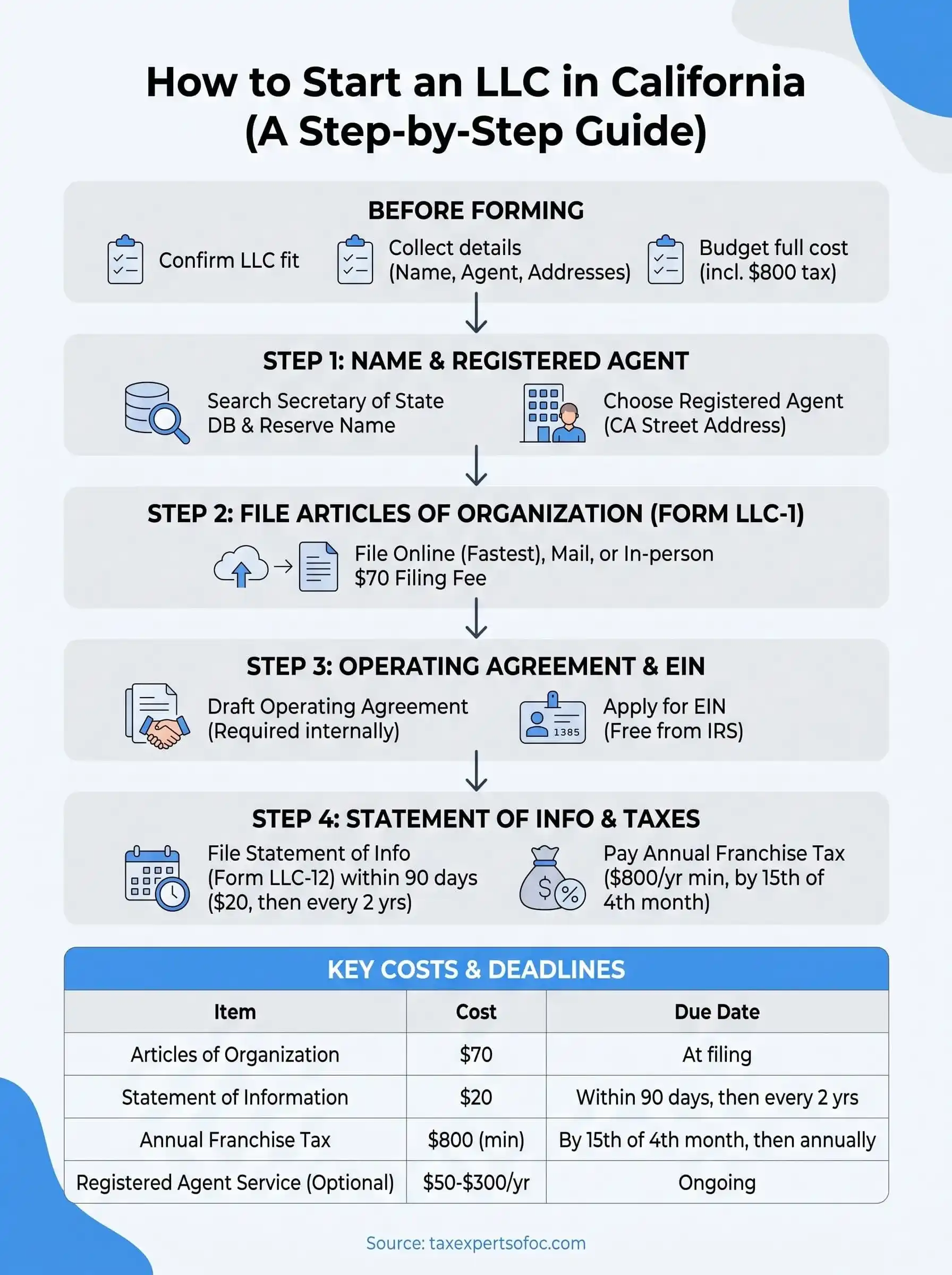
Budget for the full cost, not just the filing fee
Finally, look past the initial filing fee to what the first year actually costs. Many new owners plan for the base filing fee and get blindsided by the $800 annual franchise tax, which is due regardless of whether the business made any money that year.
| Requirement | Cost | When it's due |
|---|---|---|
| Articles of Organization | $70 | At filing |
| Statement of Information | $20 | Within 90 days of filing, then every 2 years |
| Annual Franchise Tax | $800 | By the 15th day of the 4th month after formation, then annually |
| Registered agent service (optional) | $50 to $300/year | Ongoing |
The $800 franchise tax applies even if your LLC never earns a dollar, so budget for it before you file, not after.
Step 1. Name your LLC and choose a registered agent
With your details gathered, start with the name. California requires your LLC name to include "LLC" or "Limited Liability Company" (or an accepted abbreviation), and it can't sound so close to an existing business name that it confuses customers or examiners. Search the California Secretary of State's business database before you fall in love with a name, since a rejected name means your whole filing gets kicked back and you start the clock over.

Searching takes five minutes and saves you weeks:
- Go to the Secretary of State's bizfile Online portal and run a business name search.
- Check your top choice and both backups, not just your favorite.
- Avoid restricted words like "bank," "insurance," or "trust" unless you have the licensing to back them up.
- If you're not filing right away, reserve the name for 60 days for a small fee so nobody else grabs it.
Next, lock in your registered agent, the person or company legally responsible for receiving lawsuits, subpoenas, and official state notices on your LLC's behalf. This can be yourself, an employee, or a professional registered agent service, but the agent must have a physical California street address (P.O. boxes get rejected) and be available during normal business hours to accept documents in person.
Your registered agent's address becomes public record, so most owners with a home-based business hire a professional service instead of listing their house.
Deciding between yourself and a paid service comes down to privacy and reliability. Using your own address is free but puts it on public record and means you can never step away during business hours without risking a missed notice. Hiring a service costs $50 to $300 a year but keeps your home address private and guarantees someone's always there to receive documents, which matters if you travel or run the business part-time.
Step 2. File your articles of organization
Once your name and registered agent are locked in, you're ready to file the Articles of Organization (Form LLC-1) with the California Secretary of State. This document officially creates your LLC in the eyes of the state, and it asks for the same details you already gathered: your LLC name, registered agent information, and management structure (member-managed or manager-managed). Get the management structure right here, since changing it later means amending your filing.
Choose your filing method
Submit your paperwork through whichever channel fits your timeline and budget:
- Online through bizfile Online: fastest option, typically processed within a few business days
- By mail: sent to the Sacramento office, but expect two to three weeks of processing
- In person: drop-off at the Sacramento office with expedited service available for an extra fee
The $70 filing fee applies no matter which method you choose, and expedited processing (24-hour or same-day) costs more on top of that if you're racing a deadline like a contract signing or lease start date.
File online whenever you can. Mailed paperwork sits in a queue that can stall your entire timeline for weeks.
What happens after you submit
After the state approves your filing, you'll receive a stamped, filed copy of your Articles of Organization, which is your proof the LLC legally exists. Banks, landlords, and licensing agencies will all ask to see this document, so save both a digital and physical copy. Businesses juggling multiple filings, tight deadlines, or out-of-state ownership often hand this step to a professional through LLC and corporation formation services rather than risk a rejected submission over a small formatting error.
Step 3. Create an operating agreement and get an EIN
Getting the state paperwork approved doesn't mean you're done setting up. Two more documents protect your LLC and let it actually operate, an operating agreement and an EIN, and both should happen before you open a business bank account or hire your first employee.

Draft an operating agreement that fits your structure
California doesn't file your operating agreement with the state, but it does require every LLC to have one, and skipping it leaves your business governed by default state rules that rarely match what you actually want. This internal document spells out how the business runs and who owns what, which matters most the moment partners disagree or someone wants to sell their stake.
A solid operating agreement covers:
- Ownership percentages for each member
- How profits and losses get distributed
- Voting rights and decision-making authority
- What happens if a member wants to leave or sell their share
- Management structure, matching what you listed on your Articles of Organization
An operating agreement isn't optional paperwork, it's the document that settles disputes before they end up in court.
Apply for an EIN with the IRS
Once your agreement is signed and stored, apply for your Employer Identification Number, the federal tax ID that functions like a Social Security number for your business, though it's worth confirming first whether your LLC needs an EIN at all. You'll need it to open a business bank account, hire employees, and file federal tax returns, and the fastest route is the IRS's own online EIN application, which issues your number immediately after you submit it.
Applying costs nothing directly through the IRS, so skip any site charging a fee for the same service, and lean on CPA-led tax strategy only where the structure decisions actually get complicated. If your LLC's tax structure gets complicated, particularly with multiple members or an S-corp election, compare S corp vs LLC taxes to see which setup actually saves you money before you file.
Step 4. File your statement of information and pay taxes
With your operating agreement and EIN in hand, wrap up formation by filing your Statement of Information (Form LLC-12) and getting ahead of California's tax obligations. This is the step most new owners forget, since it feels like an afterthought after the Articles of Organization, but missing the deadline triggers an automatic $250 penalty on top of the filing fee you already owe.
File your Statement of Information on time
California requires every LLC to file this form within 90 days of your Articles of Organization being approved, then again every two years after that on a schedule tied to your original filing month. The form itself is short, just your LLC's address, registered agent, management structure, and the names of your managers or members.
- File online through bizfile Online for the fastest turnaround
- Pay the $20 filing fee each time you submit
- Mark your calendar for the two-year renewal so it doesn't sneak up on you
- Update the form anytime your registered agent or address changes, not just on the renewal cycle
Miss the 90-day Statement of Information deadline and California hits you with a $250 penalty before your LLC has even filed a real tax return.
Pay the annual franchise tax
Separately from that filing, your LLC owes the $800 California LLC tax to the Franchise Tax Board, due by the 15th day of the fourth month after you form your LLC, and every year afterward regardless of revenue. LLCs earning more than $250,000 in California gross receipts also owe an additional fee on a sliding scale, so check your projected income early rather than getting surprised at tax time. Paying late adds interest and penalties on top of the $800, which stacks up fast if you let it slide for a full year. Businesses juggling this alongside quarterly estimates or payroll deposits often bring in business tax filing support from a CPA to keep every deadline straight from day one.
Keeping your California LLC in good standing
Once your LLC is formed, the real work shifts from paperwork to habits. Renew your Statement of Information every two years, pay the franchise tax on schedule, and keep your registered agent information current so you never miss a legal notice. These small, recurring tasks are what separate an LLC that stays protected from one that quietly falls out of compliance and loses its liability shield.
Starting an LLC in California isn't complicated once you know the order of operations, but staying compliant year after year is where most owners lose track. Deadlines shift, tax rules change, and a missed filing can cost more than the time it would've taken to get it right the first time. If you'd rather have professionals handle the ongoing filings, tax planning, and bookkeeping so you can focus on running your business, book a free consultation with Tax Experts of OC.