
If you're comparing s corp vs llc taxes, you've probably hit the same wall every small business owner hits: the internet gives you contradictory answers, and your specific numbers matter more than generic advice. An LLC and an S corp aren't even different tax categories at the IRS level in the way most people think, and that mix-up costs business owners real money every year.
Here's the short answer: a default LLC pays self-employment tax on all its profit, while an S corp election lets you split income into salary and distributions, cutting the amount exposed to that 15.3% tax. But that only pays off once your profit clears a certain threshold, and running payroll adds cost and paperwork you don't have with a plain LLC. There's no universal winner here, only a break-even point specific to your income.
In this article, we'll walk through how each structure is actually taxed, where the self-employment tax savings come from, what an S corp election costs you in payroll and compliance, and how to figure out whether switching makes sense for your business this year.
Why the tax difference matters for your bottom line
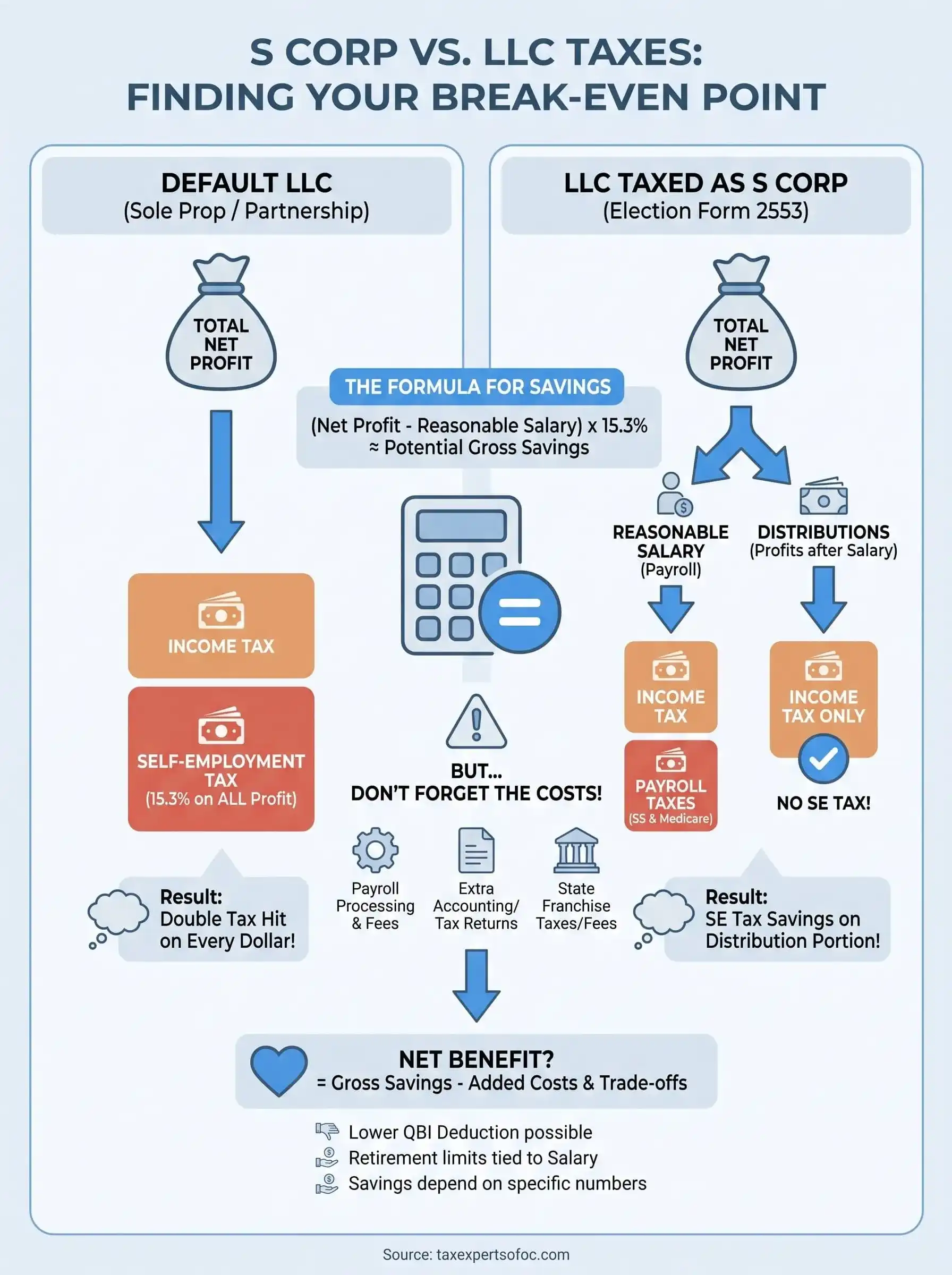
Money left on the table rarely announces itself. A single-member LLC taxed as a sole proprietorship, or a multi-member LLC taxed as a partnership, reports all of its net profit on Schedule C or Schedule K-1, and that profit gets hit twice: once for income tax, and again for self-employment tax at 15.3%. That second hit covers Social Security and Medicare, and it applies whether you paid yourself a dime or reinvested every cent back into the business. The IRS doesn't care how you used the money. It taxes the profit.
How the default LLC gets taxed
By default, the IRS treats an LLC as a "disregarded entity" if it has one owner, or as a partnership if it has more than one. Neither of those is a real tax classification on its own; they're just fallback rules that apply when you don't elect anything else. That means all net earnings flow straight to your personal return and get taxed as self-employment income, no matter how hands-on or passive your role in the business actually is.
What changes with an S corp election
Filing Form 2553 with the IRS doesn't create a new legal entity. Your LLC still exists exactly as it did before, still files the same state paperwork, still has the same liability protection. What changes is how the profit passing through it gets taxed. Once the election is in place, you're required to pay yourself a reasonable salary through payroll, and that salary is subject to Social Security and Medicare taxes just like any employee's wages. Everything left over after salary, benefits, and business expenses can go out as a distribution, and distributions skip self-employment tax entirely.
That distinction is the entire reason this comparison exists.
An S corp election doesn't lower your income tax, it lowers the slice of your profit that gets hit with self-employment tax.
Where the money actually goes
Here's a simplified look at how the same $100,000 in net profit is treated under each structure, before you've decided on a specific salary:
| Structure | Subject to self-employment tax | Subject to income tax |
|---|---|---|
| Default LLC (sole prop/partnership) | Full $100,000 | Full $100,000 |
| LLC taxed as S corp | Only the salary portion | Full $100,000 |
On paper, that gap looks modest. In practice, a few thousand dollars in avoided self-employment tax every single year compounds fast, especially for owners who redirect the savings into retirement contributions, debt payoff, or reinvestment. That's also why the reasonable salary requirement exists in the first place. Setting your salary at $10,000 while paying yourself $90,000 in distributions isn't a tax strategy, it's the kind of move that draws IRS scrutiny instead of a refund. The savings are real, but only when the numbers behind them can hold up to review.
How to calculate your self-employment tax savings
Before you file anything, run the math yourself. The self-employment tax savings from an S corp election come from one simple move: shrinking the amount of profit that gets hit with the 15.3% self-employment tax, split as 12.4% for Social Security (up to the annual wage base) and 2.9% for Medicare (with no cap, plus an extra 0.9% for high earners).
The formula behind the savings
Start with your net profit, subtract a reasonable salary for the work you actually perform, and what's left becomes your potential distribution. That distribution amount, multiplied by 15.3%, is roughly what you'd save in self-employment tax by electing S corp status instead of staying a default LLC. Say your business nets $120,000 and a fair salary for your role is $60,000. The remaining $60,000 in distributions avoids the 15.3% tax entirely, which works out to about $9,180 in savings before you subtract payroll costs.
The bigger the gap between your net profit and a defensible reasonable salary, the more an S corp election is worth pursuing.
A step-by-step calculation checklist
Work through these steps with your own numbers before deciding:
- Pull your projected net profit for the year from your bookkeeping records, not a rough guess.
- Research a defensible salary for your role using comparable job data, industry surveys, or Bureau of Labor Statistics figures.
- Subtract the salary from net profit to find your distribution amount.
- Multiply the distribution by 15.3% to estimate your gross self-employment tax savings.
- Subtract added costs, including payroll processing, workers' comp adjustments, and any extra accounting fees for running an S corp.
That last step matters more than most owners expect. Payroll software, quarterly filings, and a slightly more involved tax return all cost money, and those costs eat into the savings you calculated in step four. Once you've netted everything out, you'll have a real number instead of a hopeful one.
S corp vs LLC taxes: a real-world example
Numbers make this comparison real, so let's walk through one. Picture a freelance marketing consultant running her business as a single-member LLC, netting $150,000 in profit for the year after expenses. She's been taxed as a sole proprietor since day one and wants to know if an S corp election actually moves the needle.

Comparing the two structures side by side
Her research turns up a reasonable salary for a marketing consultant with her experience: around $70,000, based on comparable job postings and BLS wage data for her region. Here's how the two options stack up:
| Item | Default LLC | LLC taxed as S corp |
|---|---|---|
| Net profit | $150,000 | $150,000 |
| Reasonable salary | N/A | $70,000 |
| Distribution | N/A | $80,000 |
| Self-employment/payroll tax base | $150,000 | $70,000 |
| Approx. self-employment tax (15.3%) | $22,950 | N/A |
| Approx. payroll tax on salary (15.3%, employer + employee) | N/A | $10,710 |
| Gross tax savings | , | ~$12,240 |
What the savings actually look like after costs
Before she gets excited about that $12,240, she has to subtract what it costs to run payroll: roughly $900 a year for a payroll service, $600 more in tax prep fees for the added S corp return, and a small increase in her workers' comp premium. Once those costs come out, her net savings land closer to $10,500. That's still a meaningful number for a one-person consulting business, and it's the kind of gap that makes the S corp election worth the extra paperwork.
A five-figure profit alone doesn't guarantee S corp savings; it's the gap between profit and a defensible salary that decides the outcome.
Contrast that with a photographer netting $45,000. A reasonable salary for that role might be $35,000, leaving only $10,000 in distributions, which barely covers the added payroll costs and accounting fees. Same election, same paperwork, completely different result.
Other tax factors that affect your final decision
Self-employment tax savings grab the headlines, but they're not the whole story. Several other tax factors can shrink your S corp advantage or, in some cases, wipe it out entirely, and skipping this step is how business owners end up disappointed at tax time.
State-level taxes and franchise fees
Going beyond federal rules, your state tax treatment can change the math significantly. California, for example, charges S corps a 1.5% franchise tax on net income, with a $800 minimum, on top of everything you owe the IRS. Other states have their own franchise taxes, annual report fees, or minimum tax requirements for S corps that don't apply to a default LLC. Before you file Form 2553, pull up your state's specific rules, because a strong federal savings number can shrink fast once state costs enter the picture.

The QBI deduction interaction
The Qualified Business Income deduction lets many pass-through owners deduct up to 20% of their business income, but wages you pay yourself as an S corp employee don't count toward that deduction. Lowering your qualified income to boost distributions can shrink this deduction, so the two benefits partially offset each other depending on your total income and filing status.
A tax move that saves you self-employment tax can quietly cost you part of your QBI deduction, so always check both numbers together.
Retirement and benefits planning
Quietly, retirement contributions shift too. Solo 401(k) and SEP IRA limits are tied to compensation, and under an S corp, only your salary counts toward those limits, not distributions. That can actually cap how much you're able to save for retirement compared to a sole proprietor calculating contributions off full net profit. Health insurance deductions also work differently once you're an S corp employee, requiring specific reporting on your W-2 to stay deductible.
Choosing the structure that fits your business
At this point, the math should feel less abstract than it did at the start. S corp vs LLC taxes comes down to one question: does the gap between your net profit and a defensible salary generate enough self-employment tax savings to outweigh payroll costs, state fees, and any QBI tradeoffs? For some owners, that gap is thousands of dollars a year. For others, it barely covers the added paperwork. Neither answer is wrong, it just depends on your numbers.
Guessing here costs money either way, whether you elect S corp status too early or wait too long after clearing the break-even point. A CPA or Enrolled Agent who reviews your actual profit, salary comparables, and state obligations can tell you exactly where you stand this year. If you want that clarity before your next filing deadline, schedule a free consultation with Tax Experts of OC and get a number you can actually rely on.