

Most small business owners pay more in taxes than they need to, not because they're doing anything wrong, but because they're missing deductions they're fully entitled to claim. Small business tax deductions directly reduce your taxable income, which means every overlooked write-off is money you're handing to the IRS for no reason. The problem is that eligible deductions aren't always obvious, and the rules change often enough to trip up even experienced business owners.
For the 2026 tax year, several deductions have updated thresholds, phase-outs, and qualification rules that affect how much you can save. Knowing what qualifies, and how to document it properly, is the difference between a solid tax strategy and an expensive mistake during an audit. At Tax Experts of OC, our CPAs and Enrolled Agents work with small business owners across all 50 states to identify every deduction they can legally claim, so nothing gets left on the table.
This guide breaks down 13 deductions your business should be maximizing right now. Each one includes what qualifies, what doesn't, and practical tips to keep your records clean. Whether you run an LLC, S-corp, or sole proprietorship, these write-offs apply to you, and getting them right could save you thousands.
1. Legal and professional fees
Legal and professional fees are among the most consistently overlooked small business tax deductions available to owners at every income level. The IRS allows you to deduct fees paid to attorneys, CPAs, enrolled agents, and business consultants as long as those fees are ordinary and necessary for running your business. Getting this deduction right means knowing exactly what qualifies, what does not, and how to report it correctly based on your business structure.
What qualifies
You can deduct fees paid for legal services directly tied to your business operations, such as contract drafting, employment law advice, business dispute resolution, and trademark or patent filings related to your trade. Accounting and tax preparation fees also qualify, including what you pay a CPA to prepare your business return, handle bookkeeping, or represent you in front of the IRS. Consulting fees paid to business advisors and industry specialists generally qualify as well.
If you pay a professional to help you collect a business debt or defend a lawsuit directly connected to your business operations, those fees count as a deductible expense.
What does not qualify
Personal legal fees do not qualify, even when you are a business owner. Fees for a personal divorce, estate planning unrelated to the business, or a personal injury claim cannot be written off as a business expense. Fees tied to acquiring a capital asset, such as legal costs for purchasing commercial property, must be capitalized and recovered through depreciation rather than deducted in the current tax year.
Where to claim it by business type
Where you report this deduction depends entirely on your business structure. Use the table below to find the correct form:
| Business Type | Form to Use | Line |
|---|---|---|
| Sole proprietor / Single-member LLC | Schedule C | Line 17 |
| Partnership / Multi-member LLC | Form 1065 | Part II |
| S-Corporation | Form 1120-S | Page 1, Line 19 |
| C-Corporation | Form 1120 | Page 1, Line 20 |
Proof to keep in case of audit
Keep every invoice and receipt from your attorney, accountant, or consultant, along with proof of payment such as bank statements or canceled checks. You should also retain any engagement letters or contracts that describe the scope of services provided. The IRS expects you to link each fee directly to a specific business purpose, so adding a brief note to each invoice that explains the business reason will strengthen your position significantly if you are ever audited.
2. Startup and organizational costs
Starting a business costs money before you ever make a dollar, and the IRS recognizes that. Section 195 of the tax code lets you deduct qualifying startup costs, and Section 248 covers organizational costs, giving new business owners a meaningful way to recover early expenses through these small business tax deductions.
What qualifies before you open
Startup costs are expenses you paid before your business officially opened its doors. These include market research, advertising to launch your business, training employees before opening, and travel to find suppliers or business locations. Fees paid to analyze potential markets or scout business opportunities also qualify, as long as you actually started the business.
Costs you incurred while investigating a business you decided not to open do not qualify as deductible startup costs.
What counts as organizational costs
Organizational costs are a separate category from startup costs. These are the fees you paid to legally form your business entity, such as state filing fees, attorney fees for drafting partnership or operating agreements, and accounting fees tied directly to creating the entity structure.
2026 limits and timing rules
The IRS allows you to deduct up to $5,000 in startup costs and $5,000 in organizational costs in the first year your business opens. Both deductions phase out dollar-for-dollar when total costs exceed $50,000 in each category. Any remaining costs must be amortized over 180 months starting with the month your business begins operating.
Proof to keep in case of audit
Hold onto all receipts, invoices, and contracts connected to your pre-opening activities and entity formation. You should also keep a clear record of the date your business officially started, since that date determines the first year you can claim these deductions.
3. Home office deduction
The home office deduction is one of the most valuable small business tax deductions available to self-employed individuals and business owners who work from home. The IRS governs this deduction under Section 280A, and getting it right requires meeting specific eligibility rules and choosing the right calculation method for your situation.
Eligibility rules for exclusive and regular use
To qualify, the space you claim must be used exclusively and regularly for business purposes. This means a dedicated room or clearly defined area used only for work. A kitchen table where you also eat dinner does not qualify, but a spare bedroom used solely as your office does.

The exclusivity rule is strictly enforced, so even occasional personal use of the space can disqualify the entire deduction.
Simplified method vs actual expense method
You have two options for calculating this deduction. The simplified method lets you deduct $5 per square foot, up to 300 square feet, for a maximum of $1,500 per year. The actual expense method requires you to calculate the percentage of your home used for business and apply that percentage to real costs like utilities, mortgage interest, and repairs, which often produces a larger deduction but demands more recordkeeping.
Expenses you can and cannot double-dip
Under the actual expense method, you can include mortgage interest, utilities, and home insurance in your business-use calculation. However, you cannot claim the same mortgage interest on both your home office deduction and Schedule A, so you need to split those costs correctly to avoid an IRS problem.
Proof to keep in case of audit
Keep photographs of your dedicated workspace along with floor plan measurements that document its square footage. You should also retain utility bills and mortgage statements that support the actual expenses you applied to the business-use percentage calculation.
4. Rent for office space and equipment
Rent is one of the more straightforward small business tax deductions available, but it still comes with rules that catch business owners off guard. The IRS allows you to deduct rent paid for any property or equipment you use in your business, as long as you do not hold equity or an ownership interest in what you are renting.
What qualifies
You can deduct rent paid for office space, retail locations, warehouses, storage units, and equipment such as machinery, vehicles, or computers leased for business use. If you lease a piece of equipment under a standard rental agreement and do not hold an ownership stake, the full rental payment generally qualifies as a current-year deduction.
Home rent vs business rent
If you rent your home and also claim a home office deduction, you cannot deduct the full rent payment as a separate business expense. The business-use percentage of your rent is already captured through the home office deduction calculation, so claiming it again would constitute a double deduction the IRS will flag.
Renting a dedicated commercial office outside your home lets you deduct 100% of that rent without the restrictions tied to the home office rules.
How to handle shared or mixed-use spaces
When you share a rented space with another business or use it for both personal and commercial purposes, you can only deduct the portion of rent that corresponds to your actual business use. Calculate the percentage based on square footage or time used, and document that calculation clearly so you can support it during an audit.
Proof to keep in case of audit
Retain signed lease agreements and monthly rent receipts or bank statements showing each payment. For equipment rentals, keep the rental contract and payment records tied to each item alongside a brief note explaining its specific business purpose.
5. Office supplies, equipment, and software
Office supplies, equipment, and software represent some of the most common small business tax deductions that owners claim every year, but the rules for how and when you deduct each item are different. Understanding those rules upfront will prevent you from deducting something in the wrong year or on the wrong form.
What qualifies as a current-year expense
You can deduct paper, pens, printer ink, postage, folders, and other consumable office supplies in the year you purchase them, since these items are used up quickly and have no lasting value. Small tools and minor equipment purchases below the IRS de minimis safe harbor threshold of $2,500 per item can also be expensed in the current year if your business has an applicable financial statement or if you elect the safe harbor.
When equipment becomes a depreciation issue
When you buy a piece of equipment with a useful life longer than one year, the IRS generally requires you to recover that cost over time through depreciation rather than deducting it all at once. Computers, printers, furniture, and machinery all fall into this category. Section 179 and bonus depreciation offer ways to accelerate that recovery, which are covered in detail later in this guide.
Purchasing equipment near year-end can still generate a full first-year deduction if you elect Section 179 or qualify for bonus depreciation.
Software, subscriptions, and cloud tools
Off-the-shelf software and SaaS subscriptions used for business purposes are fully deductible in the year you pay for them. This includes accounting platforms, project management tools, and cloud storage services your business relies on regularly.
Proof to keep in case of audit
Retain receipts and purchase records for every supply and equipment item, along with bank or credit card statements confirming payment. For subscriptions, keep your billing history and account records that show the service was actively used for business.
6. Phone and internet
Phone and internet costs are legitimate small business tax deductions that many owners either skip entirely or claim incorrectly. The IRS allows you to deduct the business-use portion of your phone and internet expenses, but because most people use these services for personal purposes too, you need to calculate the deductible share carefully before claiming anything.
How to deduct mixed personal and business use
Your deduction is based on the percentage of time you use each service for business versus personal purposes. If you use your phone 70% for business, you can deduct 70% of the monthly bill. Track your usage over a representative period, such as 30 days, and use that data to establish a defensible percentage you apply consistently throughout the year.
A reasonable, documented percentage is far more defensible during an audit than simply claiming 100% of a shared service.
Cell phone, landline, and mobile hotspot scenarios
If you carry a dedicated business cell phone used exclusively for work, the full cost qualifies as a deduction. For shared personal and business lines, only the business-use percentage applies. Mobile hotspots used to work remotely follow the same mixed-use logic, and landlines in a home office can be partially deducted based on actual business calls made.
Wi-Fi while traveling and other edge cases
Wi-Fi fees paid at airports, hotels, or co-working spaces during business travel are fully deductible because the access serves a clear business purpose. In-flight Wi-Fi purchased to work during a business trip also qualifies as a fully deductible travel-related expense.
Proof to keep in case of audit
Retain monthly billing statements for your phone and internet accounts along with a log or screenshot history that supports your business-use percentage calculation. Keep payment records showing each month was actually paid, and attach a brief written note explaining your methodology for determining the percentage you claimed.
7. Advertising and marketing
Advertising and marketing costs are fully deductible small business tax deductions that many owners underutilize. The IRS allows you to deduct any expense that promotes your business to potential or existing customers, as long as it meets the ordinary and necessary standard under Section 162 of the tax code.
What qualifies as ordinary and necessary
An advertising expense qualifies when it is common in your industry and directly promotes your business. This includes paid ads on search engines and social media, print materials, business cards, and signage used to attract customers to your location or website.
Political contributions and donations to organizations where your business receives no promotional recognition do not meet the ordinary and necessary standard and are not deductible.
Digital ads, website costs, and creative services
Online advertising fees paid to Google, Meta, or other platforms qualify in full for the year you pay them. Your website domain registration, hosting fees, and professional design or copywriting services used to build or update your site are also deductible as advertising expenses.

Keep platform fees and creative service invoices organized by campaign so each expense has a clear business purpose attached to it.
Sponsorships, swag, and promotional events
Sponsoring a local event or sports team qualifies when your business name or logo receives public exposure as part of the arrangement. Branded merchandise given to customers also qualifies.
Costs tied to hosting a promotional event for prospective or existing customers are generally deductible, though any meals served at those events may fall under the 50% rule covered in the next section.
Proof to keep in case of audit
Retain invoices, platform billing records, and receipts for every advertising purchase. For sponsorships, keep the signed agreement confirming your business received public recognition in exchange for the payment.
8. Business insurance premiums
Business insurance premiums qualify as legitimate small business tax deductions under Section 162, as long as the policies protect your business operations. The IRS requires that premiums be ordinary and necessary, meaning they serve a real purpose related to your trade and are common in your industry.
Policies that commonly qualify
Most standard business policies qualify for a full deduction. General liability, professional liability (errors and omissions), commercial property, workers' compensation, and business interruption insurance all meet the ordinary and necessary standard. Malpractice insurance for licensed professionals such as doctors, lawyers, and accountants also qualifies in full.
If you pay premiums for a policy that covers both business and personal property, you can only deduct the portion allocated to business use.
Insurance that may not qualify
Life insurance premiums where your business is the named beneficiary do not qualify for a deduction. The IRS disallows this because the policy primarily benefits the business as an asset rather than protecting against an operating risk. Self-employed health insurance premiums follow separate rules under Section 162(l) and are deducted on Schedule 1 rather than as a direct business expense.
How to handle prepaid premiums
If you pay a premium that covers more than one tax year, you can generally only deduct the portion that applies to the current year. The remaining balance is treated as a prepaid expense and deducted in the year it actually applies.
Proof to keep in case of audit
Retain your policy documents and declarations pages alongside annual premium statements and payment confirmations from your insurer. Keep records that clearly show each policy's coverage period so the IRS can verify that your deduction lines up with the correct tax year.
9. Vehicle expenses and mileage
Vehicle costs are a substantial category of small business tax deductions that solo operators and larger businesses alike frequently underreport. The IRS gives you two methods to calculate your deduction, and choosing the right one can make a meaningful difference in how much you recover at tax time.
Standard mileage vs actual expense method
The standard mileage rate for 2026 lets you deduct a fixed amount per business mile driven, which the IRS adjusts annually. This method is simpler because it covers fuel, wear, and maintenance in one figure. The actual expense method requires you to track every vehicle cost, including gas, oil changes, insurance, tires, and depreciation, then apply the percentage of miles driven for business to that total.
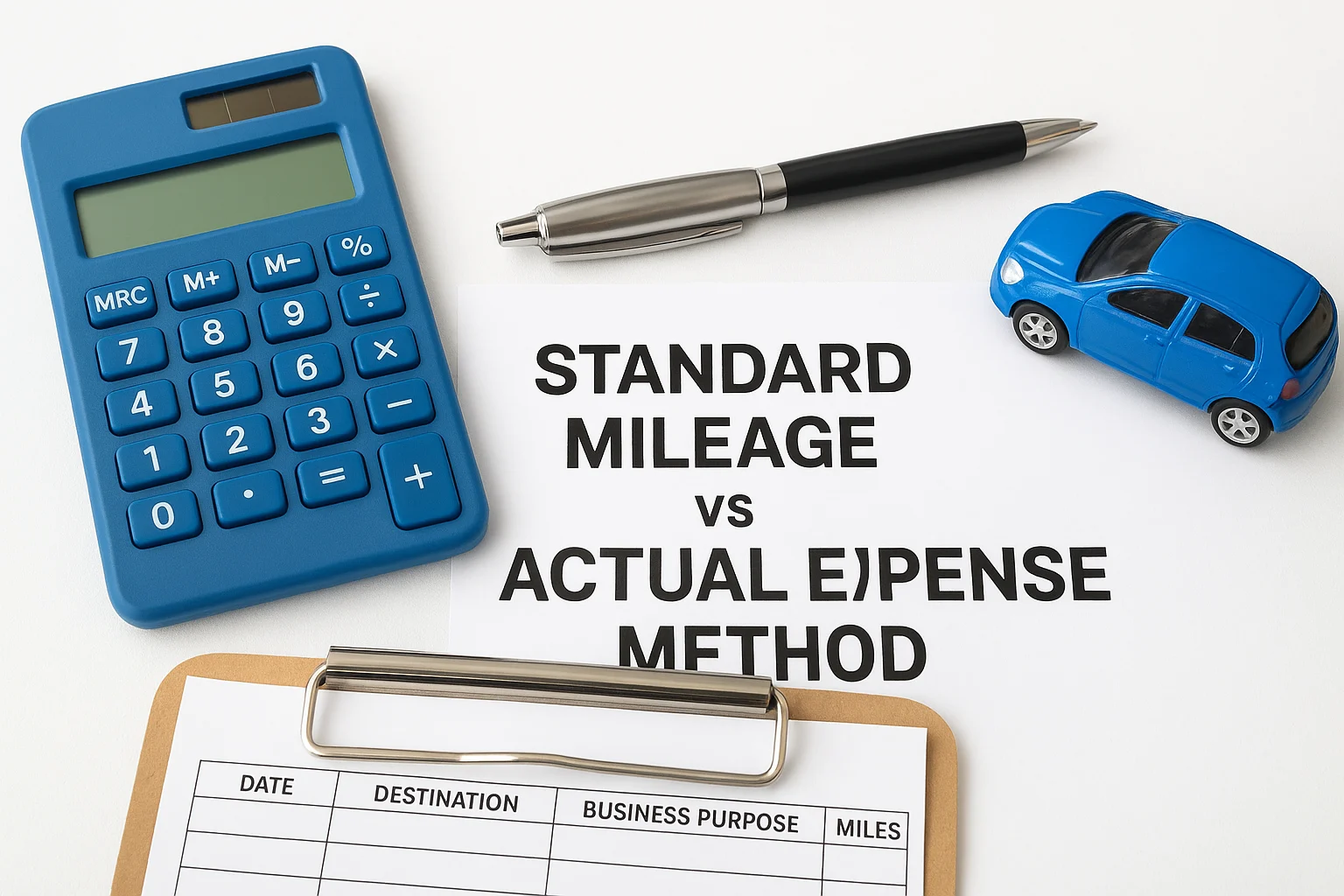
You must choose the standard mileage rate in the first year you use a vehicle for business if you want the option to switch methods in future years.
What counts as business miles
Driving to meet clients, travel between job sites, pick up supplies, and attend business-related appointments all count as business miles. Commuting from your home to a regular office does not qualify, regardless of how far you live from work. Miles driven for errands that serve both personal and business purposes require you to separate and document only the business portion.
Parking, tolls, registration, and insurance
Parking fees and tolls paid during business travel are deductible in addition to your mileage deduction under the standard rate method. Vehicle registration fees and insurance costs are only deductible under the actual expense method, not alongside the standard rate.
Proof to keep in case of audit
Maintain a mileage log that records the date, destination, business purpose, and miles driven for every business trip. Keep receipts for tolls and parking, and retain all vehicle expense records if you use the actual expense method.
10. Travel and lodging
Travel and lodging costs are fully deductible small business tax deductions when the trip serves a legitimate business purpose. The IRS allows you to deduct ordinary and necessary travel expenses incurred while traveling away from your tax home overnight for business reasons.
What qualifies as business travel
Your trip qualifies when its primary purpose is business-related, such as attending a conference, meeting clients, visiting a job site, or scouting a new market. You must travel far enough from your regular place of business that an overnight stay is reasonable and necessary, not just convenient.
The IRS defines your "tax home" as the area where your principal place of business is located, not necessarily where you live.
Airfare, hotels, local transportation, and incidentals
You can deduct economy or business-class airfare, train tickets, and bus fares paid for business travel. Hotel and lodging costs are fully deductible for the nights you are away on business. Local transportation costs at your destination, including taxis, rideshares, and rental cars used for business purposes, also qualify in full.

Mixing personal days with a business trip
When you add personal days to a business trip, the rules split. Airfare remains fully deductible as long as the primary purpose of the trip was business. Lodging and transportation costs, however, are only deductible for the days tied directly to business activity, so you need to allocate those expenses day by day.
Proof to keep in case of audit
Retain flight and hotel receipts, itineraries, and boarding passes for every trip. Keep a written record of the business purpose for each day you claim as a deductible travel day, including who you met with and why.
11. Meals and employee events
Meals are among the most frequently misunderstood small business tax deductions in the tax code. The IRS imposes strict limits on how much you can deduct, so knowing the rules before you claim anything is essential.
The 50% rule and when 100% can apply
The default rule is that business meal deductions are capped at 50% of the actual cost. This applies to meals with clients, meals during business travel, and most other situations where food costs arise in a business context. However, a 100% deduction applies when you provide meals to employees at a company-wide event, such as a holiday party or annual picnic that is open to all staff.
The 100% exception for employee events applies only when the event is primarily for the benefit of all employees, not just executives or key personnel.
Client meals vs meals for employees
Client meals require a clear business discussion to take place during or directly before or after the meal in order to qualify. Meals provided to employees as part of their compensation or for the convenience of the employer follow a separate set of rules and documentation standards than client entertainment does.
What details you must document
You must record the date, location, total cost, business purpose, and the names of everyone present at each meal to support your deduction. Without these details, the IRS can disallow the entire expense.
Proof to keep in case of audit
Retain itemized receipts rather than credit card summaries, since the IRS requires proof of exactly what was purchased. Attach a brief written note to each receipt explaining the business purpose and who attended.
12. Payroll, benefits, and contractor pay
Payroll-related costs represent some of the largest small business tax deductions available to business owners who hire workers. The IRS allows you to deduct wages, salaries, benefits, and payroll taxes paid to employees performing legitimate work for your business under Section 162.
Employee wages, payroll taxes, and benefits
Gross wages and salaries paid to your employees are fully deductible in the year you pay them, as long as the compensation is reasonable for the work performed. You can also deduct your share of payroll taxes, including Social Security and Medicare contributions, along with health insurance premiums, retirement plan contributions, and other qualifying fringe benefits you provide.
Contractor payments and 1099 basics
When you pay an independent contractor $600 or more in a calendar year, you are required to issue a Form 1099-NEC, and the full payment is deductible as a business expense. Collect a signed W-9 from every contractor before work begins so you have the information needed to file accurate 1099s at year-end.
Failing to issue required 1099 forms does not eliminate your deduction, but it can trigger IRS penalties and increased scrutiny on your return.
Common misclassification risks
Misclassifying an employee as an independent contractor is one of the most costly payroll mistakes small business owners make. The IRS applies behavioral, financial, and relationship tests to determine proper worker classification, and getting it wrong can result in back payroll taxes, penalties, and interest.
Proof to keep in case of audit
Retain payroll records, tax filings, and benefit plan documents for at least four years. Keep signed contractor agreements, W-9 forms, and copies of all 1099s issued alongside payment confirmations for every worker you compensated during the year.
13. Depreciation, Section 179, and bonus depreciation
Depreciation is how the IRS lets you recover the cost of long-term business assets over time rather than in a single tax year. For most small businesses, waiting years to fully deduct an expensive purchase is not ideal, which is why Section 179 and bonus depreciation exist as accelerated recovery options within the broader category of small business tax deductions.
What property qualifies
Tangible personal property used in your business qualifies for depreciation treatment, including computers, machinery, vehicles, and office furniture. Certain qualified improvement property, such as upgrades to the interior of a nonresidential building you use for business, also qualifies. Land and inventory do not qualify for depreciation since land does not wear out and inventory is already deducted as a cost of goods sold.
Section 179 limits and income restrictions
Section 179 lets you deduct the full cost of qualifying property in the year you place it in service rather than spreading that cost across several years. For 2026, the deduction limit is $1,160,000, and it begins to phase out dollar-for-dollar once total qualifying purchases exceed $2,890,000.
Section 179 cannot create a business loss, so your deduction is limited to your net business income for the year.
Bonus depreciation rules and timing
Bonus depreciation allows you to deduct a percentage of a qualifying asset's cost immediately in the first year. Under current law, the bonus depreciation percentage continues to phase down, so timing your asset purchases carefully matters for maximizing the benefit.
Forms and documentation to keep
Report Section 179 elections on Form 4562 and attach it to your business return. Retain purchase receipts, asset descriptions, and in-service dates for every item you depreciate, along with records showing the percentage of business use if the asset serves mixed purposes.
Final takeaway
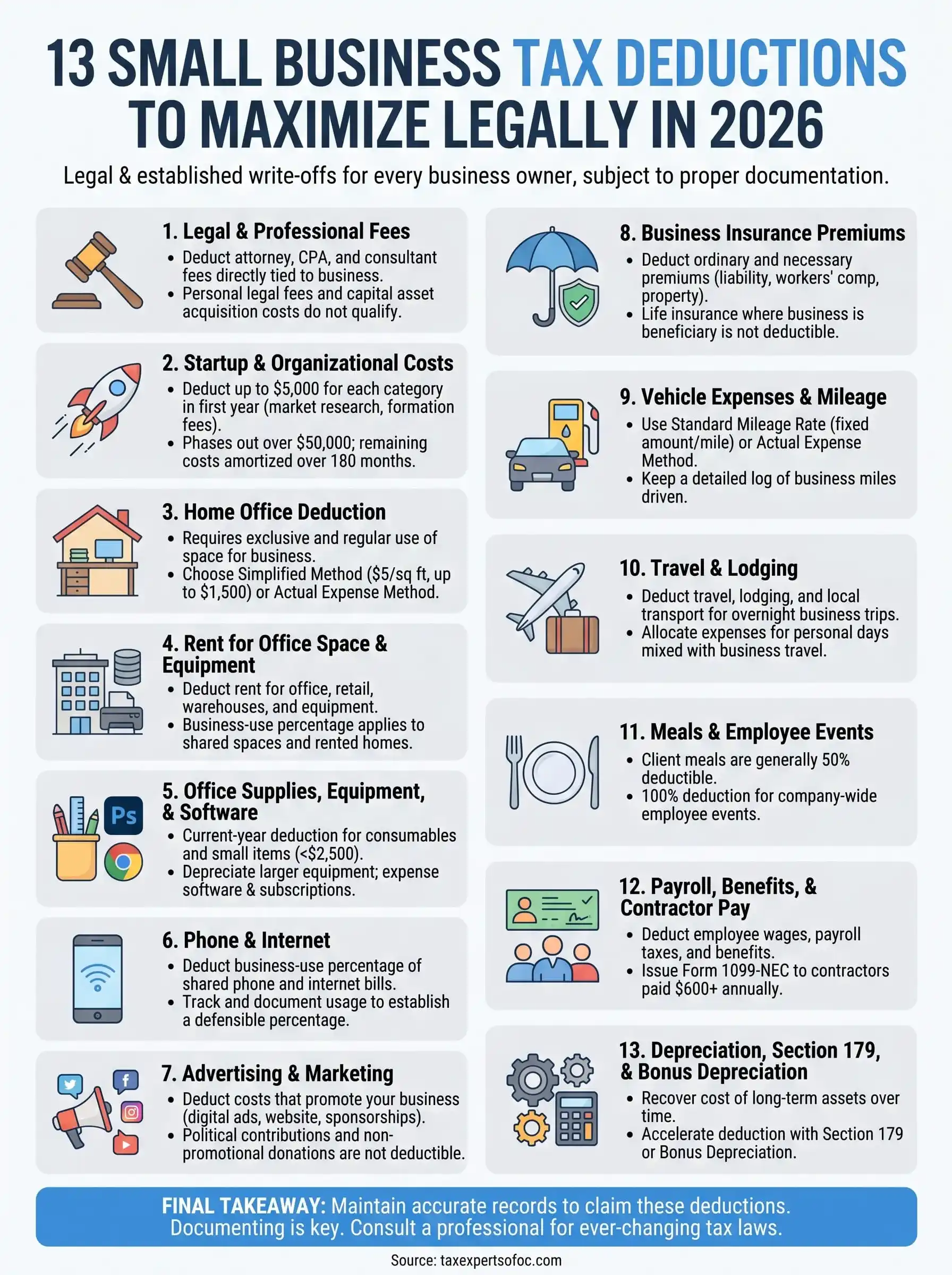
These 13 small business tax deductions cover the expenses that consistently make the biggest difference for business owners who take the time to claim them correctly. Every deduction in this guide is legal, well-established, and available to you right now, but only if you maintain accurate records and apply each rule to your specific business structure. Skipping documentation or misapplying a deduction is often more costly than missing the write-off entirely.
Tax law does not stay still. Limits, phase-outs, and bonus depreciation percentages shift from year to year, and what applied in 2025 may work differently in 2026. If you want to make sure you are capturing every deduction you are entitled to without triggering IRS scrutiny, working with a qualified professional makes a real difference. Schedule a free consultation with Tax Experts of OC to review your situation and build a strategy that keeps more money in your business.