

Most small business owners pay more in taxes than they need to, not because they're earning too much, but because they're missing deductions they legitimately qualify for. Knowing the right tax deductions for small business owners can mean the difference between owing the IRS thousands and keeping that money in your business.
The tax code offers real opportunities to reduce what you owe, but only if you know where to look. Some deductions are straightforward, like office supplies and mileage. Others, like the qualified business income deduction or home office write-off, have specific rules and thresholds that trip people up. Missing even one can cost you. Claiming one incorrectly can cost you more.
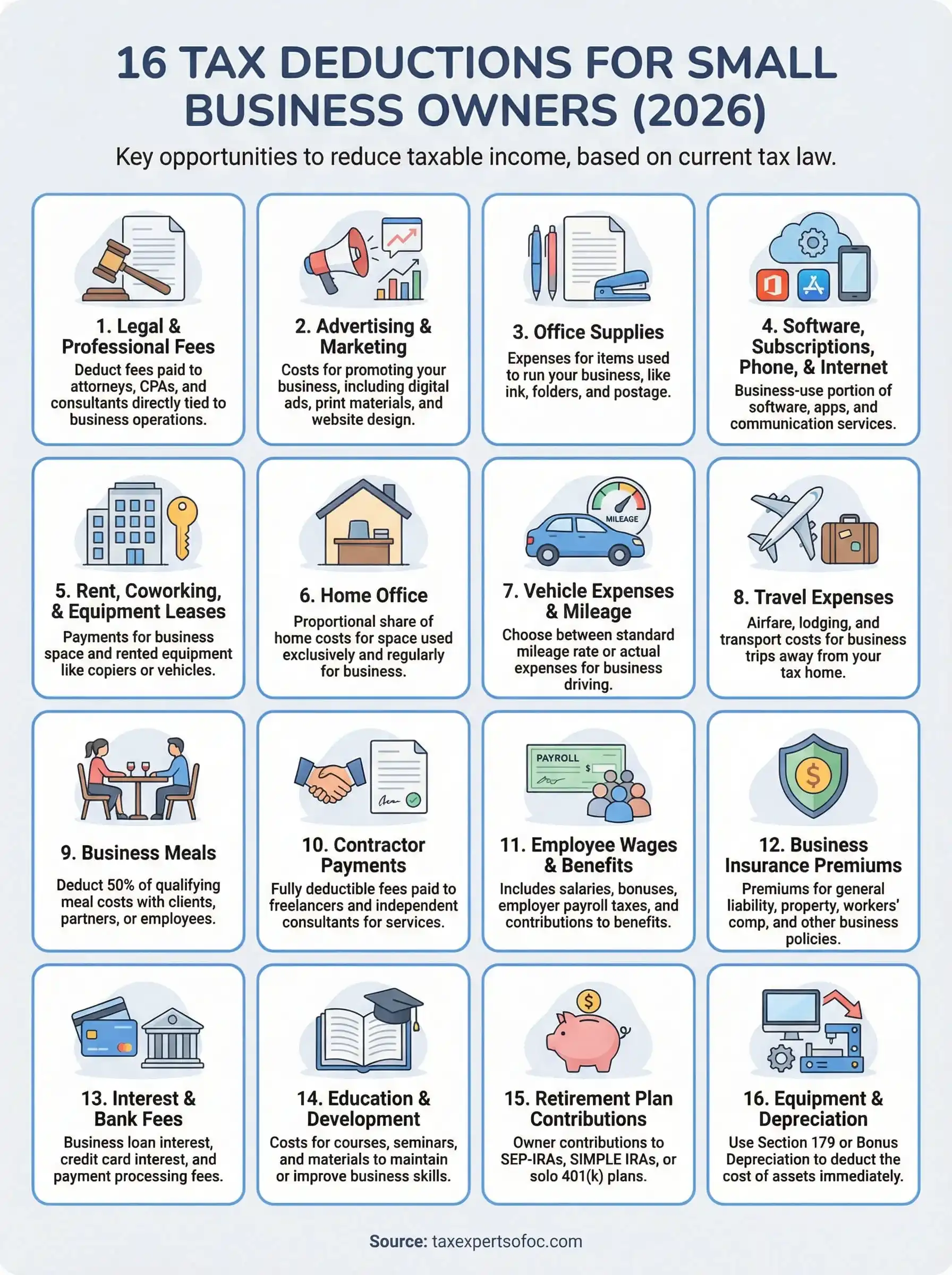
At Tax Experts of OC, our CPAs and Enrolled Agents work with small business owners across all 50 states to make sure they're capturing every deduction they're entitled to, and structuring things properly so those deductions hold up if the IRS comes asking. Below, we break down 16 deductions you should know about for the 2025 tax year, what qualifies, and how to claim each one correctly.
1. Legal and professional fees
When you hire professionals to help run your business, the IRS generally allows you to deduct those costs as ordinary and necessary business expenses under IRC Section 162. This is one of the more accessible tax deductions for small business owners, but there are clear boundaries you need to respect to avoid problems at filing time.
What you can deduct
Legal and professional fees directly tied to your business operations qualify for a full deduction. This includes fees paid to attorneys for contract review, employment disputes, and business formation advice. It also covers payments to CPAs, tax professionals, and bookkeepers who handle your business finances or prepare your business tax return.
Other deductible professional costs include:
- Consulting fees for business strategy or operations
- Tax preparation fees specific to your business return
- Fees for tax resolution services or IRS representation
- Financial advisor fees related to business finances
Personal legal fees, such as those for a divorce or a personal injury case, are not deductible, even if you pay them from a business account.
Eligibility rules to know
The IRS requires that fees be ordinary, necessary, and directly connected to your business to qualify. If a fee covers both personal and business purposes, you can only deduct the business portion of the expense. For example, if an attorney handles a business contract and a personal estate matter in the same engagement, you need to separate the invoices before claiming a deduction.
You cannot deduct legal fees incurred to acquire a capital asset, such as costs to purchase another business or real estate. Those fees must be capitalized and recovered over time rather than expensed in the current year.
How to calculate the deduction
Add up all qualifying professional fees paid during the tax year and report them on the appropriate schedule. Sole proprietors report these on Schedule C, Line 17. Partnerships and S-corporations report them on their respective business returns. If you split a fee between personal and business use, deduct only the percentage that corresponds to the business portion.
Records to keep
Strong documentation is your best protection if the IRS questions a deduction. Keep the following for every professional you pay:
- Invoices showing the date, service description, and amount billed
- Proof of payment, such as a bank statement, canceled check, or credit card statement
- Engagement letters or contracts that describe the scope of services
- A brief written note if the invoice does not clearly state the business purpose
2. Advertising and marketing
Promoting your business costs money, and the IRS lets you deduct those costs as ordinary and necessary business expenses. Advertising and marketing represent one of the most commonly used tax deductions for small business owners, covering everything from Google Ads to printed flyers.
What you can deduct
Most costs you pay to attract or retain customers qualify. This includes digital advertising such as paid search campaigns, social media ads, and sponsored content. It also covers print ads, business cards, signage, website design and maintenance, email marketing platforms, and promotional materials like branded merchandise.
Eligibility rules to know
The expense must be directly tied to promoting your business, its products, or its services. Political contributions and donations to candidates, even if you believe they benefit your business, are not deductible as advertising. Also, costs to sponsor a charitable event are treated as charitable contributions, not advertising, unless your business name or logo is displayed as part of the sponsorship.
If you pay an influencer or content creator to promote your business, that payment may require a Form 1099-NEC if it exceeds $600 in a calendar year.
How to calculate the deduction
Add up all qualifying advertising and marketing costs paid during the tax year. Sole proprietors deduct these on Schedule C, Line 8. There is no cap on this deduction, so every dollar you spend on legitimate promotion counts.
Records to keep
Keep invoices, receipts, and contracts from every vendor or platform you pay. Save screenshots of ad campaigns and retain any agreements with designers or agencies that describe the work performed.
3. Office supplies and materials
Office supplies are one of the most straightforward tax deductions for small business owners, but that simplicity can lead to sloppy recordkeeping. Staying organized here pays off when you need to back up your deduction.
What you can deduct
You can deduct the cost of supplies you use to run your business during the tax year. This includes pens, paper, printer ink, folders, postage, cleaning supplies for your workspace, and shipping materials. If you buy items in bulk, you can deduct only what you actually used during the year, not the full purchase if some stock carries over.
Eligibility rules to know
The IRS requires that supplies be used in your business, not in your personal life. If you buy a box of pens and half go home for personal use, only deduct the business share. Items that have a useful life beyond one year, such as a heavy-duty label maker or a standing desk, typically need to be treated as equipment and depreciated rather than expensed outright.
Supplies purchased for a home office must still pass the exclusive business use test before any portion qualifies as a deduction.
How to calculate the deduction
Total your qualifying supply purchases for the year. Sole proprietors report this on Schedule C, Line 22. If you split a purchase between personal and business use, apply the business-use percentage to get your deductible amount.
Records to keep
Save every receipt and invoice for office supply purchases. Note the business purpose on any receipt that does not make it obvious, and store records for at least three years from your filing date.
4. Software, subscriptions, phone, and internet
Running a business today means paying for tools that keep everything moving, and those costs add up fast. Fortunately, software, subscriptions, and communication expenses count among the most accessible tax deductions for small business owners available.
What you can deduct
You can deduct the cost of software and digital tools you use to operate your business. This covers accounting programs, project management platforms, cloud storage, cybersecurity services, and any subscription tied to business productivity. Your monthly phone and internet bills also qualify to the extent you use them for business.
- Business accounting and invoicing software
- Video conferencing and communication tools
- Cloud storage and backup services
- Industry-specific apps or platforms
- Business line phone costs
Eligibility rules to know
The IRS requires that each expense serve a legitimate business purpose. Personal streaming services, gaming subscriptions, or any software used exclusively for non-business activity does not qualify. If you use your personal phone or home internet for both work and personal purposes, you can only deduct the business-use percentage of each bill.
Estimate your business-use percentage based on actual usage patterns and document your method in case the IRS asks.
How to calculate the deduction
Add up all qualifying software fees and subscription costs paid during the year. For shared-use expenses like your phone or internet, apply your business-use percentage to the annual total. Sole proprietors report these costs on Schedule C, Line 18 for office expenses or Line 25 for utilities and phone.
Records to keep
Keep monthly billing statements and receipts for every subscription and service. Note the business purpose on each account, and save any documentation that supports the percentage you used for shared-use expenses.
5. Rent, coworking, and equipment leases
If your business pays for space or equipment it does not own, those payments typically qualify as deductible expenses under IRC Section 162. Rent and lease costs are among the most overlooked tax deductions for small business owners, particularly for those using coworking memberships or leasing vehicles and equipment rather than buying them outright.
What you can deduct
You can deduct rent paid for office space, retail locations, warehouses, or storage units used exclusively for business. Coworking memberships and day-pass fees also qualify if you use that space to conduct business. Equipment lease payments for items like copiers, vehicles, machinery, or point-of-sale systems are fully deductible in the year you make the payment.
Eligibility rules to know
The space or equipment must be used for business purposes, not personal ones. If you lease a vehicle and use it for both work and personal trips, you can only deduct the business-use portion of those lease payments. The IRS also distinguishes between a true lease and a conditional sales contract, so if your agreement gives you the option to buy the equipment at a below-market price at the end of the term, the IRS may treat the arrangement as a purchase instead.
Review your lease agreements with a tax professional before filing to confirm the IRS will classify them as true leases.
How to calculate the deduction
Add up all qualifying rent and lease payments made during the tax year. Sole proprietors report rent on Schedule C, Line 20b and equipment lease costs on Line 20a.
Records to keep
Keep signed lease agreements, monthly statements, and proof of payment for every space and piece of equipment you rent. Note the business purpose on any lease where it is not immediately clear from the document itself.
6. Home office
The home office deduction is one of the most frequently missed tax deductions for small business owners, and also one of the most frequently misunderstood. If you use part of your home regularly and exclusively for business, the IRS allows you to deduct a portion of your housing costs.

What you can deduct
Your deductible home office expenses include a proportional share of rent or mortgage interest, utilities, homeowner's or renter's insurance, and general home repairs that benefit the entire property. You can also deduct costs for improvements made directly to the office space itself.
Eligibility rules to know
The IRS enforces a strict test: the space must be used regularly and exclusively for business. A spare bedroom where you also store personal items or let guests sleep does not qualify. Your home office also needs to be your principal place of business, or a location where you meet clients on a regular basis.
Using even a small portion of your home office space for personal activity can disqualify the entire deduction.
How to calculate the deduction
Two methods are available. The simplified method lets you deduct $5 per square foot of your home office, up to 300 square feet, for a maximum of $1,500. The regular method calculates the percentage of your home used for business and applies that to your actual home expenses. Use IRS Form 8829 when claiming the regular method.
Records to keep
Document your office square footage and total home square footage to support whichever method you choose. Keep utility bills, rent receipts, and mortgage statements for the full tax year.
7. Vehicle expenses and mileage
If you use a car or truck for business, those costs qualify as tax deductions for small business owners and can add up to a meaningful reduction in your taxable income. The IRS gives you two methods to calculate the deduction, so choosing the right one depends on your situation.

What you can deduct
You can deduct the costs of driving to meet clients, traveling between job sites, making deliveries, or running business-related errands. Eligible vehicles include cars, trucks, vans, and SUVs used at least partially for business. Commuting from your home to a regular office does not qualify.
Eligibility rules to know
The vehicle must be used for legitimate business purposes, and the IRS expects you to track every trip. Personal use, including commuting, does not count. If you use the same vehicle for business and personal driving, you can only deduct the business-use portion of your total costs.
Mixing business and personal trips in the same vehicle is fine, but you must track each separately to avoid losing the deduction.
How to calculate the deduction
The IRS offers two options. The standard mileage rate for 2025 is 70 cents per mile for business travel, which you multiply by your total qualifying miles. The actual expense method lets you deduct the business-use percentage of your real costs, including gas, insurance, repairs, and depreciation. You cannot switch from actual expenses back to the standard rate once you have used actual expenses for that vehicle.
Records to keep
Maintain a mileage log that records the date, destination, business purpose, and miles driven for each trip. Also save fuel receipts, repair invoices, and insurance statements if you use the actual expense method.
8. Travel expenses
Business travel is a legitimate and often substantial cost, and it counts as one of the more valuable tax deductions for small business owners. When you travel away from your tax home for business purposes, most of the trip's costs are fully deductible.
What you can deduct
Travel expenses cover the full range of costs you incur when business takes you away from your home area overnight. Airfare, train tickets, and rental cars qualify, as do hotel stays, taxis, rideshares, and tips paid to service workers during the trip. You can also deduct dry cleaning and laundry costs incurred during a business trip, as well as baggage fees and shipping costs for work materials.
Eligibility rules to know
The IRS requires that the primary purpose of the trip be business. If you combine a vacation with a work conference, you can only deduct the business portion of travel costs, and lodging applies only to the days you conduct actual business. Trips taken solely for personal reasons do not qualify, even if you do minor work while away.
If your trip is outside the United States, special rules apply to the allocation of expenses between business and personal days.
How to calculate the deduction
Add up all qualifying travel costs paid during the tax year. Sole proprietors report travel expenses on Schedule C, Line 24a. Keep business and personal costs separated from the start so you are not reconstructing the split later.
Records to keep
Keep receipts for every travel expense, including boarding passes, hotel folios, and rental agreements. Record the business purpose and dates of each trip in a travel log or expense report.
9. Business meals
Meals with clients, partners, or employees can qualify as tax deductions for small business owners, but the IRS limits the deduction to 50% of the cost in most situations. Understanding exactly what qualifies helps you claim this deduction confidently without risking a disallowance.
What you can deduct
You can deduct 50% of the cost of a business meal when the meal has a clear business purpose and you or an employee is present. This covers meals with clients, prospective customers, and business partners, as well as meals eaten during business travel. Meals provided to employees at your workplace for your convenience as an employer may also qualify.
Eligibility rules to know
The IRS requires that the meal be directly related to your business and not lavish or extravagant given the circumstances. Entertainment costs, such as tickets to sporting events or concerts, are no longer deductible even if you discuss business during them. Only the food and beverage portion of an expense qualifies under current law.
A meal where no business is discussed or no business relationship exists will not survive IRS scrutiny, so document the purpose clearly every time.
How to calculate the deduction
Multiply your total qualifying meal costs by 50% to arrive at your deductible amount. Sole proprietors report this on Schedule C, Line 24b. If a client reimburses you for a meal, that expense does not qualify for a deduction on your return.
Records to keep
Keep itemized receipts for every business meal you claim. For each one, note the date, location, business purpose, and the names of everyone present. Credit card statements alone are not sufficient because they do not show the itemized bill.
10. Contractor payments and freelancer costs
Hiring independent contractors and freelancers to handle specific work is common for small businesses, and those payments are fully deductible as ordinary and necessary business expenses. This is one of the more straightforward tax deductions for small business owners, but the IRS attaches reporting requirements that you need to follow.

What you can deduct
You can deduct the full amount you pay to independent contractors, freelancers, and consultants who perform services for your business. This covers web developers, graphic designers, writers, bookkeepers, photographers, and any other non-employee you pay to complete business-related work.
Eligibility rules to know
The worker must be genuinely independent, not misclassified. If the IRS determines that someone you treated as a contractor is actually an employee based on the level of control you exercise over their work, you could face back payroll taxes and penalties. Review the IRS worker classification guidelines before you file.
If you pay a contractor $600 or more during the calendar year, you must issue them a Form 1099-NEC by January 31 of the following year.
How to calculate the deduction
Add up all payments made to qualifying contractors during the tax year. Sole proprietors report these costs on Schedule C, Line 11 for contract labor.
Records to keep
Keep invoices, contracts, and proof of payment for every contractor you hire. Also retain a completed Form W-9 from each contractor before you pay them, which gives you the information you need to issue a 1099 if the payment threshold is met.
11. Employee wages, payroll taxes, and benefits
If you have people on payroll, what you pay them is one of the largest and most impactful tax deductions for small business owners available. The IRS allows you to deduct wages, salaries, bonuses, and employer-side payroll taxes as ordinary and necessary business expenses under IRC Section 162.
What you can deduct
You can deduct all reasonable compensation paid to employees, including hourly wages, salaries, commissions, and bonuses. Employer contributions to health insurance premiums, retirement plans, and other employee benefits also qualify. Your share of Social Security and Medicare taxes (FICA) and any federal and state unemployment taxes you pay on behalf of employees are fully deductible as well.
Eligibility rules to know
The IRS requires that wages be reasonable and actually paid for services rendered to the business. You cannot deduct compensation paid to yourself as a sole proprietor or a partner in a partnership, since those payments are treated as owner draws, not deductible wages. S-corporation shareholders who actively work in the business must receive a reasonable salary, which the company then deducts.
Paying yourself an unreasonably low salary through an S-corporation to reduce payroll taxes is a well-known IRS audit trigger.
How to calculate the deduction
Add up all qualifying wages, employer payroll taxes, and benefit contributions paid during the tax year. Sole proprietors report employee wages on Schedule C, Line 26. Payroll taxes you paid as the employer go on Line 23.
Records to keep
Keep payroll registers, W-2 forms, and payroll tax filings for every employee. Retain benefit contribution statements and any employment agreements that support the compensation figures you report.
12. Business insurance premiums
Business insurance is a real cost of doing business, and the IRS treats it as one. Premiums you pay to protect your business qualify as ordinary and necessary expenses, making insurance one of the more accessible tax deductions for small business owners available to you.
What you can deduct
The range of deductible insurance is broad. You can deduct premiums for general liability, professional liability (errors and omissions), commercial property, and business interruption insurance. Workers' compensation coverage, commercial auto insurance on business vehicles, and cyber liability policies also qualify. If you are self-employed and pay for your own health insurance, that premium is deductible under a separate provision as an adjustment to income on Schedule 1, rather than on Schedule C.
Eligibility rules to know
The policy must cover your business, not a personal asset. Life insurance premiums where your business is the beneficiary are not deductible. Also, if you receive an insurance reimbursement for a loss, you cannot deduct the portion of the premium that corresponds to that reimbursed coverage.
Prepaid premiums that cover periods beyond the current tax year must be deducted in the year the coverage applies, not the year you paid.
How to calculate the deduction
Add up all qualifying insurance premiums paid during the tax year. Sole proprietors report this on Schedule C, Line 15. If a single policy covers both personal and business assets, deduct only the business-use portion of that premium.
Records to keep
Keep insurance declarations pages, invoices, and proof of payment for every policy you claim. Retain these records for at least three years from your filing date.
13. Interest, bank fees, and payment processing
The cost of borrowing money and accepting payments is a real business expense, and the IRS lets you deduct it. For many small business owners, these charges accumulate quietly in the background, making them some of the most overlooked tax deductions for small business owners on this list.
What you can deduct
You can deduct interest paid on business loans, business credit cards, and lines of credit used for your operations. Bank service charges, wire transfer fees, overdraft fees on business accounts, and payment processing fees charged by platforms like Stripe or Square also qualify as deductible business expenses.
Eligibility rules to know
The loan or credit account must be used for business purposes, not personal ones. If you carry a balance on a card you use for both personal and business purchases, only the interest attributable to business charges is deductible. Mixing personal and business debt on the same account complicates this calculation significantly and creates risk at audit.
Keeping a dedicated business bank account and business credit card is the simplest way to protect these deductions from IRS scrutiny.
How to calculate the deduction
Add up all qualifying interest charges, bank fees, and processing fees paid during the tax year. Sole proprietors report business interest on Schedule C, Line 16, and bank service charges or processing fees on Line 27a as other expenses.
Records to keep
Keep monthly bank and credit card statements that show every fee and interest charge you plan to deduct. Also retain loan agreements and payment processor reports that confirm the amounts paid and tie each account directly to your business operations.
14. Education and professional development
Staying sharp in your field costs money, and those costs can work in your favor at tax time. The IRS allows you to deduct education and training expenses that maintain or improve skills required in your current business, making this one of the more useful tax deductions for small business owners who invest regularly in their knowledge.
What you can deduct
Qualifying education expenses include courses, workshops, seminars, and professional certifications that relate directly to your current trade or business. You can also deduct the cost of industry books, trade publications, and online learning platforms you use for professional purposes. Continuing education required to maintain a professional license qualifies as well.
Eligibility rules to know
The IRS draws a firm line here. Education that qualifies you for a new career or trade does not qualify, even if it is related to your industry. For example, a bookkeeper who enrolls in law school cannot deduct tuition because that education leads to a different profession entirely. The training must maintain or improve skills in your existing business.
If a course qualifies you for a new profession, it does not qualify as a deductible business expense, regardless of any overlap with your current work.
How to calculate the deduction
Add up all qualifying education costs paid during the tax year. Sole proprietors report these on Schedule C, Line 27a as other business expenses. There is no dollar cap on this deduction.
Records to keep
Keep receipts, enrollment confirmations, and course descriptions for every program you claim. Retain documentation that shows the direct connection between the training and your current business activities.
15. Retirement plan contributions for owners
Contributing to a retirement plan as a business owner does more than prepare you for the future. It reduces your taxable income right now, making retirement contributions one of the most powerful tax deductions for small business owners available to you at any income level.

What you can deduct
Self-employed owners can deduct contributions made to qualified retirement plans, including SEP-IRAs, SIMPLE IRAs, and solo 401(k) plans. The deduction covers your contributions as the employer, and in some plans, your contributions as an employee participant as well.
Eligibility rules to know
Your plan must be established and funded by your tax filing deadline, including extensions, to count toward that tax year. Contribution limits vary by plan type. For 2025, a SEP-IRA allows you to contribute up to 25% of net self-employment income, with a maximum of $70,000. A solo 401(k) allows both employee and employer contributions, which can push your total contribution significantly higher.
Contributions you make on behalf of employees through a retirement plan are deducted separately as a benefit expense, not alongside your own owner contributions.
How to calculate the deduction
Self-employed owners must first calculate their net self-employment income after subtracting half of their self-employment tax. Apply your plan's contribution rate or dollar limit to that figure. Sole proprietors deduct retirement contributions on Schedule 1, Line 16, not on Schedule C.
Records to keep
Keep plan documents, contribution confirmations, and annual statements from your plan administrator. Retain proof of the contribution date to confirm the payment fell within the allowable window for the tax year you are claiming.
16. Equipment, furniture, and depreciation
Buying equipment and furniture for your business creates some of the most valuable tax deductions for small business owners on this entire list. Rather than slowly recovering the cost over years through standard depreciation, the IRS offers tools that let you deduct a large portion of the purchase price immediately in the year you put the asset to work.
What you can deduct
Qualifying purchases include computers, machinery, office furniture, and business vehicles used in your operations. Under Section 179, you can deduct the full purchase price of eligible equipment in the year you place it in service. Bonus depreciation allows an additional first-year deduction on both new and used qualifying property, which can further reduce your taxable income.
Eligibility rules to know
The asset must be placed in service and actively used for business during the tax year you claim the deduction. Section 179 carries an annual deduction limit of $1,220,000 for 2025, and you cannot claim more than your business's net taxable income for the year. Assets used partly for personal purposes require you to apply only the business-use percentage to your deduction.
Bonus depreciation phases down over time, so purchasing and placing equipment in service sooner generally yields a larger first-year write-off.
How to calculate the deduction
Use IRS Form 4562 to report all depreciation and Section 179 elections. Calculate your business-use percentage, apply it to the asset's cost, and select your preferred deduction method.
Records to keep
Keep purchase receipts, invoices, and documentation of the in-service date for every asset you depreciate. Retain a usage log showing the business-use percentage for any asset you also use for personal purposes.
Your next move
The 16 tax deductions for small business owners covered in this guide represent real money you can keep out of the IRS's hands, but only if you claim them correctly and back them up with solid records. Missing a deduction costs you. Claiming one without the right documentation can cost you even more if the IRS comes back with questions.
Knowing what you qualify for is step one. Working with a professional who can apply these rules to your specific business structure, income level, and filing situation is what turns a list like this into actual tax savings. At Tax Experts of OC, our CPAs and Enrolled Agents help small business owners across all 50 states capture every deduction they are entitled to while keeping their returns clean and defensible.
If you want to stop overpaying, schedule your free 30-minute consultation with Tax Experts of OC and find out exactly where you stand.