

Finding an IRS audit letter in your mailbox triggers instant panic, and that reaction makes sense. Your mind jumps to worst-case scenarios: penalties, back taxes, maybe even a full-blown investigation into your finances. Most audit letters are far less dramatic than that, but the letter itself is dense with IRS codes, deadlines, and legal language that gives you no clear sense of what actually happens next.
This article breaks down exactly what that letter means. You'll learn how to identify a genuine IRS notice versus a scam attempt, what the specific notice number tells you about why you're being contacted, and what the IRS expects from you within the response window they've set. We'll also cover the difference between a simple correspondence audit and a full field audit, since your next move depends heavily on which one you're facing.
At Tax Experts of OC, we handle these letters daily for clients across Orange County and nationwide. We know which responses resolve issues quickly and which ones drag a case out for months. By the end of this piece, you'll have a clear action plan and know when it's time to bring in a CPA or Enrolled Agent to represent you directly.
Why the IRS sent you an audit letter
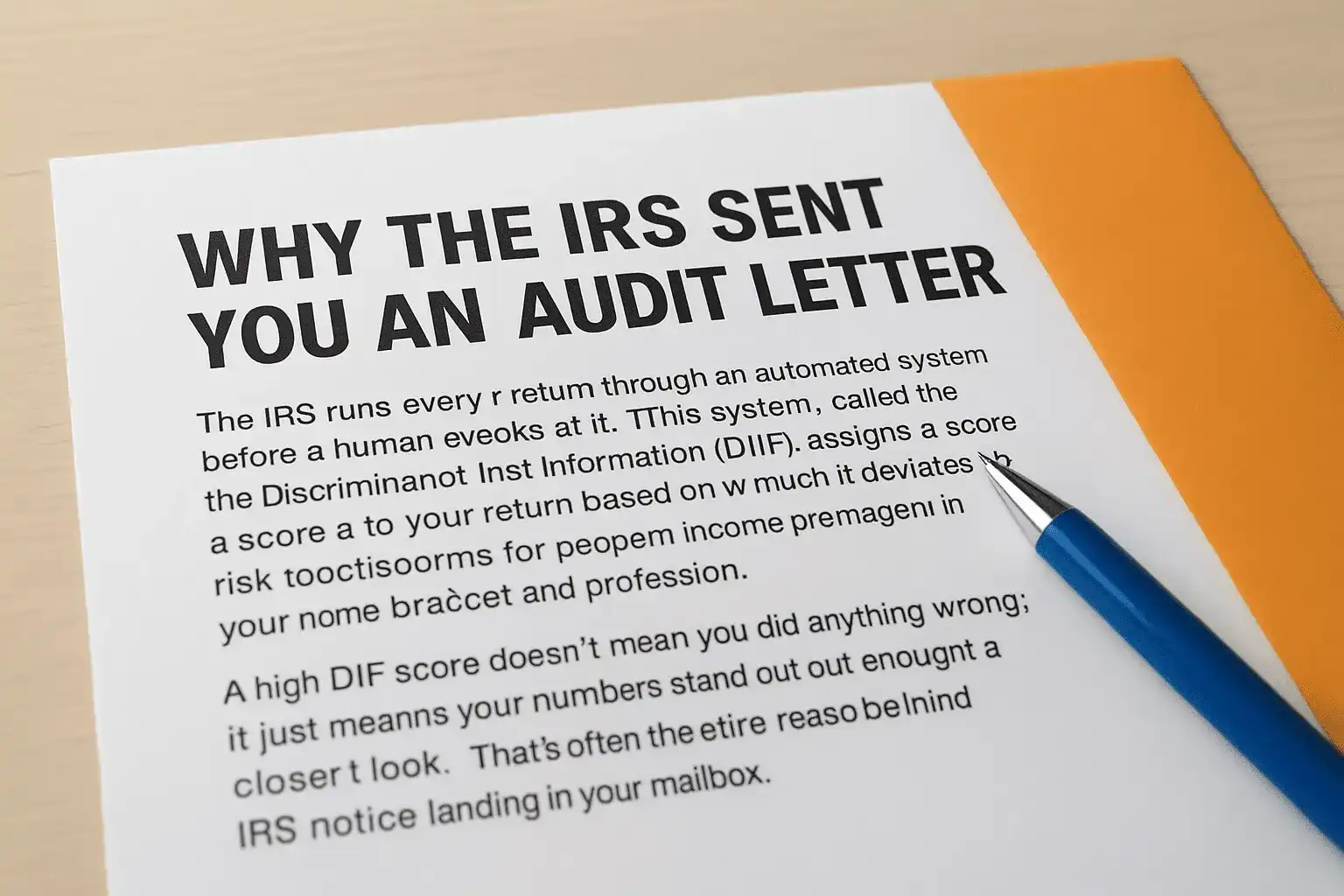
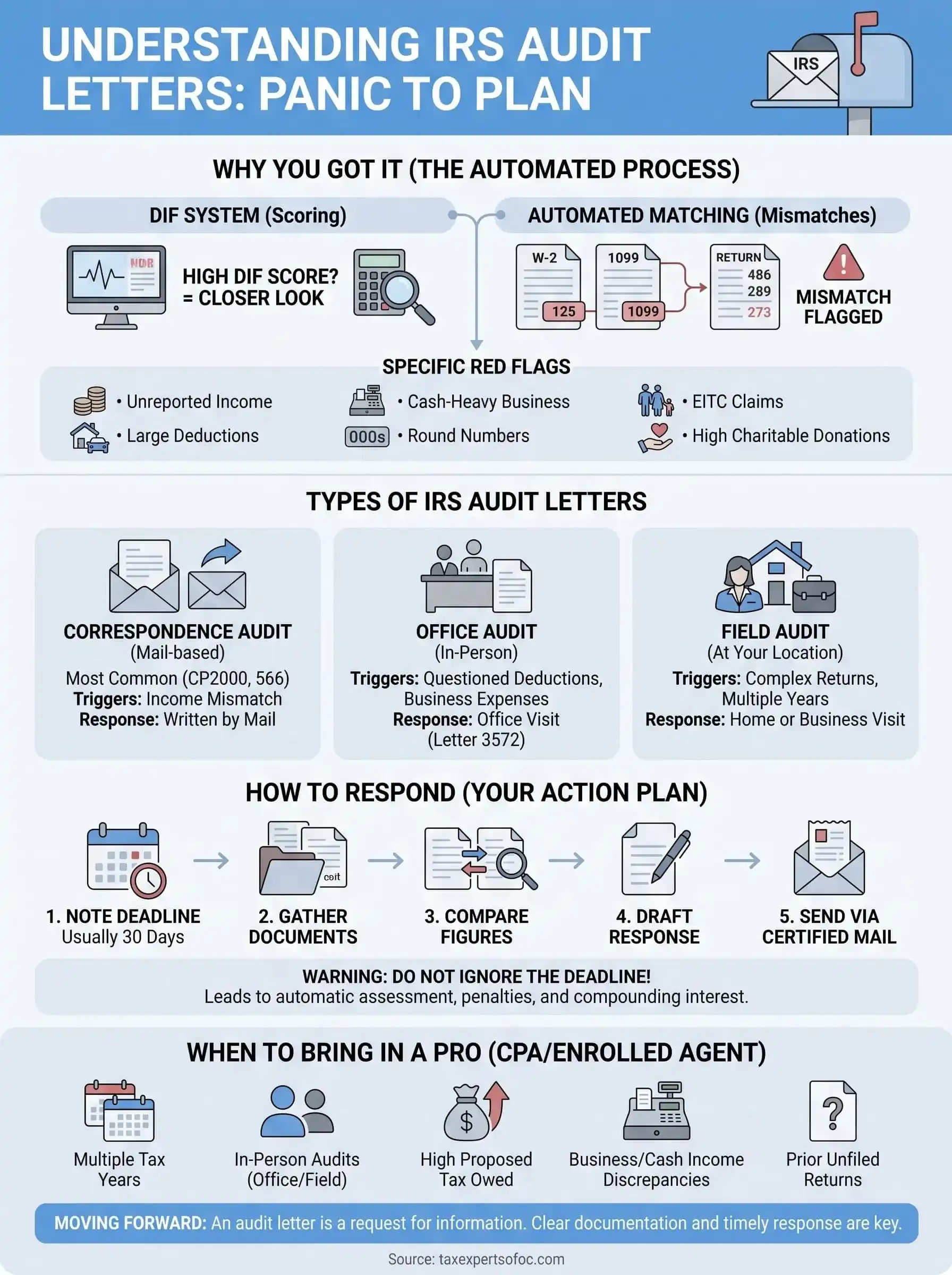
The IRS runs every return through an automated system before a human ever looks at it. This system, called the Discriminant Information Function (DIF), assigns a score to your return based on how much it deviates from statistical norms for people in your income bracket and profession. A high DIF score doesn't mean you did anything wrong, it just means your numbers stand out enough to warrant a closer look. That's often the entire reason behind an IRS notice landing in your mailbox.
The IRS matching system catches mismatches first
Beyond the DIF score, the IRS runs an automated matching program that compares every W-2, 1099, and 1098 filed by employers and banks against what you reported on your return. If your bank reports $40,000 in 1099-NEC income and you only claimed $32,000, the mismatch gets flagged automatically, no auditor required. This is the most common reason people receive a tax audit letter, and it's usually the easiest to resolve since the fix is often just providing documentation or amending the return.
Most audit letters start with a computer catching a number that doesn't match, not a person deciding to investigate you.
Specific red flags that increase your odds
Certain patterns on a return draw more scrutiny than others, regardless of how honestly you filed. Knowing these ahead of time helps you understand why your particular letter showed up:
- Unreported income that a third party already reported to the IRS
- Home office or vehicle deductions that seem large relative to reported income
- Cash-heavy business returns, especially in restaurants, salons, or construction
- Round numbers across multiple expense categories, which suggest estimates rather than records
- Earned Income Tax Credit claims, since this credit has a historically high error rate
- Charitable donations that exceed typical percentages for your income level
None of these guarantee an audit on their own, but stacking two or three of them together noticeably raises your risk profile in the IRS's system.
Confirming the letter is genuine before you respond
Scammers impersonate the IRS constantly, so verifying authenticity matters before you send anything back. A real audit letter always arrives by physical mail first, never by email, text message, or a phone call demanding immediate payment. It includes a notice or letter number in the top corner (commonly CP2000, Letter 566, or Letter 3572), your taxpayer identification number, and a specific tax year under review. The IRS also publishes guidance on recognizing scams directly on IRS.gov, which is worth checking if anything about the letter feels off, like threats of immediate arrest or requests for gift card payments.
Understanding which of these triggers applies to your situation changes how you approach your response. A simple income mismatch calls for a different strategy than a flagged home office deduction, and knowing the root cause before you reply keeps you from over-explaining or under-explaining your case.
How to respond to an IRS audit letter
Opening the envelope is the easy part. What you do in the next few days determines whether this becomes a quick fix or a drawn-out mess. Read the entire notice letter twice before doing anything else, since the specific tax year, the exact line items in question, and the response deadline are all buried in dense paragraphs that are easy to skim past.
Build your response step by step
Working through an audit response methodically saves you from missing something that reopens the case later. Follow this sequence:
- Note the deadline printed on the letter, typically 30 days from the notice date.
- Pull every document tied to the flagged item: receipts, bank statements, mileage logs, or 1099s.
- Compare the IRS figures against your own records line by line to spot the actual discrepancy.
- Draft a clear written response that addresses each point the IRS raised, nothing more and nothing less.
- Send copies, never originals, and mail everything via certified mail with a return receipt.
Calling the number on the letter can clarify small questions, but never agree to anything verbally that changes your reported tax liability. Get every commitment in writing.
Decide whether to agree or dispute
Sometimes the IRS is simply right, and the fastest path forward is agreeing to the proposed change and paying what's owed or setting up a payment plan. Other times the flagged item is fully documented on your end, and disputing it with clear evidence closes the matter without any additional tax owed. Deciding which path applies requires an honest look at your own records, not just a gut reaction to avoid conflict.
A well-organized response with clear documentation resolves most audit letters faster than a phone call ever will.
Mailing your response isn't the finish line. Keep a full copy of everything you send, including proof of mailing, since IRS processing delays sometimes stretch for months and a lost piece of correspondence shouldn't cost you the case you already won on paper.
Common types of IRS audit letters explained
Not every IRS audit letter looks the same, and the notice number in the corner tells you which kind you're dealing with. Correspondence audits, the most common type, get handled entirely through the mail and usually target a single line item. Office and field audits go much deeper, involve an in-person meeting, and often review multiple tax years at once. Recognizing which category your letter falls into shapes how much time and documentation you should expect to spend on it.
Correspondence audits handle simple mismatches
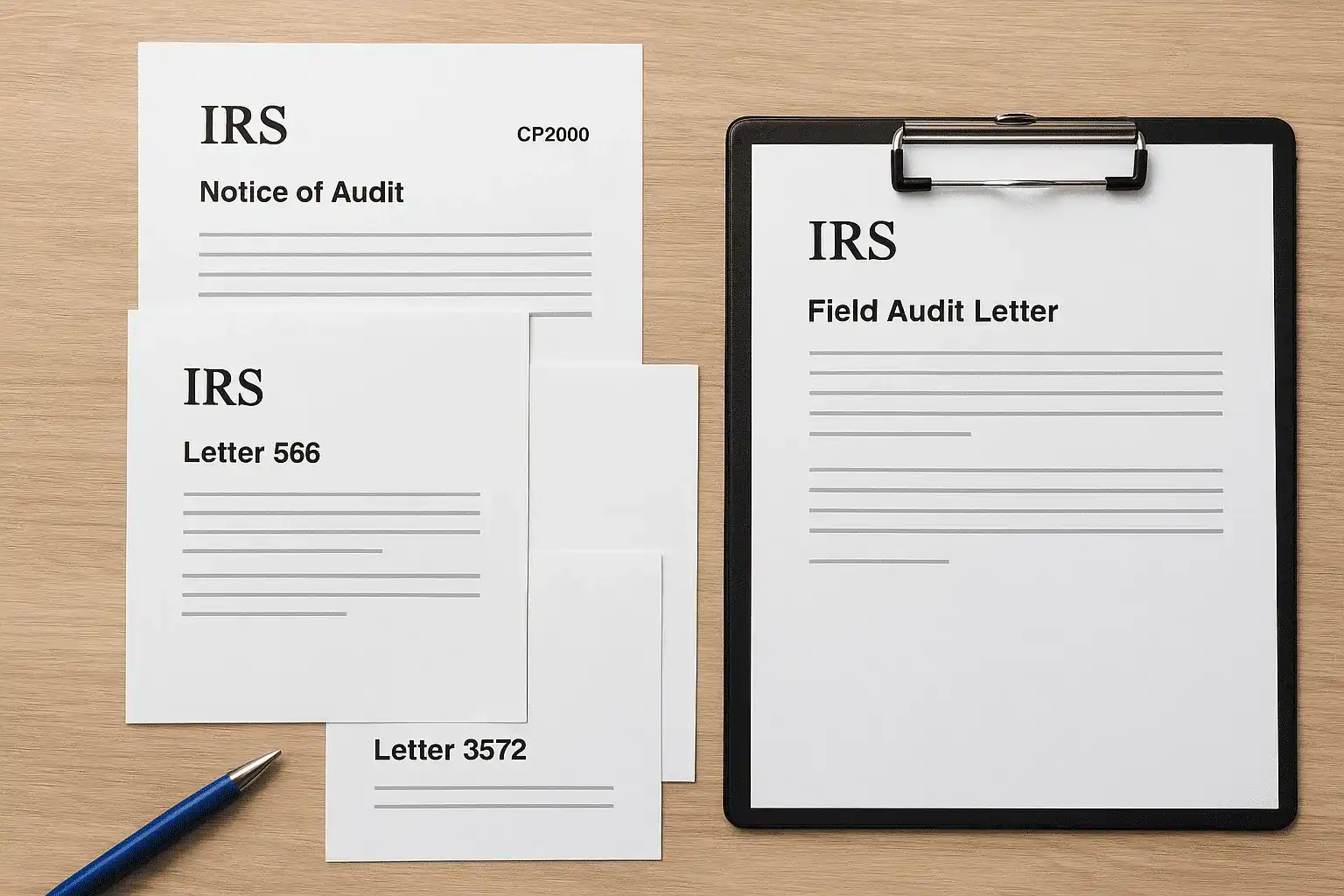
A CP2000 notice is the letter most taxpayers see, and it almost always stems from the income-matching mismatch described earlier. Letter 566 opens a similar review but gives the IRS more room to question deductions rather than just unreported income. These correspondence audits get resolved by mail, usually within a few months, and rarely require you to sit across from an agent.
The letter number in the corner tells you more about your case than the paragraph of text below it.
Office and field audits dig deeper
Letter 3572 schedules an in-person office audit, typically for self-employed taxpayers or anyone claiming business deductions the IRS wants documented in person. A field audit goes further still, sending a revenue agent to your home or business to review records directly. Both formats signal that the IRS suspects broader discrepancies, not just one flagged number.
| Notice Type | Format | Typical Trigger | Response Method |
|---|---|---|---|
| CP2000 | Income mismatch | Written response | |
| Letter 566 | Questioned deduction | Written response | |
| Letter 3572 | In-person | Business expenses | Office visit |
| Field Audit Letter | In-person | Complex or high-dollar returns | Home or business visit |
Understanding this breakdown matters because a tax audit notice requesting an office visit calls for far more preparation than one asking you to mail a receipt. Treating a field audit like a simple correspondence case is one of the fastest ways to make a manageable situation worse.
What happens if you miss the response deadline
Ignoring an IRS audit letter never makes it disappear. The response window, usually 30 days, exists because the IRS assumes silence means you agree with their proposed changes. Once that date passes without a reply, the case doesn't pause, it automatically moves forward to the next stage of collection, and you lose your best chance to correct the record with your own documentation.
Automatic assessment kicks in
Once the deadline lapses on a CP2000 or similar notice, the IRS typically issues a Statutory Notice of Deficiency, often called a 90-day letter. This document formally assesses the tax based entirely on the IRS's own figures, meaning any deductions or income corrections you could have provided are simply left out of the calculation. From that point forward, you're arguing against a number the IRS already considers final unless you take further action.
Silence after an audit letter doesn't close your case, it just hands the IRS permission to decide it for you.
Penalties compound quickly
Missing the deadline also triggers financial consequences that stack on top of each other the longer the case sits unresolved:
- Failure-to-pay penalty of 0.5% of the unpaid tax per month
- Accuracy-related penalty of up to 20% if the IRS determines the original understatement was substantial
- Daily compounding interest on the total balance, which keeps growing even while you're deciding what to do
These charges add up fast, and unlike the original tax owed, they're entirely avoidable if you respond on time.
You still have options after the deadline
You aren't necessarily out of moves once the window closes. Requesting an audit reconsideration can reopen the case if you have documentation you didn't submit the first time, and filing a petition with Tax Court within 90 days of the deficiency notice preserves your right to dispute the amount before you pay anything. Neither path is as smooth as responding on time, but both keep the door open when a deadline slips past you.
When to bring in a tax professional
Some audit letters you can handle alone with a folder of receipts and a calm afternoon. Others put real money and legal exposure on the line, and that's when a CPA or Enrolled Agent stops being optional. Enrolled Agents hold federal authorization to represent taxpayers before the IRS on any matter, a credential the IRS itself explains on its site, and that authority matters once your case moves past a simple mailed correction.
Signs your case needs representation
Certain situations tip the balance toward hiring help rather than replying solo. Watch for these markers:
- Multiple tax years under review at once, not just a single flagged line item
- Field or office audits requiring an in-person meeting with a revenue agent
- Business income discrepancies involving cash transactions or mixed personal expenses
- Proposed tax owed exceeding a few thousand dollars
- Prior unfiled returns the IRS discovers during the review
Any one of these on its own can justify professional help. Two or more together almost always do.
Once an audit touches multiple years or real money, representation stops being a convenience and becomes protection.
What a professional actually changes
Hiring representation shifts more than just paperwork. A CPA or Enrolled Agent can speak directly to the IRS on your behalf, which means you're no longer the one fielding phone calls or accidentally saying something that widens the scope of the audit. They also know which documentation formats satisfy an examiner and which invite follow-up questions, a distinction that saves weeks of back-and-forth. Because we work these cases daily at Tax Experts of OC, we've seen how a poorly worded taxpayer response turns a one-item correspondence audit into a full review of three tax years.
Finally, timing matters as much as expertise. Bringing in help after you've already sent a confusing or incomplete response limits what a professional can undo. Reaching out the moment a field audit letter or a notice with a large proposed balance arrives gives your representative room to shape the case from the start, rather than repair it after the fact.
Moving forward after an audit notice
An IRS audit letter isn't a verdict, it's a request for information, and how you respond determines everything that follows. Read it carefully, identify the notice type, gather your documentation, and reply before the deadline passes. Most cases resolve cleanly when you treat the letter as a puzzle to solve rather than a threat to dodge.
Still, some situations outgrow a DIY approach fast, especially once multiple years, business income, or real money enter the picture. Trying to handle a field audit alone, or missing a deadline because the letter felt too confusing to tackle, turns a manageable notice into a drawn-out fight.
You don't have to sort through IRS codes and deadlines by yourself. If your letter feels bigger than a quick documentation fix, schedule a free consultation with Tax Experts of OC and let a CPA or Enrolled Agent take it from here.