
You opened an IRS bill and the number is wrong. Maybe the audit happened while you were away, the notice went to an old address, or the IRS ignored records you would have sent. Now you owe tax you do not think you owe. You still have options, and IRS audit reconsideration is one of them.
Audit reconsideration is a request asking the IRS to review an audit assessment again after it has already been made. You can ask if you did not respond during the audit, or if you have new documents the auditor never saw. You start by sending a written request, often with Form 12661, plus the supporting records. Expect a review of several months, and the IRS may pause collection while it looks at your case.
Below, we explain who qualifies, which documents carry the most weight, what a sample request letter should say, and how long the process usually takes. At Tax Experts of OC, our CPA and Enrolled Agent handle these disputes for clients in all 50 states, so we point out the mistakes that get requests rejected.
Why IRS audit reconsideration matters
Most people assume an audit result is final. It is not. An assessment you disagree with can still be challenged after the normal appeal windows close, and that gap is exactly where audit reconsideration fits. Ignore it, and a wrong number turns into a real debt with interest and penalties stacked on top.
What a wrong assessment costs you
Once the IRS assesses the tax, collection begins. You get a bill, then reminder notices, and eventually a Notice of Intent to Levy if the balance stays unpaid. Interest compounds daily on the tax and on most penalties. Audits often add a 20% accuracy-related penalty, and the failure-to-pay penalty adds 0.5% per month, up to 25%.
A $15,000 error can grow by thousands in a couple of years. Beyond the math, the IRS can file a lien, garnish wages, or levy a bank account. That is why timing matters. The sooner the IRS corrects the number, the less interest and penalty it builds on a balance you may not owe.
A wrong assessment does not fix itself, and the interest keeps running while you wait.
Where reconsideration fits among your options
Reconsideration is not your first line of defense. It is the one you use when the earlier doors have closed or were never opened to you. Appeals and Tax Court come first when they are still available, so check which stage your case is in before you file anything.
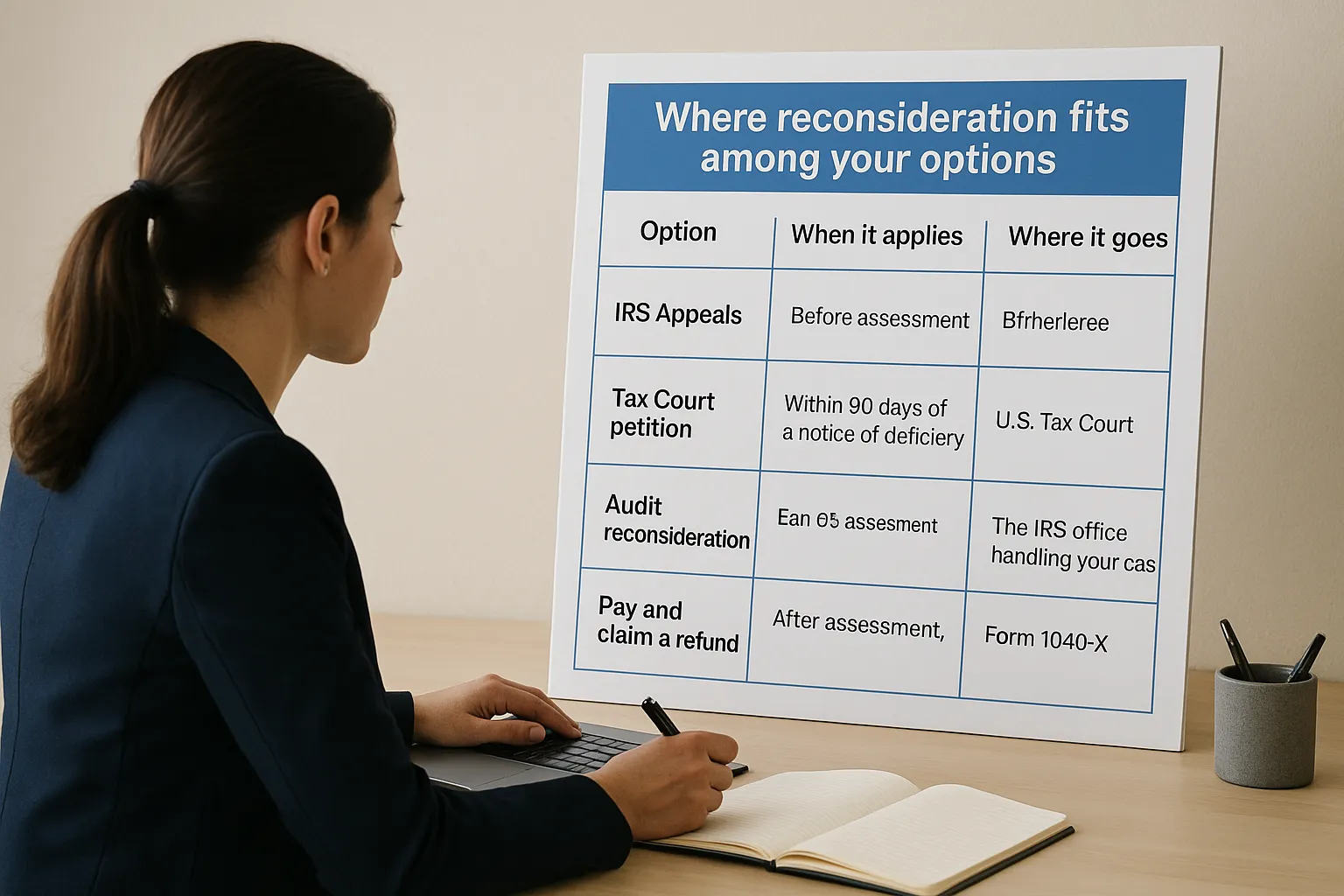
| Option | When it applies | Where it goes |
|---|---|---|
| IRS Appeals | Before assessment, after a 30-day letter | IRS Independent Office of Appeals |
| Tax Court petition | Within 90 days of a notice of deficiency | U.S. Tax Court |
| Audit reconsideration | After assessment, with new records or a missed audit | The IRS office handling your case |
| Pay and claim a refund | After you pay the bill in full | Form 1040-X or Form 843 |
A situation that shows the value
Consider a freelancer who never filed a return for a given year. The IRS built a substitute return from 1099 income, allowed no business expenses, and assessed $38,000. The freelancer had a full year of receipts and mileage logs. Filing the real return and asking for reconsideration can replace that inflated figure with the true one, often cutting it by more than half.
The same logic applies if you moved and never received the audit letters, or if you answered but the examiner never saw your records. The IRS describes this process in Publication 3598. Your practical takeaway is simple. Gather the assessment notice and every record you hold now, because the strength of your documents decides whether the IRS reopens the case.
How to request audit reconsideration step by step
Learning how to request audit reconsideration is mostly a matter of doing a few things in the right order. A clean, specific file gives the examiner a reason to reopen your case instead of a reason to close it.
The five steps
Work through these in sequence. Skipping the first one is the most common way people waste months.
- Confirm your stage. Check that Appeals and Tax Court are no longer open to you, using the table above.
- Pull the assessment notice. Write down the tax year, the amount assessed, and the IRS office that handled the audit.
- Complete Form 12661 or write a letter that names each item you dispute and why.
- Attach new records. Include receipts, bank statements, a filed return, or anything the auditor never saw.
- Sign, copy, and mail it. Keep a full duplicate for your files.
Be precise about what you dispute. Writing "the IRS disallowed $9,400 in business mileage, and my logs prove it" gives the reviewer a specific item to check. Writing "the audit is wrong" gives them nothing to act on.
Where to send it
Send the request to the address on your audit report or assessment notice. If that notice is gone, call the number on your most recent IRS letter and ask where to direct a reconsideration request for that tax year. Use certified mail with a return receipt, because you need proof of the date the IRS received it.
The IRS can only reconsider what you clearly identify and document, so specifics matter more than volume.
Handling collection while you wait
Filing does not automatically stop collection. If a revenue officer or the collection unit already has your account, tell that employee in writing and attach a copy of your request. Ask them to hold enforcement while the review runs.
Pay attention to every deadline on collection notices in the meantime. A pending request is a reason to ask for a hold, not permission to ignore a levy warning.
Who qualifies and when the IRS says no
Situations that qualify
You can use IRS audit reconsideration when the assessment sits on your account and you have a real reason the number is wrong. The IRS looks for a missed chance to be heard or new information. Common cases include:
- You moved and never received the audit letters or the notice of deficiency.
- You were audited, did not respond, and now have the records.
- You sent documents during the audit, but the examiner never considered them.
- The IRS assessed tax on a substitute return, and you have since filed an original return.
- You found new evidence, such as receipts, a corrected Form W-2, or bank statements.
Each of these works because the IRS decided without the full picture. Fixing that is the whole point. Paying first is not required, and a request can go in while the balance is unpaid. If you already paid and want money back, file a refund claim as well, since refunds generally must be claimed within three years of filing or two years of payment, whichever is later.
When the IRS says no
Rejections usually trace back to a short list of causes. Check yourself against it before you mail anything:
- You offer no new information, only disagreement with the result.
- You already submitted the same records, and the IRS reviewed them.
- The Tax Court already issued a final decision for that year.
- You signed a closing agreement, such as Form 906, that settled the year.
- A prior reconsideration request was denied, and you have nothing new this time.
The IRS reopens a closed audit for new evidence or a missed chance to be heard, never for a second look at the same facts.
The second bullet trips up the most people. If the auditor held your receipts and rejected them, sending them again with a stronger letter will not change the outcome. Add something new, such as third-party statements, a corrected return, or records that fill the gap the examiner pointed to.
A denial is not always the end. Your letter should explain the reason, and it may describe whether Appeals can review the decision. Read it closely and note the response deadline, then decide whether better documents or a different route makes sense.
Documents to include and a sample request letter
Your file decides the outcome. In IRS audit reconsideration, the examiner reopens a case only when the papers show the original number was wrong. Organize your records by disputed item, and keep the package tight enough that a reviewer can check each claim in minutes.
Documents that carry the most weight
Start with the basics, then add proof for each item you dispute. Match every document to a line on the audit report, so the reviewer never has to guess why a page is there.
- The audit report or assessment notice showing the tax year and amount.
- Form 12661 or your signed letter.
- An original return, if the IRS assessed you on a substitute return.
- Receipts, invoices, and bank or card statements for disputed deductions.
- Mileage logs, home office measurements, or similar records.
- Third-party proof, such as a corrected Form W-2 or 1099, a lease, or a letter from a payer.
- Proof of an old address, if you never received the audit letters.
Send clear copies, never originals. Keep a duplicate of the whole package, because you will want it if the IRS asks a follow-up question.
Every disputed item needs a document the auditor never saw, or the request goes nowhere.
A sample request letter
Adapt this template to your facts. Use one numbered reason per disputed item, and name the attachment that supports it. Keep the tone factual.
[Your name]
[Address]
[Phone] | SSN last four: [XXXX]

[Date]

Internal Revenue Service
[Address from your audit report]

Re: Request for audit reconsideration, tax year [YYYY]
Assessed amount: $[amount]

I am requesting reconsideration of the audit assessment for the tax year above. I disagree with these items:

1. [Item], $[amount]. [Why it is wrong.] See Attachment A.
2. [Item], $[amount]. [Why it is wrong.] See Attachment B.

[I did not receive the audit notices because I moved on (date).] [OR: I did not have these records until (date).] The attached documents were not reviewed in the original audit. Please adjust the assessment and abate the related penalties and interest.

Attachments: [list each one]

Sincerely,
[Signature]
[Printed name]
Sign it and add a daytime phone number. Mail it by certified mail, and write the date you sent it on your copy.
What happens after you file and how long it takes
What the IRS does first
Once your package arrives, the IRS assigns it to an examiner who compares your records with the original audit file. Expect an acknowledgment letter after a few weeks. You may also get a request for more documents. Answer by the date stated, because a missed deadline gives the examiner an easy reason to close the file.
Meanwhile, keep your address and phone number current with the IRS. Reply to every request in writing, send it by certified mail, and keep copies of everything you send.
The three possible outcomes
Every IRS audit reconsideration ends in one of three results. Knowing which one you got tells you what to do next.

| Outcome | What it means | Your next move |
|---|---|---|
| Full acceptance | The IRS removes or reduces the assessment | Check the revised balance against your records |
| Partial acceptance | Some items are allowed, others rejected | Pay what remains or answer the rejected items with new proof |
| Denial | The assessment stays as is | Read the explanation and decide whether new evidence or Appeals is realistic |
If the IRS lowers your tax, the penalties and interest tied to that amount shrink with it. You should receive a revised notice. Recalculate it yourself, because errors happen, and a balance that is still too high is worth a quick call.
How long it takes
Plan on several months. A simple case with clean records can finish in about three months. In our experience, cases with multiple disputed items, outside records, or a substitute return to replace often run six months or longer. The IRS sets no fixed deadline for its answer.
A complete first submission is the fastest way to a decision, because every follow-up request adds weeks.
Silence does not mean denial. If 60 days pass without an acknowledgment, call the number on your most recent IRS letter, give your tax year, and ask who has the file. Write down the date, the name, and the employee ID number of anyone you speak with, so you can show your follow-up if the request seems lost.
Keep paying attention to your account while you wait. If a collection notice arrives, send a copy of your pending request to the sender right away and ask for a hold.
Next steps after an audit you disagree with
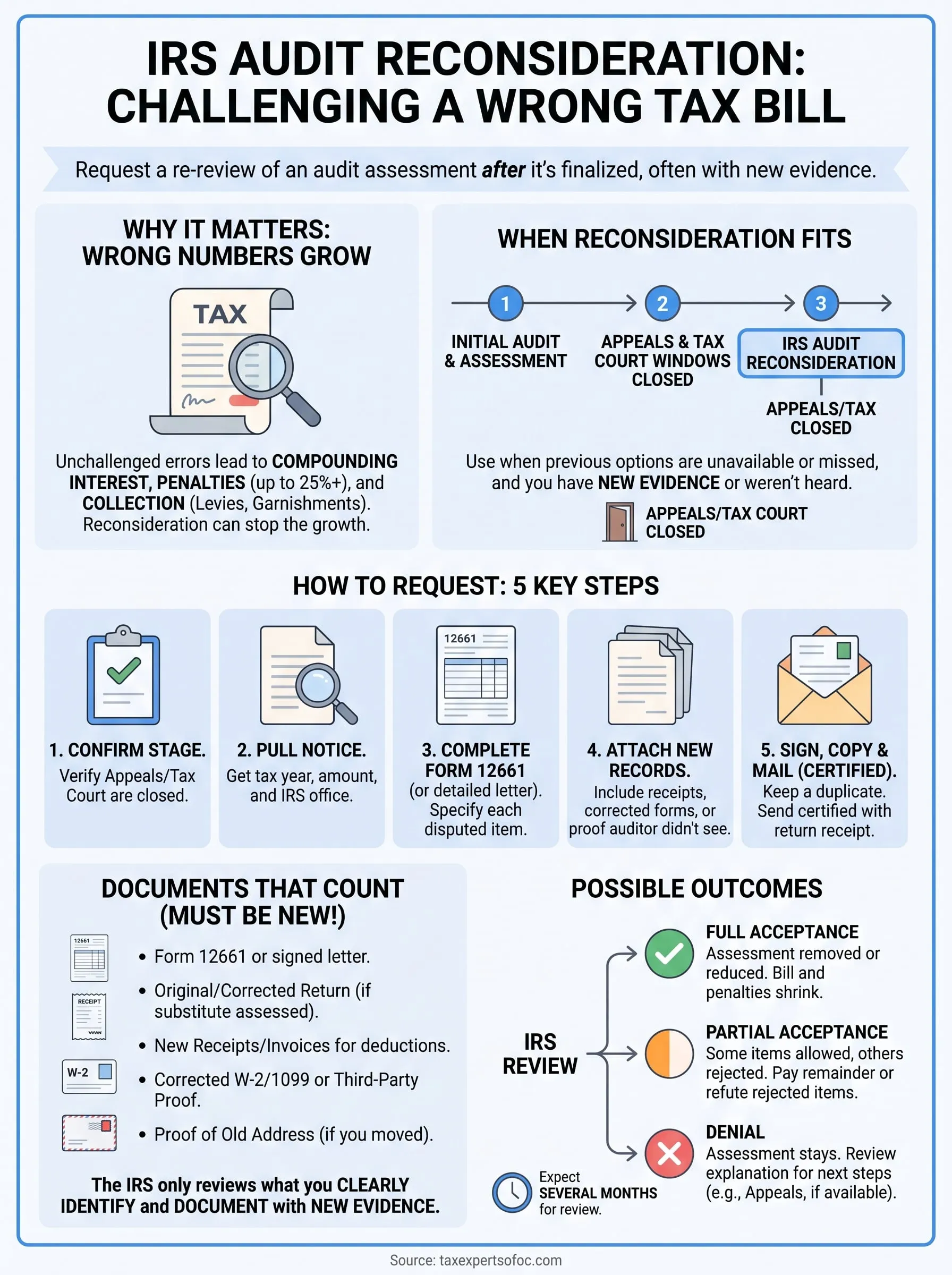
An audit assessment is not always the final word. IRS audit reconsideration lets you put new records, or a chance you missed to be heard, in front of the IRS again. It only works if you name each disputed item and back it with documents the auditor never saw.
Start today. Pull your assessment notice, confirm that Appeals and Tax Court are closed to you, and complete Form 12661 or the sample letter above. Mail it certified and keep a full copy. If collection has begun, ask for a hold in writing. If 60 days pass with no word, call and ask who has your file.
If the paperwork feels risky, get help before you file. Our CPA and Enrolled Agent provide audit representation, reviewing your records and building the request for you. You can book a free 30-minute consultation with Tax Experts of OC and find out whether your case is worth reopening.