
An IRS audit letter shows up in your mailbox, and suddenly you're staring at deadlines, document requests, and a stack of tax jargon you don't fully understand. Your first instinct might be to handle it yourself, but one wrong statement to an auditor can turn a routine review into a much bigger problem. This is exactly where IRS tax audit representation changes the outcome.
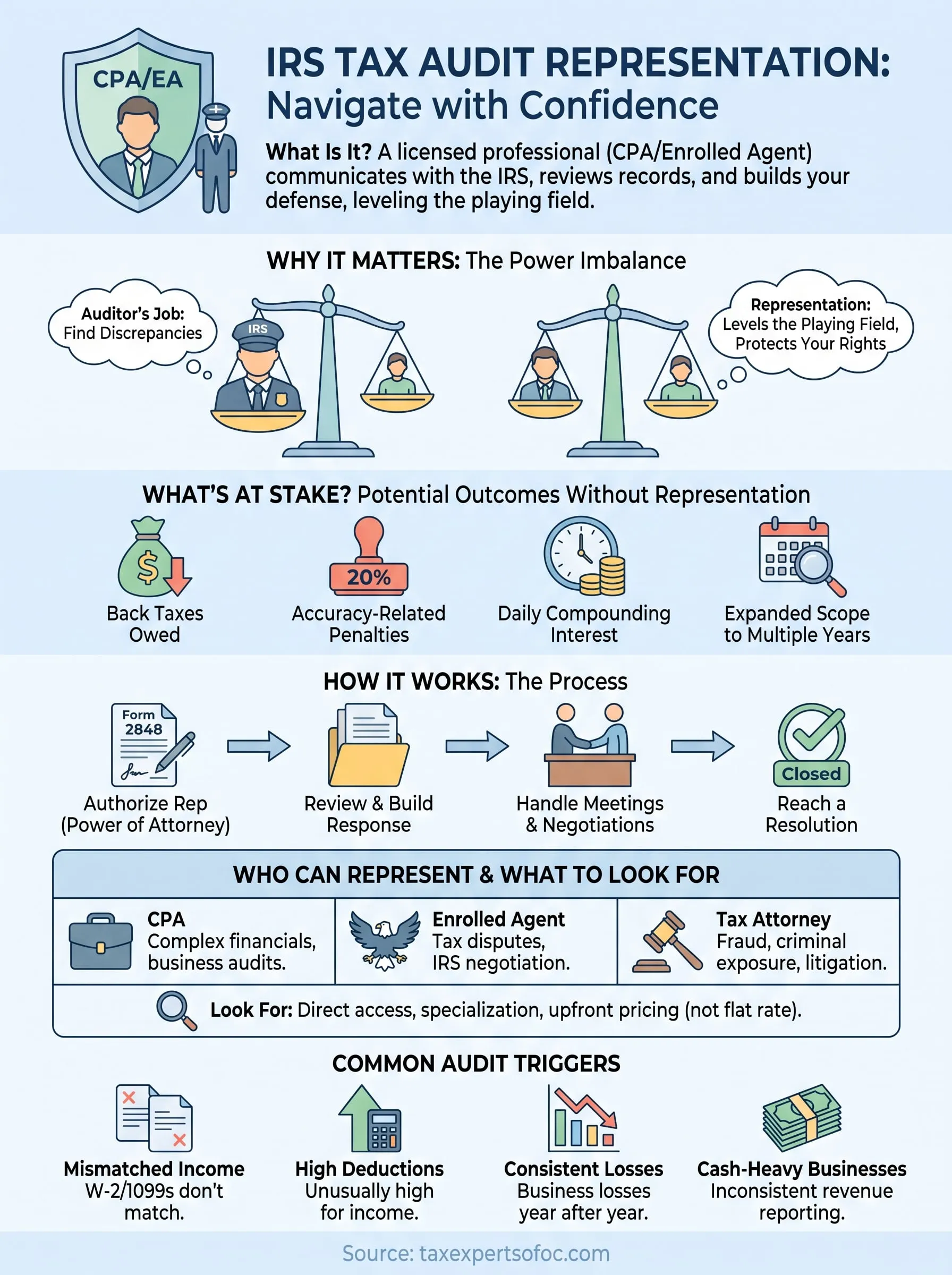
Tax audit representation means a licensed professional, a CPA or Enrolled Agent, steps in and communicates with the IRS on your behalf. They review your records, prepare responses, attend meetings or calls, and negotiate directly with the auditor so you're not doing it alone or saying something that hurts your case. It's the difference between reacting under pressure and having someone who knows the process build your defense.
In this article, we'll break down what audit representation actually covers, who qualifies to provide it, and what the process looks like from the first notice to resolution. If you're facing an audit and wondering whether you need backup, you'll walk away knowing exactly what to expect and how the right representation can protect your finances.
Why IRS tax audit representation matters
Most people assume they can just answer the auditor's questions honestly and everything will work out. That assumption is exactly what gets taxpayers into trouble. IRS auditors are trained to ask questions that expand the scope of a review, and every answer you give becomes part of the official record. Without someone managing that conversation, a simple audit over one deduction can spiral into a full examination of multiple tax years.
The power imbalance is real
Understand that the auditor's job is to find discrepancies, not to help you minimize what you owe. They know the tax code, the audit procedures, and how to phrase questions that lead you into admissions you didn't intend to make. Tax audit representation levels that playing field because your representative speaks the same technical language and knows which questions to answer, which to redirect, and which documents actually need to go on record.
The moment you let a trained professional speak for you instead of the IRS, you stop playing defense on the auditor's terms.
What's actually at stake
Often the financial exposure in an audit goes well beyond the original tax bill. Additional penalties, accruing interest, and in serious cases, referral for criminal investigation are all real possibilities when an audit is mishandled. Consider what's typically on the line:

- Back taxes owed on disallowed deductions or unreported income
- Accuracy-related penalties, often 20% of the underpayment
- Interest charges that compound daily until the balance is paid
- Expanded scope, where the IRS pulls additional tax years into the review
- Fraud penalties or criminal referral in cases involving intentional misstatements
Professional representation exists specifically to keep these outcomes from happening, or to negotiate them down when they're unavoidable.
Protecting your legal rights during the process
Since taxpayers have specific protections under the law, including the right to representation itself, most people never learn about these rights until they're already deep into a stressful exchange with the IRS. The Taxpayer Bill of Rights guarantees you the right to retain a representative and the right to have that person present during interviews and correspondence. A qualified representative also knows how to invoke deadlines, request extensions, and push back on unreasonable document demands, things most taxpayers don't realize they can do.
Therefore, going into an audit alone isn't just stressful, it's a strategic disadvantage. At Tax Experts of OC, we've seen firsthand how a case changes the moment a CPA or Enrolled Agent providing help with audits and IRS notices takes over communication with the IRS. Clients stop losing sleep over what to say next, and the focus shifts to building a factual, well-documented response instead of reacting to each new IRS letter as it arrives.
How IRS tax audit representation works
Once you hire a representative, the process follows a fairly predictable sequence, even though every audit has its own wrinkles. IRS tax audit representation starts with a power of attorney, and knowing how to complete Form 2848 matters, because that form legally authorizes your CPA or Enrolled Agent to speak and act on your behalf. From that point forward, the IRS is required to route all correspondence and calls through your representative instead of you directly.
Reviewing the notice and building a response
After the power of attorney is filed, your representative pulls together your tax records and reviews exactly what the IRS is questioning. This step matters because most audit notices only flag one or two issues, like a disputed deduction or a CP2000 notice for unreported 1099 income, and a good representative won't volunteer information beyond that scope. They organize supporting documentation, draft written responses, and prepare a clear narrative that answers the IRS's questions without opening new lines of inquiry.
Handling meetings and negotiations
During interviews, correspondence exams, or in-person meetings, your representative attends in your place or sits alongside you and controls how questions get answered. Here's what that typically looks like in practice:
- Confirm the audit type: correspondence, office, or field audit
- Request and organize all documents the IRS cites in its notice
- Draft a formal written response or prepare talking points for a meeting
- Attend the exam or call as your authorized representative
- Negotiate any proposed adjustments, penalties, or payment terms
Reaching a resolution
Eventually, the audit closes with one of three outcomes: no change to your return, an agreed adjustment, or a disputed finding that moves toward appeals. Throughout this process, your representative's job is to make sure the final result reflects what the law actually requires, not just what the auditor initially proposed.
Who can represent you and what to look for
Not just anyone can sit across from an IRS auditor and speak for you. Federal law limits IRS tax audit representation to three types of professionals who hold what's called "unlimited representation rights": Certified Public Accountants, Enrolled Agents, and tax attorneys. Each has passed rigorous testing or licensing requirements and can represent taxpayers on any matter before the IRS, regardless of who prepared the original return.

If the person representing you can't legally sign a power of attorney form, they can't legally speak for you either.
Because credentials vary in scope and specialty, it helps to know how the three options compare before you hire one.
| Professional | Licensed By | Best Suited For |
|---|---|---|
| CPA | State Board of Accountancy | Complex financial records, business audits, bookkeeping ties |
| Enrolled Agent | IRS directly | Straightforward tax disputes, IRS negotiation experience |
| Tax Attorney | State Bar | Fraud allegations, criminal exposure, litigation |
Given that most audits involve documentation and negotiation rather than legal proceedings, a CPA or Enrolled Agent covers the vast majority of cases without the higher cost of an attorney. Choosing the right CPA for IRS problems matters just as much as credentials. Ask how many audits they've handled in the past year, whether they specialize in your specific issue, like unreported income or disallowed deductions, and whether they'll be the one actually talking to the IRS rather than handing your file to junior staff.
Ultimately, direct access to a working CPA or Enrolled Agent, not a call center or a rotating cast of assistants, is what separates firms that resolve cases efficiently from ones that just collect a fee. That's the model we built at Tax Experts of OC, where clients work with the same professional from the first notice through resolution.
What it costs and what usually triggers an audit
Pricing for IRS tax audit representation varies based on the complexity of your case, not a flat rate you can find on a rate card. A simple correspondence audit over one disallowed deduction might run a few hundred dollars, while a field audit spanning multiple tax years with business records involved, which is how a business tax audit usually unfolds, can run into the thousands. Reputable firms quote a fee after reviewing your notice and records, not before, because guessing at the scope upfront just leads to surprise bills later.
A firm that quotes you a price before reading your audit notice is guessing, not planning your defense.
Getting a fair price
Before you sign anything, ask for a written engagement letter that spells out exactly what's included, whether that's document review, correspondence, meeting attendance, or appeals if needed. At Tax Experts of OC, we provide upfront pricing and a free 30-minute consultation so you know the cost before committing, along with payment plans for clients facing financial hardship.
Common audit triggers
Understanding what actually draws IRS attention helps you see why representation matters even for taxpayers who believe they've done nothing wrong. The IRS audit selection process often flags returns based on statistical anomalies rather than intentional wrongdoing. Common triggers include:
- Income reported that doesn't match W-2s or 1099s on file
- Large charitable deductions relative to reported income
- Consistent business losses claimed year after year
- Unusually high deductions for a given income bracket
- Cash-heavy businesses with inconsistent revenue reporting
- Claiming the home office deduction without clear documentation
Any one of these can trigger a review, and once the IRS opens a file, the burden shifts to you to prove your numbers are accurate. That's precisely the moment a qualified representative earns their fee, by making sure the documentation tells a clean, defensible story from the start.
Moving forward after an audit notice
An audit notice doesn't have to derail your finances or your peace of mind. What matters most is how quickly you bring in qualified help before you've said something to the IRS that limits your options. IRS tax audit representation puts a trained professional between you and the auditor, someone who reviews your records, controls the narrative, and negotiates from a position of knowledge instead of fear.
Remember that the taxpayers who come out of an audit in the best shape are rarely the ones who tried to handle it alone. They're the ones who treated that first notice as a deadline to act, not a problem to ignore. If you've received a letter from the IRS, don't wait for the next one to show up before you get support. Explore our IRS tax problem resolution services, schedule a free consultation, and talk to a CPA or Enrolled Agent who can start building your response today.