
When the IRS sends a notice or starts collecting on a debt, your first instinct might be to search for a CPA for IRS problems near me, and that instinct is right. A qualified CPA who specializes in tax resolution can negotiate directly with the IRS on your behalf, stop aggressive collection actions, and help you regain control of your finances. But not every CPA handles IRS disputes, and picking the wrong one can cost you time, money, and peace of mind.
The challenge is knowing what to look for. Tax resolution requires a specific skill set, experience with audits, back taxes, penalties, installment agreements, and offers in compromise. A CPA who only does annual filings may not have the knowledge or the IRS authorization needed to represent you effectively. The difference between general tax prep and real IRS problem-solving is significant, and understanding that difference is the first step toward getting the help you actually need.
This guide walks you through exactly how to choose the right CPA for your IRS issue, what credentials and questions matter most, and how to avoid common mistakes that delay resolution. At Tax Experts of OC, our CPA and Enrolled Agents handle IRS disputes for clients across all 50 states, so whether you're local to Orange County or working with us remotely, we built this guide from the same process we use to help people every day.
What a CPA can handle with the IRS
A CPA who specializes in IRS problems does far more than prepare returns. When you search for a CPA for IRS problems near me, you want someone who actively represents you before the IRS, communicates with revenue officers on your behalf, and understands which resolution programs apply to your specific situation. General tax preparers are not authorized to do this. A licensed CPA or Enrolled Agent with full representation rights can appear before the IRS Examination Division, the Appeals Office, and the Collection Division, which covers most of the serious problems taxpayers face.
Direct IRS Representation
When the IRS contacts you, a qualified CPA steps between you and the agency. You authorize that representation by signing a Power of Attorney (Form 2848), and from that point forward, the IRS communicates with your representative, not directly with you. This matters because IRS revenue officers and auditors are trained negotiators who know the system inside out. Having a CPA who understands the Internal Revenue Manual and IRS collection procedures gives you a significant advantage you simply cannot replicate on your own.
A Power of Attorney filed with the IRS stays active until you revoke it, meaning your CPA can handle every phase of your case from the first notice all the way through final resolution.
Your CPA can also place holds on collection actions, including wage garnishments and bank levies, while your case is under active review. That hold buys time to assess your full financial picture and build the strongest possible resolution strategy before any money changes hands.
IRS Problems a CPA Can Resolve
A tax resolution CPA handles a wide range of IRS disputes, and each one requires a different approach, different forms, and different negotiation tactics. Here is a breakdown of the most common issues and what a CPA actually does to address each one:
| IRS Problem | What a CPA Does |
|---|---|
| Audit (correspondence or in-person) | Reviews your records, responds to IRS requests, and represents you through the audit process |
| Back taxes and unfiled returns | Prepares and files missing returns, often reducing the total liability in the process |
| Tax debt and penalties | Negotiates an Installment Agreement, Currently Not Collectible status, or an Offer in Compromise |
| Wage garnishment or bank levy | Files a release request and negotiates a structured payment plan |
| IRS notices (CP2000, CP504, LT11, etc.) | Responds on your behalf and disputes incorrect or inflated assessments |
| Innocent Spouse Relief | Documents your case and submits Form 8857 with supporting evidence |
These are not simple letter-writing tasks. Each resolution path carries strict IRS deadlines and procedural rules, and missing a response window or submitting the wrong form can permanently close off options you need. A CPA who handles these cases regularly knows the correct timelines, the right forms, and how to communicate with IRS personnel in a way that keeps your case moving forward rather than stalling in their queue.
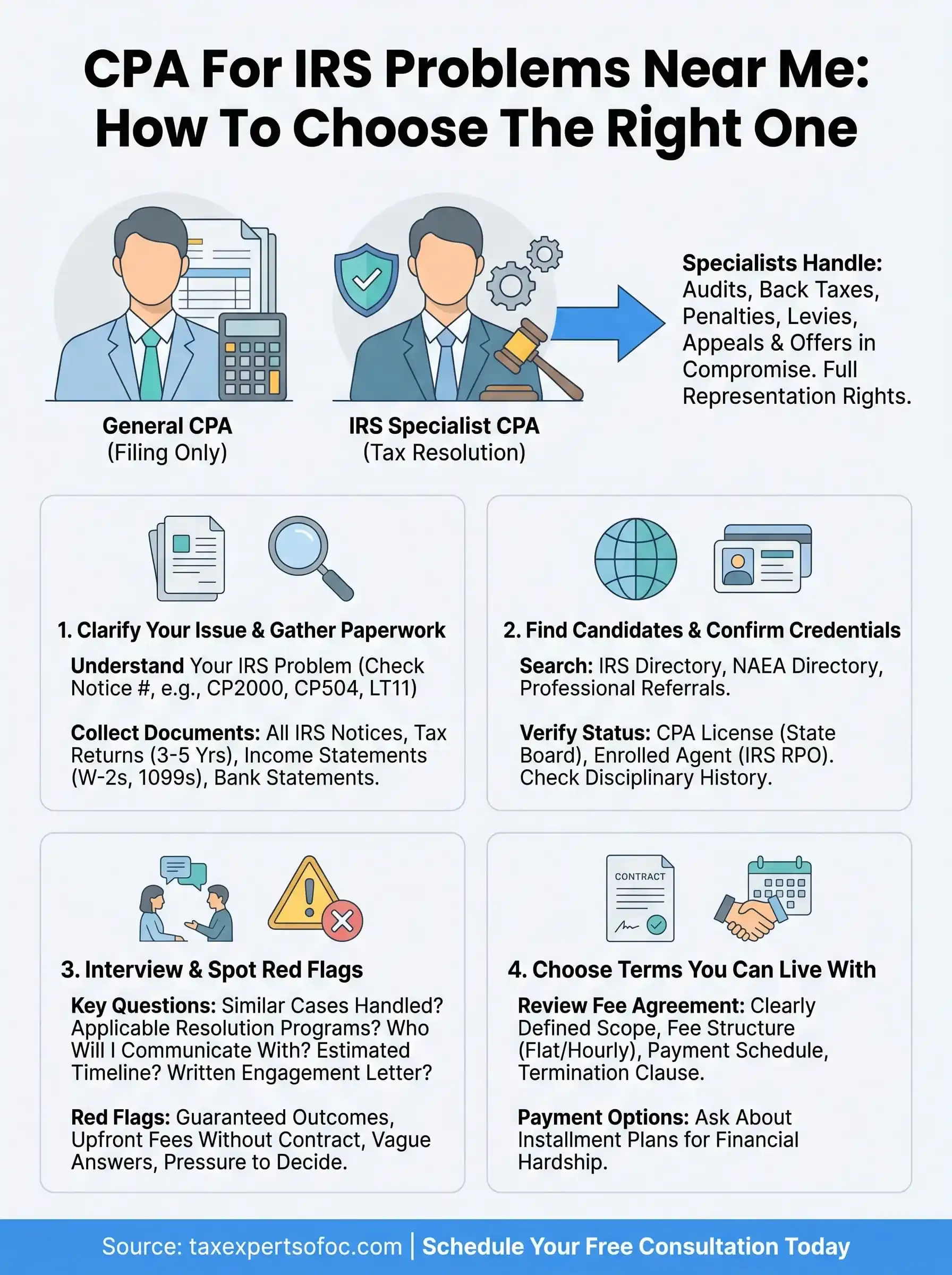
Step 1. Clarify your issue and gather paperwork
Before you contact any tax professional, take 15 minutes to understand your situation as clearly as possible. When you search for a CPA for IRS problems near me, every firm will ask you the same basic questions: what type of notice did you receive, how much do you owe, and how many years are involved? Knowing the answers before your first call saves time and helps the CPA give you an accurate assessment rather than a vague estimate.
Know What Type of IRS Problem You Have
Different IRS problems require different resolution strategies, so identifying your specific issue upfront shapes everything that follows. Check every notice you have received and look for the notice number printed in the upper right corner. Each number corresponds to a specific IRS action, and that number tells the CPA exactly where your case stands in the collection or examination process.
The notice number on your IRS letter is one of the most useful pieces of information you can hand to a tax professional, so never ignore it or discard it.
Here are the most common notice types and what they signal:
- CP2000: The IRS found income you did not report and is proposing additional tax
- CP503 or CP504: You have an unpaid balance and the IRS is escalating collection
- LT11 or Letter 1058: A Final Notice of Intent to Levy, meaning collection action is imminent
- CP90: The IRS intends to seize your assets
Documents to Collect Before Your First Call
Gathering paperwork before your first meeting keeps the conversation focused and helps the CPA build an accurate picture of your full liability from day one. Pull together the following before you pick up the phone:
- All IRS notices and letters, sorted by date
- Tax returns for the past three to five years, or however many years are in dispute
- W-2s, 1099s, and any other income statements for those years
- Bank statements if the IRS is questioning income or expenses
- Any prior correspondence you already sent to the IRS
Step 2. Find candidates and confirm credentials
Once you know your issue and have your documents ready, you can start building a short list of candidates. Searching for a CPA for IRS problems near me will return dozens of results, but most general accounting firms are not equipped to handle serious IRS disputes. Your goal at this stage is to filter for specialists, not generalists, so focus your search on firms that explicitly advertise tax resolution, IRS representation, and back tax help.
Where to Search
The best starting points are the IRS Directory of Federal Tax Return Preparers and the National Association of Enrolled Agents (NAEA) directory, both of which let you filter by credential and location. The IRS directory is available at irs.treasury.gov and allows you to search by zip code and credential type. You can also ask your accountant or attorney for a referral, since professionals in adjacent fields often know who handles IRS work well in your area.
A referral from a trusted professional cuts your vetting time significantly because someone already vetted the person for you.
Avoid relying solely on paid advertisements or generic review sites. Firms that appear at the top of paid search results are not automatically the most qualified, so always cross-reference any name you find with the official credential databases below before moving forward.
How to Verify Credentials
Before you call anyone, confirm that their license is active and in good standing. Use these official sources to check:

- CPA license: Search your state's Board of Accountancy website by name
- Enrolled Agent status: Verify through the IRS Return Preparer Office
- Disciplinary history: Check the AICPA or your state board for any prior sanctions
A valid CPA license plus clean disciplinary history gives you a reliable baseline before you invest time in an interview. Do not skip this step even if someone comes with strong word-of-mouth recommendations.
Step 3. Interview and spot red flags
Once your short list is ready, schedule a consultation with each candidate and treat it like a job interview, because that is exactly what it is. Most reputable tax resolution firms offer a free initial consultation, which gives you direct access to the professional who will handle your case. Use that time to assess their experience with your specific IRS problem, not just their credentials on paper.
A CPA who cannot clearly explain your resolution options in plain language during the first call is unlikely to communicate well throughout the entire case.
Questions That Reveal Real Experience
Asking the right questions separates a tax resolution specialist from a general practitioner quickly. When you search for a CPA for IRS problems near me, the firms that stand out are the ones whose professionals answer these questions with specific, confident detail rather than vague reassurances.
Use this list of questions in every interview:
- How many cases similar to mine have you handled in the past two years?
- Which IRS resolution programs do you think apply to my situation, and why?
- Who will I communicate with directly throughout my case?
- What is your estimated timeline for resolution?
- Can you provide a written engagement letter outlining fees and scope before I sign anything?
Red Flags That Tell You to Walk Away
Certain warning signs appear early and should stop you from signing any agreement. Watch for these during and after your consultation:
- Guaranteed outcomes: No CPA can guarantee the IRS will accept an Offer in Compromise or waive penalties
- Upfront fees with no written contract: Legitimate firms provide a written engagement letter before collecting payment
- Vague answers about who handles your case: You should know the name of the person working your file
- Pressure to decide immediately: Reputable professionals give you time to review terms before committing
Step 4. Choose terms you can live with
Once you select the right CPA for IRS problems near me, the final step before work begins is reviewing the engagement terms carefully. This is where many people rush because they feel urgency around their IRS issue, but the engagement letter is a legally binding document that defines exactly what your CPA will do, what it will cost, and what happens if the scope changes. Read every line before you sign.
What to Look for in a Fee Agreement
A clear, written fee agreement protects both you and the CPA by eliminating ambiguity about scope and billing. The agreement should spell out exactly which IRS problems are covered, which resolution strategies the CPA will pursue, and whether additional work falls outside the original fee. If anything is missing or vague, ask for a revised version before you pay a single dollar.
Your engagement letter should include the following items:
- Scope of services: which specific IRS issues are covered (audit, levy release, installment agreement, etc.)
- Fee structure: flat fee, hourly rate, or a combination, stated clearly in dollar amounts
- Payment schedule: deposit amount, subsequent payments, and due dates
- Communication terms: how often you receive updates and through which channels
- Termination clause: conditions under which either party can exit the agreement
If a firm cannot produce a written engagement letter before collecting payment, that is a strong signal to walk away and find someone else.
Payment Options When Funds Are Tight
Many people dealing with IRS problems are also managing financial hardship, which makes large upfront accounting fees difficult. Reputable firms understand this reality and typically offer structured payment plans that let you pay for services over time rather than all at once.
Ask directly whether the firm offers installment payments or reduced rates for hardship situations, and get any flexibility confirmed in writing. A firm worth hiring will answer that question honestly and work with your actual budget rather than turn you away.
Move forward with confidence
Finding the right CPA for IRS problems near me takes more effort than a quick Google search, but every step in this guide moves you closer to real resolution. You now know what a qualified tax resolution CPA can actually do, how to vet credentials, what questions expose experience, and what contract terms to demand before you commit. That knowledge puts you in a far stronger position than most people who contact the IRS alone or hire the first name they find.
Your IRS problem will not shrink by waiting. The longer a balance goes unresolved, the more penalties and interest accrue, and the more collection tools the IRS has available to use. Take what you have gathered here and put it to work now. If you want a team of experienced CPAs and Enrolled Agents who handle IRS disputes nationwide, schedule your free consultation with Tax Experts of OC and get a clear picture of your options today.