

An IRS notice of deficiency is a formal letter, often called a 90-day letter, that says the IRS believes you owe more tax than you reported. It gives you 90 days to challenge that finding in U.S. Tax Court before the agency adds the amount to your account. If the notice is addressed to you outside the United States, you get 150 days. The letter is not a bill yet, but it is the last step before one.
"Deficiency" is a legal term. It means the gap between the tax the IRS says is correct and the tax shown on your return. The IRS calls the letter a statutory notice because federal law requires it before the agency can assess a disputed income tax deficiency. You may see it labeled CP3219A, CP3219N, or Letter 3219. The 90-day rule works the same on all of them.
This article explains why the notice matters, how to respond, how the deadline is counted, and what happens if you go to Tax Court. At Tax Experts of OC, our CPA and Enrolled Agent work on IRS notices for clients in all 50 states, so the steps below reflect how these letters are handled in practice.
Why an IRS notice of deficiency matters
An IRS notice of deficiency matters because it is your last chance to dispute the tax before paying it, and the deadline is strict. Once the 90 days pass, the IRS can assess the amount and start collection.
What the notice is and is not
The notice is a proposed change, not an assessment. It lists the extra tax, any penalties, and interest that the IRS calculates. It also prints the last day to file a petition with the Tax Court. The IRS must send it by certified or registered mail to your last known address, and the 90 days run from the mailing date, not from the day you open the envelope.
Why the IRS sends one
Most notices follow an earlier letter that you did not answer or that did not settle the dispute. Two sources are common:

- Income mismatches. The IRS matches your return against W-2s and 1099s. If a payer reported income you left off, the Automated Underreporter program proposes a change first, then sends the deficiency notice if the issue stays open.
- Audit disagreements. After an examination, the IRS may disallow deductions or credits. If you do not agree with the findings, it issues the notice.
What happens if you ignore it
If you do nothing, the IRS assesses the tax after day 90 and sends a bill. Interest and penalties keep growing, and collection tools such as liens, levies, and wage garnishment become available to the agency. You also lose the right to dispute the amount in Tax Court before paying.
The notice of deficiency is not the bill. It is your one window to argue before the bill exists.
How to respond to a notice of deficiency
You have three real choices: agree and close the matter, dispute the amount in Tax Court, or let the deadline pass. Only the first two protect you. Decide which one fits within the first couple of weeks, not the last few days.
First steps to take this week
Work through this list in order:
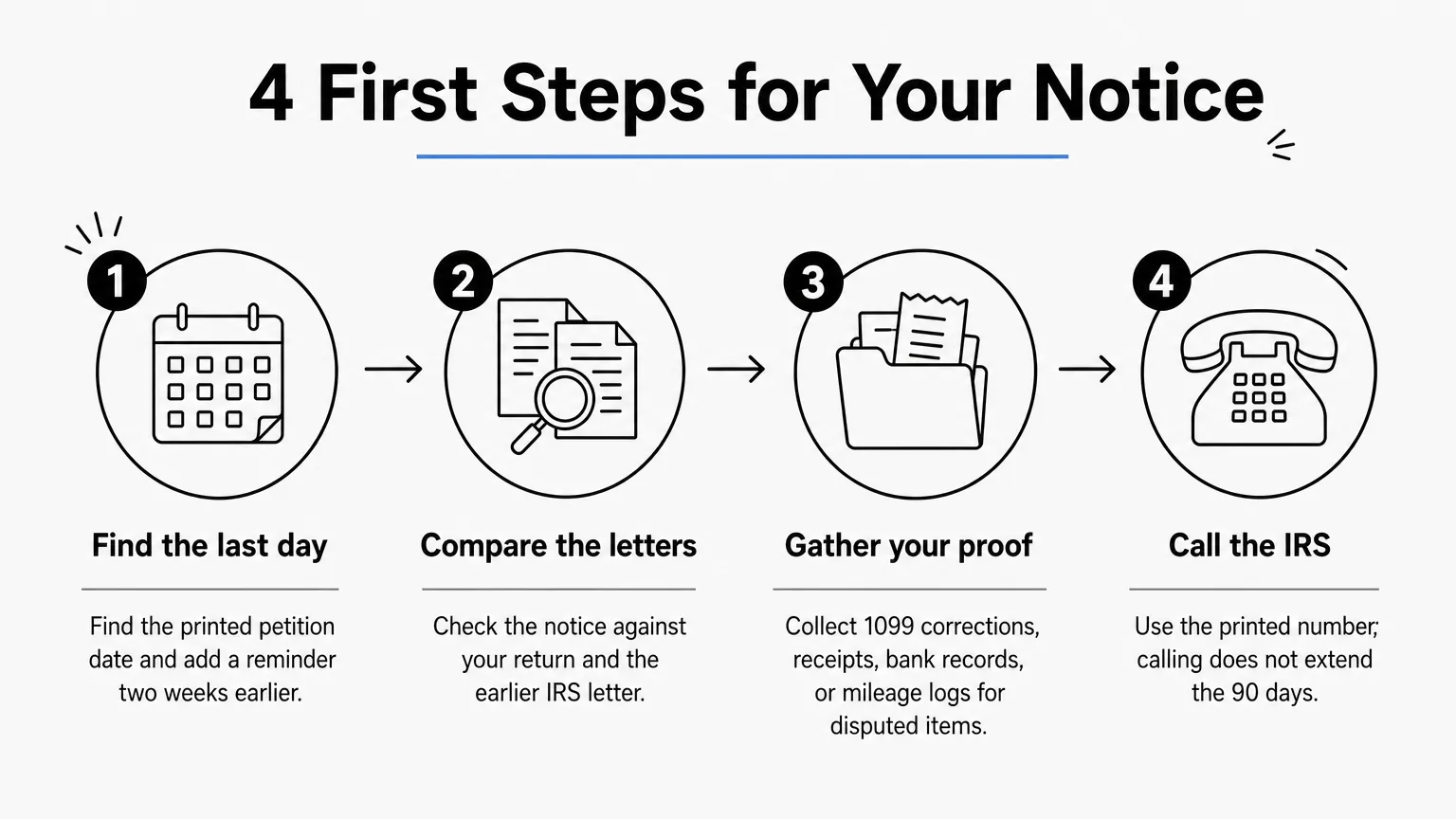
- Find the last day to petition. It is printed on the notice. Put it on your calendar with a reminder two weeks earlier.
- Compare the notice to your return and to the earlier IRS letter, such as a CP2000 or an audit report. Identify each item the IRS changed.
- Gather proof for every item you dispute: 1099 corrections, receipts, bank records, or mileage logs.
- Use the phone number printed on your notice if you need to talk to the IRS. Calling can resolve errors, but it does not extend the 90 days.
Your options compared
| Option | What you do | Effect on your rights | Best when |
|---|---|---|---|
| Agree | Sign the waiver (Form 5564) or pay | Lets the IRS assess right away and ends your Tax Court route | The IRS is correct on every item |
| Dispute | File a petition in U.S. Tax Court | Blocks assessment while the case is pending | You disagree in whole or in part |
| Do nothing | Let day 90 pass | The IRS assesses and bills you | Almost never |
You can also pay first and sue for a refund later in a federal district court or the Court of Federal Claims, but that requires paying the full amount up front. For most people, the Tax Court petition is the cheaper route.
If you agree with only part of the notice, you can still dispute the rest, so do not sign anything until you have checked every line.
How the 90-day deadline works
The 90 days start on the date the IRS mails the notice, and the exact last day is printed on the letter. Use that printed date, not your own count, as the controlling deadline.
Counting your days
Here is a worked example. Suppose a notice is mailed on March 1. March has 30 days left after the 1st, April has 30, and May adds 30 more, so day 90 lands on May 30. If that day falls on a weekend or legal holiday in Washington, D.C., the deadline moves to the next business day. For a person addressed outside the United States, the same notice carries 150 days.
A USPS postmark on or before the last day counts as timely filing for a paper petition. Do not cut it close. File electronically through the Tax Court's DAWSON system, or mail the petition early with tracking.
Can the deadline be extended?
Treat the deadline as fixed. The IRS has no authority to move the date, and a call or a letter to the agency does not pause the clock. Courts have debated whether a late petition can ever be excused, but you should never plan around that argument. If you miss the date, the Tax Court may dismiss your case for lack of jurisdiction.
The only safe assumption is that day 90 is final, so file early.
What happens when you petition the Tax Court
Filing a petition stops the IRS from assessing the disputed amount while the case is pending, and most cases end in settlement with IRS Appeals rather than a trial. You do not have to pay the disputed tax first.
How to file the petition
A valid petition needs a few things:

- A copy of the notice of deficiency attached to the petition.
- The filing fee, which is $60.
- Each disputed item and the reason you disagree, stated clearly.
- A small case election if the amount in dispute is $50,000 or less for each tax year, which gives you a simpler, less formal procedure.
You can file through DAWSON or use the Tax Court's simplified petition form (Form 2) by mail.
What to expect afterward
After you file, the IRS answers the petition, and the case is usually referred to IRS Appeals for settlement talks. Many disputes resolve there. If not, the court sets a trial and issues a decision. Once the amount becomes final, the IRS assesses it, and you can ask for an installment agreement if you cannot pay in full.
Getting help with a notice
You can represent yourself in Tax Court. If you want help, a CPA or Enrolled Agent can review the notice, rebuild your records, and negotiate with the IRS. Tax Court litigation itself requires someone admitted to that court's bar, so ask any representative up front who will actually appear on your case. Tax Experts of OC offers a free 30-minute consultation and flexible payment options for qualified clients, which is enough time to review your notice and confirm your deadline.
A petition filed on time keeps every option open, including settlement.
Act before the 90 days run out
An IRS notice of deficiency is a proposed tax increase, not a final bill. You can agree, dispute it in Tax Court, or pay and seek a refund, but only until the printed deadline passes. Read the notice the day it arrives, mark the last day to petition, and collect proof for every item you dispute.
If you are unsure whether to sign, pay, or petition, get a second opinion before you choose. You can book a free consultation with Tax Experts of OC and have a CPA or Enrolled Agent look at your letter before your time runs short.