

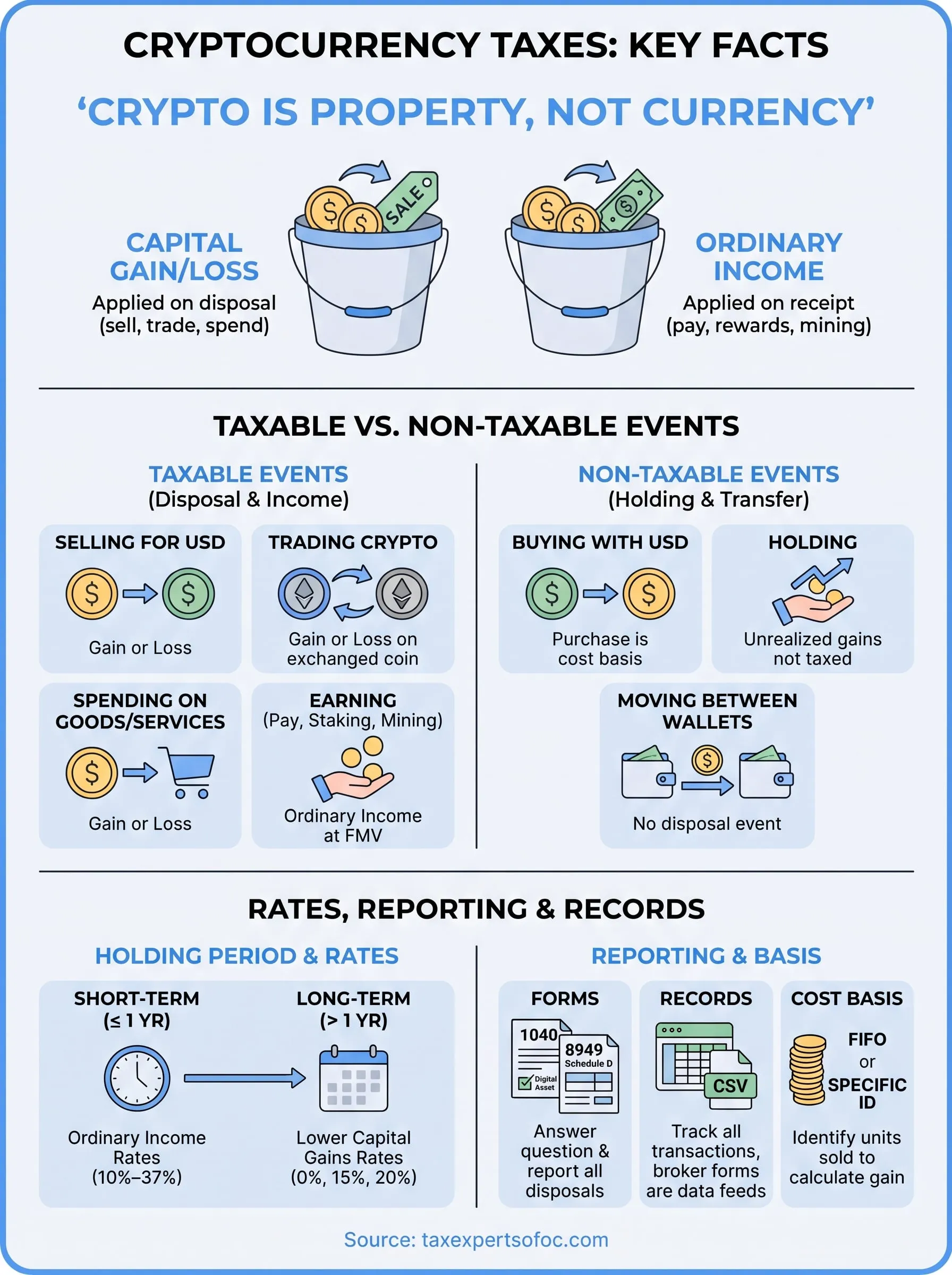
Cryptocurrency taxes are the federal and state taxes you owe when you sell, spend, trade, or earn digital assets. The IRS treats crypto as property, not currency. A sale or trade creates a capital gain or loss, and crypto you receive as pay or rewards counts as ordinary income. Buying coins, holding them, or moving them between your own wallets is not taxable, but every filer must still answer the digital asset question on Form 1040.
This article covers why the rules matter, how to report crypto on your return, which transactions trigger tax, and which rates apply. It then shows how to calculate a gain or loss, how special cases like NFTs and DeFi work, how to lower your bill legally, and what to do if you missed a year. Rate tables use 2025 tax year thresholds, which the IRS adjusts every year.
Tax Experts of OC is a CPA and Enrolled Agent firm. We prepare returns for investors and represent taxpayers before the IRS in all 50 states. This is the explanation we would give you at the start of a consultation. It is general information, not advice for your specific facts.
Why cryptocurrency taxes matter to every filer
Cryptocurrency taxes matter because the IRS treats every digital asset as property, asks all taxpayers about it on page one of Form 1040, and now receives transaction data directly from crypto brokers. A small trade carries the same reporting duty as a large one.
Crypto is property, not currency
Under IRS Notice 2014-21, virtual currency is taxed as property. The same rules that apply when you sell a stock apply when you sell Bitcoin. Each sale, trade, or purchase made with crypto is its own event with its own gain or loss. If you pay for a $5 coffee with coins you bought for less, you technically have a small taxable gain.

That framing explains the two kinds of tax you will meet. Capital gains tax applies when you dispose of crypto. Ordinary income tax applies when you receive crypto as pay or rewards. Almost every rule below falls into one of those two buckets.
The IRS taxes crypto as property, so every disposal produces a measurable gain or loss.
No minimum amount lets you skip reporting
Many people ask whether they need to report crypto under $600. There is no dollar floor for your own reporting duty. The $600 figure comes from thresholds that payers use to decide when to send certain 1099 forms. It was never a limit on what you owe. If you sold, traded, or earned crypto, you report the activity even when the amount is small and no form arrives in the mail.
What mistakes can cost
Leaving crypto off a return exposes you to interest and a 20% accuracy-related penalty on the resulting underpayment. Skipping the return entirely adds failure-to-file penalties. Willful evasion is a federal crime. Brokers now report your gross proceeds on Form 1099-DA, so the IRS has data to match against what you file. A missing sale is easier to spot than it used to be.
How to report cryptocurrency taxes on your return
You report crypto by listing every taxable transaction, calculating each gain or loss, and carrying the totals to the right forms on your federal return. The steps below follow the order you would actually work in.
The five-step process
- Collect records from every exchange, wallet, and platform you used, including accounts you no longer open. Export full transaction histories as CSV files and save purchase confirmations.
- Flag taxable events. Mark each sale, trade, spend, and income receipt. The next section lists which ones count.
- Calculate proceeds, cost basis, and gain or loss for each disposal. Record the dollar value of each income receipt on the day you received it.
- Enter the results on the forms in the table below.
- Answer the digital asset question and keep your records for as long as you hold the asset, plus at least three years after you report its sale.

Software or a spreadsheet can handle step 3, but you remain responsible for the numbers. A cryptocurrency tax calculator is only as good as the data you feed it, and tools differ in how they treat transfers between wallets. Check any output against your own records before you file.
Which form carries which transaction
| What happened | Where it goes |
|---|---|
| Sold, traded, or spent crypto held as an investment | Form 8949, then Schedule D, then Form 1040 |
| Staking rewards, airdrops, hard fork coins, hobby mining | Schedule 1, other income |
| Crypto earned as a contractor, business mining, sales to customers | Schedule C, plus Schedule SE for self-employment tax |
| Crypto paid to you as an employee | Wages, reported with your W-2 income |
| Gift above the annual exclusion ($19,000 per recipient for 2025) | Form 709, filed by the giver |
| Charitable donation of crypto worth over $500 | Form 8283 |
Form 8949 lists each disposal with a description, the dates you acquired and sold the asset, proceeds, cost basis, and gain or loss. The 2025 form has separate boxes for digital assets, based on whether you received a Form 1099-DA and whether it reported basis. Your totals then flow to Schedule D. The IRS digital assets page lists current forms and FAQs.
Form 1099-DA and the digital asset question
Form 1099-DA is informational only, so you still file Form 8949 even when you receive one. For 2025 transactions, brokers report gross proceeds but not cost basis. Basis reporting begins for assets acquired on or after January 1, 2026 and held with the broker. If you moved coins in from another platform, the form may show no basis and overstate your gain unless you correct it with your own records. Ask the broker for a corrected form only when it has major errors, such as a purchase listed as a sale.
Form 1099-DA is a data feed to the IRS, not your return, so your own records decide the numbers.
Everyone who files must check Yes or No on the digital asset question. Check Yes if you received crypto as payment, a reward, or from mining, staking, or a fork, or if you sold, exchanged, or otherwise disposed of any. Check No if you only held crypto, bought it with U.S. dollars, or moved it between wallets you own.
Returns for a given year are generally due April 15 of the next year. An extension gives you more time to file, not more time to pay. If you expect a large gain, make quarterly estimated payments so you avoid an underpayment penalty.
Which crypto transactions are taxable
A crypto transaction is taxable when you dispose of the asset or receive it as income. Buying and holding are not taxable. The table below shows where each common activity falls.
Taxable and non-taxable events at a glance
| Transaction | Taxable? | Treatment |
|---|---|---|
| Buy crypto with U.S. dollars | No | Purchase price becomes your cost basis |
| Hold crypto while its value rises | No | Unrealized gains are not taxed |
| Move crypto between wallets you own | No | Keep records so basis follows the coins |
| Sell crypto for U.S. dollars | Yes | Capital gain or loss |
| Trade one crypto for another | Yes | Capital gain or loss on the coin you gave up |
| Spend crypto on goods or services | Yes | Capital gain or loss |
| Receive crypto as pay for work | Yes | Ordinary income at fair market value |
| Receive staking, mining, airdrop, or hard fork coins | Yes | Ordinary income at fair market value |
| Give crypto as a gift | Not for the giver | Possible Form 709; recipient takes your basis |
| Donate to a qualified charity | No gain | Possible deduction |

Do you pay tax before you withdraw to your bank?
The tax event is the sale or trade, not the withdrawal. If you sold Bitcoin for dollars inside an exchange, you have a taxable disposal even if the cash never leaves the platform. If you hold coins and have not sold them, nothing is owed, even after a big price run.
The same logic catches people on the other side. Crypto-to-crypto trades are taxable even though no dollars change hands. Swapping Ethereum for a stablecoin realizes the gain or loss on the Ethereum at that moment.
How income events are valued
When you earn crypto, you owe ordinary income tax on its fair market value in U.S. dollars on the day you gained control of it. That value then becomes your cost basis. If you receive $200 of staking rewards and sell them later for $250, you report $200 of income when received and a $50 capital gain when sold.
Income events are taxed twice in two forms: once as income at receipt, and again as a gain or loss when you sell.
Cryptocurrency tax rates: what you will owe
Crypto gains and income are taxed federally at 10% to 37% when short-term or earned, and at 0%, 15%, or 20% when long-term. A 3.8% surtax and state income tax can apply on top. Your holding period and total income decide where you land.
Short-term gains and income
If you held the asset one year or less, the gain is short-term and taxed at your ordinary rate. Crypto earned as income uses the same rates. These are the 2025 brackets for taxable income:
| Rate | Single | Married filing jointly |
|---|---|---|
| 10% | $0 to $11,925 | $0 to $23,850 |
| 12% | $11,926 to $48,475 | $23,851 to $96,950 |
| 22% | $48,476 to $103,350 | $96,951 to $206,700 |
| 24% | $103,351 to $197,300 | $206,701 to $394,600 |
| 32% | $197,301 to $250,525 | $394,601 to $501,050 |
| 35% | $250,526 to $626,350 | $501,051 to $751,600 |
| 37% | Over $626,350 | Over $751,600 |
Brackets are marginal. A single filer with $25,000 of taxable income pays 10% on the first $11,925 and 12% on the remaining $13,075, not 12% on everything.
Long-term gains
Crypto held more than one year qualifies for the lower long-term rates. These are the 2025 thresholds:
| Rate | Single | Married filing jointly | Head of household |
|---|---|---|---|
| 0% | Up to $48,350 | Up to $96,700 | Up to $64,750 |
| 15% | $48,351 to $533,400 | $96,701 to $600,050 | $64,751 to $566,700 |
| 20% | Over $533,400 | Over $600,050 | Over $566,700 |
Higher earners may also owe the 3.8% net investment income tax. It applies to the lesser of your net investment income or the amount your modified adjusted gross income exceeds $200,000 (single) or $250,000 (married filing jointly). Most states with an income tax also tax crypto gains, so check your state's rules.
What $100,000 or $300,000 in gains costs
The table assumes a single filer, no other income, the 2025 standard deduction of $15,750, and federal tax only.
| Scenario | Estimated federal tax |
|---|---|
| $100,000 short-term gain | $13,449 |
| $100,000 long-term gain | $5,385 |
| $300,000 long-term gain | $39,185 ($35,385 plus $3,800 net investment income tax) |
The first row is $1,192.50 at 10%, $4,386 at 12%, and $7,870.50 at 22% on $84,250 of taxable income. The same $100,000 costs less than half as much when held past one year.
The same gain can cost less than half as much when you hold the asset for more than a year.
How to calculate your crypto gain or loss
Your gain or loss on each disposal equals proceeds minus cost basis. Proceeds are what you received, measured in U.S. dollars at the time of the sale or trade. Cost basis is what you paid to acquire the asset.
The formula and fees
Fees adjust both sides. Fees paid to buy crypto are added to your basis. Fees paid to sell are subtracted from your proceeds. If you buy $300 of Bitcoin and pay $10 in fees, your basis is $310. Sell it for $400 and your gain is $90.
When you trade one coin for another, your proceeds are the fair market value of what you received. That same amount becomes the basis of the new coin.
Choosing a cost basis method
If you bought the same coin at different prices, you need a rule for which units you sold. FIFO, first in first out, is the default when you do not identify specific units. Specific identification lets you pick which units to sell, but you need records that identify them. Since January 1, 2025, the IRS expects you to track basis wallet by wallet and account by account, not across your whole portfolio.
Here is why it matters. You bought one coin for $20,000 and another for $60,000, then sell one for $70,000. Under FIFO your gain is $50,000. By identifying the $60,000 coin, your gain is $10,000.
A worked example
Sam is single with $70,000 of taxable income from wages in 2025. He sells Ethereum bought in March for $5,000 at $9,000 in October. He sells Bitcoin bought in 2023 for $4,000 at $10,000. He also received $1,200 of staking rewards, valued on the days received.
| Item | Amount | Rate | Federal tax |
|---|---|---|---|
| Staking income | $1,200 | 22% | $264 |
| Short-term gain (Ethereum) | $4,000 | 22% | $880 |
| Long-term gain (Bitcoin) | $6,000 | 15% | $900 |
| Total | $11,200 | $2,044 |
Sam's ordinary income stays in the 22% bracket, and his long-term gain sits above the 0% threshold, so it is taxed at 15%. His basis in the staked coins is $1,200 for any future sale. State tax is extra.
Special cases: NFTs, DeFi, gifts, and lost coins
Special assets and activities follow the same two-bucket logic of capital gains and ordinary income, but a few details change the outcome.
Paid in crypto, mining, and self-employment
If an employer pays you in crypto, the fair market value counts as wages, with withholding and payroll tax. If you are a contractor, you report the income on Schedule C and owe self-employment tax. Mining as a business lets you deduct costs like electricity and equipment depreciation.
Mining as a hobby is still income, but you cannot deduct the expenses. After you receive coins as pay or rewards, their value on that day is your basis for any later sale.
NFTs, stablecoins, and DeFi
NFTs are property. Buying one with crypto is a disposal of that crypto, and selling it creates a gain or loss. Some NFTs may be treated as collectibles, taxed at up to 28% on long-term gains. Creators report sale proceeds as income.
Stablecoins are property too. Gains are usually tiny, but the trades still count. For DeFi, the IRS has not published detailed guidance on arrangements like liquidity pools, so document every swap and deposit. The conservative approach is to treat them as taxable trades, and a professional should review any large position.
Gifts, donations, and lost coins
Giving crypto is not taxable for the giver. If the gift exceeds the annual exclusion, the giver files Form 709, which usually creates no tax. The recipient takes the giver's basis and holding period.
Donating appreciated crypto held over a year to a qualified charity generally avoids the gain and may earn a deduction. Noncash gifts over $500 need Form 8283, and over $5,000 may need a qualified appraisal. Whether hacked or stolen coins create a deduction is contested, and simply losing your keys generally does not, so ask a professional before claiming a loss.
How to lower your crypto tax bill legally
You cannot avoid capital gains tax on cryptocurrency by hiding it, but you can legally reduce it through timing, holding periods, and loss planning. Each strategy below uses a rule written into the tax code.
Strategies that work
- Hold past one year. Moving a gain from short-term to long-term cuts the rate sharply.
- Sell in a low-income year. For 2025, a single filer with taxable income up to $48,350 pays 0% on long-term gains.
- Harvest losses. Losses offset gains, then up to $3,000 of ordinary income per year, with the rest carried forward. The stock wash-sale rule does not currently apply to crypto, though Congress has proposed changing that.
- Identify high-basis lots. Selling the units you paid the most for reduces the gain.
- Donate appreciated coins held over a year instead of selling them.
- Use a retirement account. Gains inside a self-directed IRA are deferred, or tax-free in a qualified Roth.
Rules change, so confirm the current treatment of each strategy before you act.
What does not work
Leaving transactions off your return, assuming crypto is anonymous, or using offshore exchanges does not remove the duty to report. U.S. taxpayers owe tax on worldwide income, and exchanges report to the IRS. These choices turn a manageable tax bill into a penalty problem.
Legal savings come from timing and records, never from leaving transactions off the return.
What to do if you missed crypto income in past years
If you left crypto off a past return, file or amend it before the IRS contacts you. Voluntarily correcting a return shows good faith and usually costs less than waiting for a notice.
Amending a prior return
You amend a filed return with Form 1040-X, generally within three years of filing the original. Attach a corrected Form 8949 and any schedules for crypto income. Rebuild your cost basis from exchange histories, bank statements, and blockchain records. If you cannot document basis, you may have to treat the whole sale amount as gain, so reconstruct as much as you can.
Handling an IRS notice or unfiled years
A common letter is a notice proposing changes because your return did not match reported data. Read the response deadline and answer in writing, with records that support your numbers. If you never filed for a year, file now. Tax Experts of OC handles IRS notices, back taxes, and unfiled returns for individuals and businesses, and offers flexible payment options for qualified clients.
Next steps for your crypto tax return
Cryptocurrency taxes come down to a few ideas. Crypto is property, so selling, trading, or spending it triggers a gain or loss. Income from pay or rewards is taxed when you receive it. Holding and moving your own coins is not taxable. Your holding period and income set the rate, and your own records, not a broker's form, decide the numbers.
If your history spans several exchanges, wallets, or years, a CPA or Enrolled Agent can save you time and protect you from costly errors. You can book a free 30-minute consultation with Tax Experts of OC to talk through your return, a past year you need to fix, or a plan for your next sale.