
You pay too much in taxes if you're only filing once a year and hoping for the best. Real tax reduction strategies work because you apply them before December 31, which is why year-end tax planning strategies beat rushing through forms in April. Every dollar you shift into a retirement account, every deduction you actually track, and every credit you claim on time is money that stays in your pocket instead of going to the IRS.
This article gives you nine income tax reduction strategies that individuals and business owners use right now to lower what they owe, legally and with documentation to back it up, alongside the broader planning moves individuals can make to cut taxes. You'll see how retirement contributions, timing of income and expenses, entity structure, and often-missed credits combine into a real plan rather than a last-minute scramble.
We built this list around the same tax planning strategies our CPAs and Enrolled Agents use with clients across the country. Some of these moves fit W-2 employees, others apply to LLC owners and self-employed professionals managing quarterly payments. Read through all nine, then figure out which ones match your situation, because the best tax burden reduction strategies are the ones you actually put into practice this year.
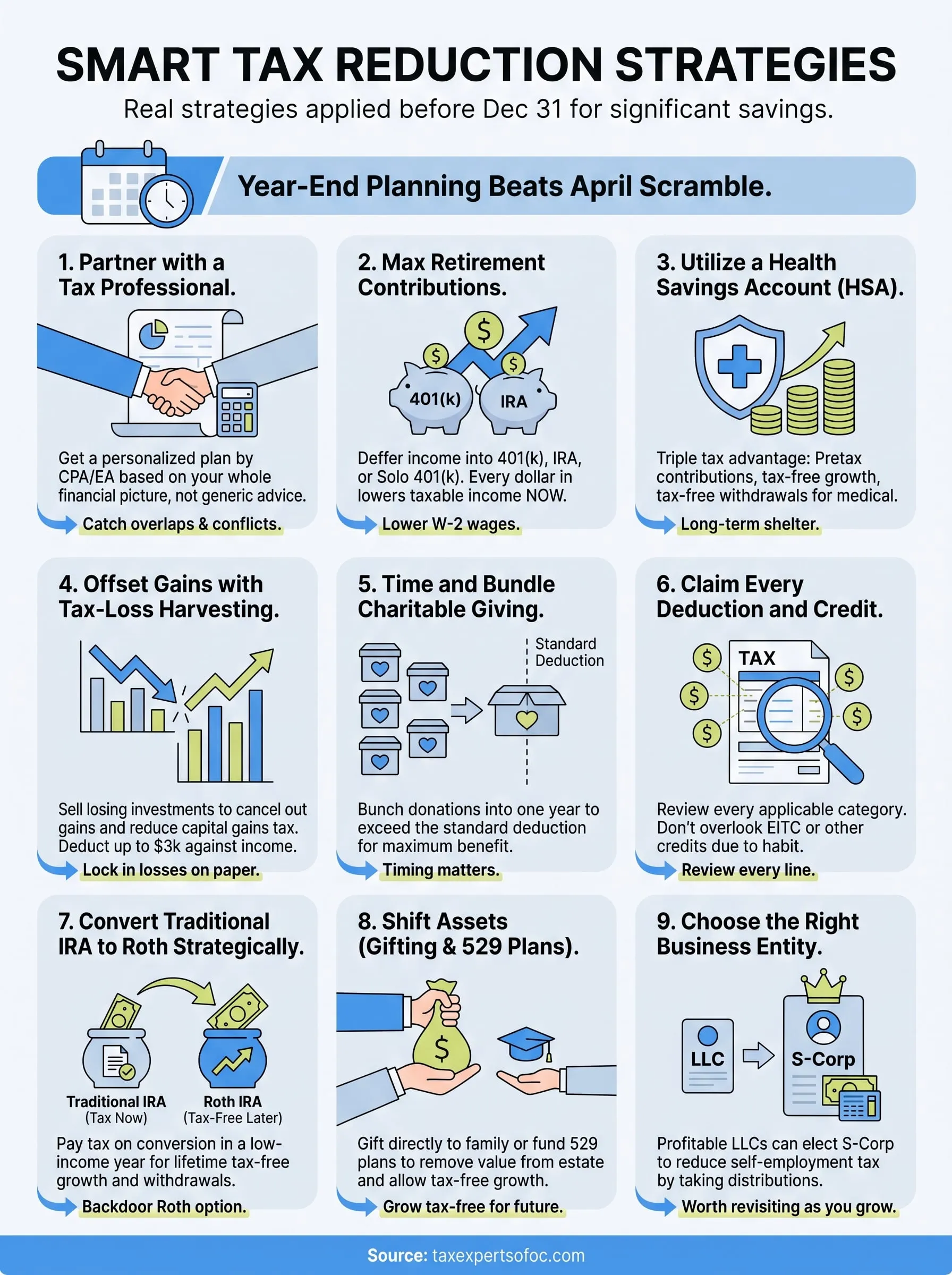
1. Partner with a tax professional for a personalized plan
Software can total your W-2s, but it can't tell you that restructuring your LLC as an S-corp would save you $8,000 a year, or that you qualify for a credit buried three schedules deep, which is one of the clearest signs it's time to bring in a CPA instead of filing yourself. A CPA or Enrolled Agent looks at your whole financial picture, income, business structure, dependents, investments, and builds a plan around it instead of just filling in boxes. This is the strategy that makes every other one on this list work better, because a tax planning advisor catches the overlaps and conflicts a generic checklist never will.
A good tax plan is built months before you file, not the night before the deadline.
How it works
You start with a consultation where the professional reviews last year's return, current income, and any changes coming up: a new business, a home sale, a job change. From there, they map out specific tax reduction strategies tied to your numbers, not generic advice pulled from a blog post. At Tax Experts of OC, that first conversation is a free 30-minute consultation, and clients get direct access to a CPA or EA rather than a call center rep reading from a script.
Who it's for
This fits almost everyone, but it matters most for:
- Business owners weighing entity structure or facing quarterly estimated payments, who need a tax plan built for a small business
- Individuals with multiple income streams, rental property, or investment gains
- Anyone who received an IRS notice or has unfiled back returns
- Households navigating a major life event: marriage, inheritance, retirement
Rules and limits to keep in mind
A professional can only work with accurate records, so you still need to track receipts, mileage, and business expenses throughout the year. Planning sessions cost money upfront, though most clients recover that fee many times over through good tax planning strategies applied correctly. Timing also matters. Many moves, like retirement contributions or entity elections, have hard deadlines, so waiting until March to call someone limits what they can actually do for your current tax year.
2. Max out your retirement account contributions
Every dollar you put into a traditional 401(k) or IRA reduces your taxable income dollar for dollar, right now, not someday. This is one of the best tax reduction strategies available because it does two things at once: it shrinks your tax bill this year and builds retirement savings you control. Employers who offer a match make this even better, since that match is free money layered on top of your own tax savings.
Every dollar you defer into a retirement account is a dollar the IRS can't touch this year.
How it works
Contributions to a traditional 401(k) come out of your paycheck before taxes, lowering your reported wages on your W-2. If you're self-employed, a SEP IRA or Solo 401(k) deduction lets you defer a much larger chunk of business income using the same principle.
Who it's for
This strategy suits:
- W-2 employees with access to an employer plan, especially one with matching
- Self-employed professionals and business owners without a workplace plan
- Anyone in a higher tax bracket now than they expect in retirement
Rules and limits to keep in mind
For 2025, the 401(k) employee contribution limit is $23,500, with an extra $7,500 catch-up if you're 50 or older, according to the IRS. Traditional IRA limits sit much lower at $7,000, and deductibility phases out at higher incomes if you or a spouse have a workplace plan. Miss the calendar-year deadline for 401(k) deferrals and you lose that year's opportunity for good.
3. Put pretax dollars into a health savings account
Few accounts beat the triple tax advantage of a health savings account: contributions go in pretax, growth is tax-free, and withdrawals for qualified medical expenses never get taxed. This is one of the more overlooked tax reduction strategies because people treat their HSA like a spending account instead of a long-term shelter for both healthcare costs and taxable income.

No other account lets you dodge taxes coming in, growing, and going out.
How it works
Money you contribute directly, or through payroll deduction, lowers your adjusted gross income for the year. Funds you don't spend roll over indefinitely and can even be invested, so a fully funded HSA doubles as a backup retirement account once you turn 65 and lose the medical-expense restriction.
Who it's for
This fits people enrolled in a qualifying high-deductible health plan, particularly:
- Younger, healthier individuals who rarely hit their deductible
- Families anticipating predictable medical or dental costs
- Anyone already maxing out a 401(k) and looking for another pretax bucket
Rules and limits to keep in mind
Eligibility requires a high-deductible health plan, and for 2025 the contribution caps sit at $4,300 for individual coverage and $8,550 for family coverage, per the IRS. Withdrawals for non-medical purposes before age 65 trigger both income tax and a 20% penalty, so keep receipts and only tap the account for legitimate expenses.
4. Offset gains with tax-loss harvesting
Selling a losing investment isn't a failure, it's one of the more useful tax reduction strategies available to anyone with a taxable brokerage account. You lock in a loss on paper, use it to cancel out gains elsewhere in your portfolio, and reduce the capital gains tax you'd otherwise owe this year.
A loss you sell on purpose is worth more than a gain you never planned for.
How it works
You sell an investment trading below what you paid, then apply that realized loss against realized gains from other sales. If losses exceed gains, you can deduct up to $3,000 against ordinary income and carry the rest forward to future years, per the IRS.
Who it's for
This strategy suits:
- Investors holding a mix of winners and losers in a taxable account
- Anyone who sold a business, property, or stock for a large gain this year
- High earners looking to smooth out capital gains across multiple tax years, often as part of broader tax planning for high income earners
Rules and limits to keep in mind
The wash-sale rule blocks you from claiming a loss if you buy the same or a substantially identical security within 30 days before or after the sale. This applies across all your accounts, including IRAs, so coordinate carefully if you manage multiple brokerage accounts. Harvesting works only in taxable accounts, not retirement accounts, since 401(k)s and IRAs already shield gains from annual taxation.
5. Time and bundle your charitable giving
Most people give to charity throughout the year in small amounts that never add up to more than the standard deduction, so the gift produces zero tax benefit. Bunching donations into a single year, then taking the standard deduction in the years between, is one of the smarter tax reduction strategies for anyone who gives consistently but itemizes inconsistently.
A donation only saves you tax money when it pushes you past the standard deduction, so timing the gift matters as much as the gift itself.
How it works
Instead of donating $5,000 a year for three years, you contribute $15,000 in one year, often through a donor-advised fund, then grant that money out to charities over the following years at your own pace. The lump sum clears the standard deduction threshold in the contribution year, and you still take the standard deduction in the off years.
Who it's for
This approach fits:
- Regular charitable donors whose annual giving falls near or below the standard deduction
- Homeowners who no longer itemize now that mortgage interest has dropped
- Anyone with a high-income year who wants a bigger deduction to offset it
Rules and limits to keep in mind
Cash gifts to public charities are deductible up to 60% of your adjusted gross income, and donated appreciated stock up to 30%, according to the IRS. Keep receipts for every gift over $250, since the IRS requires written acknowledgment before you can claim it.
6. Claim every deduction and credit you qualify for
Most taxpayers leave money on the table simply because they don't know a deduction or credit individuals can claim exists. The Earned Income Tax Credit alone goes unclaimed by an estimated one in five eligible filers every year, according to the IRS. Reviewing every line of the tax code that applies to your situation, rather than settling for the standard deduction out of habit, is one of the simplest tax burden reduction strategies available to almost anyone.
The deduction you never claim costs you as much as the one you overpay.
How it works
You or your preparer walk through every category, education costs, dependent care, home office use, energy-efficient home improvements, and match your actual expenses against what the tax code allows. Some credits, like the Child Tax Credit or the American Opportunity Credit, apply automatically once you enter dependent or tuition information correctly, though it helps to know how a credit differs from a deduction.
Who it's for
This applies broadly, but especially to:
- Parents paying for childcare, tuition, or adoption expenses
- Homeowners who installed solar panels, insulation, or efficient HVAC systems
- Self-employed people with a dedicated home office space
- Lower and middle-income earners who qualify for the EITC
Rules and limits to keep in mind
Many credits phase out above certain income thresholds, so eligibility shifts as your earnings change year to year. Documentation requirements are strict, keep receipts, mileage logs, and dated invoices, since the IRS can request proof during an audit. Overlooking one credit rarely triggers a problem, but claiming one you don't qualify for can trigger penalties and interest.
7. Convert traditional IRA funds to a Roth strategically
A Roth conversion sounds backward at first, you pay tax now on money you didn't have to touch yet, but timed right, it's one of the smarter tax reduction strategies for your lifetime tax bill rather than just this year's return. You move money from a traditional IRA into a Roth IRA, pay ordinary income tax on the converted amount, and every dollar afterward grows and withdraws completely tax-free.
Paying tax once at a low rate beats paying tax every year at a higher one.
How it works
You choose an amount to convert, often enough to fill up your current tax bracket without spilling into the next one, and report that amount as taxable income for the year. Because there's no income limit on conversions, even high earners locked out of direct Roth contributions can use this route, commonly called a backdoor Roth.
Who it's for
This strategy fits well for:
- Anyone in a temporary low-income year: between jobs, early retirement, or a slow business year
- High earners who want Roth savings but exceed direct contribution income limits
- People expecting higher tax rates in retirement than they pay today, where cutting taxes on retirement income becomes the real goal
Rules and limits to keep in mind
Converted funds must sit in the Roth for five years before penalty-free withdrawal of the converted principal, even if you're over 59½. Converting too much in one year can push you into a higher bracket or trigger higher Medicare premiums, so run the numbers before you pull the trigger. The IRS also requires you to include pro-rata amounts from any other traditional IRA balances, which complicates the math if you hold multiple accounts.
8. Shift income and assets through gifting and 529 plans
Wealthy families use gifting and education accounts to move money out of their taxable estate while helping the next generation, and the tax savings stack up quietly over time. Shifting assets this way is one of the quieter tax reduction strategies because it doesn't show up as a line on your own return, it shows up as income and growth that never gets taxed at your rate in the first place.
Money you give away today can grow tax-free for someone else tomorrow.
How it works
You give cash or assets directly to family members, often children or grandchildren, under the annual gift tax exclusion, removing that value from your estate without filing a gift tax return. Contributions to a 529 education plan grow tax-free and come out tax-free when used for qualified tuition, books, or room and board, and several states offer a deduction or credit for the contribution itself.
Who it's for
This strategy suits:
- Parents and grandparents funding future education costs
- High-net-worth individuals managing estate tax exposure
- Business owners gifting shares of a growing company at today's lower valuation
Rules and limits to keep in mind
For 2025, you can gift up to $19,000 per recipient without touching your lifetime exemption or filing paperwork, according to the IRS. Some states cap 529 deductions or don't offer one at all, and non-qualified 529 withdrawals trigger income tax plus a 10% penalty on earnings.
9. Choose the right business entity structure
Your business structure decides how much self-employment tax you pay, not just how you're organized on paper. A sole proprietor pays 15.3% self-employment tax on every dollar of net profit, while an S-corp owner only pays payroll tax on a reasonable salary and can take the rest as a distribution, which is the heart of the S corp versus LLC tax comparison. Picking the right structure is one of the highest-value tax reduction strategies for anyone running a profitable small business, and it's a decision worth revisiting as your income grows.

The entity you filed under three years ago might be costing you thousands today.
How it works
Once your LLC nets enough profit, usually somewhere north of $60,000 to $80,000, you can elect S-corp taxation with the IRS. You pay yourself a reasonable salary for an S corp owner subject to payroll tax, then take remaining profit as a distribution that skips self-employment tax entirely.
Who it's for
This fits:
- LLC owners and sole proprietors with consistent, growing net profit
- Consultants, contractors, and service-based businesses with few employees
- Partners weighing S-corp election against staying a partnership
Rules and limits to keep in mind
The IRS requires your salary to reflect fair market pay for your role, and setting it too low invites an audit. S-corp status adds payroll processing, a separate business return, and stricter bookkeeping requirements. Election deadlines fall early in the tax year, so waiting until filing season to file Form 2553 for S corp election means missing the current year entirely.
Putting these strategies to work for you
None of these nine moves work if they stay on a list you read once and forget. Tax reduction strategies only pay off when you match them to your actual numbers: your income, your filing status, your business structure, and the deadlines attached to each one. A W-2 employee maxing out a 401(k) needs a different plan than a business owner weighing an S-corp election, and mixing up the timing can cost you an entire year's opportunity.
That's exactly why the first strategy on this list, working with a professional, matters more than any single tactic here. A CPA or Enrolled Agent turns these ideas into a coordinated plan built around your actual return, not a generic checklist. If you're ready to stop guessing and start saving, book a free 30-minute consultation for tax planning services in Orange County and get a plan built around your numbers before the year closes out.