

Most small business owners overpay the IRS every year, not because they're careless, but because they treat taxes as a once-a-year scramble instead of an ongoing strategy. If you're only thinking about deductions in March or April, you've already missed half the opportunities available to you. A solid tax planning business strategy works year-round, not just at filing time, and it's the difference between reacting to your tax bill and controlling it.
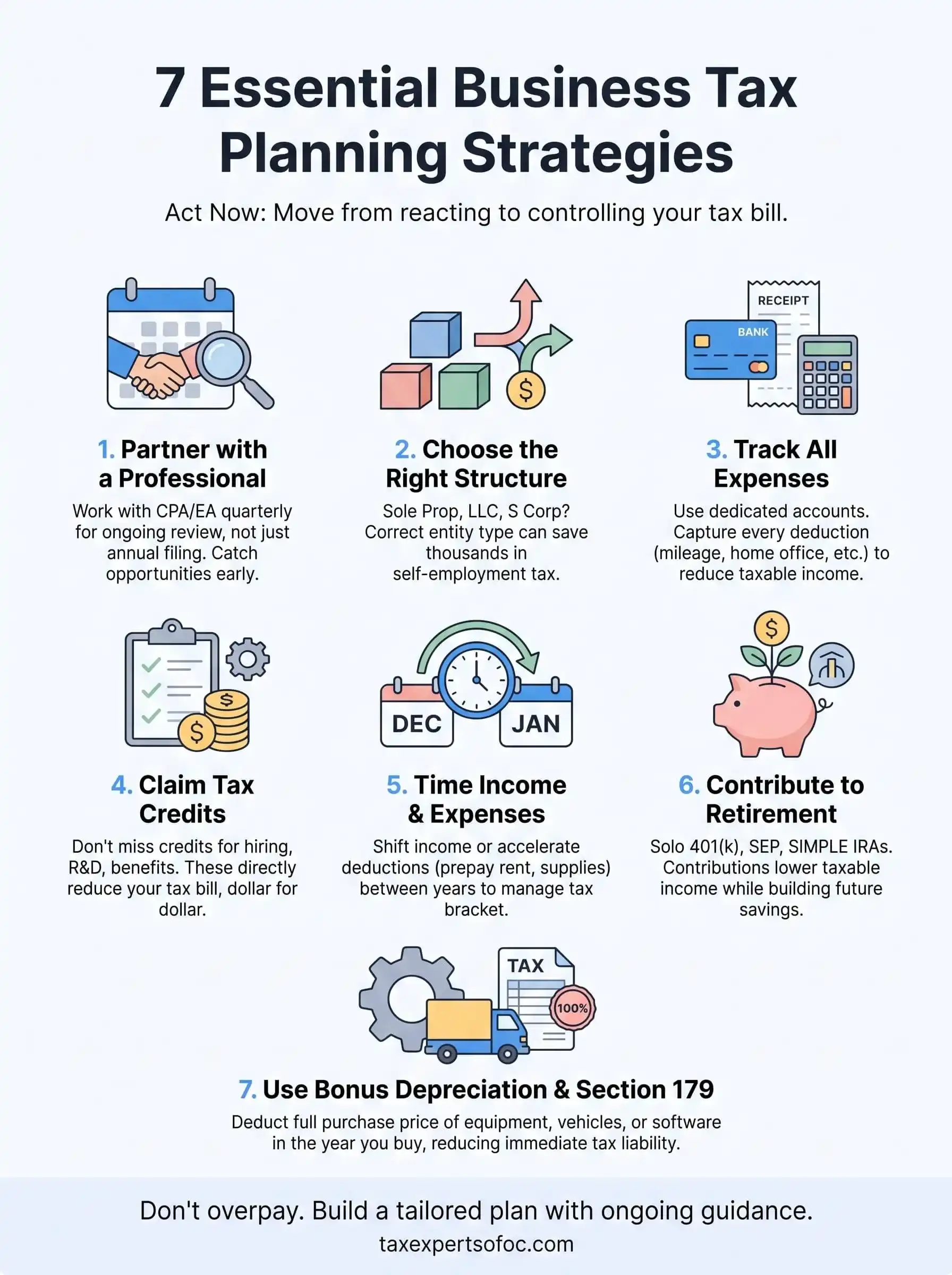
This article gives you seven concrete, actionable tax planning strategies for small businesses you can start using now, whether you run a sole proprietorship, an LLC, or a corporation. These aren't generic tips pulled from a blog mill. They're the same approaches CPAs and Enrolled Agents use with real clients to legally cut tax liability while keeping the IRS off their backs.
We'll walk through entity structure decisions, retirement contributions, expense timing, and other business tax planning strategies that actually move the needle on your bottom line. If you'd rather have a professional review your specific situation, Tax Experts of OC offers a free 30-minute consultation to help you build a plan tailored to your business.
1. Partner with a CPA or enrolled agent for ongoing planning
One-time tax prep looks backward at a year that's already closed. Ongoing tax planning looks forward and gives you room to actually change the outcome. When you work with a CPA or Enrolled Agent throughout the year instead of just at filing season, you get someone watching your income, expenses, and entity structure in real time, catching opportunities before December 31 instead of pointing them out after it's too late to act.
How it works
A CPA or Enrolled Agent (EA) reviews your financials on a recurring basis, typically quarterly, and flags moves you can still make before the tax year closes. That might mean adjusting estimated payments, timing a large purchase, or restructuring how you pay yourself. Enrolled Agents are federally licensed by the IRS and can represent you directly in audits, collections, and appeals, which matters if your planning ever crosses into a dispute. CPAs bring broader accounting expertise, including financial statement work and multi-state compliance. Many firms, including ours, pair both credentials so you get planning and representation from the same team instead of bouncing between specialists.
The businesses that save the most on taxes aren't the ones with the best software. They're the ones with a professional checking in before decisions get made, not after.
Who it's best for
This approach fits business owners who've outgrown DIY software and want a second set of eyes on decisions before they're locked in. It's especially valuable if you're managing payroll, multiple revenue streams, or an entity structure more complex than a sole proprietorship. New business founders also benefit, since early decisions about entity type and bookkeeping systems set the tone for every tax return that follows. If you've ever gotten an IRS notice and had no idea how to respond, that alone is a sign you need ongoing professional oversight rather than annual filing help.
Potential tax savings
Savings vary by business, but the pattern holds: proactive clients consistently pay less than those who only engage a professional at tax time. Quarterly check-ins catch missed deductions, prevent underpayment penalties, and surface entity or timing changes worth thousands over a year. According to the IRS Small Business and Self-Employed Tax Center, proper recordkeeping and planning throughout the year directly reduce the risk of costly errors and missed deductions come filing season. The upfront cost of ongoing guidance is almost always smaller than what it recovers.
2. Choose the right business structure for your tax situation
Your business structure decides how much of your income gets hit by self-employment tax, corporate tax, or nothing extra at all. A sole proprietorship or single-member LLC passes all profit straight to your personal return, where it's subject to the full 15.3% self-employment tax on top of income tax. An S corporation lets you split income into salary and distributions, and only the salary portion carries that self-employment tax burden. That difference alone can save thousands a year once your profit grows past a certain point.

How it works
Switching structures usually means electing S corp status with the IRS (Form 2553) once your LLC or corporation is already formed, or restructuring outright if you're still a sole proprietor. The IRS requires you to pay yourself a "reasonable salary" before taking distributions, and getting that number wrong invites an audit. This is one of the clearest examples of tax planning for business owners where the paperwork is simple but the judgment call isn't.
The right entity choice isn't about which structure sounds most professional, it's about which one taxes your actual profit the least.
Who it's best for
Businesses netting roughly $60,000 or more in annual profit typically see the biggest benefit from an S corp election. Partnerships and multi-owner LLCs also gain from a structure review, since profit-sharing rules affect each partner's tax exposure differently.
Potential tax savings
A profitable single-member LLC that reclassifies as an S corp can often cut self-employment tax by several thousand dollars annually, depending on the salary-to-distribution split chosen.
3. Track and maximize your business expense deductions
Most business owners leave money on the table simply because they don't track expenses closely enough to claim everything they're entitled to. Expense deductions reduce your taxable income dollar for dollar, so a missed $500 deduction isn't a rounding error, it's real tax you paid unnecessarily. Solid tax planning for small businesses starts with a system that captures every deductible cost as it happens, not a shoebox of receipts you sort through in April.
How it works
Keep a dedicated business bank account and credit card so expenses never mix with personal spending, which is one of the fastest ways to lose deductions or trigger IRS scrutiny. Use bookkeeping software or a bookkeeper to categorize costs monthly, covering the usual suspects like home office use, mileage, software subscriptions, and professional fees, along with commonly missed items like a percentage of your phone bill, business-related meals, and continuing education. The IRS guide to business expenses lays out what counts as ordinary and necessary, which is the legal standard every deduction has to meet.
A deduction you can't document is a deduction you don't actually have.
Who it's best for
This strategy matters for every business owner, but it delivers the most value to service-based businesses and freelancers whose expenses are easy to overlook without a system, like home office costs, vehicle use, and client-related travel.
Potential tax savings
Consistent tracking typically recovers thousands in deductions that would otherwise go unclaimed, especially once you account for mileage and home office deductions across a full year. Businesses that reconcile expenses monthly instead of annually also catch categorization errors before they become audit red flags.
4. Claim tax credits your business may qualify for
Deductions shrink your taxable income, but tax credits cut your tax bill directly, dollar for dollar. Most small business owners assume credits are reserved for big corporations with dedicated tax departments, so they never bother checking what they qualify for. That assumption costs real money every year, especially for businesses that hire, invest in research, or offer employee benefits without realizing those activities come with credits attached.
How it works
Common credits include the Work Opportunity Tax Credit for hiring from certain target groups, the Small Business Health Care Tax Credit if you cover employee premiums, and the R&D credit if you're developing new products or processes, even in a small way. Retirement plan startup costs and paid family leave programs also carry their own credits. The IRS Credits and Deductions for Businesses page lists the full range, but matching your actual operations to the right credit takes someone who knows where to look.
A missed credit isn't a smaller refund, it's cash you handed the IRS for nothing.
Who it's best for
This strategy suits business owners who hire regularly, invest in equipment or software development, or offer employee benefits like health coverage. It's also worth a close look for corporations and LLCs taxed as corporations, since many credits phase differently depending on entity type. If you've never asked your preparer specifically about credits, you're likely leaving some unclaimed.
Potential tax savings
Credits vary widely, but even a single qualifying credit can offset thousands in tax liability in one year. Layering several credits together, hiring incentives plus retirement plan credits, for example, compounds the savings further. Reviewing eligibility annually as part of broader tax planning strategies for businesses ensures you're not paying more than the law actually requires.
5. Time income and expenses to your advantage
Your tax bill isn't just about how much you earn, it's about when you earn it and when you spend it. Income timing and expense timing let you shift taxable income between years, which matters most when you expect a big swing in profit or a change in your tax bracket. This is one of the simpler tax planning strategies for small businesses to execute, but most owners never think about it until December, when half the options are already off the table.
How it works
Cash-basis businesses have the most flexibility here. Delay invoicing until early January if you expect next year's income to fall in a lower bracket, or push clients to pay in December if you need to offset a high-income year with matching expenses. On the expense side, consider accelerating deductible purchases, like stocking up on supplies, prepaying rent, or renewing software subscriptions before year-end, to pull deductions into the current tax year.
A dollar of income or expense doesn't change size, but the year you recognize it in absolutely changes what you owe.
Who it's best for
This fits businesses with variable income, seasonal revenue spikes, or a year that looks meaningfully different from the last. Accrual-basis businesses have less room to maneuver but can still time large equipment purchases or contract signings. It's also useful for business owners who know a major life event, like retirement or a sale, will change their tax bracket soon.
Potential tax savings
Shifting even $20,000 to $30,000 of income into a lower-bracket year can save several thousand dollars in combined federal and self-employment tax. Pairing income timing with expense acceleration often produces the biggest single-year impact of any strategy on this list.
6. Contribute to a retirement plan for your business
Every dollar you put into a qualifying retirement plan reduces your taxable income for the year, while also building savings you'd probably want anyway. Business owners often skip this because they assume retirement accounts are a personal finance decision separate from business tax planning, but the contribution limits and deduction rules make this one of the most powerful levers on this entire list.
How it works
Solo 401(k)s let a self-employed owner contribute as both employee and employer, pushing the deduction well past what a traditional IRA allows. SEP IRAs work well for businesses with a few employees since contributions scale with compensation, and SIMPLE IRAs suit smaller teams that want lower administrative overhead. Contributions come off your taxable income dollar for dollar, and in many cases you have until your tax filing deadline, including extensions, to fund the prior year. The IRS retirement plans comparison chart breaks down contribution limits and eligibility by plan type.
A retirement contribution is one of the few tax moves that lowers your bill this year and pays you back later.
Who it's best for
Solo 401(k)s suit owner-only businesses with no employees, while SEP and SIMPLE IRAs fit businesses with staff who want to offer a benefit without the cost of a full 401(k) program. This strategy works especially well for high-income years when you need a larger deduction without spending more on the business itself.
Potential tax savings
A Solo 401(k) contribution can shelter tens of thousands of dollars from tax in a single year, depending on your income and the salary-versus-distribution split under an S corp structure. Even a modest SEP IRA contribution of $10,000 to $15,000 can meaningfully lower your bracket while adding real savings toward retirement.
7. Use bonus depreciation and Section 179 for equipment
Buying equipment, vehicles, or software for your business doesn't have to mean waiting years to recover the cost through slow depreciation schedules. Section 179 and bonus depreciation let you deduct the full purchase price in the year you buy it, turning a big expense into an immediate tax reduction instead of a multi-year write-off.

How it works
Section 179 allows you to expense qualifying equipment, machinery, and certain software up to an annual limit set by the IRS, which adjusts most years. Bonus depreciation works alongside it and can apply even when a business shows a loss, unlike Section 179, which is capped by your taxable income. The IRS depreciation guidance spells out what qualifies and how the two rules interact, since stacking them incorrectly is a common error. Timing the purchase and placing the asset in service before December 31 is what locks in the deduction for that tax year.
Equipment you were going to buy next quarter anyway is worth buying this quarter if it drops your tax bill now.
Who it's best for
This strategy fits businesses investing in vehicles, machinery, computers, or office equipment, and it's a staple among corporate tax planning strategies for companies scaling operations. LLCs and S corps with strong current-year profit benefit most, since the deduction offsets income dollar for dollar right when it's earned.
Potential tax savings
A $40,000 equipment purchase fully expensed under Section 179 can save well over $10,000 in combined tax, depending on your bracket and entity structure. Pairing this with year-end income timing often produces the largest single deduction available to a profitable small business.
Putting these strategies to work
None of these seven strategies work in isolation, and none of them work if you only think about taxes once a year. Entity structure, retirement contributions, expense timing, and equipment purchases all interact with each other, which is exactly why business owners who plan quarterly consistently outpace those who scramble every April. Pick one or two strategies from this list that fit your current situation, whether that's an S corp election or finally opening a Solo 401(k), and start there instead of trying to overhaul everything at once.
Quietly overpaying the IRS year after year isn't caution, it's a missed opportunity you can fix starting today. Tax planning for business owners works best with a professional who knows which moves apply to your specific numbers and deadlines. If you want help building a plan around your business instead of guessing at deductions alone, schedule a free consultation with Tax Experts of OC and get a strategy tailored to your situation.