

December 31 is a hard deadline. Once the calendar flips, most of the moves that could have lowered your tax bill for the year disappear, and you're stuck with whatever number shows up on your return. Tax planning year-end is the window to still change that number, and most taxpayers let it close without doing anything about it.
If you're searching for ways to act before that deadline, here's the direct answer: you can still shift income, accelerate deductions, and restructure investments to reduce what you owe, but only if you make specific moves in the next few weeks. Strategies like maximizing retirement contributions and tax-loss harvesting can move your liability by thousands of dollars, and none of them require waiting until filing season to see the benefit.
Below, we've put together 10 year end tax planning strategies that our CPAs and Enrolled Agents use with clients across Orange County and nationwide every fall, drawn from the same tax strategies individuals use to cut taxes all year long. You'll find practical steps covering retirement accounts, charitable giving, business deductions, and income timing, so you can walk into next April with a smaller bill instead of a surprise.
1. Get a year-end tax review from a CPA or enrolled agent
Before you touch a single strategy on this list, sit down with a professional and look at where you actually stand. A year-end tax review takes your income, withholding, business activity, and life changes from the past twelve months and translates them into a real projected tax bill, not a guess. Most people don't know if they're going to owe money or get a refund until they file, and by then it's too late to fix anything. A review in October or November gives you enough runway to actually act on what you find.
How it works
A CPA or Enrolled Agent pulls your pay stubs, 1099s, brokerage statements, and business profit and loss reports, then runs a projection of your total tax liability for the year. This isn't a full return, it's a working estimate that flags problems while you can still solve them: underpaid estimated taxes, a jump into a higher bracket from a bonus or asset sale, or a business that's about to owe more self-employment tax than expected. From there, your tax advisor builds a short list of moves specific to your numbers, not generic advice pulled from a blog post.
A tax return just reports what already happened. A year-end review is the last chance to change what happens.
Who it's for
This step matters most if your income changed meaningfully this year, whether that's a new job, a business that grew or shrank, a stock sale, an inheritance, or a divorce. Business owners with fluctuating quarterly income benefit especially, since a single strong quarter can throw off an entire year's estimated tax payments. Retirees taking distributions from multiple accounts, and anyone juggling W-2 income alongside freelance or 1099 work, also tend to find surprises they didn't expect once someone actually runs the numbers.
2025 deadlines and limits
The practical window for a review runs from October through the third week of December. Waiting past mid-December cuts out options like retirement contributions through your paycheck, business equipment purchases, or restructuring investment sales, since custodians and payroll systems need lead time to process changes before December 31. Fourth-quarter estimated tax payments for the self-employed are typically due January 15 of the following year, and a review before year-end lets you adjust that payment based on an accurate projection instead of a rough estimate.
- Schedule your review by mid-October if you have business income or plan a Roth conversion
- Book by early December at the latest for retirement contribution or charitable giving adjustments
- Bring your last three pay stubs, current brokerage statements, and any 1099s received so far
Mistakes to avoid
Don't wait until you're already filing your return to ask, "could I have done something differently?" By then, every deadline mentioned above has passed. Skipping this step because you used software last year is another common misstep, since software reports history, it doesn't project forward or recommend action, which is the difference between tax preparation and tax planning. Some taxpayers also try to DIY the projection with a spreadsheet, which misses interactions between AMT, phase-outs, and state tax rules that a working professional catches immediately. If you want that projection done properly, our team offers a free 30-minute consultation to walk through your specific numbers before the year closes.
2. Max out your retirement account contributions
Every dollar you push into a traditional 401(k), 403(b), or SEP IRA before December 31 comes straight off your taxable income for the year. Retirement account contributions are one of the few levers you can still pull with days left on the calendar, and unlike a lot of tax moves, this one also builds your net worth instead of just shrinking a bill.

How it works
Contributions to a traditional 401(k) or 403(b) get deducted from your paycheck before taxes are calculated, so bumping your contribution percentage now lowers your taxable wages for the rest of the year. Self-employed taxpayers get more room to work with through a SEP IRA or Solo 401(k), both of which allow contributions based on net business income and, in the case of a Solo 401(k), can be funded up until your tax filing deadline (including extensions) even though the account itself needs to be opened by December 31, so it's worth knowing how much a Solo 401(k) contribution actually deducts.
The contribution room you don't use by December 31 for a workplace plan is gone for good.
Who it's for
Salaried employees with room left in their 401(k) elective deferral limit benefit most, especially anyone who got a raise or bonus mid-year and hasn't adjusted their contribution rate. Business owners and freelancers with strong profit this year should look hard at a SEP IRA or Solo 401(k) before assuming they're stuck with a large tax bill.
2025 deadlines and limits
| Account | 2025 contribution limit | Catch-up (age 50+) |
|---|---|---|
| 401(k) / 403(b) | $23,500 | $7,500 ($11,250 for ages 60-63) |
| Traditional/Roth IRA | $7,000 | $1,000 |
| SEP IRA | Lesser of $70,000 or 25% of compensation | Not applicable |
Workplace plan contributions must post by December 31, since payroll can't retroactively adjust a check that's already been issued. IRA contributions, by contrast, can be made until the April filing deadline and still count for 2025.
Mistakes to avoid
Waiting until your December paycheck to raise your contribution rate rarely works, since payroll systems typically need at least one pay cycle to process the change. Solo 401(k) owners who forget the account has to exist by December 31 lose the option entirely, even if they still have until spring to fund it. If you're not sure how much room you have left for the year, our team can check your numbers during a free consultation before the deadline passes.
3. Consider a Roth conversion before year-end
Moving money from a traditional IRA into a Roth IRA means paying tax now on the converted amount, in exchange for tax-free growth and withdrawals later, one of several tax-free retirement planning strategies worth mapping out. A Roth conversion makes the most sense in a year when your income, and therefore your tax bracket, is temporarily lower than usual, since you're paying tax on the conversion at today's rate instead of whatever rate applies when you'd otherwise be forced to withdraw the money.
How it works
You instruct your custodian to move funds directly from your traditional IRA to a Roth IRA, and the converted amount gets added to your taxable income for the year, reported on Form 1099-R. There's no dollar limit on how much you can convert, so partial conversions let you convert just enough to fill up your current tax bracket without spilling into the next one. This is a calculation your CPA can run precisely once your year-end review is done, since guessing wrong means paying more tax than necessary.
A Roth conversion only saves you money if you're paying tax at a lower rate today than you'll pay tomorrow.
Who it's for
This strategy suits people between jobs, business owners with a slow year, or anyone whose income dropped due to a layoff, sabbatical, or early retirement before Social Security or RMDs kick in. It also works well for younger investors decades from retirement, since converted funds have more time to grow tax-free before withdrawal.
2025 deadlines and limits
Roth conversions must be completed by December 31, 2025, since the entire converted amount counts as income for the tax year in which the transfer occurs. Unlike IRA contributions, there's no grace period into the following spring.
- Confirm your custodian's processing cutoff, some require requests submitted by mid-December
- Run the numbers before converting to avoid triggering the Additional Medicare Tax or Net Investment Income Tax
- Consider spreading conversions across several years instead of one large lump sum
Mistakes to avoid
Converting too much in a single year is the most expensive mistake we see, since it can push you into a higher bracket and erase the benefit entirely. Skipping the effect on Medicare premiums two years out is another common oversight, since a large conversion can raise your IRMAA surcharge later. Reversing a conversion isn't an option anymore either, since the IRS eliminated recharacterization for conversions back in 2018, so once it's done, it's done. Talk to our team through a free consultation before you convert anything.
4. Harvest investment losses to offset capital gains
Selling losing investments before December 31 lets you use those losses to cancel out gains elsewhere in your portfolio, and sometimes even against your ordinary income. Tax-loss harvesting turns a bad stock pick into a real deduction, which is one of the few silver linings available when the market moves against you during the year.

How it works
You sell an investment sitting at a loss, and that loss first offsets any capital gains you've realized this year, whether from other stock sales, mutual fund distributions, or the sale of a business. If your losses exceed your gains, up to $3,000 of the excess can offset ordinary income, and anything beyond that carries forward to future tax years indefinitely. Many investors reinvest the proceeds into a similar, but not identical, security to stay in the market while still capturing the loss for tax purposes.
A loss you never sell to realize is just a number on a screen. Sell it, and it becomes a deduction.
Who it's for
Anyone holding taxable brokerage accounts with positions currently below their purchase price should look at this before year-end, especially if you've already realized large gains this year from a business sale, real estate transaction, or a winning stock. Investors sitting on both winners and losers can pair the two, selling losers to offset the gains from selling winners, and come out with a much smaller net taxable amount.
2025 deadlines and limits
Trades must settle by December 31, 2025 to count for this tax year, and most brokerages need the sell order placed a few business days before that to guarantee settlement. Keep these limits in mind:
- $3,000 maximum net loss deductible against ordinary income per year ($1,500 if married filing separately)
- Unlimited losses can offset capital gains dollar-for-dollar
- Excess losses carry forward with no expiration date
Mistakes to avoid
Watch out for the wash sale rule, since buying back the same or a substantially identical security within 30 days before or after the sale disallows the loss entirely. Placing the trade too close to December 31 also risks a settlement delay that pushes it into the next tax year, so give yourself a buffer of at least a week. Selling purely for tax reasons, without regard to whether the position still fits your investment strategy, is another trap worth avoiding. If you're not sure which lots to sell or how the wash sale rule applies to your specific holdings, book a free consultation with our team before you place any trades.
5. Take your required minimum distributions on time
Once you hit the age where the IRS requires withdrawals from your retirement accounts, missing the deadline costs you far more than the tax on the distribution itself. Required minimum distributions, or RMDs, are a mandatory part of any thorough tax planning year-end checklist, since the penalty for skipping one dwarfs almost every other mistake on this list.
How it works
Each traditional IRA, 401(k), and most inherited retirement accounts carry an RMD calculated by dividing your account balance as of December 31 of the prior year by a life expectancy factor from the IRS Uniform Lifetime Table. Custodians usually calculate this number for you and send a notice, but the responsibility to actually withdraw it, and pay tax on it as ordinary income, falls on you. Account holders with multiple IRAs can total the RMDs across those accounts and withdraw the sum from just one of them, though 401(k) plans generally require a separate withdrawal from each employer plan.
Missing an RMD deadline turns a routine withdrawal into one of the steepest penalties in the entire tax code.
Who it's for
This applies directly to anyone age 73 or older with a traditional IRA, SEP IRA, or old 401(k) balance sitting untouched, and it sits at the center of planning taxes on retirement income. Inherited IRA beneficiaries also face RMD rules, often on a compressed 10-year distribution schedule under the SECURE Act, and should confirm their specific timeline with an advisor rather than guess.
2025 deadlines and limits
Most account holders must withdraw their full RMD by December 31, 2025. First-time RMD recipients get a one-time grace period until April 1 of the following year, though taking two distributions in one calendar year can push you into a higher bracket.
- RMD age: 73 for those born 1951-1959, rising to 75 for those born 1960 or later
- Penalty for a missed or shortfall RMD: 25% of the amount not withdrawn, reduced to 10% if corrected within two years
- Qualified charitable distributions up to $108,000 in 2025 can satisfy your RMD without adding to taxable income
Mistakes to avoid
Forgetting an inherited account is the most common oversight, since it's easy to lose track of a smaller balance from a parent or relative. Assuming your custodian will withdraw the money automatically is another risky bet, since many only calculate the amount and leave the transaction to you. If you're unsure whether you've satisfied every RMD across every account this year, our team can check during a free consultation before the December 31 cutoff.
6. Give strategically to charity before December 31
Writing a check to your favorite nonprofit is only the simplest version of charitable giving, and often not the most tax-efficient one. Strategic charitable giving means choosing the right asset to donate and the right vehicle to donate it through, so the same generosity that helps a cause also lowers your tax bill by more than a cash gift ever could.

How it works
Donating appreciated stock or mutual fund shares you've held over a year lets you deduct the full fair market value while skipping the capital gains tax you'd owe if you sold the shares first. A donor-advised fund takes this further, letting you contribute a lump sum this year, take the full deduction now, and decide which charities receive the money over the following years. Bunching two or three years of planned giving into one December contribution can also push you over the standard deduction threshold, so the itemized deduction actually does something for you.
Donating appreciated stock instead of cash gets you a bigger deduction and erases the capital gains tax in the same move.
Who it's for
Anyone holding highly appreciated stock outside a retirement account should look at this before writing a check from a bank account instead. Taxpayers whose itemized deductions normally sit close to the standard deduction benefit most from bunching, since a single large gift year can unlock itemizing when spreading gifts evenly across years never would.
2025 deadlines and limits
Gifts must be made, not just pledged, by December 31, 2025 to count for this tax year, and stock transfers need to settle in the charity's account by then too, so start the transfer well before the holidays.
- Cash gifts to public charities: deductible up to 60% of adjusted gross income
- Appreciated stock gifts: deductible up to 30% of adjusted gross income
- Excess contributions carry forward for up to five years
Mistakes to avoid
Donating cash when you're sitting on appreciated stock leaves money on the table, since you pay tax on the sale you didn't need to make. Waiting until December 30 to initiate a stock transfer risks missing the settlement window entirely, especially with a brokerage that isn't your charity's usual custodian. If you're weighing a donor-advised fund against a direct gift, our team can walk through the numbers during a free consultation before you decide.
7. Max out your HSA and FSA contributions
Health savings and flexible spending accounts let you set aside pretax dollars for medical costs, and both come with a use-it-or-lose-it clock that resets on December 31. HSA and FSA contributions shrink your taxable income immediately, and unlike most of the moves on this list, they cover expenses you're probably already paying for anyway, from prescriptions to dental work.
How it works
A Health Savings Account, available only if you're enrolled in a high-deductible health plan, lets you contribute pretax dollars that grow tax-free and roll over year to year with no expiration. A Flexible Spending Account works differently: money goes in pretax through your employer, but most plans force you to spend it by December 31 or lose it, though some allow a small carryover or a short grace period into March. Maxing out an HSA before year-end also works as a stealth retirement account, since after age 65 you can withdraw funds for any purpose without penalty, paying only ordinary income tax like a traditional IRA.
Money left in an FSA on January 1 doesn't roll over, it just disappears.
Who it's for
Anyone on a high-deductible health plan with room left in their HSA contribution limit should top it off before the deadline, especially if you're also eyeing the account as a long-term retirement supplement. Employees with an FSA and unspent funds sitting in the account need to schedule appointments and stock up on eligible expenses now, before the balance disappears for good.
2025 deadlines and limits
| Account | 2025 contribution limit | Rollover rules |
|---|---|---|
| HSA (self-only) | $4,300 | Full balance carries forward every year |
| HSA (family) | $8,550 | Full balance carries forward every year |
| FSA (health care) | $3,300 | Up to $660 carryover, if your plan allows it |
HSA contributions can technically be made until the April tax deadline and still count for 2025, but FSA elections and spending must generally wrap up by December 31 unless your employer offers a grace period.
Mistakes to avoid
Letting FSA funds expire unused is the most common waste we see, so check your balance now and book any dental, vision, or medical appointments you've been putting off. Confusing HSA and FSA rules is another frequent slip, since assuming your HSA balance disappears at year-end like an FSA leads people to spend money they didn't need to. If you're not sure how much room you have left in either account, our team can check during a free consultation before the deadline passes.
8. Time your income and deductions strategically
When you receive income and when you pay deductible expenses can matter as much as how much you actually earn or spend. Timing income and deductions means pushing income into next year or pulling deductions into this one, whichever direction lowers your total tax bill once you know where you're likely to land.
How it works
If you expect to be in a lower bracket next year, ask a client to hold a December invoice until January, or delay a bonus if your employer allows it. If the opposite is true and this year's rate is lower, accelerate income by billing early or exercising stock options now instead of waiting. On the deduction side, prepaying your January mortgage payment, state estimated taxes, or a planned business expense before December 31 pulls that write-off into the current year instead of the next.
The value of a deduction depends entirely on which year's tax bracket it lands in.
Who it's for
Self-employed taxpayers and business owners have the most control here, since they can decide when to invoice clients or when to buy equipment, which is why timing sits high on any small business tax plan. Anyone expecting a bracket change next year, whether from a new job, retirement, or a business sale, should map out both years before deciding which direction to shift income and deductions, and higher earners have more moves available than most people realize.
2025 deadlines and limits
Any income shift or expense prepayment needs to happen by December 31, 2025 to affect this year's return, and the constructive receipt rule means income you have unrestricted access to counts as received even if you don't cash the check.
- Section 179 lets businesses deduct up to $2.5 million in qualifying equipment purchases placed in service by December 31, 2025, one of many write-offs a small business can claim legally
- Bonus depreciation sits at 100% for qualifying property under current law
- State and local tax deduction is capped at $10,000 for most filers, so prepaying beyond that cap gains you nothing
Mistakes to avoid
Prepaying state taxes past the SALT cap is a common wasted move, since the extra payment simply doesn't count toward your deduction. Deferring income without checking next year's projected bracket can also backfire, turning what looked like a smart delay into a bigger bill later. Business owners sometimes buy equipment purely for the deduction without needing it, which spends real cash to save a fraction in tax. A free consultation with our team can confirm which direction actually helps your specific numbers before you commit to anything.
9. Make tax-free gifts to family and fund education
Moving money to family members before December 31 can shrink your taxable estate and, in some cases, your income tax bill in the same year. Tax-free gifting works alongside education funding tools like a 529 plan, giving you two separate levers that both reduce what the IRS eventually collects from your family, whether now or decades from now.

How it works
Once you give any single person more than the annual exclusion in a calendar year, you're supposed to file a gift tax return on Form 709, though no actual tax is usually owed until you exhaust your lifetime exemption. 529 plan contributions aren't federally deductible, but many states, California included, offer other benefits, and the money grows tax-free as long as it's used for qualified education expenses. Superfunding a 529 lets you front-load five years of annual exclusion gifts into a single contribution, provided you file the election on your gift tax return.
A gift you make before December 31 removes both the asset and its future growth from your taxable estate.
Who it's for
Grandparents and parents looking to help fund a child's education, and anyone with an estate large enough to worry about future estate tax exposure, should look at this before year-end alongside the other tax moves high net worth families make. High-net-worth families already using their annual exclusion every year benefit most from superfunding, since it moves a much larger sum out of the estate in one move.
2025 deadlines and limits
- Annual gift tax exclusion: $19,000 per recipient ($38,000 for married couples splitting gifts)
- Lifetime gift and estate tax exemption: $13.99 million per person
- 529 superfunding: up to $95,000 per giver ($190,000 per married couple) treated as five years of gifts at once
Gifts must be completed, meaning the funds actually transferred, by December 31, 2025 to count against this year's exclusion.
Mistakes to avoid
Sending money without documenting the gift is a common oversight, since a paper trail matters if the IRS ever asks about your lifetime exemption usage. Superfunding a 529 without filing the five-year election on your gift tax return is another frequent slip, and it can trigger unnecessary reporting. Talk to our team through a free consultation before moving large sums to family this year.
10. Resolve outstanding IRS issues before year-end
Carrying unresolved back taxes, unfiled returns, or an open audit into a new tax year only compounds the problem, since penalties and interest keep accruing every single day you wait. Resolving IRS issues before December 31 clears the deck so your year-end tax planning actually works, since none of the strategies above matter much if the IRS is already garnishing your wages or holding a lien on your property.
How it works
A CPA or Enrolled Agent reviews your IRS account transcripts to see exactly what's owed, what's been filed, and what notices are outstanding, since guessing at your own balance almost always undercounts the penalties and interest stacked on top. From there, the steps for clearing back taxes range from an installment agreement that spreads payments over time, to an offer in compromise that settles the debt for less than the full amount, to simply filing years of missing returns to stop the failure-to-file penalty from growing further. Getting into current compliance, meaning every required return is filed, is a prerequisite the IRS demands before it will even discuss a payment plan or settlement, so catching up on unfiled returns comes first.
An unresolved IRS notice doesn't go away on its own, it just gets more expensive the longer you leave it.
Who it's for
This step applies directly to anyone who's received a CP2000 notice, a certified letter about back taxes, or a wage garnishment threat this year, all situations where representation for audits and IRS notices pays for itself. It also applies to business owners behind on payroll tax deposits, since the IRS treats trust fund recovery penalties for unpaid payroll taxes with particular urgency compared to other debts.
2025 deadlines and limits
There's no single December 31 cutoff here, but acting before year-end matters because failure-to-file and failure-to-pay penalties accrue monthly, and a fresh IRS collection cycle often starts in January. Consider these figures:
- Failure-to-file penalty: 5% of unpaid tax per month, up to 25% (what it costs to file taxes late)
- Failure-to-pay penalty: 0.5% of unpaid tax per month, also capped at 25%
- Interest accrues daily at the current federal short-term rate plus 3%
Mistakes to avoid
Ignoring IRS notices in the hope they'll disappear is the single costliest mistake taxpayers make, since silence often triggers automatic collection action. Trying to negotiate directly with the IRS without understanding your options can also lock you into an installment agreement that's larger than necessary. If you're facing back taxes or an open notice right now, book a free 30-minute consultation with our team before the new year adds another layer of penalties to your balance.
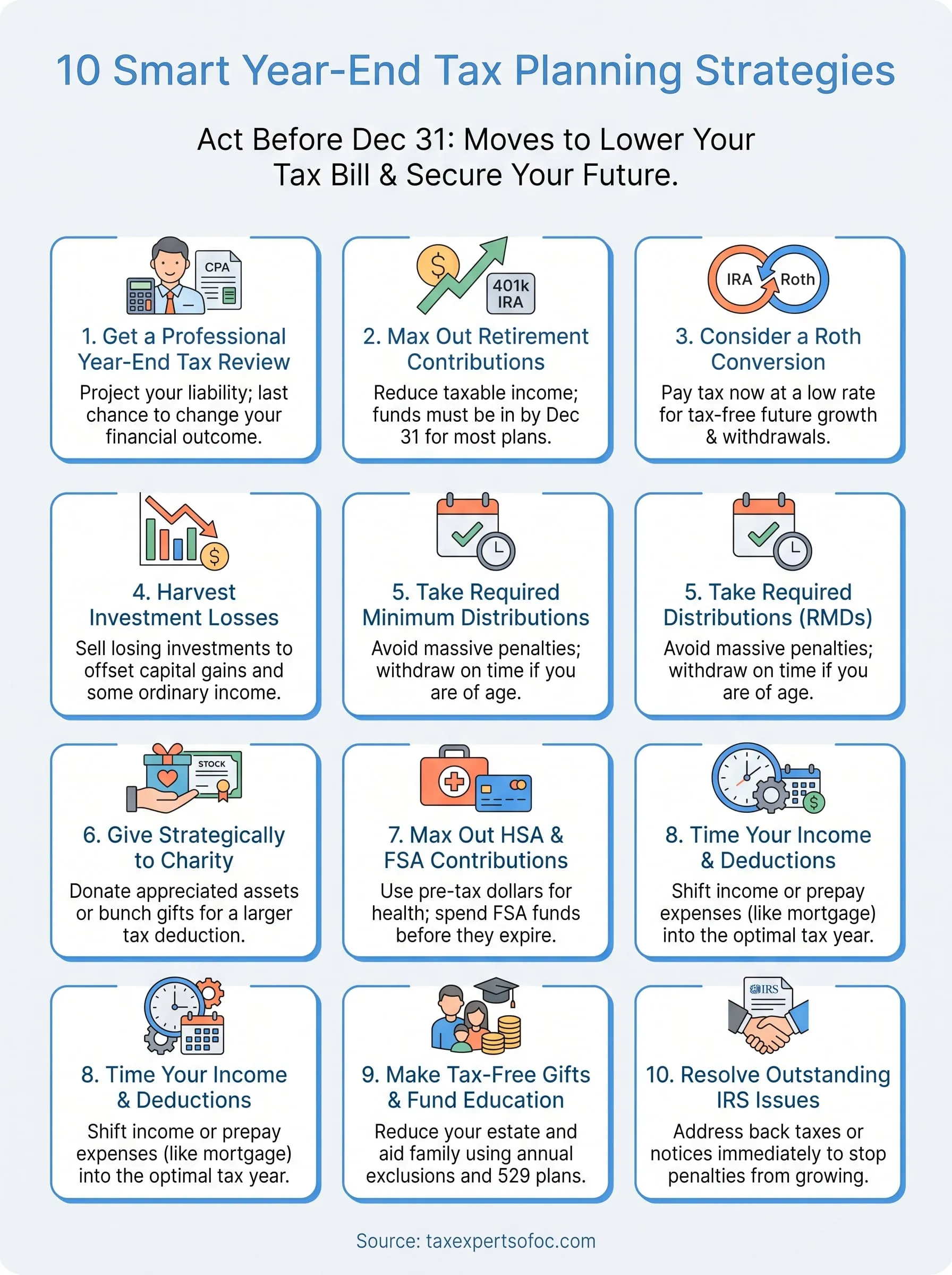
Turning these strategies into a plan
Ten strategies on a page won't lower your tax bill by themselves. Year-end tax planning only works when someone runs your actual numbers against these options and tells you which three or four apply to your situation this year, not all ten. A retiree with RMDs due doesn't need advice about Roth conversions timed for a low-income year, and a business owner behind on payroll deposits should fix that before worrying about charitable bunching.
What matters now is speed. Custodians, payroll systems, and brokerages all need lead time before December 31, and every week you wait narrows what's still possible. A CPA or Enrolled Agent can turn this list into a short, specific plan built around your income, your accounts, and your deadlines. If you want that plan before the calendar closes on 2025, book your free 30-minute consultation and see what our CPA-led tax planning in Orange County can do for your numbers.