

If you're self-employed and stashing money into a Solo 401(k), you're probably wondering exactly how much of that contribution comes off your tax bill. The solo 401 k tax deduction isn't a flat number. It depends on whether you're contributing as an employee, an employer, or both, and on how your business is structured as a sole proprietorship, S-corp, or partnership.
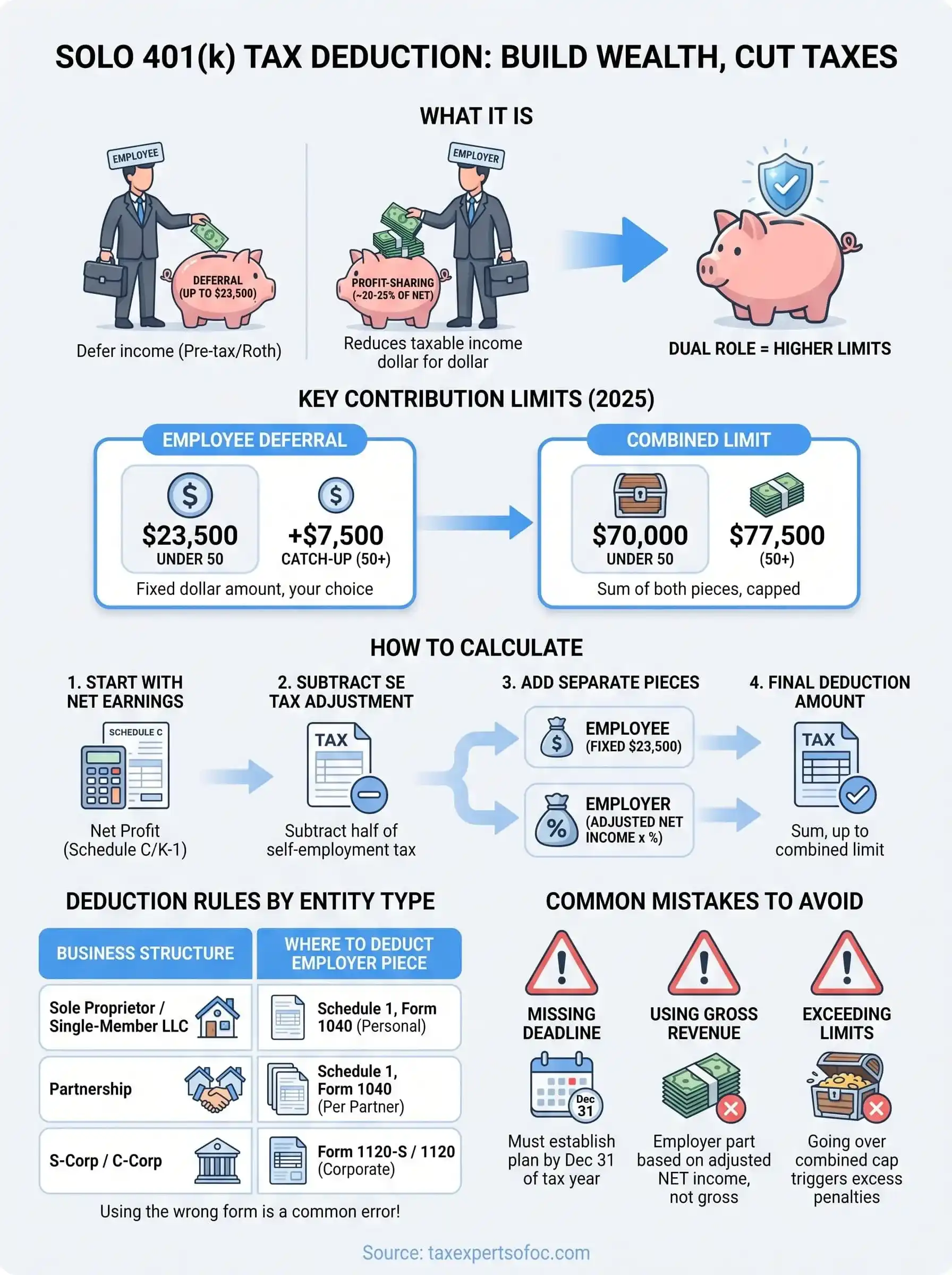
Here's the short answer: you can deduct both your employee deferral (up to $23,500 in 2025 for under-50) and your employer profit-sharing contribution (roughly 20-25% of net self-employment income, depending on entity type), and the combined limit tops out at $70,000 for 2025, or $77,500 with catch-up contributions if you're 50 or older. The exact math changes based on your income and business type.
We'll break down how to calculate your maximum deductible contribution, walk through where these amounts actually go on your tax return, and flag the mistakes that trigger IRS scrutiny. If your situation involves multiple income streams or an S-corp structure, this is where a CPA or Enrolled Agent earns their fee.
Why the Solo 401(k) deduction matters for the self-employed
When you work for yourself, nobody else is padding your retirement account. There's no HR department matching 4% of your salary, and no pension quietly building in the background. The Solo 401(k) tax deduction is one of the few tools that lets you build real retirement wealth while cutting your current tax bill, and for many self-employed filers it's the single biggest deduction they'll claim all year. Understanding it isn't optional if you want to keep more of what you earn.
You're both the employer and the employee
A regular 401(k) only lets you contribute as an employee. A Solo 401(k) lets you wear both hats: you defer income as the employee, and you also make a profit-sharing contribution as the employer. That dual role is why the contribution limits are so much higher than a traditional IRA or SEP IRA, and why the deduction carries more weight. If you only had access to an IRA, you'd be capped around $7,000 a year. With a Solo 401(k), you're working with a ceiling in the tens of thousands, and every dollar of that employer contribution reduces your taxable income dollar for dollar.
Lowering taxable income now, not just saving for later
Most people think of a retirement plan deduction purely as a savings vehicle, but the immediate tax relief is just as important. Every dollar you contribute lowers your adjusted gross income for the year, which can drop you into a lower tax bracket, reduce phase-outs on other credits, and shrink what you owe in April.
The Solo 401(k) deduction does double duty: it cuts your tax bill this year and builds your retirement nest egg for later.
For a self-employed person earning $150,000, the difference between contributing nothing and maxing out a Solo 401(k) can mean thousands of dollars in tax savings in a single filing year, on top of tax-deferred growth for decades. That's not a marginal benefit. It's often the difference between a stressful tax season and a manageable one, which is exactly why getting the calculation right matters so much.
How to calculate your Solo 401(k) tax deduction
Calculating your Solo 401(k) tax deduction starts with net self-employment income, not gross revenue. You subtract business expenses first, then account for the deductible portion of self-employment tax, before you ever touch the retirement math. Skip this step and you'll overstate what you're allowed to contribute, which creates a real problem if the IRS ever looks closely.

Start with your net earnings
Begin with your net profit from Schedule C (or K-1 income if you're a partner), then subtract half of your self-employment tax. That adjusted number, not your total revenue, is what employer contribution limits are based on for sole proprietors and partners.
Add the employee and employer pieces separately
Once you know your adjusted net income, calculate each contribution type on its own:
| Contribution type | 2025 limit | Based on |
|---|---|---|
| Employee deferral | $23,500 ($31,000 if 50+) | Fixed dollar amount, your choice |
| Employer profit-sharing | ~20% of net self-employment income (sole prop/partnership) or 25% of W-2 wages (S-corp/C-corp) | Net earnings after self-employment tax adjustment |
| Combined limit | $70,000 ($77,500 if 50+) | Sum of both pieces, capped |
Your deduction is the sum of two separate calculations, not one simple percentage of income.
Running both numbers separately matters because sole proprietors use a different formula than S-corp owners. Mixing them up is one of the most common errors we see when self-employed filers try to do this math without guidance.
How to claim the deduction based on your business type
Where you actually report the Solo 401(k) tax deduction depends entirely on how your business is structured. The IRS doesn't use one line for everyone, so plugging your contribution into the wrong form is a fast way to get a notice asking you to explain the discrepancy.
Sole proprietors and single-member LLCs
Sole proprietors deduct the full contribution, employee deferral and employer piece combined, on Schedule 1, Line 16 of Form 1040. This flows from your Schedule C net profit calculation, and it's an above-the-line deduction, meaning you get it whether or not you itemize.
Partnerships
Partners report their share of net self-employment income from Schedule K-1, then calculate the deduction themselves and claim it on their personal Schedule 1, just like a sole proprietor. The partnership itself doesn't take the deduction on its return.
S-corps and C-corps
Here's where it changes completely. If you run payroll through an S-corp or C-corp, your contribution is based on your W-2 wages, not net business profit, and the employer contribution gets deducted on the corporate return (Form 1120-S or 1120) as a business expense, not on your personal 1040.
Sole proprietors deduct on their personal return, but S-corp owners deduct through the business, and mixing up the two is one of the most common filing errors we see.
| Entity type | Where employer contribution is deducted |
|---|---|
| Sole proprietor/single-member LLC | Schedule 1, Form 1040 |
| Partnership | Schedule 1, Form 1040 (per partner) |
| S-corp | Form 1120-S |
| C-corp | Form 1120 |
Example: how much a solo 401(k) can save you in taxes
Numbers make this real faster than any formula. Picture a freelance consultant, 45 years old, running a single-member LLC with $150,000 in net profit after expenses. She's in the 24% federal bracket, and she wants to see exactly what a Solo 401(k) contribution does to her tax bill.

Running the math
Here's how her contribution breaks down once you subtract the self-employment tax adjustment and apply the employer formula for a sole proprietor:
| Item | Amount |
|---|---|
| Net self-employment income (after SE tax adjustment) | ~$139,500 |
| Employee deferral | $23,500 |
| Employer profit-sharing (20% of adjusted net income) | $27,900 |
| Total Solo 401(k) contribution | $51,400 |
| Federal tax savings at 24% bracket | ~$12,336 |
That $51,400 contribution isn't just retirement savings sitting in an account. It's also $12,336 she doesn't send to the IRS this year, money that stays in her control instead of leaving her bank account in April.
A $51,400 Solo 401(k) contribution at a 24% marginal rate puts over $12,000 back in your pocket the same year you contribute.
Why the comparison matters
Compare that to a SEP IRA, which would cap her employer contribution around the same 20% but skip the employee deferral entirely. She'd lose access to that extra $23,500 in deductible contributions, meaning roughly $5,600 less in tax savings for no good reason. Side by side, the gap between plan types adds up fast once you factor in years of compounding. That gap is exactly why business structure and plan choice matter as much as the contribution itself, and it's why running your own numbers, or having a professional run them, pays for itself many times over.
Mistakes that can shrink or void your deduction
Most lost deductions come down to timing, paperwork, or a math error nobody caught until the IRS did. The Solo 401(k) tax deduction rewards precision, and small slip-ups can cost you thousands or trigger an audit you didn't need.
Missing the plan establishment deadline
Your Solo 401(k) must be established by December 31 of the tax year, even though you have until the tax filing deadline (plus extensions) to actually fund it. Set up the plan in February for last year's return, and the entire deduction disappears. The IRS retirement plan FAQ page spells this out clearly, and it's a rule that catches new filers every year.
Overstating your net self-employment income
Calculating the employer contribution off gross revenue instead of adjusted net income is the single most common error we see. It inflates your deduction and creates an excess contribution that the IRS expects you to correct, sometimes with penalties attached.
A missed deadline or an inflated income figure can turn a smart tax move into an IRS notice.
Contributing above the combined limit
Exceeding the $70,000 combined cap (or $77,500 with catch-up), whether from a math mistake or forgetting a prior contribution to another employer plan, creates excess contributions that must be withdrawn before the deadline or taxed twice.
Using the wrong form for your entity type
S-corp owners who deduct their contribution on Schedule 1 instead of Form 1120-S, or sole proprietors who route it through the wrong line, invite a mismatch notice. Here's a quick checklist to avoid the usual traps:
- Confirm plan setup happened by December 31
- Base employer contributions on adjusted net income, not gross revenue
- Track any other employer plan contributions toward the combined limit
- Match the deduction to the correct form for your entity type
Getting your Solo 401(k) deduction right
Getting the solo 401 k tax deduction right comes down to three things: knowing which entity rules apply to you, calculating off adjusted net income instead of gross revenue, and hitting the December 31 plan deadline every single year. Skip any one of those steps and you either leave money on the table or invite a notice you didn't need. This deduction rewards precision more than most, which is exactly why so many self-employed filers get it wrong without meaning to.
Getting professional eyes on your numbers before you file, not after, is the difference between a deduction that holds up and one that gets flagged. If your income mixes W-2 wages, Schedule C profit, or multiple entities, the math stops being simple fast. That's where working with a licensed CPA or Enrolled Agent pays for itself. Schedule a free consultation with Tax Experts of OC and get your Solo 401(k) deduction calculated correctly the first time.