

Most people save for retirement without ever asking what they'll actually keep after taxes. You put money into a 401(k) for years, then find out that every withdrawal gets taxed as ordinary income, sometimes at a higher rate than you expected once required minimum distributions kick in, which is why cutting taxes on retirement income deserves its own plan. Tax free retirement planning flips that script by focusing on where you put money today so you owe little or nothing on it later.
This isn't about finding a loophole. It's about using accounts and strategies the tax code already allows, things like Roth conversions, health savings accounts, and cash-value life insurance, in the right order and at the right time, which is really what tax planning is at its core. Done well, tax-free retirement planning can mean the difference between a retirement income that shrinks every time tax law changes and one that stays predictable no matter what Congress does next.
Below, we cover eight strategies our CPAs and Enrolled Agents actually use with clients, from Roth IRA ladders to smart Social Security timing. If you're still working, retired, or somewhere in between, you'll find at least one move here worth applying to your own plan.
1. Partner with a CPA or enrolled agent for your plan
Before you touch a single account, get a professional who can see your whole financial picture. Most people try to build tax free retirement planning strategies from blog posts and forum threads, then get surprised when two smart-sounding moves cancel each other out. A CPA or Enrolled Agent looks at your income, your existing accounts, your state of residence, and your timeline together, then builds a sequence that actually works instead of a pile of disconnected tactics.
How it works
A qualified tax professional starts by pulling your last two or three years of returns and mapping out your current accounts: traditional IRAs, 401(k)s, brokerage accounts, HSAs, and any pensions or Social Security you expect. From there, they project your future tax brackets under a few scenarios, working today versus retired, married versus single after a spouse passes, before and after RMDs start. That projection tells you which strategies from this list actually apply to your situation and in what order to use them. Our team at Tax Experts of OC builds this kind of multi-year plan for clients specifically because a Roth conversion that makes sense in one tax bracket can backfire in another.
A plan built around your actual numbers beats a strategy borrowed from someone else's tax bracket every time.
Who it's best for
This step matters most for people with more than one type of account or more than one moving part in their finances. If you're 50 or older with a mix of pre-tax and after-tax savings, own a business, or expect a windfall like an inheritance or home sale, professional guidance pays for itself quickly. It's also essential for anyone already dealing with back taxes or an IRS notice, since you can't plan a tax-free future while an old tax problem is still open, so learn your options for clearing back taxes first. People with a single employer 401(k) and no other complications can often handle basic contribution decisions alone, but even they benefit from a second opinion every few years as tax law shifts.
Rules and limits to know
Not every tax preparer offers the same depth of service, and the titles matter more than people realize, so it helps to know how to choose the right tax pro before you sign anything.
| Professional | What they can do | Best for |
|---|---|---|
| CPA | Full tax planning, complex return prep, audit representation, business accounting | Business owners, high-income households, multi-year strategy |
| Enrolled Agent | IRS representation in all 50 states, tax resolution, return prep | IRS disputes, back taxes, multi-state filers |
| Seasonal tax preparer | Basic return filing | Simple, single-income returns with no planning needs |
Both CPAs and Enrolled Agents can represent you before the IRS, which matters if a strategy ever gets questioned on audit. A seasonal preparer at a storefront chain typically can't. Also check that whoever you hire actually does forward-looking planning, not just backward-looking return preparation, since planning and preparation are different services. Those are different skills, and a lot of preparers only offer the second one.
Potential drawbacks
Professional guidance costs money upfront, and that's the honest tradeoff. A one-time planning engagement or ongoing advisory relationship runs more than filing a return through software, and some people balk at paying for advice they could theoretically piece together themselves, so it's worth knowing when hiring a CPA beats DIY. There's also a real risk in choosing the wrong professional: someone who only preps returns and doesn't do strategic planning will miss the sequencing questions that make tax-free retirement planning work. Ask directly whether a prospective advisor does multi-year tax projections before you hire them, look at what individual tax planning services include, and look for firms that offer a free consultation so you can gauge their approach before committing any money. A 30-minute consultation costs you nothing and tells you quickly whether someone understands your situation well enough to build a real plan around it.
2. Maximize Roth IRA and Roth 401(k) contributions
Roth accounts are the most direct tool in tax free retirement planning, and most people underuse them. You contribute money you've already paid tax on, it grows without any tax drag, and you pull it out in retirement without owing the IRS a dime. No other account offers that combination as cleanly, which is why it's usually the first move a CPA suggests once your income allows it.

How it works
With a Roth IRA or Roth 401(k), you contribute after-tax dollars instead of getting a deduction today. That money then grows tax-free, and qualified withdrawals in retirement, meaning after age 59½ and once the account has been open five years, come out with zero federal tax owed. Compare that to a traditional 401(k), where every withdrawal gets taxed as ordinary income no matter how much the account has grown. Many employers now offer a Roth 401(k) option alongside the traditional version, and some even match contributions into a designated Roth account under recent rule changes. Employer matching contributions paired with your own Roth deferrals can build a surprisingly large tax-free bucket over a career.
Money you never have to report on a tax return again is the closest thing the tax code offers to a guarantee.
Who it's best for
This strategy suits younger workers and anyone who expects to be in a higher tax bracket later than they are now, since paying tax on contributions at today's lower rate is cheaper than paying it on withdrawals at a higher rate down the road. It also works well for high earners who max out a Roth 401(k) through work even if their income disqualifies them from a Roth IRA directly, alongside the other strategies that help high income earners cut taxes, and for anyone who wants a source of retirement income that doesn't count toward the income thresholds that trigger higher Medicare premiums or Social Security taxation.
Rules and limits to know
Contribution limits and income phase-outs change almost every year, so check current figures before you contribute.
| Account | 2025 contribution limit | Income phase-out (single) |
|---|---|---|
| Roth IRA | $7,000 ($8,000 if 50+) | $146,000 to $161,000 |
| Roth 401(k) | $23,500 ($31,000 if 50+) | No income limit |
The IRS updates these thresholds annually, and a Roth 401(k) has no income cap, which makes it the workaround for high earners shut out of a direct Roth IRA contribution.
Potential drawbacks
Contributing to a Roth means giving up a deduction now, which raises your current taxable income compared to a traditional account. If you're in your peak earning years and already in a high bracket, that upfront tax hit can sting more than it saves later, especially if you expect your income to drop meaningfully in retirement. Roth IRAs also come with income limits that lock out higher earners entirely, though the backdoor Roth conversion we cover later in this list gets around that restriction for people willing to do the extra paperwork.
3. Use a health savings account for tax-free withdrawals
Health savings accounts get overlooked in most tax free retirement planning conversations because people think of them as a medical expense tool, not a retirement account. That's a mistake. An HSA is the only account in the tax code that gives you a deduction going in, tax-free growth, and tax-free withdrawals coming out, as long as you spend the money on qualified medical costs. Once you understand how it stacks up against a Roth or traditional IRA, it's hard to ignore.
How it works
Contributions to an HSA reduce your taxable income the year you make them, the balance grows tax-free in mutual funds or similar investments depending on your provider, and withdrawals for qualified medical expenses never get taxed at all. Retirees often use their HSA to cover Medicare premiums, dental work, hearing aids, and long-term care costs, all of which add up fast after 65. After that age, you can also withdraw funds for any reason without penalty, though you'll owe ordinary income tax on non-medical withdrawals, similar to a traditional IRA. Many people contribute the maximum and pay out-of-pocket for current medical costs, letting the HSA balance compound for decades before touching it.
An HSA is the rare account that never taxes you, not on the way in, not while it grows, and not on the way out for medical costs.
Who it's best for
This strategy fits anyone enrolled in a high-deductible health plan who can afford to pay current medical bills out of pocket instead of tapping the HSA immediately. It's especially valuable for younger, healthier workers who have decades for the account to grow, and for anyone already maxing out a 401(k) or Roth IRA and looking for another tax-advantaged bucket. Business owners and self-employed people benefit too, since HSA contributions reduce self-employment income the same way they reduce W-2 income.
Rules and limits to know
Eligibility and contribution limits depend on your health plan type and change yearly.
| Coverage type | 2025 contribution limit | Catch-up (55+) |
|---|---|---|
| Self-only | $4,300 | $1,000 |
| Family | $8,550 | $1,000 |
You must be enrolled in an IRS-qualified high-deductible health plan to contribute, and once you enroll in Medicare, you can no longer add new contributions. Keep receipts for medical expenses indefinitely, since you can reimburse yourself from the HSA years later, even decades after the expense, as long as the account was open when you paid.
Potential drawbacks
Qualifying for an HSA means accepting a high-deductible health plan, which isn't right for everyone, particularly people with chronic conditions who hit their deductible every year regardless. Withdrawals for non-medical reasons before age 65 trigger both income tax and a 20% penalty, a steep cost if you need the cash unexpectedly. And record-keeping matters more here than with other accounts. Lose track of your receipts and you may struggle to prove a withdrawal years down the line qualifies as tax-free.
4. Invest in municipal bonds for tax-free interest
Municipal bonds are one of the oldest tools in tax free retirement planning, and they still work exactly the way they did decades ago. You lend money to a state, city, or local agency, and in exchange, the interest you earn stays free of federal income tax. It's a straightforward trade: lower yields than corporate bonds, but a tax bill that never shows up.

How it works
When you buy a municipal bond, you're financing a public project like a school, hospital, or road, and the government issuer pays you interest for the life of the bond. That interest is exempt from federal tax, and if you buy a bond issued by the state where you live, it's often exempt from state tax too, sometimes called a double tax-free bond. Retirees typically hold munis directly or through a municipal bond fund, using the interest as a steady income stream that doesn't add to their taxable income the way a bond fund holding corporate debt would.
Interest that never touches your tax return is worth more than a higher yield that does.
Who it's best for
Municipal bonds suit retirees in higher tax brackets who need reliable income without pushing their taxable income higher. Because muni interest doesn't count as taxable income, it also helps keep you under the thresholds that trigger higher Medicare premiums or taxation of Social Security benefits, something we cover more in the last strategy on this list. If you're in a lower bracket already, the math often favors taxable bonds instead, since their higher yield outweighs the tax savings from a muni.
Rules and limits to know
The tax treatment of municipal bonds depends on a few specifics worth checking before you buy:
- Interest is generally exempt from federal income tax, per the IRS rules on tax-exempt bonds.
- State tax exemption usually applies only to bonds issued within your own state of residence.
- Some municipal bonds, called private activity bonds, can trigger the alternative minimum tax for certain high earners.
- Selling a bond before maturity for a profit still creates a taxable capital gain, even though the interest itself was tax-free.
Potential drawbacks
Municipal bonds pay less than comparable corporate or Treasury bonds, so the tax savings only pay off if you're actually in a high enough bracket to benefit. Quality varies too. Not every municipal issuer is equally creditworthy, and a small city or agency facing budget trouble can default, so diversification across issuers or a well-run bond fund matters. Lastly, munis carry the same interest rate risk as any bond: when rates rise, the market value of existing bonds falls, which matters if you need to sell before maturity rather than hold to collect interest.
5. Leverage life insurance for tax-free retirement income
Cash-value life insurance sits in a strange corner of tax free retirement planning because most people only think of it as a death benefit. Permanent policies, whole life or indexed universal life, build a cash value alongside that death benefit, and you can borrow against that cash value tax-free while you're alive. Used correctly, it becomes a supplemental income stream that never shows up on a tax return.

How it works
A portion of every premium you pay into a whole life or indexed universal life policy goes into a cash value account that grows tax-deferred. Once that balance builds up over years, you can take policy loans against the cash value instead of withdrawing money outright, and loans aren't taxable income because you're technically borrowing your own collateral, not making a withdrawal. The loan gets repaid, often automatically, from the death benefit when you pass away, which is why the strategy works best over a long time horizon rather than as a quick fix.
Borrowing against your own policy beats withdrawing from a taxable account, because a loan never generates a tax bill.
Who it's best for
This strategy fits high earners who've already maxed out Roth IRAs, Roth 401(k)s, and HSA contributions and want another tax-advantaged bucket. It also suits people who value guaranteed cash value growth and want a death benefit for their family alongside a retirement income tool. Business owners sometimes use it for key person or buy-sell arrangements, getting retirement flexibility as a secondary benefit of a policy they need for other reasons anyway.
Rules and limits to know
A few structural details determine whether the strategy actually delivers tax-free income:
- The policy must stay within IRS limits on premium relative to death benefit to avoid becoming a Modified Endowment Contract, which loses the tax-free loan treatment.
- Loans reduce the death benefit if not repaid, so heirs receive less if you borrow heavily and never pay it back.
- Interest accrues on outstanding loans, and an unpaid loan that causes the policy to lapse can trigger a surprise tax bill on the gain inside the policy.
Potential drawbacks
Permanent life insurance costs far more than term insurance for the same death benefit, and a meaningful chunk of early premiums covers insurance costs and commissions rather than building cash value. It takes ten to fifteen years before the cash value grows enough to make borrowing worthwhile, so this isn't a strategy for anyone nearing retirement with no policy already in place. Policy loans also carry real risk: let one grow too large relative to the cash value and the policy can lapse, turning years of tax-deferred growth into a taxable event all at once.
6. Time Roth conversions strategically
A Roth conversion moves money from a traditional IRA or 401(k) into a Roth account, and you pay ordinary income tax on the amount converted in the year you do it. That sounds like the opposite of tax free retirement planning, but timed right, it's one of the most powerful moves on this list. You're paying tax now, at a rate you control, to avoid a larger tax bill later that you don't control.
How it works
You convert a chunk of a traditional IRA or old 401(k) into a Roth IRA, and the converted amount gets added to your taxable income for that year. The trick is converting during a low-income window, a year between jobs, an early retirement year before Social Security and RMDs start, or a year with unusually large deductions, so the converted dollars get taxed at a lower rate than they would sitting in a traditional account until age 73. Many people do this in pieces over several years, a practice often called a Roth conversion ladder, filling up a lower tax bracket each year rather than converting everything at once and jumping into a higher one.
The goal isn't avoiding tax on the conversion, it's paying less tax now than you'd pay on the same money later.
Who it's best for
This strategy suits people with a gap between when they stop working and when Social Security or RMDs begin, since that window often produces the lowest taxable income of their entire retirement. It also fits anyone who expects tax rates to rise, whether from personal income growth, a spouse's Social Security starting, or broader changes in tax law. High net worth households building an estate for heirs like it too, since a Roth account passed to a beneficiary comes with no future income tax owed.
Rules and limits to know
A few mechanics determine how much a conversion actually costs you:
| Factor | Why it matters |
|---|---|
| Marginal tax bracket | Converting too much in one year can push you into a higher bracket |
| Five-year rule | Each conversion has its own five-year clock before penalty-free withdrawal of converted funds |
| Medicare IRMAA | A large conversion can spike Medicare premiums two years later |
| Pro-rata rule | If you hold pre-tax and after-tax IRA funds, the IRS taxes conversions proportionally across all your IRA balances |
Potential drawbacks
Converting the wrong amount in the wrong year can backfire badly. Push yourself into a higher bracket, trigger a Medicare premium surcharge, or lose eligibility for a tax credit, and the conversion costs more than the future tax savings it was supposed to generate. Overestimating your future tax bracket is another common error. If your retirement income ends up lower than expected, you may have paid tax on the conversion for no real benefit. Since a Roth conversion is generally irreversible once completed, running the numbers with a CPA before you convert matters more here than with almost any other strategy on this list.
7. Sell your home tax-free with the capital gains exclusion
For most retirees, a home is the single largest asset they own, and selling it can trigger a bigger tax bill than any account on this list if you don't plan around it. The capital gains exclusion on a primary residence is one of the simplest tools in tax free retirement planning, yet plenty of long-time homeowners never realize how much of their home sale actually stays tax-free.

How it works
When you sell a home you've owned and lived in as your primary residence for at least two of the last five years, you can exclude up to $250,000 of capital gains from federal tax if you're single, or $500,000 if you're married filing jointly. That exclusion applies to the profit, meaning the sale price minus your original purchase price and any qualifying improvements, not the full sale amount. Downsizing retirees often use this to convert decades of home equity into cash without owing the IRS anything on a large chunk of it.
A home sale can hand you hundreds of thousands of dollars in gains without a single dollar going to federal tax, if you meet the ownership and use rules.
Who it's best for
This strategy fits retirees planning to downsize, relocate to a lower cost-of-living area, or move closer to family once the kids are grown. It also helps anyone who bought a home decades ago in a market that's appreciated sharply, since that gap between purchase price and current value is exactly what the exclusion protects. Married couples selling a long-held home benefit the most, since the $500,000 exclusion covers far more of a typical gain than the $250,000 single filer limit, one of several tax moves married couples should coordinate.
Rules and limits to know
The exclusion has specific eligibility requirements the IRS spells out in Publication 523:
| Requirement | Detail |
|---|---|
| Ownership test | Owned the home at least 2 of the last 5 years |
| Use test | Lived in it as primary residence at least 2 of the last 5 years |
| Frequency limit | Can only claim the exclusion once every 2 years |
| Exclusion amount | $250,000 single, $500,000 married filing jointly |
Gains above these thresholds get taxed as long-term capital gains, so a home that's appreciated well beyond the exclusion still leaves some taxable profit on the table.
Potential drawbacks
High-value homes in markets like coastal California can easily generate gains beyond the exclusion limit, leaving a real tax bill even after the exemption applies. Selling also means giving up the step-up in basis heirs would receive if they inherited the home instead, which can erase capital gains entirely for a beneficiary who sells later, a question worth raising with an estate tax preparer. And the two-year use requirement catches people off guard if they've converted a longtime residence into a rental or moved out for an extended period before selling, since time away from the home can disqualify part or all of the exclusion.
8. Coordinate Social Security, RMDs, and gifting strategies
Even the best-built tax-free accounts can't save you if you mismanage the income sources that surround them. Social Security taxation, required minimum distributions, and charitable gifting all interact with each other, and getting the order wrong can push you into higher tax brackets and higher Medicare premiums right when you thought you'd locked in a tax-efficient retirement. This last strategy ties the whole list together.
How it works
Up to 85% of your Social Security benefit becomes taxable once your combined income crosses certain thresholds, and required minimum distributions from traditional accounts count toward that combined income calculation. Coordinating the two means drawing from Roth accounts, HSAs, or muni bond interest in years when an extra dollar of traditional income would trigger more Social Security taxation, rather than pulling everything from a traditional IRA by default. Once you turn 73, RMDs become mandatory whether you need the cash or not, so many retirees redirect unwanted distributions through a Qualified Charitable Distribution, sending up to $108,000 directly from an IRA to charity in 2025 without the amount ever counting as taxable income at all.
The account you draw from matters as much as how much you draw, since one dollar can trigger a tax bill three different ways depending on where it comes from.
Who it's best for
This coordination matters most for retirees with multiple income sources, Social Security, a pension, RMDs, and investment income, all landing in the same tax year. It's especially valuable for charitably inclined retirees over 70½ who'd rather send IRA money to a cause they care about than watch it get taxed and spent on something else. Anyone approaching age 73 with a large traditional IRA balance should start this planning years in advance and keep it going year-round rather than every April, since RMD amounts are based on prior-year balances and can't be undone once the year begins.
Rules and limits to know
| Rule | 2025 detail |
|---|---|
| RMD start age | 73 (rising to 75 for those born 1960 or later) |
| Social Security taxation threshold | Up to 85% taxable above $34,000 (single) / $44,000 (married) combined income |
| QCD annual limit | $108,000 per person directly from an IRA to charity |
| RMD penalty | 25% of the amount not withdrawn, reduced to 10% if corrected quickly |
The IRS explains RMD rules in detail, including how QCDs satisfy your RMD requirement while excluding the amount from taxable income entirely.
Potential drawbacks
This strategy demands more coordination than any single account move on this list, and mistakes compound quickly since Social Security, RMDs, and gifting all touch the same tax return. Missing an RMD deadline still carries a real penalty even after recent relief lowered it, and QCDs must go directly from the custodian to the charity, since routing the money through your own hands first disqualifies it. Getting the sequencing wrong in any single year can raise your Medicare premiums two years later, a lag that catches many retirees off guard.
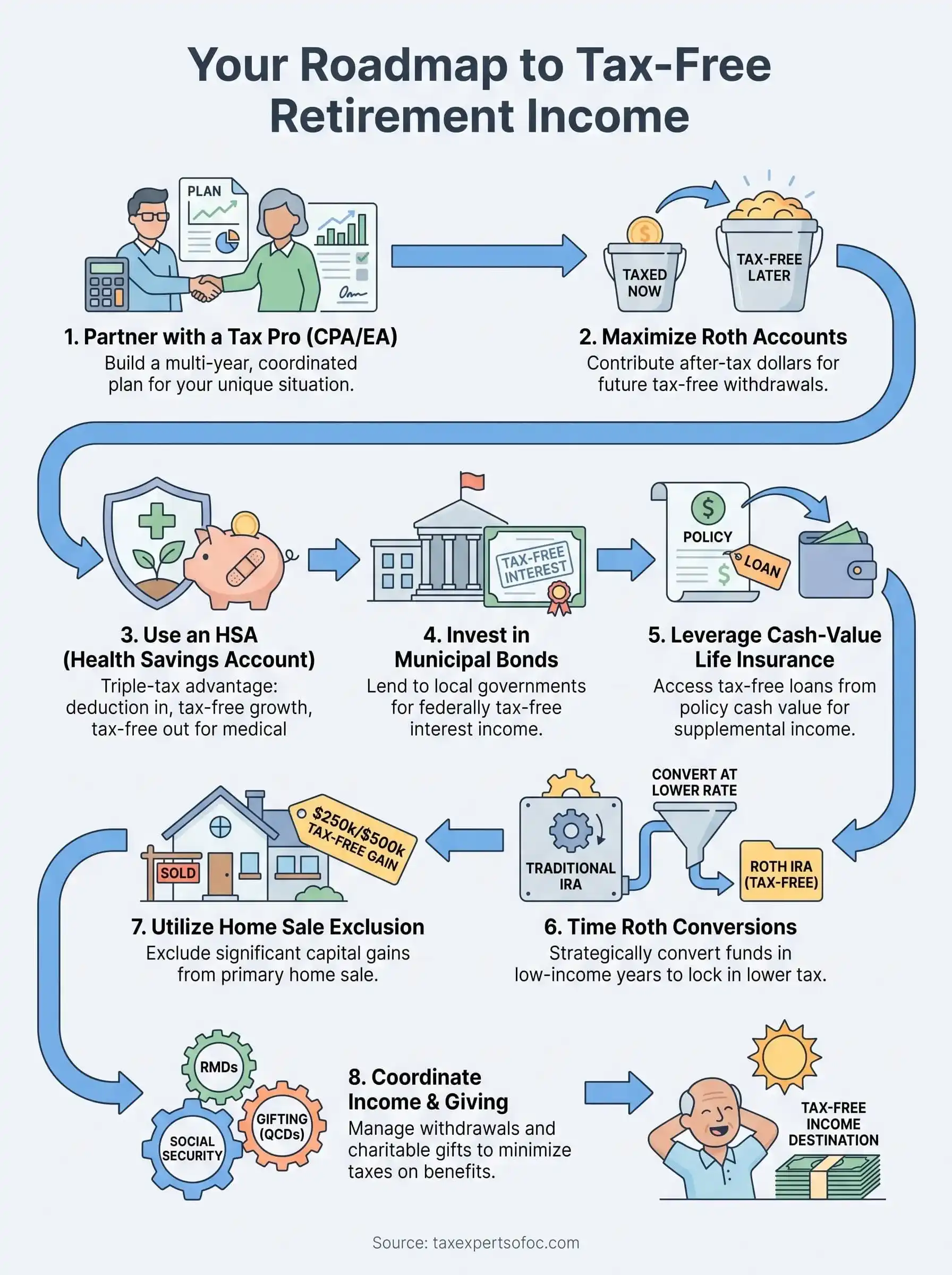
Building your tax-free income roadmap
No single strategy on this list builds a tax-free retirement by itself. Tax free retirement planning works because these eight moves reinforce each other: Roth contributions today, an HSA growing quietly in the background, muni bonds filling income gaps, and careful sequencing once RMDs and Social Security enter the picture. Skip the coordination step and you risk one smart move canceling out another.
Order matters as much as the accounts themselves. A Roth conversion done in the wrong year, a home sale that ignores the basis step-up, or an RMD that pushes you into a Medicare surcharge can undo years of careful saving. That's why every strategy here works best inside a plan built around your actual numbers, not a generic checklist.
If you want help sequencing these moves correctly, talk to Tax Experts of OC about CPA-led tax planning services in Orange County and build a roadmap that actually holds up at tax time.