

Most people only think about taxes in April, then wonder every year why the bill keeps climbing. A tax planning advisor works differently: instead of just recording what already happened, they build a strategy months or years ahead to keep more money in your pocket legally. If you're searching for one, you're probably tired of surprises, overpaying, or feeling like your accountant only shows up once a year.
So what does a tax planning advisor actually do? They analyze your income, business structure, investments, and life changes to find legal deductions, credits, and timing strategies that a basic tax preparer often misses. The goal isn't just filing a return correctly, it's reducing your long-term tax liability while keeping you compliant with IRS rules.
In this article, we'll break down exactly what a tax planning advisor handles, how they differ from a standard tax preparer, and the signs that tell you it's time to bring one onto your team. At Tax Experts of OC, our CPAs and Enrolled Agents handle this kind of strategic planning daily for individuals and business owners across the country, so we'll share what real, effective tax planning looks like.
Why a tax planning advisor matters for your finances
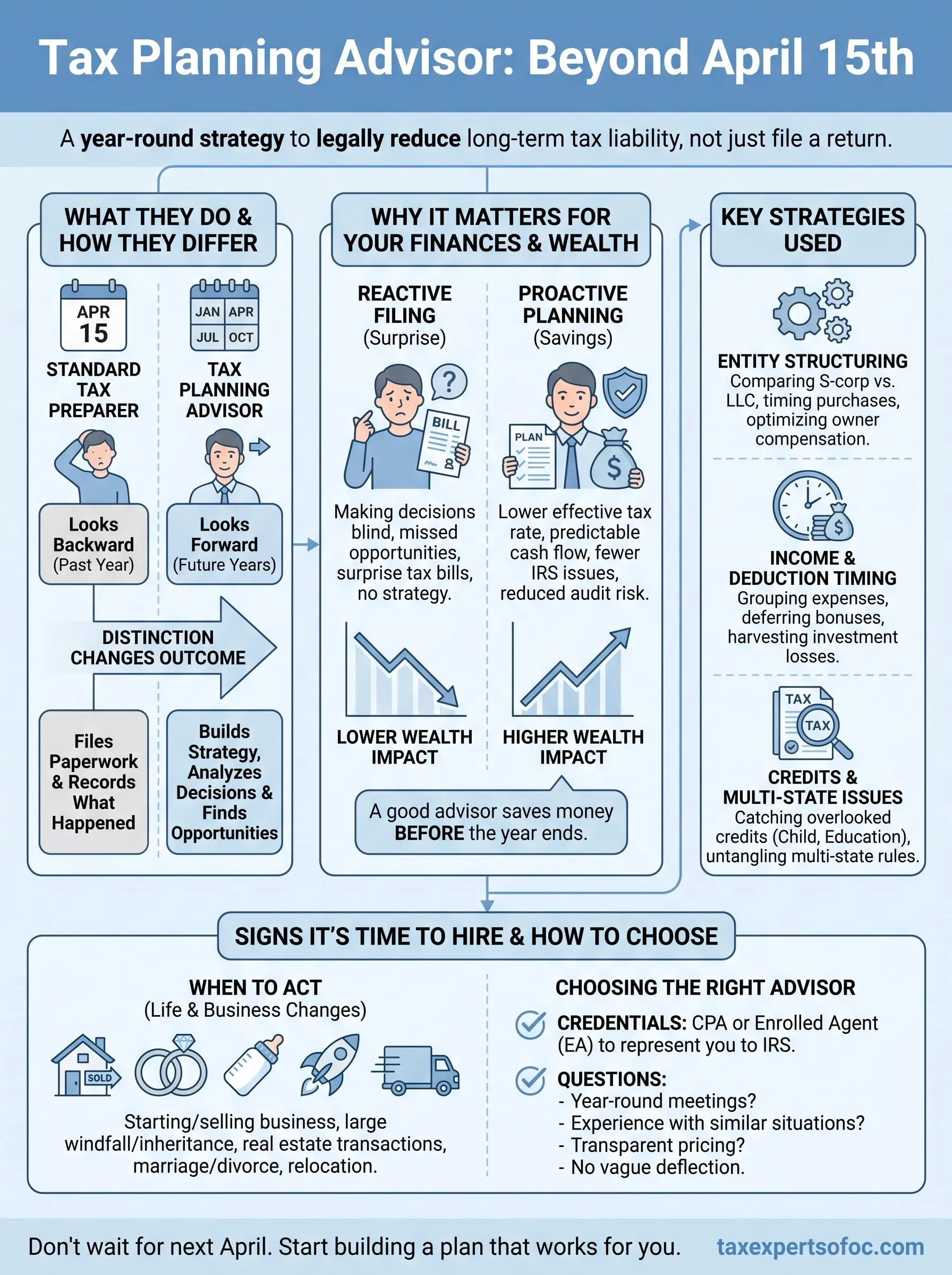
Many taxpayers assume their tax preparer and their tax planning advisor are the same person doing the same job. They aren't. A preparer looks backward at a year that's already closed and files the paperwork, and that distinction between planning and preparation changes everything about the outcome. A planning advisor looks forward, mapping out decisions before you make them so the tax bill shrinks before it's ever calculated. That difference alone can mean thousands of dollars a year for a business owner or a family with multiple income sources.
The cost of reactive tax filing
Without proactive planning, you end up making financial decisions blind. You sell an investment without knowing the capital gains hit. You take a bonus without adjusting withholding. You grow your business without restructuring for tax efficiency. Each of these moments is a missed opportunity that a tax strategist would have flagged in advance. Reactive filing means you find out what you owe after it's too late to change anything.
A good tax planning advisor saves you money before the tax year ends, not after.
Long-term wealth impact
Over a five or ten-year span, the gap between reactive filing and proactive planning compounds. Retirement contributions timed correctly, entity structures chosen deliberately, and deductions captured every year instead of missed sporadically all add up. Consider the difference in outcomes below.

| Approach | Typical Result |
|---|---|
| Reactive filing only | Surprise tax bills, missed deductions, no year-round strategy |
| Ongoing tax planning | Lower effective tax rate, predictable cash flow, fewer IRS issues |
Owners who commit to planning taxes year-round tend to see steadier finances because there are no April surprises draining working capital.
Reducing audit and compliance risk
Strategic tax planning also protects you from the kind of mistakes that trigger IRS scrutiny in the first place. When deductions and credits are documented properly throughout the year instead of reconstructed at the deadline, your return holds up better if it's ever questioned. That protection matters more than most people realize until they receive a notice. The IRS has published guidance on recordkeeping requirements, and advisors who plan ahead build files that meet those standards from day one, according to the IRS recordkeeping guidelines.
Peace of mind for complex situations
Finally, planning matters because life and business rarely stay simple. Getting married, selling a rental property, launching an LLC, or hiring your first employee all change your tax picture. A tax planning advisor who already knows your finances can react to these changes with a strategy instead of scrambling. That kind of steady guidance is exactly why our CPAs and Enrolled Agents at Tax Experts of OC treat planning as an ongoing relationship, not a once-a-year appointment.
How to choose the right tax planning advisor
Not every accountant labeled as a planner actually plans. Some just prepare returns with a fancier title attached. Before you hire someone to guide your tax strategy, look past the marketing and check what they're actually licensed and equipped to do.
Credentials that actually matter
Start with the license. A CPA or Enrolled Agent (EA) has passed rigorous exams and holds the right to argue your case to the IRS if a dispute ever comes up. General bookkeepers and seasonal preparers often can't. Verify credentials through the IRS directory of federal tax return preparers rather than taking a website's word for it.
Hire the person who can represent you to the IRS, not just file your paperwork.
Questions to ask before you hire
Good advisors welcome direct questions about how they work. Ask these before signing anything:
- Do you meet with clients throughout the year, or only at tax time?
- Have you handled situations like mine, whether that's a multi-state business, a rental portfolio, or an S-corp election?
- What's your fee structure, and is pricing transparent upfront?
- Can you represent me directly if the IRS sends a notice?
A firm that answers these clearly, without vague deflection, is signaling real experience rather than a sales pitch.
Watch for red flags
Steer clear of anyone who promises guaranteed refunds before reviewing your documents, or who avoids putting fees in writing. Transparency matters here because tax planning touches your entire financial life, not just one form. At Tax Experts of OC, every new relationship starts with a free 30-minute consultation and upfront pricing, so you know exactly what you're getting before committing to a plan. That kind of clarity is what separates a genuine tax planning advisor from someone just chasing seasonal business.
Strategies a tax planning advisor uses to lower your taxes
A skilled tax planning advisor pulls from a toolbox built over years of handling real client situations, not a generic checklist. The specific mix depends on whether you're a W-2 employee, a business owner, or someone juggling both, but the underlying goal stays the same: legally shrink what you owe while keeping every move defensible if the IRS ever asks questions.
Entity structuring and business decisions
Business owners often overpay simply because they picked the wrong legal structure years ago and never revisited it. Switching an LLC to an S-corp election, for example, can reduce self-employment tax once income crosses a certain threshold, which is why it pays to compare which structure saves an owner more money. Timing equipment purchases, retirement plan contributions, and owner compensation around your fiscal year also shifts your taxable income into a more favorable position.

The right entity structure alone can save a growing business thousands every year.
Income timing and deduction bunching
Other strategies focus on when income and expenses hit your return rather than how much you earn overall. Grouping deductible expenses into a single year, deferring a bonus into January, or harvesting investment losses before December 31 are all timing moves that cut a personal tax bill, and a proactive advisor plans them months in advance instead of scrambling in March.
| Strategy | Best Fit For |
|---|---|
| S-corp election | Profitable LLC owners paying heavy self-employment tax |
| Retirement plan contributions | High earners with fluctuating income |
| Deduction bunching | Homeowners and charitable donors near itemizing thresholds |
| Loss harvesting | Investors with taxable brokerage accounts |
Credits and multi-state considerations
Finally, effective tax strategy includes catching the credits most individuals overlook, like the Child Tax Credit, education credits, or energy-efficiency incentives, plus untangling multi-state filing rules for remote workers and business owners operating across state lines. These details are exactly where a general preparer falls short and a dedicated advisor earns their fee.
Signs it's time to bring in a tax planning advisor
Some situations make the case for professional help obvious, but most people wait too long to act on them. If you recognize yourself in the list below, that's your cue to stop filing on your own and bring in a tax planning advisor before the next filing deadline sneaks up on you.
Financial and life changes that raise the stakes
Certain milestones shift your tax picture enough that guesswork stops being an option. Watch for:
- Starting or selling a business, or bringing on your first employee
- Receiving an inheritance, large bonus, or stock windfall
- Buying, selling, or renting out real estate
- Getting married, divorced, or supporting aging parents
- Working across multiple states or relocating for a new job
Each of these events changes your income structure, and a tax strategy advisor can adjust your plan before the change costs you money.
If a major life or business event just happened, that's the moment to call an advisor, not after you file.
Warning signs your current approach isn't working
Other signals are quieter but just as telling. You're paying a bigger bill every year without understanding why. You've received an IRS notice and don't know who to call or what to do next. Your accountant only contacts you once, at filing time, with no strategy discussion in between. You're guessing at estimated quarterly payments instead of calculating them. Any one of these points to a gap that reactive filing alone won't close.
Running a growing business or juggling investments without a forward-looking plan almost always means leaving money on the table. If these signs sound familiar, the team at Tax Experts of OC offers a free 30-minute consultation to review your situation and map out a real strategy, not just another filing appointment.
Putting tax planning into practice
A tax planning advisor turns tax season from a once-a-year scramble into a year-round strategy that protects your income before the IRS ever sees your return. You've seen how planning differs from filing, what to look for when hiring someone, the strategies advisors actually use, and the moments that signal you can't keep handling this alone. None of that knowledge helps, though, until you act on it.
Growing businesses, life changes, and rising tax bills rarely wait for a convenient time. Every quarter you delay is another quarter of missed deductions and reactive decisions instead of a real tax strategy. If you recognized your own situation anywhere in this article, don't wait for next April to do something about it. Schedule your free 30-minute consultation for tax planning services in Orange County and start building a plan that actually works for you.