
Your corporate return is due soon and you're not going to make it. Maybe your bookkeeping fell behind, your CPA needs more time, or you're still waiting on K-1s for a partnership return on Form 1065. Whatever the reason, filing a corporate tax extension is a routine move, not a red flag, and the IRS makes it straightforward if you know the right form.
The answer is IRS Form 7004. This single form covers C corporations, S corporations, partnerships, and most other business entities, and it buys you an automatic six-month extension to file, as long as you submit it before your original deadline and pay any estimated tax owed. There's no need to explain why you need more time. You just need to file it correctly and on time.
This guide walks through the entire corporate tax extension filing process step by step: who qualifies, the exact corporate tax filing extension deadline for your entity type, how to complete Form 7004 accurately, and your options for filing corporate tax extension online versus by mail. We'll also cover common mistakes that trigger penalties, so you can file with confidence and avoid IRS trouble later.
What Form 7004 does and who qualifies
Form 7004, officially titled "Application for Automatic Extension of Time To File Certain Business Income Tax, Information, and Other Returns," gives you six extra months to submit your business return. Filing an extension for corporate tax return purposes doesn't require a reason. The IRS grants the extension automatically once you file the form correctly and on time, no explanation, no approval letter, no waiting period.
Almost every business entity type qualifies, which is why this form covers so much ground. C corporations, S corporations filing Form 1120-S, multi-member LLCs taxed as partnerships, and even certain trusts and estates all use the same form. What changes is the specific tax form your extension applies to, since Form 7004 references a code tied to your underlying return.
An extension to file is not an extension to pay, and mixing up those two ideas is the single most common mistake business owners make.
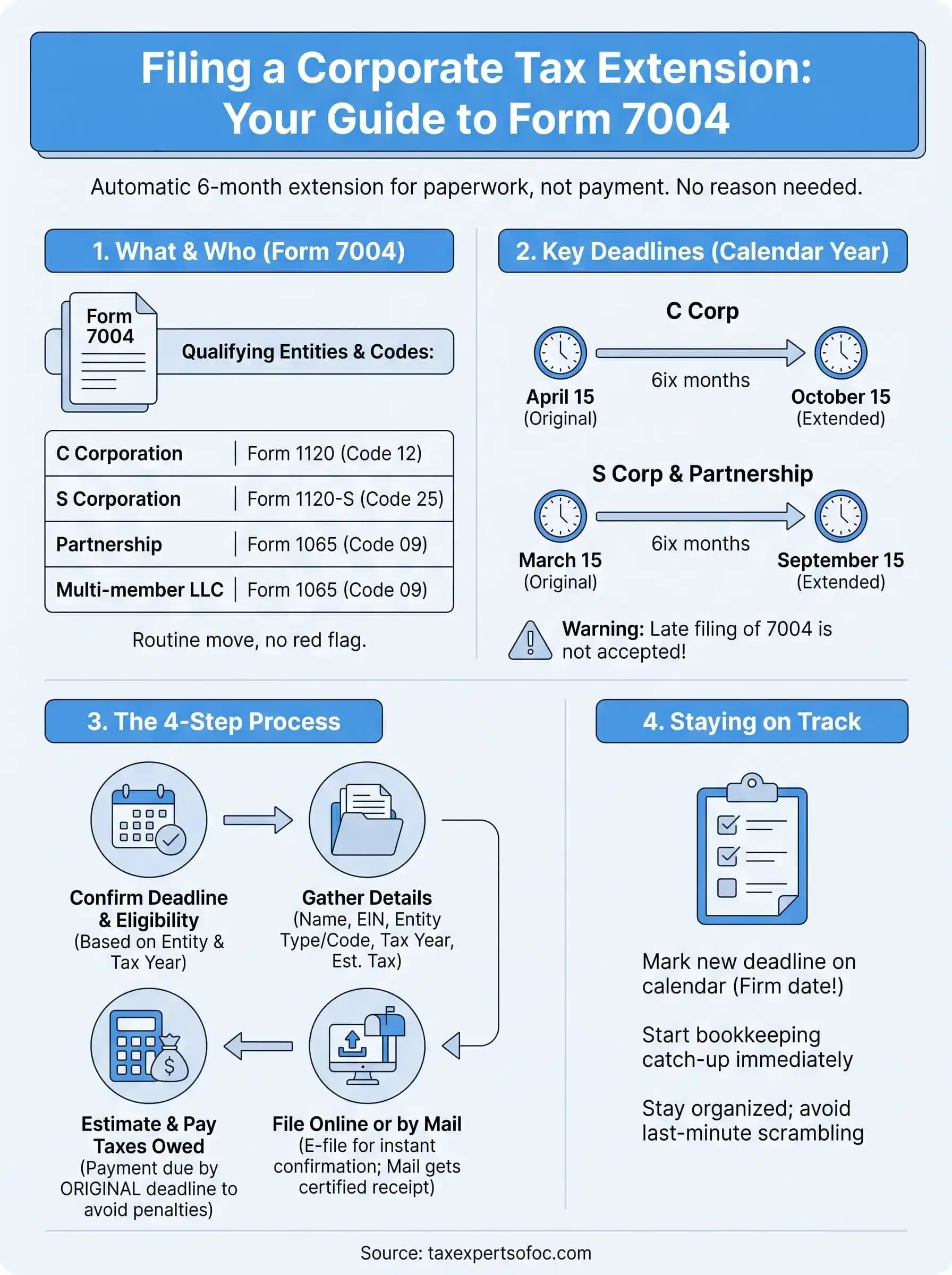
Here's a quick reference for which form code applies to common entities:
| Entity Type | Underlying Tax Form | Form 7004 Code |
|---|---|---|
| C Corporation | Form 1120 | 12 |
| S Corporation | Form 1120-S | 25 |
| Partnership | Form 1065 | 09 |
| Multi-member LLC (partnership election) | Form 1065 | 09 |
Sole proprietors and single-member LLCs reporting on Schedule C don't use Form 7004 at all. They extend through Form 4868, the individual extension form with its own rules and deadlines, since their business income flows to a personal return. Knowing which category you fall into before you start is what keeps this process fast instead of frustrating.
Step 1. Confirm your deadline and eligibility
Before you touch Form 7004, pin down your exact corporate tax filing extension deadline. It's tied to your entity type and your tax year, not a single date for everyone. Calendar-year C corporations file Form 1120 by April 15, so their extension request is due that same day, pushing the new deadline to October 15. Calendar-year S corporations and partnerships work on a tighter clock: their original due date is March 15, and Form 7004 extends that to September 15.
Fiscal-year filers need to do their own math. The rule is the 15th day of the fourth month after year-end for C corps, and the 15th day of the third month after year-end for S corps and partnerships.
| Entity Type | Original Deadline (Calendar Year) | Extended Deadline |
|---|---|---|
| C Corporation | April 15 | October 15 |
| S Corporation | March 15 | September 15 |
| Partnership | March 15 | September 15 |
Miss the original due date, and there's nothing left to extend, the IRS won't accept a late-filed 7004.
Eligibility hinges entirely on timing. An IRS corporate tax filing extension only works if you submit Form 7004 on or before your original deadline, not after.
Step 2. Gather your business and tax details
Once you know your deadline applies, pull together the paperwork before you open the form. Filing corporate tax extension online goes faster when you're not hunting for an EIN or last year's tax liability mid-session. Have these items on hand:
- Your business's legal name exactly as registered with the IRS
- Employer Identification Number (EIN)
- Business address (matching prior filings, since mismatches can flag your extension)
- Entity type and corresponding Form 7004 code (from the table in the previous section)
- Tax year start and end dates, especially if you're a fiscal-year filer
- Estimated total tax liability for the year
- Any prior-year overpayments or estimated payments already made
A ten-minute records check now saves you a rejected or delayed extension later.
Double-check your business name and EIN against last year's return. The IRS matches Form 7004 against its records, and even a small typo, like a missing hyphen in an LLC name, can cause a mismatch. If you've changed accountants or software recently, verify your EIN is entered consistently everywhere. This groundwork also sets you up for step three, where you'll need accurate numbers to estimate what you actually owe.
Step 3. Estimate and pay any taxes owed
Getting filing a corporate tax extension right means understanding what it actually extends. Form 7004 pushes your paperwork deadline, not your payment deadline. The IRS still expects your estimated tax liability paid in full by the original due date, whether that's March 15 or April 15 depending on your entity type. Skip this step and you're facing penalties even with an approved extension sitting in the system.
Start by pulling numbers from your bookkeeping: revenue, deductible expenses, and any estimated payments already made throughout the year. Subtract prior payments and credits from your projected liability to land on what you still owe.
Paying nothing while assuming the extension covers you is the fastest way to turn a routine filing into a penalty notice.
Underpayment triggers two separate charges: a failure-to-pay penalty of 0.5% per month and interest that compounds daily, the same penalties and interest that hit a late return, per the IRS guidelines on penalties. If your bookkeeping is behind and you can't calculate an exact figure, estimate conservatively and pay slightly more. Overpayments get refunded; underpayments get penalized.
Step 4. File Form 7004 online or by mail
Once your numbers are ready, you have two ways to submit Form 7004. Filing corporate tax extension online through IRS Modernized e-File (MeF), either directly or via approved tax software, gives you instant confirmation that the IRS accepted it, which is why most CPAs recommend it over paper, and it helps to know how IRS e-file works before you start. If you'd rather mail it, print the completed form and send it to the address listed in the Form 7004 instructions, which varies by state and entity type, and get proof of mailing since there's no confirmation otherwise.
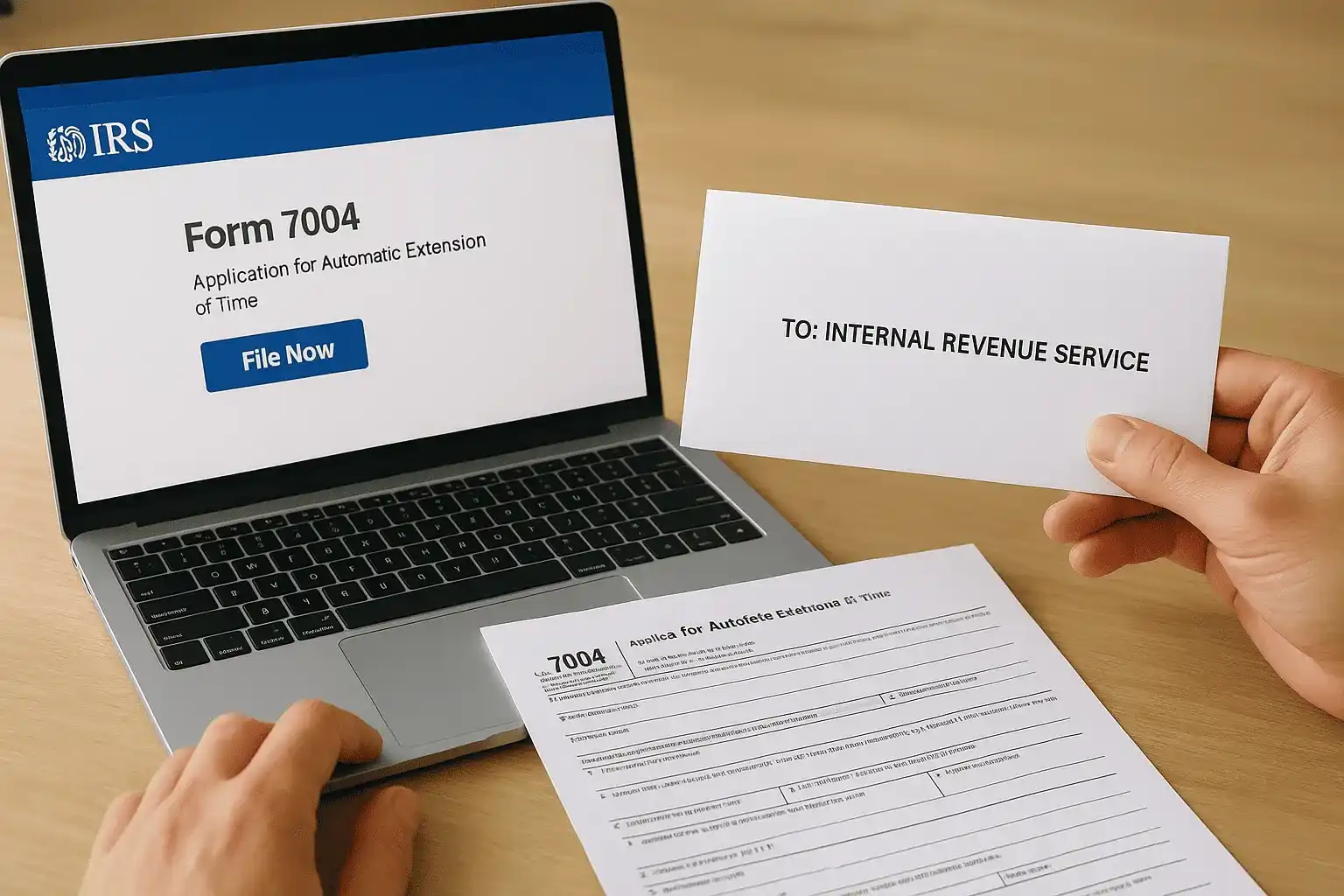
E-filing gives you a timestamped receipt; a mailed form only gives you a hope that it arrives on time.
Compare your two options before deciding:
| Method | Confirmation | Speed | Best For |
|---|---|---|---|
| E-file (MeF) | Instant electronic acceptance | Same day | Most filers, tight deadlines |
| Paper mail | Certified mail receipt only | Days to weeks | Filers without e-file access |
Whichever route you choose, submit any payment owed alongside it through IRS Direct Pay or EFTPS if you're paying electronically. Keep a copy of the filed form and payment confirmation in your records, since you'll need both if questions come up before your extended deadline.
Keeping your extension on track
Filing a corporate tax extension buys you time on paperwork, not a pass on your obligations. Once your Form 7004 is accepted, mark your new deadline on the calendar and treat it as firm, not flexible. Bookkeeping catch-up should start immediately, not in month five, since scrambling in September or October defeats the purpose of the extra time you just secured. Six months disappears fast when you're also running a business.
Staying organized now means fewer surprises later, but tax situations involving unpaid balances, multi-state returns, or IRS notices often need more than a form and a calendar reminder. That's where working with a professional pays off, especially if your extension involves back taxes, an audit, or a return more complex than a typical calendar-year filing. If you want that guidance without guesswork, schedule a free consultation with Tax Experts of OC for CPA-led business tax filing and get your extension, and your return, handled correctly the first time.