

IRS audit representation means a credentialed tax professional, either a CPA, an enrolled agent, or a tax attorney, handles your IRS examination for you. Once you sign a power of attorney, the IRS deals with your representative instead of with you. They gather your records, answer the examiner's questions, negotiate the result, and manage any appeal. You can attend meetings if you want to, but you rarely have to.
An audit is not an accusation. It is a review of whether your return matches your records. Still, what you send and say in the first few weeks shapes the outcome. This article explains why representation matters, who is allowed to provide it, how it works from the first letter to the final agreement, what it costs, and how to choose a professional you can trust.
Tax Experts of OC is a tax resolution and accounting firm in Orange County, California, serving clients in all 50 states by phone, email, and secure remote tools. Audits are a core part of our work, and you deal directly with a CPA and an Enrolled Agent, not general staff. What follows is what we would tell you on a first call.
Why IRS audit representation matters
An audit is decided by documents and by what you say, and a representative controls both. That is why IRS audit representation pays off even when your return was honest. Examiners move quickly. A taxpayer working alone tends to volunteer extra information, miss a deadline, or concede a point that a professional would have contested.
A representative stands between you and the examiner, so you never have to improvise an answer.
How likely an audit is and how it starts
Well under 1 percent of individual returns are audited in a typical year, though the odds rise with income and with certain credits. The IRS opens an audit by mail. It does not start one by phone, email, text, or social media message. Notices come in three formats:
- Correspondence audit: handled by mail, usually covering one or two items. This is the most common type.
- Office audit: an in-person meeting at an IRS office.
- Field audit: an agent reviews your records at your home or business. This is typical for complex returns and business owners.
A CP2000 notice is different. It is an automated mismatch letter, not a formal audit, but it carries a response deadline, usually 30 days. A representative can answer it the same way.
What tends to trigger an audit
Income that does not match W-2 and 1099 data is the biggest trigger, because the IRS matches those automatically. Others include deductions that are large compared with income, business losses year after year, big charitable gifts, home office claims, cash-heavy businesses, and refundable credits such as the Earned Income Tax Credit.
Does the IRS forgive honest mistakes? Partly. You still owe the correct tax and interest, and the IRS can add a 20 percent accuracy-related penalty on the underpayment. You can get that penalty removed by showing reasonable cause. Making that case well is routine work for a representative.
What representation changes in practice
The Taxpayer Bill of Rights, summarized in IRS Publication 1, includes your right to retain a representative of your choice. With one in place, questions go through your representative and answers stay limited to what was asked. Records arrive organized. Your representative also tracks the clock. The IRS generally has three years from filing to assess more tax, or six if you left out more than 25 percent of your gross income.
Who can represent you in an IRS audit
CPAs, enrolled agents, and attorneys can represent you before the IRS with unlimited representation rights. They can handle any tax matter for any taxpayer, in audits, appeals, and collections. Most other preparers cannot.
The three credentials compared
| Credential | Licensed by | Typical strength | Best fit |
|---|---|---|---|
| CPA | State board of accountancy | Accounting depth, business records | Business and individual audits with records issues |
| Enrolled Agent (EA) | IRS, after a three-part exam | Pure tax specialization | Most audits and appeals |
| Tax attorney | State bar | Legal strategy, litigation | Fraud exposure, Tax Court, large disputes |

All three owe you confidentiality. Communications with a CPA or EA fall under a limited federal privilege for noncriminal tax matters (IRC section 7525). That privilege does not extend to criminal matters. Attorney-client privilege is broader.
Who cannot represent you
A preparer who holds only a PTIN has limited rights or none. Preparers with a limited IRS filing season credential can represent only on returns they prepared and signed, and only in narrow settings. Your return software cannot represent you at all. Before you hire anyone, ask what credential they hold and confirm it.
Choosing between a CPA, an EA, and an attorney
For most audits, a CPA or Enrolled Agent is the efficient choice. They know the examination process daily and usually charge less than a litigator. Bring in a tax attorney when the examiner raises possible fraud, when criminal exposure is a real concern, or when you expect to end up in Tax Court. Many firms, including ours, will tell you honestly when your case needs one.
How IRS audit representation works step by step
IRS audit representation starts when you sign Form 2848, Power of Attorney and Declaration of Representative, and ends when the audit closes or moves to appeals. Everything between is documentation, negotiation, and deadlines.
Authorize your representative with Form 2848
Form 2848 names your representative, the tax form (usually Form 1040 or 1120), and the years under audit. It must be signed and submitted to the IRS. Be specific, because the authority only covers what you list. Form 8821 is not a substitute. It lets someone view your IRS records but gives no right to speak for you.
The steps from notice to closing
- Send the notice to your representative right away. Deadlines are printed on the letter and do not move on their own.
- Your representative reviews the issues and, if needed, asks the examiner for more time.
- You collect records: bank statements, receipts, invoices, mileage logs, and 1099s tied to the items questioned.
- Your representative submits the documents or attends the meeting.
- The examiner issues findings. You get no change, a proposed adjustment you accept, or one you dispute.
- If you disagree, the IRS issues a 30-day letter that lets you request an appeal. A notice of deficiency gives you 90 days to petition the Tax Court.

Missing the deadline in an audit letter costs more than almost any mistake you can make inside the audit.
What you still do yourself
Representation does not mean disappearing. You stay honest, you supply complete records, and you read what you sign. Do not call the examiner once your representative is in place, since mixed messages hurt your case. Keep your tax records for at least three years, and longer if you have business or property transactions.
How much IRS audit representation costs
There is no standard price. Cost depends on audit type, number of years, record quality, and the credential you hire. A one-issue correspondence audit takes far less work than a multi-year field audit of a business.
What drives the fee
| Scenario | Work involved | Common pricing style |
|---|---|---|
| Correspondence audit, one or two items | Review notice, assemble and submit records | Flat fee |
| Office audit, several items | Records review, prep, meeting | Flat fee or hourly |
| Field audit of a business, multiple years | Extensive records work, repeated meetings | Hourly or retainer |
| Appeals or Tax Court | Written protest, conferences, negotiation | Separate quote |
Fees rise when your bookkeeping is incomplete, because someone has to reconstruct income and expenses. Attorneys typically bill more per hour than CPAs and EAs. A complex multi-year audit can reach thousands of dollars. Ask for the scope in writing.
Pay for the complexity of your audit, not for the title on the business card.
Audit defense plans versus hiring after the notice
Some preparers and software companies sell prepaid audit defense plans at filing time. These can be reasonable, but read the terms. Check which years and states are covered, whether a CPA, EA, or attorney does the work, and what happens if the audit reaches appeals. Hiring a professional after the notice arrives costs more in a bad year and nothing in a quiet one.
Lower-cost routes
Low Income Taxpayer Clinics, funded in part by the IRS, represent qualifying taxpayers for free or a small fee when income and the amount in dispute fall below set limits. At Tax Experts of OC, we offer a 30-minute free consultation, upfront pricing, and flexible payment options for clients under financial pressure.
How to choose a qualified audit representative
Choose someone whose credential you have verified, who handles audits regularly, and who gives you a written scope and fee. Those three checks screen out most bad outcomes in IRS audit representation.
Verify before you sign
Look up CPAs on the state board of accountancy site and attorneys on the state bar site. Enrolled agents are listed in the IRS directory of federal tax return preparers with credentials. A reputable professional gives you their license or enrollment details without hesitation. If they sign Form 2848, they are declaring under penalty of perjury that they are authorized to represent you.
Questions worth asking
- How many audits like mine have you handled in the last year?
- Will you personally work on my case, or hand it to junior staff?
- What exactly does the fee cover, and what triggers an extra charge?
- How often will you update me?
- What happens if the audit goes to appeals?
Red flags
Walk away from anyone who guarantees a result, since no one controls what the IRS decides. Be wary of fees based on a percentage of the tax you "save," and of anyone who will not put the engagement terms in writing. Pressure to decide today is also a warning sign. A good professional explains the risks first, including the ones that make your case look worse.
A representative who promises to win is selling confidence. One who explains your options is doing the job.
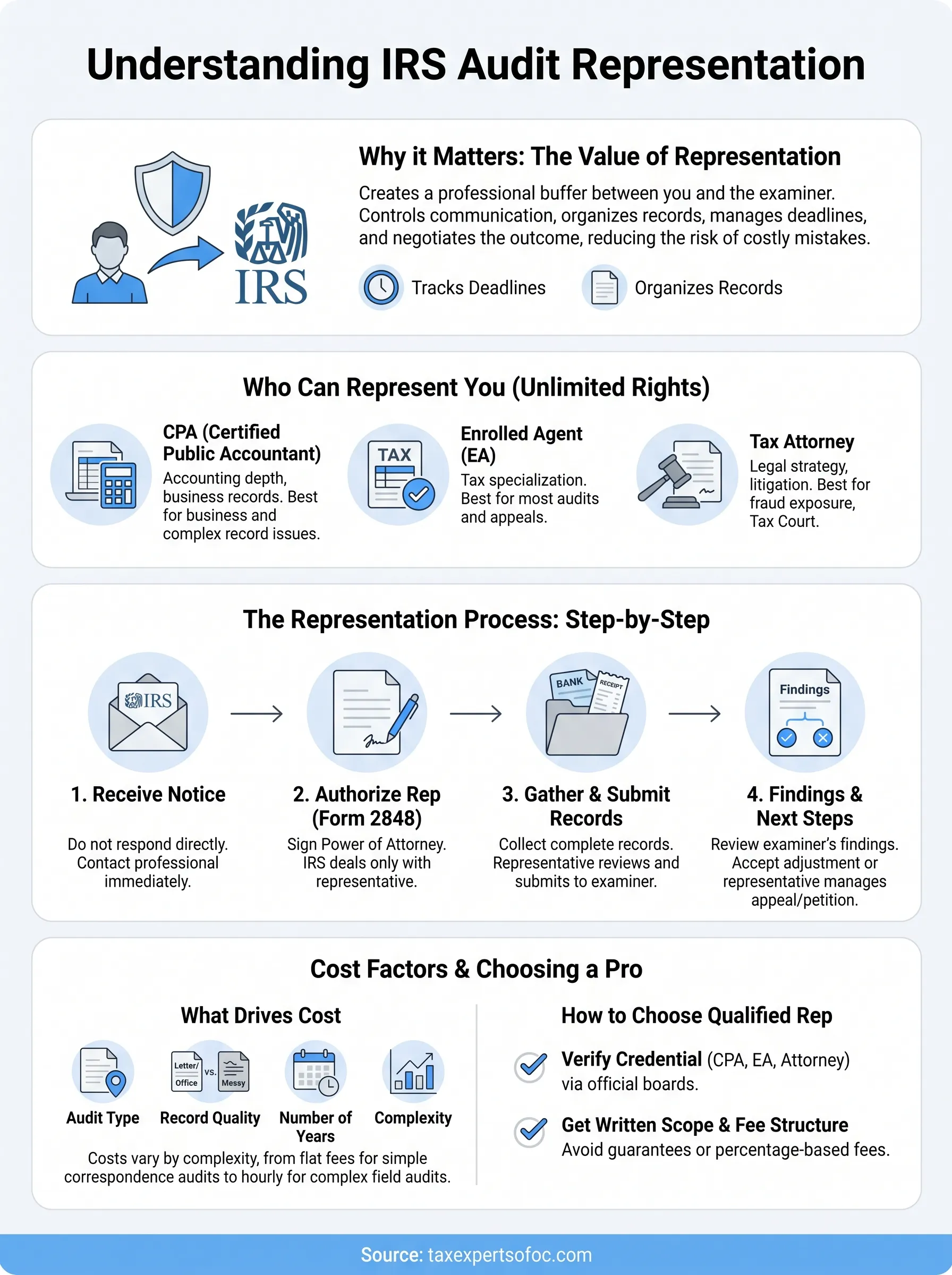
Getting your audit handled the right way
IRS audit representation puts a licensed CPA, enrolled agent, or tax attorney between you and the examiner. It protects your rights, controls deadlines, and keeps your answers accurate. Cost depends on the complexity of the audit, and the right choice is the one whose credentials you have confirmed and whose fee is in writing.
If you have an audit letter, do not respond yet and do not wait. Note the deadline, gather the notice, and talk to a professional first. You can book a free 30-minute consultation with Tax Experts of OC and speak directly with a CPA or Enrolled Agent about your notice and your options.