

An audit letter from the IRS has a way of turning a normal Tuesday into a stressful week. You start searching for a tax attorney for irs audit representation because you want someone who understands the rules better than you do and who won't let the IRS push you into a corner. That instinct is right, but the title on someone's business card matters less than what they can actually do for your specific situation.
With IRS tax audit representation, a qualified representative reviews your notice, gathers your financial records, and communicates directly with the auditor so you never have to face them alone. The real question isn't just "attorney or not," it's whether the person handling your case has direct IRS experience and the credentials to negotiate, appeal, or settle if things get complicated.
This article breaks down exactly what a tax attorney does during an audit, when hiring one makes sense versus when a CPA or Enrolled Agent is the smarter, more affordable choice, and how Tax Experts of OC puts that same level of representation to work for clients facing IRS scrutiny nationwide.
Why you need a tax attorney during an IRS audit
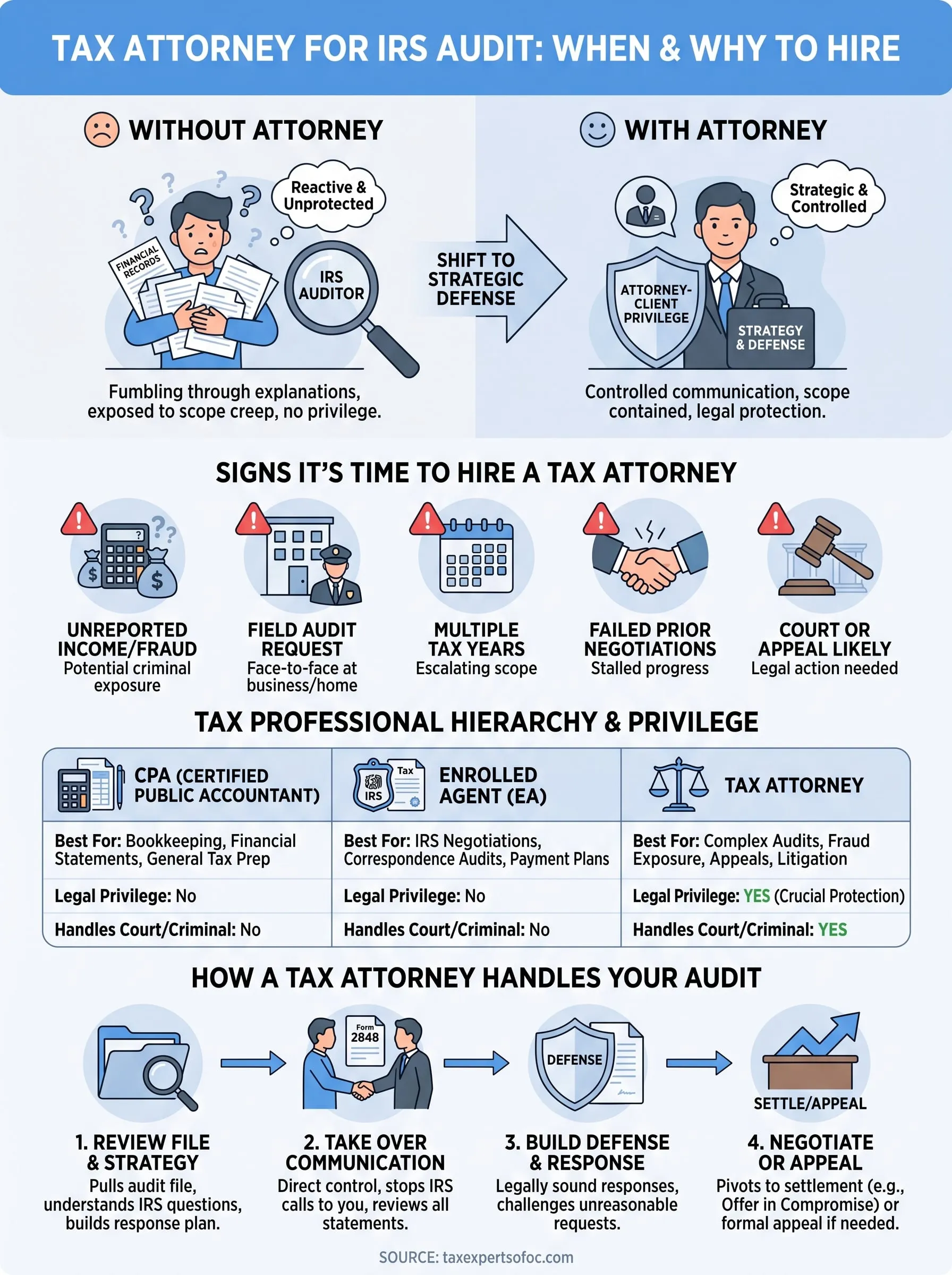
An IRS auditor's job is to find discrepancies, not to help you save money. That single fact explains why so many taxpayers who go it alone end up owing more than they expected. Every question an auditor asks is designed to build a case, and answering casually or incompletely can hand them exactly the ammunition they need. A skilled tax attorney for IRS audit representation flips that dynamic. Instead of you fumbling through explanations, your attorney controls what information reaches the auditor and how it's framed.
The IRS has more leverage than you think
The agency can summon bank records, subpoena third parties, and expand the scope of an audit if it suspects something doesn't add up. Once an examiner starts pulling threads, a routine review of one tax year can turn into a multi-year investigation. Legal representation during an audit exists specifically to keep that scope contained. An attorney knows which requests are reasonable and which overreach the auditor's authority, and they'll push back on the latter before it snowballs into a bigger problem.
The moment an audit stops being routine and starts touching potential fraud or criminal exposure, only an attorney's privilege can protect what you say.
Attorney-client privilege changes what you can safely disclose
This is the piece most taxpayers overlook. Conversations with a CPA or bookkeeper generally aren't protected from IRS scrutiny the way conversations with an attorney are. If your audit involves unreported income, aggressive deductions, or anything that could be read as intentional, you need someone bound by attorney-client privilege before you say another word to the IRS. That protection doesn't exist with most other financial professionals, and it's the single biggest reason high-stakes audits call for legal counsel specifically.
Audits rarely stay simple
What starts as a request for receipts can escalate into a field audit at your business or home, or a referral to IRS Criminal Investigation if the auditor spots red flags. Taxpayers who show up unrepresented often don't recognize the warning signs until it's too late to change course. According to the IRS's own audit guidance, you have the right to representation at any point during the process, and exercising that right early protects you far better than trying to fix mistakes after the fact.
Deciding which professional to call for IRS problems isn't about assuming the worst. It's about making sure someone with legal training is watching for the moment your audit needs a different level of protection than paperwork alone can provide.
How a tax attorney handles your IRS audit
Once you bring in an audit representation attorney, the process shifts from reactive to strategic. Your attorney starts by pulling the actual audit file, not just the notice you received, so they know exactly what the IRS is questioning and why. From there, they build a response plan before a single document goes back to the examiner.
Taking over communication with the IRS
Before anything else, your attorney handles how to file Form 2848, the power of attorney form, so the IRS must contact them instead of you. That single step stops the phone calls, the surprise letters, and the pressure to answer questions on the spot. Direct communication control means every statement made on your behalf gets reviewed for accuracy and legal exposure first.
A tax attorney's real value isn't paperwork, it's standing between you and every question the IRS asks.
Building your defense and negotiating outcomes
Your attorney typically works through several stages during a full audit defense:
- Reviewing prior returns and supporting records for accuracy and consistency
- Identifying which deductions or positions carry audit risk
- Preparing a documented, legally sound response to each IRS request
- Negotiating adjustments, penalty abatement, or payment terms if liability is confirmed
- Filing an appeal if the auditor's findings are wrong or excessive
Throughout this, your tax attorney for irs audit representation keeps the case moving toward resolution rather than escalation. If the audit reveals a balance due, the attorney can pivot immediately into settlement talks, whether that means an installment agreement, an offer in compromise, or a formal appeal, without you needing to start over with a new professional. That continuity matters. Switching representatives mid-audit costs time, and time is exactly what the IRS uses to its advantage when a case drags on unresolved.
Signs it's time to hire a tax attorney
Not every audit needs a lawyer. A straightforward correspondence audit asking you to confirm a charitable deduction receipt is usually manageable with a CPA or Enrolled Agent. But certain red flags signal that the stakes have moved beyond routine paperwork, and recognizing them early can save you from a much bigger problem later.

Warning signs that call for legal representation
Watch for these situations, which almost always mean it's time to bring in a tax attorney for irs audit defense rather than handle things alone:
- The IRS mentions unreported income, often starting with a CP2000 notice, offshore accounts, or cash transactions
- You've received a summons or a request that feels like a criminal referral is possible
- The auditor is asking about multiple tax years instead of just one
- You know a return contained an intentional error or omission
- The examiner has requested a face-to-face field audit at your home or business
- Prior negotiations with the IRS have already broken down
If your gut tells you an audit could turn into a criminal matter, that instinct is the clearest sign you need an attorney, not a bookkeeper.
Trust the trajectory, not just the current letter
Questions escalate. What begins as a request for mileage logs can shift into questions about business structure, related entities, or personal spending patterns. Escalating scope is a signal on its own, even before the IRS says the word
Tax attorney vs. CPA vs. enrolled agent
Each of these professionals can represent you before the IRS, but their training and legal authority differ in ways that matter once an audit gets serious. A CPA specializes in accounting and financial statements, so it's worth knowing what a CPA can and can't do before the IRS. An Enrolled Agent is licensed specifically in tax law and can represent any taxpayer in any state, but neither holds attorney-client privilege. Only a licensed attorney can shield your conversations from being used against you if the case turns adversarial.

Comparing the three credentials
| Credential | Best For | Legal Privilege | Handles Court/Criminal Cases |
|---|---|---|---|
| CPA | Bookkeeping, financial statements, general tax prep | No | No |
| Enrolled Agent | IRS negotiations, correspondence audits, payment plans | No | No |
| Tax Attorney | Complex audits, fraud exposure, appeals, litigation | Yes | Yes |
Only an attorney's privilege protects what you say when an audit starts looking like a legal problem instead of a paperwork problem.
Why the distinction matters in practice
Suppose your audit involves a disputed deduction with no fraud risk. An Enrolled Agent can likely resolve it faster and for less money than an attorney would charge, which is why it helps to understand who can represent you before the IRS. Together, a CPA and Enrolled Agent cover the vast majority of routine tax matters efficiently. Situations that involve potential penalties tied to intent, unreported income, or a referral to IRS Criminal Investigation, though, call for someone who can invoke privilege and represent you in Tax Court if negotiations fail.
Understanding this hierarchy is exactly why a firm structured around direct access to both a tax attorney for irs audit defense and CPA-level accounting gives clients flexibility. You get the right professional for the actual risk level of your case, not a one-size-fits-all engagement that either overcharges for simple issues or under-protects you when the stakes rise.
What to look for when choosing a tax attorney
Picking the right representative matters as much as deciding to hire one at all. A tax attorney for irs audit defense should have direct experience with the IRS, not just a general practice that occasionally touches tax law. Ask upfront how many audits they've handled in the last year and whether they've taken cases through appeals or Tax Court. Vague answers here are a warning sign worth taking seriously.
Credentials and experience to verify
Before signing an engagement letter, confirm the basics:
- Active state bar license and good standing
- Specific experience with IRS audits, not just tax planning or estate work
- A clear explanation of your case strategy before you pay anything
- Access to both legal and accounting expertise under one roof
- Transparent, upfront pricing instead of vague hourly estimates
The attorney who can explain your case strategy in plain language before you pay a dime is usually the one who knows what they're doing.
Why access to a full team changes the outcome
An audit rarely stays confined to legal questions alone. You'll often need bookkeeping cleanup, prior-year reconciliation, or ongoing tax planning services once the audit resolves. Choosing a firm where a CPA, Enrolled Agent, and attorney work together means you're not juggling three separate professionals who don't talk to each other. Value matters too. Tax Experts of OC offers a free 30-minute consultation specifically so you can evaluate fit and pricing before committing, which is exactly the kind of transparency you should expect from anyone handling something this consequential. If a firm won't give you a straight answer about experience, cost, or strategy during that first call, treat it as a reason to keep looking rather than a detail to overlook.
Facing your audit with the right support
An audit letter doesn't have to turn into a financial disaster. The right representation at the right time is what separates a manageable correction from months of escalating exposure. You've seen why attorney-client privilege matters, when a CPA or Enrolled Agent is enough, and what red flags mean you need legal muscle behind you instead of just paperwork help.
Getting this decision right matters more than saving a few hundred dollars on the wrong professional. Direct experience with the IRS, not general practice credentials, is what actually protects you when an examiner starts asking harder questions.
If you're staring at an audit notice right now, don't wait for the situation to escalate before getting help. Schedule a free 30-minute consultation with Tax Experts of OC and talk through your IRS tax problem resolution options with someone who has handled audits like yours before.