
An IRS CP503 notice is a mailed reminder that you still owe tax and the IRS has not received payment or a response after earlier bills. For most individuals it is the third balance-due notice, and it warns that collection action, including a federal tax lien, may follow. You resolve it by paying, setting up a payment plan, or disputing the balance before the date printed on the notice.
You can spot the letter by the "CP503" code in the top right corner, next to your tax year, the amount due, and a payment coupon. It is not a lawsuit and not yet a levy, but it is the point where the IRS stops being patient.
This article explains why an IRS CP503 matters, how to respond step by step, which payment and relief options exist if you cannot pay in full, and what notice comes next. Tax Experts of OC, a CPA and Enrolled Agent firm in Orange County, California, helps clients in all 50 states handle notices like this one.
Why an IRS CP503 notice deserves fast action
A CP503 matters because it shows the IRS is moving from billing toward collection, and every month you wait adds penalties and interest to the balance. Acting now is the cheapest option you will have.
What the notice tells you
The IRS sends a CP503 when earlier bills went unpaid and it has not heard from you. Read the whole letter, because it is specific to your account. Look for these items:
- The tax year and tax form the balance relates to
- The total due, split into tax, penalties, and interest
- The date by which the IRS wants payment or contact
- The payment coupon at the bottom
- The phone number for your account
What waiting costs you
Two charges grow while the balance sits. The failure-to-pay penalty is 0.5% of the unpaid tax per month, up to 25%. Interest accrues daily at the federal short-term rate plus 3 percentage points, and the IRS resets that rate every quarter.

Here is a worked example. You owe $8,000 in unpaid tax. The penalty adds $40 a month, which is $480 after a year, before any interest. The IRS may also file a Notice of Federal Tax Lien, a public claim against your property.
A CP503 is your cheapest moment to act, because the balance only grows from here.
How to respond to an IRS CP503 notice
Respond by confirming the balance is correct, then paying or arranging a plan before the date on the notice. Do not set the letter aside, even if you plan to dispute it.
Check that the balance is correct
Compare the amounts with your filed return, your estimated payments, and any earlier IRS letters. Your IRS online account shows your current balance and payment history. If you already paid, reply with proof of payment as the notice instructs. If you disagree with the amount, send a written explanation with supporting documents to the address on the notice, or call the number printed on it.
Pay or contact the IRS
Follow these steps in order:
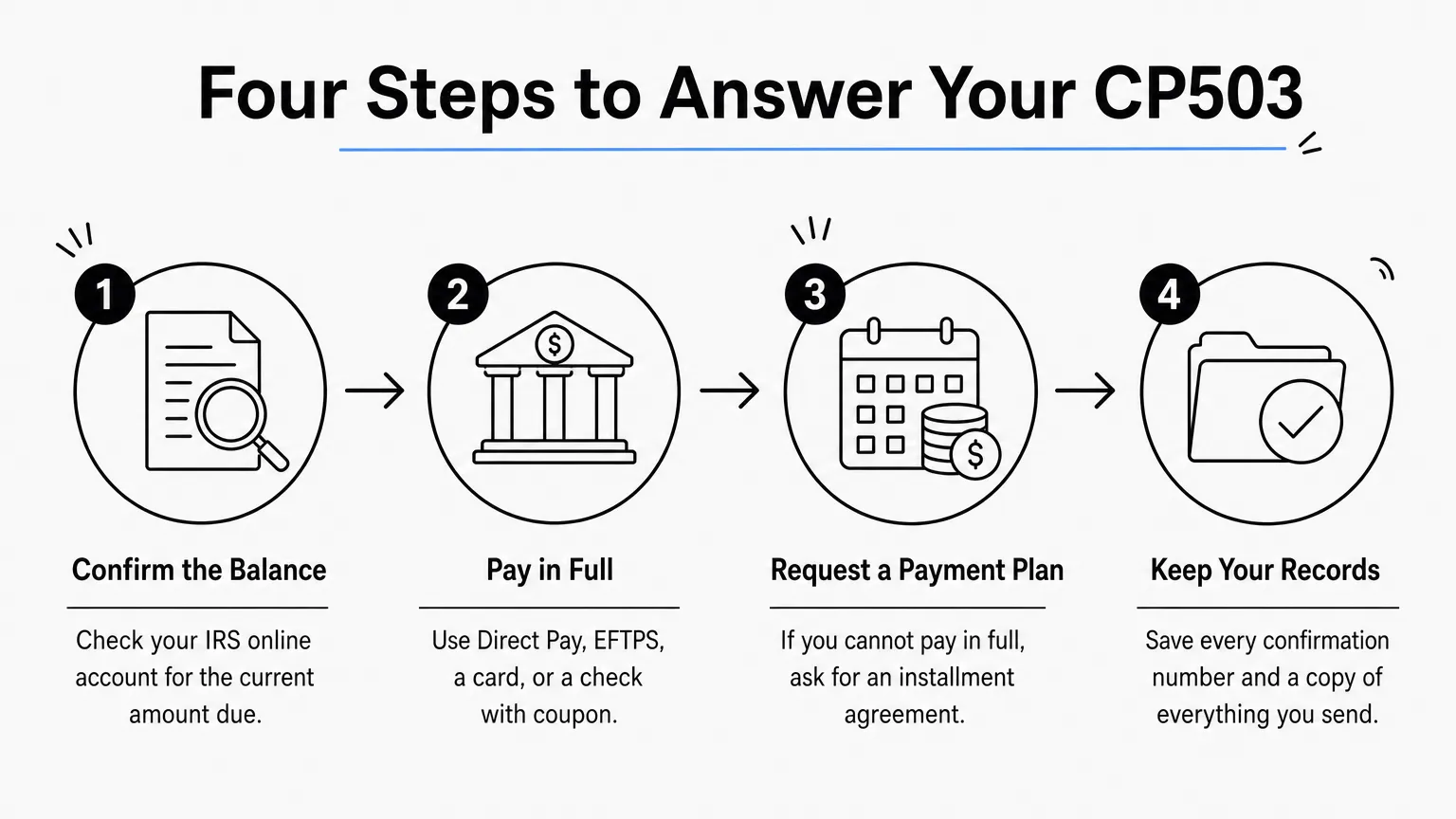
- Confirm the balance in your online account.
- If you can pay in full, use IRS Direct Pay (free, from a bank account), EFTPS, a debit or credit card through an approved processor (fees apply), or a check made out to "United States Treasury" with the coupon. Write your Social Security number, tax year, and form number on the check.
- If you cannot pay in full, request a payment plan, covered in the next section.
- Keep every confirmation number and a copy of everything you send.
For phone help, use the number on your notice first. The IRS individual line is 800-829-1040, and hold times can be long.
Contact the IRS before the response date, not after, even if you can only pay part of the balance.
Payment plans and relief if you cannot pay in full
If you cannot pay the full amount, ask for an installment agreement first. While one is in effect, the IRS generally holds off on most collection action, as long as you stay current on payments and file your returns on time.
Payment options compared
| Option | Best for | Key terms |
|---|---|---|
| Short-term payment plan | You can pay within 180 days | Up to 180 days, no setup fee, interest and penalties continue |
| Long-term payment plan | You need more than 180 days | Monthly payments, setup fee applies, individuals owing up to $50,000 can apply online |
| Offer in compromise | You likely can never pay the full amount | Settle for less, based on your income, expenses, and assets, approval not guaranteed |
| Currently not collectible | Paying would block basic living costs | Collection pauses, interest keeps accruing |
| Penalty abatement | Clean recent compliance history or reasonable cause | Can remove penalties, interest usually stays |
The IRS adjusts thresholds and fees from time to time, so confirm current terms on IRS.gov before you apply.
How long approval takes
Online applications usually give you an answer right away. A request by mail on Form 9465 can take about 30 days. While you wait, keep paying what you can and keep filing returns, because a missed payment or an unfiled return can void the arrangement.

A payment plan does not erase penalties or interest, but it stops the notices from escalating.
What happens after a CP503 notice
If you do not respond, the next step is a CP504, a notice of intent to levy, followed by a final notice that gives you hearing rights. The IRS can also file a lien at any point in the process.
The notice sequence
| Notice | Purpose |
|---|---|
| CP14 | First bill for a balance due |
| CP501 | First reminder |
| CP503 | Second reminder, warns of lien or levy |
| CP504 | Intent to levy, including your state tax refund and other property |
| Letter 1058 or LT11 | Final notice of intent to levy, with 30 days to request a Collection Due Process hearing |
The order varies, especially for business accounts, and the IRS sometimes skips a step. A levy lets the IRS take money from bank accounts or wages, so the final notice and its 30-day deadline are not ones to miss.
When to get professional help
Bring in a professional when the balance is large, several years are involved, you have unfiled returns, or you disagree with the amount. Tax Experts of OC has a CPA and an Enrolled Agent who can speak with the IRS on your behalf. The firm offers a free 30-minute consultation and flexible payment options for qualified clients.
Be careful about scams too. A real CP503 arrives by mail, and the IRS does not demand gift cards or threaten you by text. If you doubt a letter, check your balance in your IRS online account.
The longer a notice sits unanswered, the fewer options you have, so get advice at the CP503 stage.
Your next move on a CP503
An IRS CP503 is a reminder with a deadline. Read it, verify the balance, and then pay, set up a payment plan, or dispute it before the response date. Doing so keeps penalties smaller and keeps you out of the CP504 and levy stage.
If the amount is more than you can handle alone, or the notice does not match your records, you do not have to sort it out by yourself. You can talk to a tax professional about your CP503 notice and get a clear plan before the IRS escalates.