
Every hour you spend categorizing transactions, reconciling accounts, and chasing receipts is an hour you're not spending on the work that actually grows your business. For most small and mid-sized companies, outsourced bookkeeping offers a straightforward fix: hand the financial record-keeping to a qualified team so you can focus on operations and revenue.
But "outsourced" can mean a lot of different things. You might work with a solo freelancer overseas, a tech-driven platform, or a full-service accounting firm with CPAs on staff. The costs, service quality, and level of oversight vary widely between these options, and picking the wrong one can create more problems than it solves. That's why it helps to understand exactly how outsourced bookkeeping works before you commit, including what you should expect to pay and what separates a reliable provider from a risky one.
At Tax Experts of OC, we provide scalable bookkeeping and accounting support to businesses across all 50 states, backed by a CPA and Enrolled Agent who understand the tax implications behind every ledger entry. We built this guide to give you a clear, honest breakdown of your options, how outsourced bookkeeping functions day to day, what it typically costs, and which providers are worth considering, so you can make a confident decision for your business.
Why outsourced bookkeeping matters for small businesses
Most small business owners start out handling their own books. That makes sense when you have a handful of transactions a month and time to spare. But as your business grows, the volume and complexity of your financial records grow with it, and what used to take an hour on a Sunday afternoon can balloon into a part-time job with real financial consequences if something goes wrong.
The hidden time cost of doing it yourself
Running your own books isn't just about the hours you spend on it directly. Every time you sit down to reconcile accounts, chase down a missing receipt, or figure out why your bank balance doesn't match your records, you pull yourself away from revenue-generating work. The U.S. Small Business Administration recognizes that small business owners already wear multiple hats, and adding bookkeeper to that list often means none of the roles get the attention they deserve.
Your time spent on bookkeeping is time you're not spending on sales, client relationships, or product development. When you factor in the mental overhead of keeping financial details straight alongside everything else you manage, the true cost of DIY bookkeeping goes well beyond what a professional service would charge, and a professional would typically complete the same work more accurately and in less time.
Outsourcing your bookkeeping doesn't mean losing control of your finances. It means freeing yourself to focus on the parts of your business only you can handle.
What happens when the numbers are wrong
Bookkeeping errors don't stay contained. A miscategorized expense can distort your profit and loss statement, push you toward decisions based on bad data, and create complications when tax time arrives. Missed deductions, incorrect payroll records, and unreconciled accounts can trigger IRS notices or penalties that cost far more to resolve than clean, professional bookkeeping would have in the first place.
Poor record-keeping also drives cash flow problems that catch owners off guard. When you don't have a current, accurate picture of your receivables, payables, and bank position, you make financial decisions based on guesswork rather than facts. Reliable, up-to-date books give you the visibility to manage cash flow proactively instead of reacting to a shortfall after it happens.
When growth makes the problem worse
Scaling a business means more vendors, more employees, more accounts, and more transactions to track every month. Many owners hit a tipping point where their current setup, whether that's a spreadsheet or a software tool they update occasionally, simply can't keep pace. Outsourced bookkeeping services are built to scale with your business, so your records stay accurate regardless of how fast things are moving.
Expanding into new states, adding revenue streams, or bringing on staff all introduce compliance requirements that go beyond basic transaction tracking. A qualified bookkeeping team knows how to manage multi-state sales tax obligations, payroll tax filings, and entity-level reporting that would take you considerable time and research to navigate alone. The more your business grows, the more value an experienced bookkeeping partner delivers, because the stakes attached to getting the numbers right grow right along with your revenue.
How outsourced bookkeeping works day to day
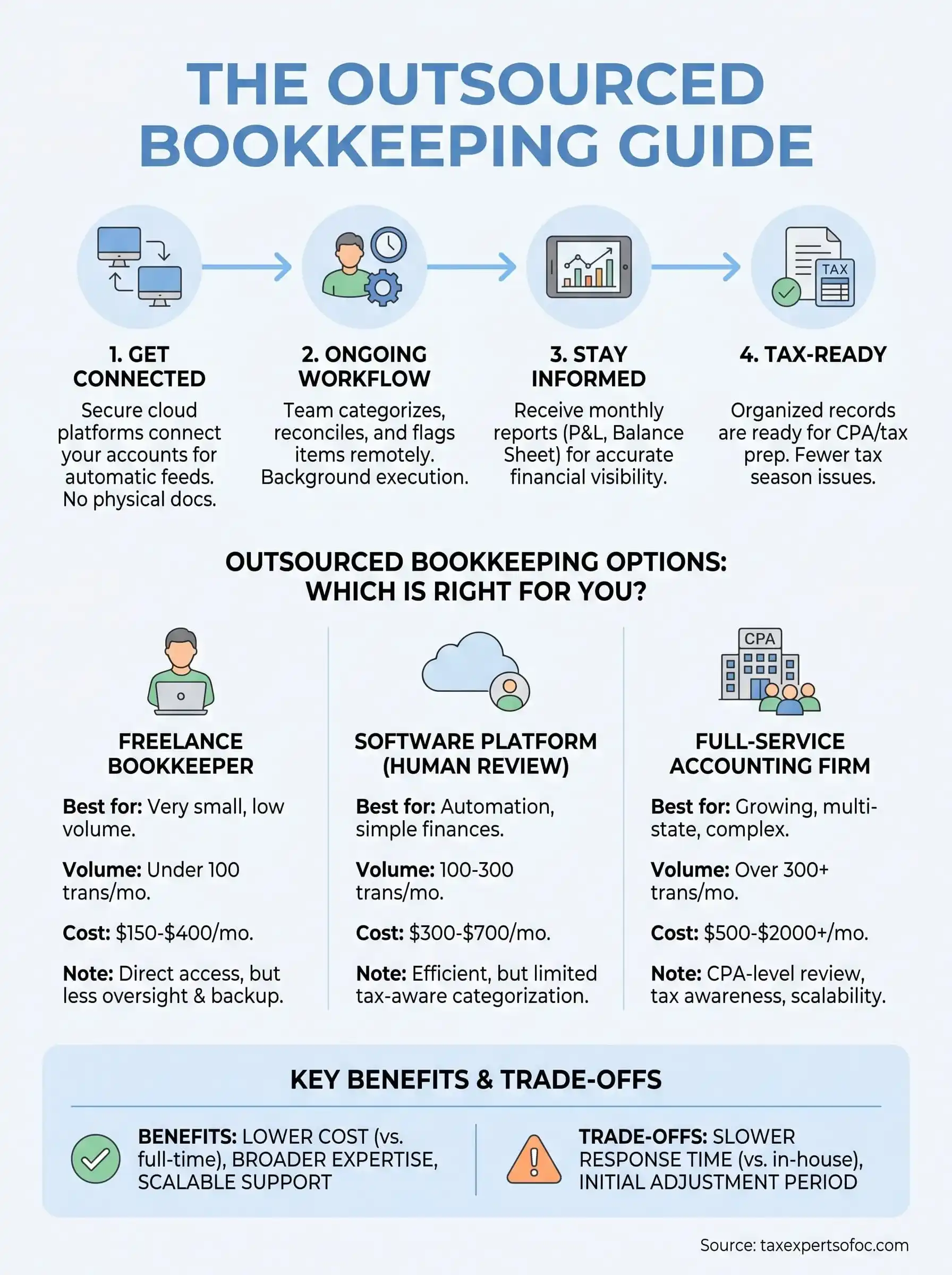
When you hire an outsourced bookkeeping service, the process follows a predictable rhythm that fits around your existing operations without requiring you to restructure how you run your business. Most providers work remotely, so you never need to hand over physical documents or sit in lengthy meetings. Instead, everything runs through secure cloud-based platforms that connect your bank accounts, payment processors, and accounting software directly to your bookkeeping team.

Getting connected and setting up access
The first step is onboarding, where your provider gains access to the tools and accounts they need to do the work accurately. This typically involves connecting to your accounting software, linking your business bank accounts and credit cards for automatic transaction feeds, and reviewing any historical records that need cleaning up before ongoing work begins.
Your provider will also gather details about your business structure, how you categorize expenses, and any specific reporting requirements you have. This setup phase usually takes one to two weeks, and it is where a reliable provider asks detailed questions rather than simply accepting a login and diving in without context. A firm that invests time upfront in understanding your business is far less likely to produce reports full of miscategorized entries that you have to correct later.
The quality of your onboarding sets the tone for the entire engagement, so a provider that takes time to understand your business before touching your books is one worth trusting.
What the ongoing workflow looks like
Once setup is complete, the day-to-day work runs largely in the background. Your bookkeeper pulls in transaction data automatically, categorizes income and expenses according to your chart of accounts, reconciles your bank and credit card statements each month, and flags any transactions that need your input before they get posted. You handle your business, and your bookkeeper handles the records.
If a transaction is unclear, you will receive a brief message asking for clarification, which typically takes minutes to resolve rather than hours of digging through records yourself.
How you stay informed
Staying informed does not require constant back-and-forth communication. Most outsourced bookkeeping arrangements include a monthly delivery of core financial reports: a profit and loss statement, a balance sheet, and a cash flow summary. These reports give you an accurate picture of your business finances at the close of each period, so every decision you make rests on current data rather than rough estimates.
What an outsourced bookkeeper can handle
The scope of work a professional bookkeeping service covers is broader than most owners expect when they first start looking into outsourced bookkeeping. Beyond tracking deposits and expenses, a qualified team manages the full financial picture of your business on an ongoing basis, giving you clean records at every stage without requiring you to stay involved in the details yourself.
Core transaction and recordkeeping tasks
At the foundation, your bookkeeper records and categorizes every financial transaction your business runs through, including income, expenses, bank transfers, and vendor payments. They reconcile your bank accounts and credit card statements each month to confirm that every transaction in your records matches what actually cleared your accounts, which eliminates the errors and discrepancies that tend to build up silently over time.
Your bookkeeper also maintains your chart of accounts, which is the organized structure that determines how every dollar gets classified in your records. Keeping that structure consistent and correctly applied is what makes your financial reports useful for real decision-making rather than just a raw list of numbers with no meaningful context behind them.
Accounts payable and receivable
A bookkeeping team can manage both sides of your cash flow. On the payable side, they track what you owe to vendors, record bills as they arrive, and keep your outstanding obligations visible so you never miss a payment or pay something twice. On the receivable side, they record customer invoices, apply payments when they come in, and maintain an accurate view of what remains outstanding at any point in the month.
Knowing exactly what you are owed and what you owe at any given moment gives you real control over your cash flow rather than a rough estimate.
Financial reporting and tax-ready records
Each month, your bookkeeper produces the core financial statements your business needs to operate with clarity: a profit and loss statement, a balance sheet, and a cash flow report. These documents reflect your actual financial position, not rough estimates, and they give your CPA or tax preparer the clean, organized records they need to file accurately and on time.
When your books are maintained by a qualified professional throughout the year, tax season stops being a frantic scramble to locate receipts and reconstruct records from memory. Everything is already in order, categorized correctly, and ready for review well before any filing deadline arrives.
Benefits and trade-offs to know upfront
Outsourced bookkeeping delivers real advantages for most small businesses, but it is not a perfect solution for every situation. Understanding both sides before you commit helps you set the right expectations, choose the right provider, and avoid frustration after you have already handed over access to your financial records.
The clear advantages
The most immediate benefit is cost compared to hiring in-house. A full-time bookkeeper in the United States earns between $45,000 and $60,000 per year according to the U.S. Bureau of Labor Statistics, and that figure does not include benefits, payroll taxes, or the time you invest in hiring and training. An outsourced team delivers the same core functions at a fraction of that cost, with no overhead tied to employee management.
You also gain access to a broader depth of expertise than a single in-house hire can typically provide. A professional bookkeeping firm employs specialists who understand accounting software, multi-state requirements, and industry-specific reporting standards. That depth is difficult to replicate with one generalist, and it becomes increasingly valuable as your business grows more complex.
The right arrangement gives you professional-grade financial records without the fixed cost of a full-time employee on your payroll.
Where the model has limits
Response time is the most common trade-off owners encounter. When a question comes up mid-week that requires a quick answer, you may wait hours rather than minutes for a reply from an external team. That delay is manageable for routine bookkeeping tasks, but it can feel limiting if you are used to asking a question and getting an immediate face-to-face answer from someone down the hall.
There is also a short adjustment period at the start of any engagement while your provider learns your business, your chart of accounts, and any preferences you have for how your records are organized. During the first month or two, you should review reports closely and provide feedback so your bookkeeper calibrates to your needs accurately. Providers who handle onboarding thoroughly shorten that adjustment window significantly, which is why the quality of your initial setup matters more than most owners realize before they get started.
How much outsourced bookkeeping costs in 2026
Pricing for outsourced bookkeeping varies significantly depending on the provider type, your business complexity, and the scope of work involved. A solo freelancer handling basic transaction categorization for a low-volume business will charge far less than a full-service accounting firm staffed by CPAs and Enrolled Agents managing multi-state compliance, payroll reconciliation, and detailed financial reporting every month. Understanding what drives that range helps you compare quotes accurately rather than simply choosing the lowest number you see.
What drives your monthly cost
The two biggest factors in your pricing are transaction volume and service scope. A business running 50 transactions per month through a single bank account costs much less to maintain than one running 500 transactions across multiple accounts, payment processors, and credit cards. Every additional account your bookkeeper reconciles and every additional report they produce adds time to the engagement, and that time appears directly in your monthly rate.
Additional factors include payroll complexity, catch-up work on backlogged records, the number of states your business operates in, and whether you need accrual-basis accounting rather than simpler cash-basis tracking. Most providers price these additions either as flat monthly add-ons or by placing your account into a higher service tier during the initial assessment.
Typical pricing ranges in 2026
Most businesses fall into one of three pricing tiers based on their needs and the type of provider they engage.
| Service tier | Monthly cost range | Best for |
|---|---|---|
| Freelance bookkeeper | $150 to $400 | Very small businesses with low transaction volume |
| Software-based platform | $300 to $700 | Businesses that want automation with light human review |
| Full-service accounting firm | $500 to $2,000+ | Growing businesses that need CPA-level oversight |
The cheapest option rarely stays cheap once you factor in the time you spend reviewing errors or rebuilding records before tax season.
When a higher price is worth it
Paying more for a firm with qualified professionals on staff delivers value that extends well beyond clean transaction records. When your bookkeeper understands the tax implications behind each entry, catches problems before they compound, and produces reports your CPA can use without correction, you reduce your total accounting spend across the full year rather than saving a few hundred dollars a month while paying to fix problems later. Firms with CPAs or Enrolled Agents on staff can also flag issues that a software platform or general-purpose freelancer would miss, protecting you from IRS notices and penalties that cost far more than the price difference between service tiers.
How to choose the right service model
Not every outsourced bookkeeping provider is built for the same type of business, and choosing the wrong model creates friction that shows up in your reports, your tax filings, and your time. Before you compare pricing or read through service descriptions, start by getting a clear picture of what your business actually needs so you can evaluate providers against real criteria rather than marketing language.

Match the model to your transaction volume
Transaction volume is the most reliable starting point for narrowing down your options. A freelancer or entry-level software platform can handle a business running 30 to 75 transactions per month with a single bank account and straightforward expense categories. Once you cross into higher volumes, multiple accounts, or layered revenue streams, you need a structured team with defined review processes, not a solo contractor managing your account between other clients.
Use this framework to orient your search:
- Under 100 transactions per month: A software-based platform or experienced freelancer can cover the basics
- 100 to 300 transactions per month: A mid-tier platform with human review or a small accounting firm becomes the right fit
- Over 300 transactions or multi-state operations: A full-service firm with qualified professionals on staff is the appropriate level of support
Consider who will actually handle your account
Many providers advertise a team but assign your account to a single junior staff member with limited oversight. Before you sign anything, ask directly who reviews the work and what credentials that person holds. A bookkeeper who operates without CPA-level review in the background may produce records that look clean but contain categorization errors that create real problems at tax time.
A qualified reviewer catching one misclassified expense category can easily save you more than a full year of the price difference between service tiers.
Firms that employ CPAs or Enrolled Agents bring a layer of tax awareness to the bookkeeping work itself, not just to the annual filing. That means your monthly records reflect an understanding of deductibility, entity-level reporting requirements, and compliance obligations that a general-purpose bookkeeper may not recognize.
Factor in your tax complexity
If your business operates across multiple states, carries inventory, or files as an S-Corp or partnership, your bookkeeping needs overlap directly with your tax filing requirements. In that case, working with a firm that handles both functions, or at minimum coordinates closely with your tax preparer, prevents the gaps and rework that cost you money every spring.
Top outsourced bookkeeping options to consider
The outsourced bookkeeping market breaks down into three distinct categories, each suited to a different stage of business and level of financial complexity. Knowing what each one delivers, and where it falls short, saves you from signing up for a service that looks right on the surface but creates problems once you are actually relying on it month to month.

Software-based platforms with human review
Several technology-driven services pair accounting software with a dedicated bookkeeper who reviews your records each month. These platforms work well for businesses with straightforward finances, consistent transaction categories, and a single operating state. They automate the data-entry side of bookkeeping efficiently, which keeps costs relatively low for high-volume, low-complexity accounts.
The main limitation is depth. Most software-platform services assign you a bookkeeper who works from a standardized workflow, so they may not recognize tax-sensitive categorization issues or multi-state compliance requirements that fall outside their standard process. If your finances are simple and your tax situation is straightforward, this model delivers solid value at a reasonable monthly rate.
What you save in monthly fees can disappear quickly if categorization errors require your CPA to rebuild records before filing.
Freelance bookkeepers
Hiring an independent bookkeeper through a professional network gives you direct access to one person who handles your account personally. This model works for very small businesses with low transaction volumes that do not yet need formal reporting or CPA-level review behind the scenes.
The risk with freelancers is inconsistency in credentials and availability. Without a team structure behind them, a solo bookkeeper who becomes unavailable, whether due to health, schedule changes, or client overload, leaves you without support at a critical moment. Before hiring a freelancer, verify their credentials, confirm they carry professional liability coverage, and understand clearly what happens to your account if they become unavailable.
Full-service accounting firms
A firm that employs CPAs or Enrolled Agents alongside dedicated bookkeepers provides the highest level of oversight and tax awareness built directly into your monthly records. This model suits growing businesses, multi-state operators, and any owner whose financial records feed directly into complex tax filings each year.
Tax Experts of OC offers scalable bookkeeping and accounting support backed by a CPA and Enrolled Agent who stay actively involved in your records year-round. That means your books stay accurate, your tax exposure stays visible, and your financial reports reflect the kind of professional review that actually holds up under scrutiny.
Getting started and staying in control
Starting with outsourced bookkeeping does not require an extensive transition period or major disruption to your current operations. The key is approaching the first few weeks with clear communication so your provider understands your business before they touch a single transaction. What you define upfront determines how accurately your records reflect your actual financial activity for every month that follows, which makes the onboarding conversation the most important step in the entire engagement.
Start with a clear scope conversation
Before your provider gains access to your accounts, walk them through how your business generates revenue, how you categorize expenses, and any areas where your records need to be cleaned up from prior periods. Be specific about which accounts to connect, which transactions might look unusual but are routine for your business, and what reports you need each month to make decisions confidently.
A bookkeeper who understands your business model from the start produces accurate, useful reports from the first month rather than spending several months learning through trial and error.
Give your provider a written summary of your preferences and review it together before work begins. Confirming shared expectations in writing protects both sides and gives you a clear reference point if the work drifts from what you agreed on.
Set up a monthly review habit
Receiving your financial reports every month is only useful if you actually read them and compare them against your expectations. Set aside 30 to 60 minutes at the close of each period to review your profit and loss statement, check your bank reconciliations, and flag any line items that look off before the next month builds on top of them. Catching a miscategorized expense in month one takes minutes. Catching it in month nine means unraveling several months of compounding records.
Regular reviews also signal to your provider that you are actively engaged, which raises the standard of care they apply to your account consistently throughout the year.
Keep your access and records current
Never hand over sole access to your financial accounts. You should always retain your own login credentials and administrator access to every platform your bookkeeper uses, including your accounting software and connected bank feeds. Retaining access ensures you can pull any report independently, respond to IRS inquiries with accurate records, and transition providers smoothly if your needs ever change without losing historical data.
Next steps
You now have a clear picture of how outsourced bookkeeping works, what it costs, and what separates a reliable provider from one that creates more problems than it solves. The practical move from here is to assess your current setup honestly. Look at your transaction volume, your tax complexity, and the quality of your current records, then match those factors to the service tier that fits your business rather than simply choosing the lowest price available.
If your books need cleanup before you can hand them off, or if your tax situation requires a firm with qualified professionals reviewing your records year-round, that narrows your options quickly. Tax Experts of OC provides scalable bookkeeping and accounting support backed by a CPA and Enrolled Agent who stay actively involved in your finances every month. Schedule your free 30-minute consultation to find out exactly what your business needs and what it would cost to get there.