
Running payroll for startups feels simple until your first hire shows up on the books. Suddenly you're calculating withholdings, filing state new-hire reports, and hoping you didn't miss a deadline that triggers an IRS penalty. Most founders don't budget time for this, and that's exactly when mistakes creep in.
This guide compares the seven platforms and services actually worth considering in 2026, based on pricing transparency, ease of setup, and how well each one handles multi-state compliance as you scale. We looked at everything from DIY software to full-service providers with dedicated support, so you can match the option to your headcount and budget instead of guessing.
You'll find a straight comparison of features, costs, and who each option fits best, whether you're running a two-person LLC or scaling past your first ten employees. If you'd rather skip the spreadsheet altogether, our team at Tax Experts of OC handles payroll setup and ongoing compliance directly, so you can focus on building the business instead of chasing filing deadlines.
1. Tax Experts of OC – full-service payroll with CPA oversight
Most payroll software leaves you to interpret IRS notices and state filing rules on your own. Tax Experts of OC flips that model by pairing payroll for startups with the same CPAs and Enrolled Agents who handle tax resolution and bookkeeping for the firm's clients. Instead of logging into a dashboard and hoping the software calculated your withholdings correctly, you get a licensed professional reviewing your payroll runs, your quarterly filings, and your year-end forms before anything goes out the door.
How it works
You start with a free 30-minute consultation where the team reviews your entity type, headcount, and states of operation. From there, they set up your payroll system, register you with the relevant state agencies, and run payroll on your chosen schedule while handling all federal and state tax deposits. Everything happens remotely through secure virtual channels, so it doesn't matter if your team is in Irvine or spread across five states.
Best for
This option suits founders who already have (or expect to have) tax complexity: multi-state employees, contractor-to-employee conversions, or a history of missed filings that needs cleanup. It's also the right fit if you want one point of contact handling payroll, bookkeeping, and tax planning together instead of juggling three separate vendors.
When payroll errors carry IRS penalties, having a CPA behind the payroll run matters more than a slick dashboard.
Key features
- Payroll processing with CPA and Enrolled Agent oversight
- Multi-state registration and compliance handling
- Integrated bookkeeping and tax planning
- Transparent, upfront pricing with no hidden fees
- Flexible payment plans for startups facing cash flow strain
- Virtual consultations available in all 50 states
Pricing
Pricing is quoted after the free consultation, based on headcount, filing frequency, and how many states you operate in. There's no generic per-employee sticker price because the service includes compliance review, not just check-cutting. If your startup has outgrown a self-serve payroll app or you've already received a notice from the IRS or a state agency, book a consultation with Tax Experts of OC before your next payroll run.
2. Gusto – best all-in-one payroll for early-stage startups
Gusto built its reputation on making payroll for startups approachable for founders who have never run payroll before. It's a self-serve platform, so you won't get a CPA reviewing your filings like you would with a full-service provider, but the interface walks you through setup step by step and automates most of the tax filing work behind the scenes.
How it works
You enter your company and employee details, connect a business bank account, and Gusto calculates withholdings, files federal and state payroll taxes, and generates year-end W-2s and 1099s automatically. Employees get self-service access to pay stubs and tax documents through their own portal.
Best for
Gusto fits early-stage startups with a handful of employees and straightforward, single-state or low-complexity multi-state setups. Founders who want software they can manage themselves, without hiring an accountant just to run payroll, tend to land here first.
Gusto works best when your payroll is simple enough that software alone can keep you compliant.
Key features
- Automatic federal and state tax filing
- Employee self-service portal
- Health benefits and 401(k) integration
- Basic HR tools like onboarding checklists
Pricing
Plans start around $40 per month plus roughly $6 per employee, scaling up for premium HR and compliance features.
3. Rippling – best for startups planning to scale fast
Rippling built its platform around a single idea: your payroll for startups shouldn't live in a different system than your HR, IT, and device management. Once your headcount grows past a handful of people, that unified data model saves real time, since onboarding a new hire automatically provisions their laptop, software accounts, and benefits alongside their paycheck setup.

How it works
Rippling runs on a modular "apps" structure, where payroll is the core module and you add HR, IT, or finance apps as needed. New hires fill out one onboarding flow that feeds payroll, benefits enrollment, and equipment provisioning simultaneously, and the system runs payroll automatically based on the schedules and rules you configure.
Best for
Rippling suits fast-growing startups that expect to add employees across multiple states or countries within a year or two. It's a strong fit if you're already thinking about global contractors, IT provisioning, or complex org structures, and you'd rather build on one platform now than migrate later.
If you're scaling headcount quickly, choosing a platform that grows with you beats switching systems mid-hypergrowth.
Key features
- Unified payroll, HR, and IT management
- Global payroll and contractor payments
- Automated onboarding and device provisioning
- Custom workflow automation across departments
Pricing
Rippling starts at $8 per employee per month for the base payroll module, but most startups end up paying more once they add HR, IT, or benefits apps, since pricing is modular and quoted per feature set.
4. QuickBooks Payroll – best for startups already on QuickBooks
If your bookkeeping already lives in QuickBooks, adding QuickBooks Payroll keeps everything under one login instead of syncing two separate systems. It's built by Intuit specifically to plug into your existing chart of accounts, so payroll expenses land in the right categories without manual journal entries.
How it works
Once you connect payroll to your QuickBooks Online account, you enter employee pay rates and hours, and the system calculates withholdings, runs direct deposits, and files your federal and state payroll taxes automatically on the higher-tier plans. Time tracking and expense data flow straight into your books, so your financial reports stay current without a separate reconciliation step.
Best for
This option suits startups already running their accounting through QuickBooks who want payroll without adopting a whole new platform. It works well for founders who value clean books over advanced HR tools, especially service businesses and small teams under twenty employees.
Adding payroll to a tool you already trust for bookkeeping beats learning a second system from scratch.
Key features
- Direct integration with QuickBooks Online accounting
- Automatic tax filing on Premium and Elite plans
- Same-day direct deposit on higher tiers
- Built-in time tracking add-on
Pricing
Plans range from roughly $45 to $125 per month, plus $6 to $10 per employee, depending on whether you need automated tax filing or same-day deposits.
5. OnPay – best affordable multi-state payroll
OnPay targets founders who need multi-state payroll without paying enterprise prices for it. Unlike some budget tools that charge extra for every additional state, OnPay bakes multi-state filing into its single flat rate, which matters if your startup hires remote employees scattered across different time zones and tax jurisdictions.
How it works
You set up your company profile once, and OnPay automatically registers your tax withholding accounts for each state where you have employees. The platform calculates and files federal, state, and local payroll taxes, handles new-hire reporting, and syncs directly with popular accounting software so your books stay accurate without manual entry.
Best for
OnPay fits startups with remote or distributed teams who need multi-state compliance but don't want to pay per-state add-on fees. It also suits founders in regulated industries like agriculture or healthcare, since OnPay includes built-in support for industry-specific pay rules.
Flat-rate multi-state pricing keeps payroll predictable even as your team spreads across the country.
Key features
- Multi-state tax filing included at no extra cost
- Integrated health benefits and workers' comp
- Accounting software sync
- Free account setup and data migration from prior providers
Pricing
OnPay charges a flat $40 per month plus $6 per employee, regardless of how many states you operate in, making it one of the more predictable options on this list for growing, distributed teams.
6. ADP Run – best for compliance-heavy growth
ADP has run payroll for large enterprises for decades, and ADP Run is the version scaled down for smaller companies that still want that level of compliance backing. If your startup is adding employees across states with different tax rules, or you're worried about audit exposure as you grow, ADP's compliance infrastructure carries more weight than most startup-focused tools built in the last decade.
How it works
You set up your company profile and employee data, and ADP Run calculates withholdings, runs direct deposits, and files federal, state, and local payroll taxes on your behalf. Because ADP maintains its own compliance team tracking IRS regulations and state law changes, updates to tax tables and filing requirements happen automatically in the background, without you needing to track legislative changes yourself.
Best for
ADP Run suits startups approaching 20 to 50 employees in industries with heavier regulatory exposure, like healthcare, finance, or manufacturing. It also fits founders who've been burned by a filing error before and want a provider with deep compliance resources behind every payroll run.
Compliance-heavy industries benefit more from ADP's decades of regulatory tracking than from a flashier startup interface.
Key features
- Dedicated compliance and regulatory tracking team
- Multi-state tax filing and new-hire reporting
- HR support add-ons, including background checks
- Scalable plans that grow into ADP's enterprise products
Pricing
ADP doesn't publish flat rates. Expect a custom quote starting around $59 per month plus $4 to $8 per employee, rising with added HR and compliance features.
7. Justworks – best PEO for HR, benefits, and payroll
Justworks operates differently from every other option on this list because it's a PEO, a professional employer organization that co-employs your workers to give you access to enterprise-grade benefits and HR support. For payroll for startups with just a few employees, this structure means you get the same health insurance rates and 401(k) plans that companies with hundreds of workers negotiate, without the bargaining power to get there on your own.

How it works
Justworks becomes the employer of record for tax and benefits purposes, while you keep full control over hiring, firing, and day-to-day management. Payroll runs automatically on your schedule, and the platform bundles in workers' comp coverage, HR compliance support, and access to large-group health plans through its co-employment model.
Best for
This fits founders who want benefits parity with bigger companies while their headcount is still small, especially in competitive hiring markets like tech or biotech. It also suits startups without a dedicated HR person, since Justworks' support team fields employee questions directly.
A PEO lets a five-person startup offer benefits that used to require fifty employees to negotiate.
Key features
- Co-employment PEO model with bundled HR support
- Large-group health insurance and 401(k) access
- Automated payroll and tax filing
- Compliance support across multiple states
Pricing
Justworks charges a flat monthly fee per employee, generally $59 to $109, depending on whether you choose the basic or Plus plan with expanded benefits options.
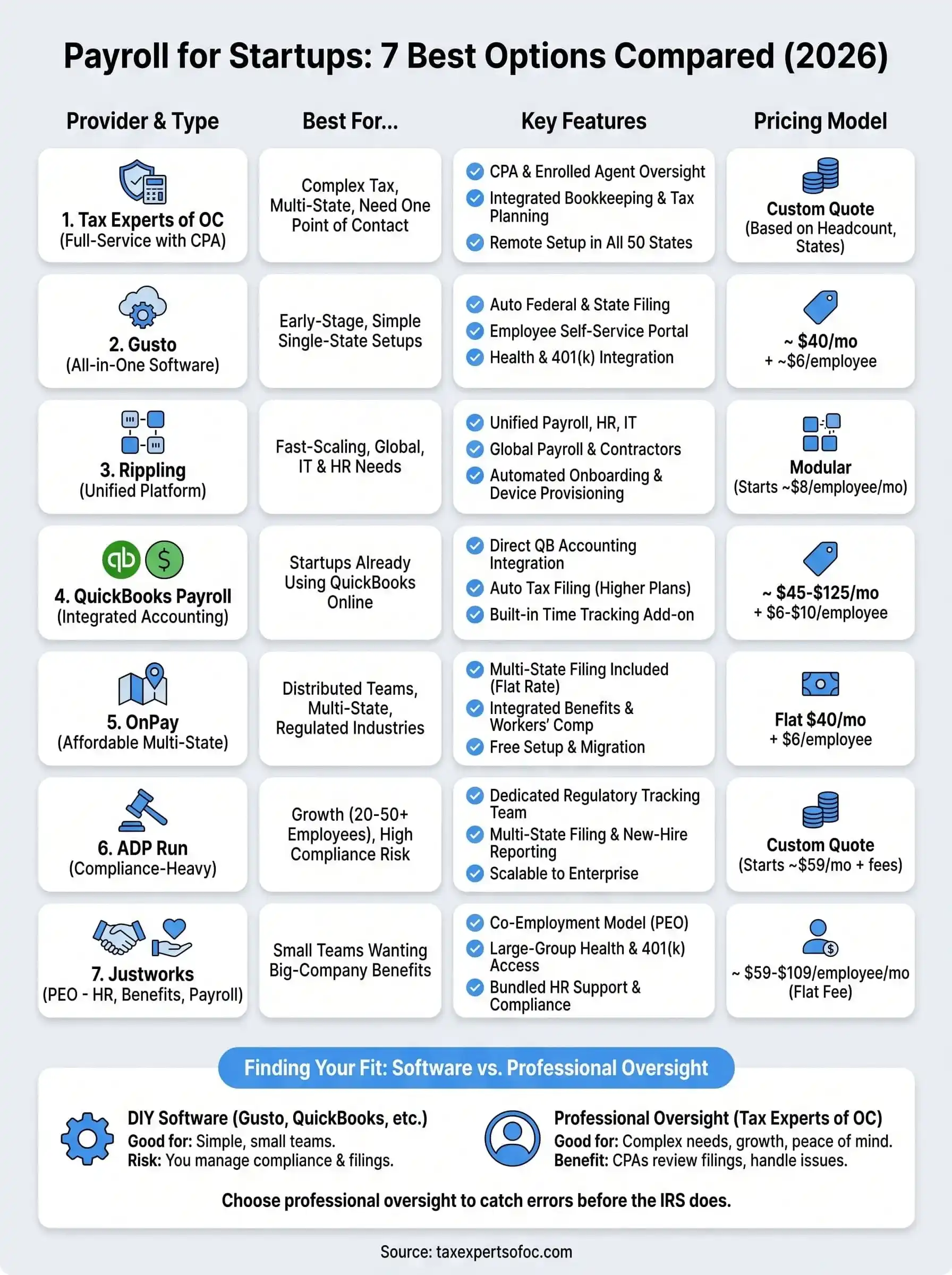
Finding the right payroll fit for your startup
Software like Gusto or QuickBooks Payroll works fine when your startup is small, single-state, and your tax situation is simple. But payroll for startups rarely stays simple for long. Add a remote hire in another state, convert a contractor to an employee, or miss one filing deadline, and suddenly you're managing compliance risk that a self-serve dashboard was never built to catch.
Table comparisons help you narrow the field, but the real question is whether you want to manage payroll yourself or hand it to someone who catches problems before the IRS does. If you've already got a notice in hand, or you just don't want to find out the hard way that your withholdings were off, professional oversight beats software alone. Our team at Tax Experts of OC runs payroll, handles the filings, and keeps a CPA in the loop the whole time. Schedule your free consultation with Tax Experts of OC and get payroll off your plate for good.