
Every filing season, thousands of people ask the same question: do I actually have to file a return this year? Maybe your income dropped, you're a dependent with a part-time job, or you're retired and living on Social Security. The requirements for income tax filing aren't one-size-fits-all, and guessing wrong can cost you a refund or land you a notice from the IRS.
The short answer is that whether you must file depends on your filing status, your age, and your gross income for the year. The IRS sets specific thresholds for each combination, and self-employed individuals face a separate, much lower bar. Even if you fall under the threshold, filing can still make sense if you had tax withheld or qualify for credits like the EITC.
In this article, we'll walk through the exact income tax filing requirements for singles, married couples, heads of household, and dependents, explain how the minimum tax filing income changes with age, and cover the special cases that catch people off guard. If you're still unsure after reading, our CPAs and Enrolled Agents at Tax Experts of OC can review your situation directly.
Why income tax filing requirements matter
Getting this wrong in either direction creates real problems. File when you didn't need to, and you waste time gathering documents for nothing. Skip filing when you were required to, and the IRS can assess penalties for filing taxes late, charge interest on any unpaid balance, and eventually send collection notices. Understanding the actual income tax filing requirements for your situation isn't just paperwork trivia, it's the difference between a clean tax season and a problem that snowballs into something bigger.
The cost of skipping a required return
Missing a filing obligation rarely stays a small issue. The IRS can prepare a substitute return on your behalf using only the income data it has from employers and banks, without applying deductions or credits you'd otherwise claim. That usually means a bigger tax bill than if you'd filed yourself. Add the failure-to-file penalty, which the IRS sets at 5% of unpaid tax per month up to 25%, and a manageable situation can turn into serious back tax debt fast, at which point you'll need help catching up on unfiled tax returns.
Filing late costs more than filing wrong, so when in doubt, file.
Money you might be leaving on the table
Often the bigger issue isn't a penalty, it's a missed refund. If your employer withheld federal income tax and your earnings fell below the minimum tax filing income threshold, you're owed that money back, but only if you file. The same goes for refundable credits.
- The Earned Income Tax Credit, one of the most valuable tax credits for individuals, can put thousands back in your pocket even at low income levels.
- The Additional Child Tax Credit is refundable even if you owe no tax.
- Estimated payments or extra withholding sit unclaimed until you submit a return.
Some taxpayers walk away from real money every year simply because they assumed no income meant no reason to file.
Why the rules feel confusing
Threshold confusion comes from the fact that the numbers shift constantly. Standard deduction amounts rise with inflation almost every year, age adds extra deduction room, and self-employment income triggers a completely different, lower bar than wage income. That's exactly why so many people either overfile out of caution or underfile out of assumption. The next sections break down the specific numbers so you're working from facts, not guesswork, about whether you actually need to submit a return this year.
How to determine if you need to file
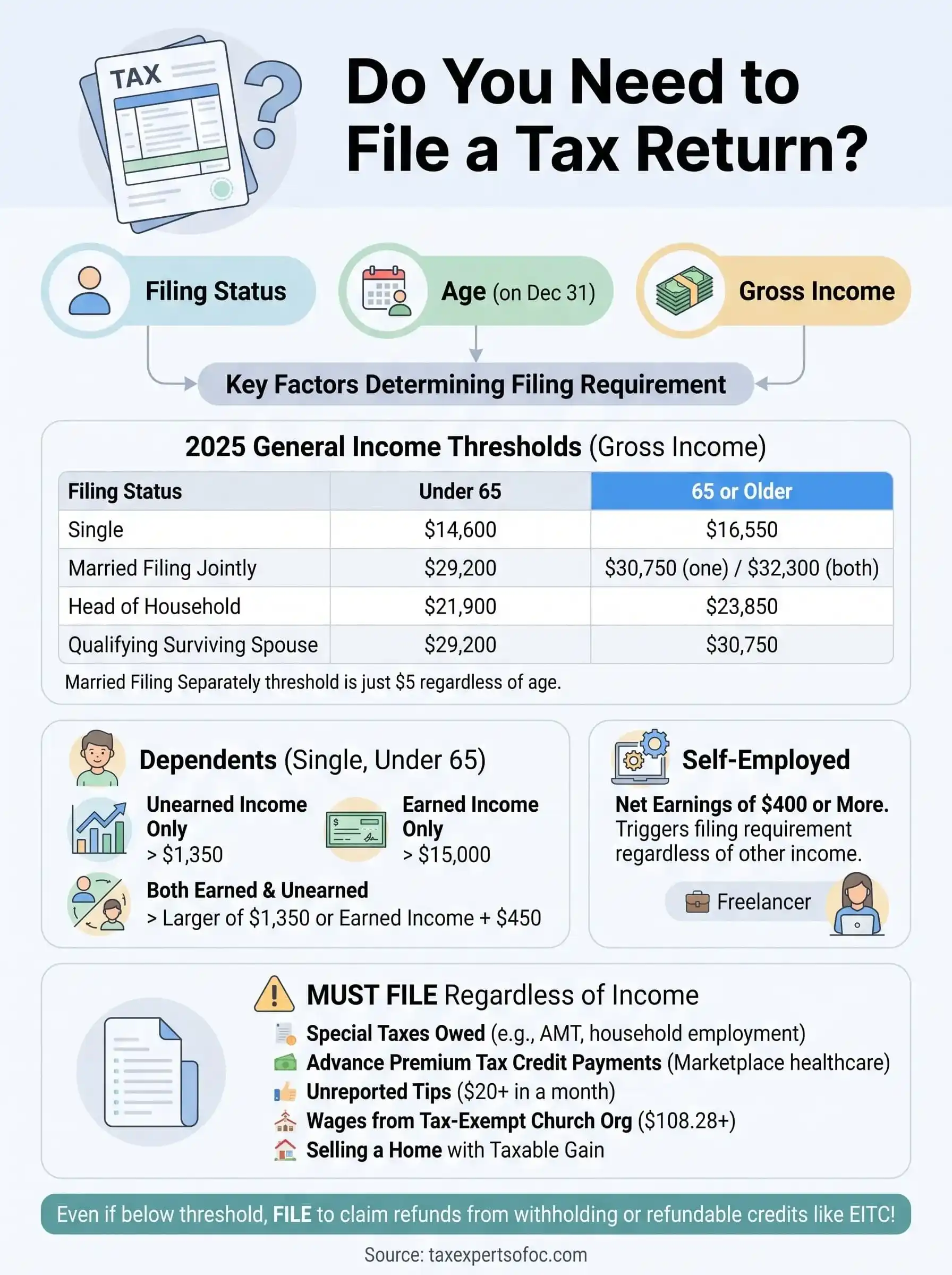
Figuring out your filing requirement starts with four numbers: your filing status, your age on December 31, your gross income, and your source of that income. The IRS runs these through a simple comparison. Add up all your taxable income for the year, including wages, self-employment earnings, interest, dividends, and rental income, then compare that total against the threshold assigned to your filing status and age bracket. If your gross income meets or exceeds that number, you must file.
A quick self-check
Before you dig into the exact tables in the next section, run through this checklist:
- Confirm your filing status (single, married filing jointly, married filing separately, head of household, or qualifying surviving spouse).
- Note whether you or your spouse turned 65 or older during the tax year, since that raises the threshold.
- Total your gross income from every source, not just your paycheck.
- Check whether any of it came from self-employment.
Your filing status and age set the bar, but self-employment income lowers it dramatically.
Self-employment changes the math entirely. Someone earning wages might sit comfortably below the standard threshold, but the same dollar amount earned through freelance work, gig driving, or a small side business triggers a filing requirement at just $400 in net earnings, because of self-employment tax obligations that exist separately from income tax and often come with estimated quarterly tax payments.
Married filing separately deserves its own mention here too, since that status carries the lowest threshold of all, often just a few dollars of gross income, which is one reason choosing a filing status as a married couple matters so much. If any of these factors apply to you and the numbers feel murky, the free consultation our team offers is built exactly for sorting this out before it becomes a bigger issue.
Income thresholds by filing status and age
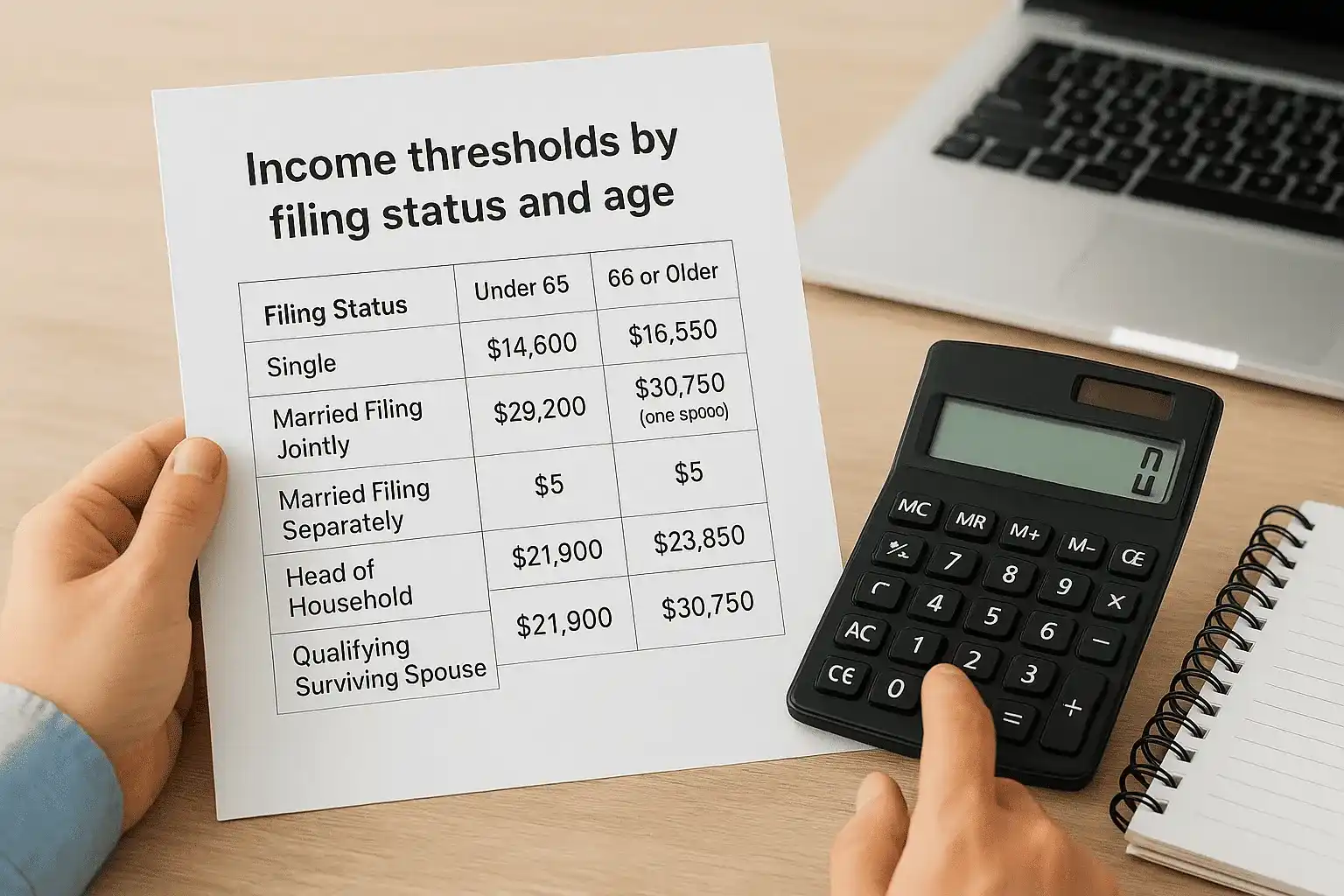
These numbers form the backbone of any answer to the minimum income thresholds by filing status question. The IRS updates the standard deduction each year for inflation, and that standard deduction sets the threshold below which most people aren't required to file. Age plays a role too. Once you or your spouse turn 65, you get an additional deduction amount, which pushes your filing threshold higher.
2025 tax year thresholds
For returns covering the 2025 tax year, here's how the thresholds break down by filing status and age:
| Filing Status | Under 65 | 65 or Older |
|---|---|---|
| Single | $14,600 | $16,550 |
| Married Filing Jointly | $29,200 | $30,750 (one spouse 65+) / $32,300 (both 65+) |
| Married Filing Separately | $5 | $5 |
| Head of Household | $21,900 | $23,850 |
| Qualifying Surviving Spouse | $29,200 | $30,750 |
Age 65 doesn't just bring Medicare, it bumps your filing threshold higher too.
Married filing separately stands out immediately. That $5 figure isn't a typo. Congress set it deliberately low so spouses can't quietly split income to dodge filing obligations. Everyone else on that table gets meaningful breathing room before the IRS expects a return.
Social Security benefits complicate the picture further, since they're often excluded from gross income for this test unless combined with other substantial income. Retirees living solely on Social Security frequently fall below every threshold above and owe nothing, though cutting taxes in retirement takes more thought once other income appears. Mixing in a pension, part-time job, or investment income changes that calculation fast, so don't assume retirement automatically means no filing requirement without running the actual numbers.
Filing requirements for dependents
Being claimed as a dependent on someone else's return doesn't exempt you from filing your own. Dependents follow a separate, generally lower set of thresholds that split income into two categories: earned income (wages, tips, self-employment) and unearned income (interest, dividends, capital gains). A teenager with a summer job and a college student with investment income from a custodial account can both trigger a filing requirement well before they'd expect it.

2025 dependent thresholds
Here's how the numbers break down for single dependents under 65 for the 2025 tax year:
| Income Type | Filing Required If |
|---|---|
| Unearned income only | Over $1,350 |
| Earned income only | Over $15,000 |
| Both earned and unearned | Gross income exceeds the larger of $1,350 or earned income (up to $14,600) plus $450 |
| Net self-employment earnings | $400 or more |
A dependent's part-time job doesn't erase their filing requirement, it just uses a different set of numbers.
Married dependents and those 65 or older or blind face adjusted figures, generally a bit higher, but the same split between earned and unearned income still applies. Parents often assume a child's small paycheck or brokerage account doesn't matter, then get surprised when a filing requirement shows up anyway. Kiddie tax rules can also apply once a dependent's unearned income crosses certain limits, pulling part of it into the parent's tax bracket instead of the child's. Sorting out whether your dependent needs to file, and whether it makes sense to file even below the threshold to recover withheld tax, is a quick fix during a consultation with our office rather than a guessing game done alone.
When you must file regardless of income
Some situations force a return no matter how low your gross income falls. The IRS lists specific triggers that override every threshold in the table above, and missing one of these is a common reason otherwise careful taxpayers end up with a notice. These special filing requirements exist because certain taxes and reconciliations can't happen any other way.
Special situations that trigger a filing requirement
Here are the most common scenarios where you must file even with minimal or no reportable income:
- You owe special taxes, including additional tax on a retirement plan distribution, household employment taxes, or alternative minimum tax.
- You received advance payments of the health insurance premium tax credit through the marketplace and need to reconcile them.
- Your net self-employment earnings hit $400 or more, triggering self-employment tax regardless of your total income.
- You had tips of $20 or more in a month that you didn't report to your employer.
- You sold a home and have a taxable gain that isn't fully excluded.
- You received wages of $108.28 or more from a church or qualified church-controlled organization exempt from Social Security and Medicare tax.
Certain taxes trigger a filing requirement all by themselves, no matter how little you earned.
Override situations like these often surprise people who assumed a quiet year meant no obligation. If any of these apply to your situation, or you're not sure whether one does, a quick call with our Enrolled Agents can confirm it before a missed deadline turns into penalties and interest.
Making sense of your filing situation
At this point, you've got the full picture: filing status and age set your baseline threshold, self-employment drops that bar dramatically, dependents follow their own earned/unearned split, and certain taxes force a return no matter your income. Knowing where you land on these requirements for income tax filing protects you from penalties on one side and missed refunds on the other. Overthinking it wastes time. Ignoring it invites a notice.
Questions still linger for plenty of people, especially when income comes from multiple sources or a dependent's situation gets complicated. That's normal, and it's exactly the kind of gray area a professional sorts out in minutes rather than hours of searching IRS publications. If you're still unsure whether you need to file this year, or want to make sure you're not leaving a refund unclaimed, book a free consultation for CPA-led tax preparation services with Tax Experts of OC and get a straight answer from a CPA or Enrolled Agent.