
Tax planning and preparation are two different jobs that work best together. Tax preparation is filing: you hand over your income documents, and a professional calculates what you owe and submits the return for the year that just ended. Tax planning is strategy: you make decisions during the year, while the numbers can still change, so you legally owe less and nothing surprises you at filing time.
Most people only ever buy the first half. Their return is accurate, their bill is whatever the year produced, and the same surprise returns next April. Planning is the missing half, and it is where the real money decisions get made.
This article explains why the difference matters, what each service includes, how to run both across the calendar, and how to choose a CPA or Enrolled Agent who handles both. Tax Experts of OC is a CPA and Enrolled Agent firm that prepares returns and plans ahead for individuals and businesses in all 50 states, so what follows reflects daily practice, not theory.
Why the difference between tax planning and tax preparation matters
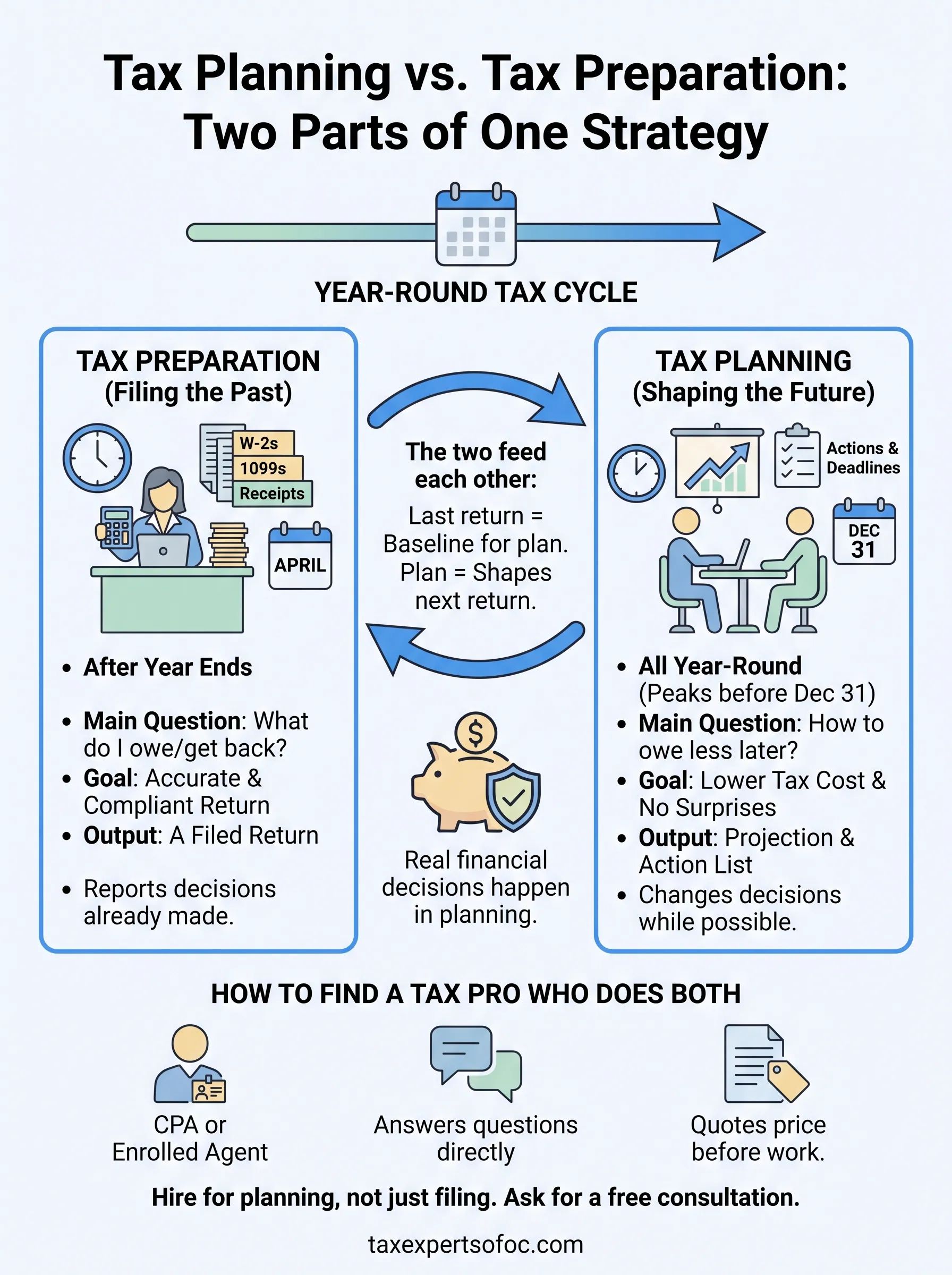
The difference matters because tax preparation only reports decisions you already made, while tax planning changes those decisions while they can still change. By January, most of your tax year is locked in, and no preparer can undo it. Knowing where each service sits in time tells you what to expect from it and when to call.
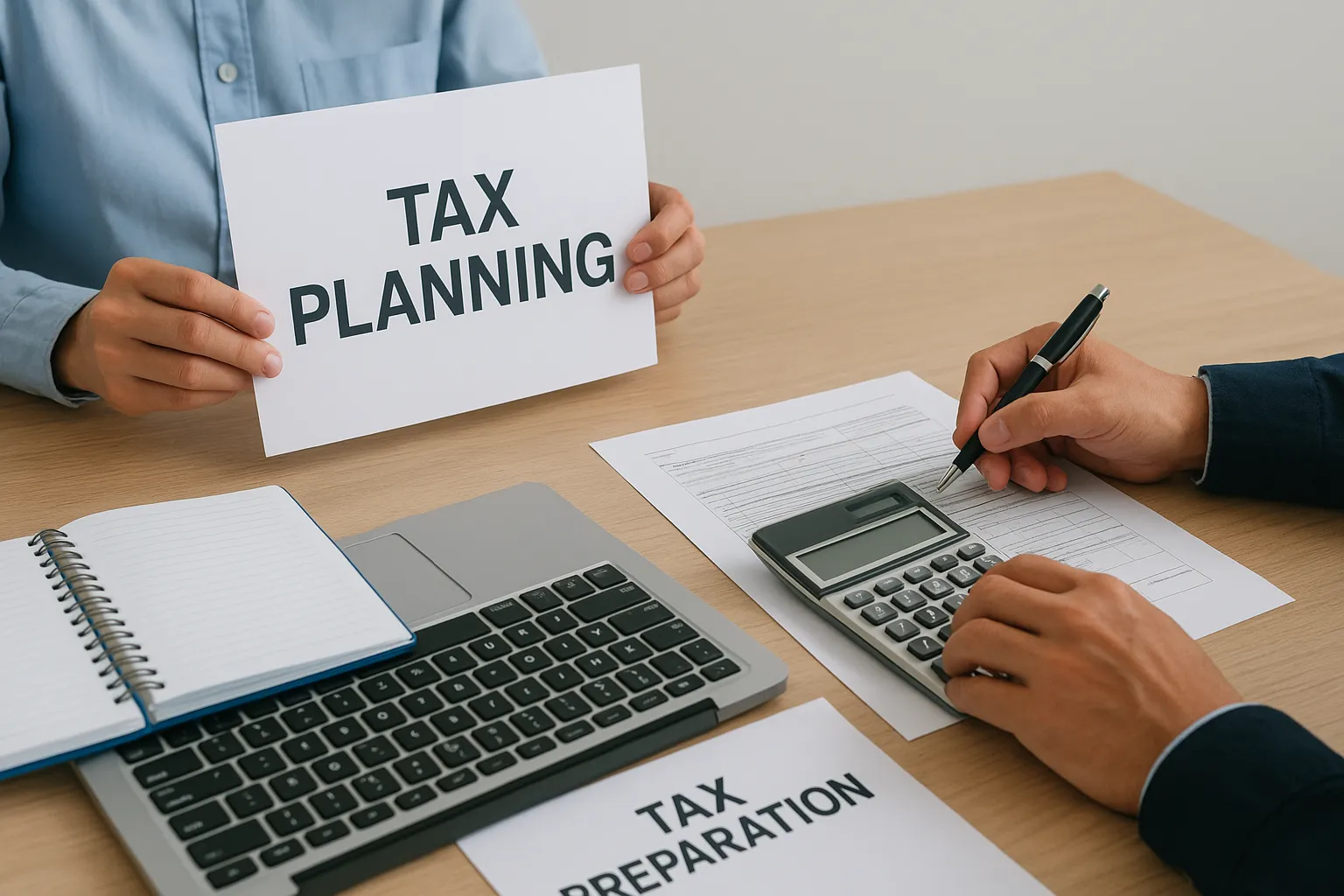
Preparation looks back, planning looks ahead
Preparation is a record, and planning is a forecast. A preparer takes the W-2s, 1099s, and receipts you collected and turns them into a filed return. A planner takes your expected income and expenses for the current year and asks which moves are still available before the books close.
| Tax preparation | Tax planning | |
|---|---|---|
| When it happens | After the year ends | All year, peaking before December 31 |
| Main question | What do I owe or get back? | What can I do now to owe less later? |
| Main goal | An accurate, compliant return | Lower tax cost and no surprises |
| What you receive | A filed return | A projection and an action list |
Preparation reports your tax year. Planning shapes it.
What happens when you only do one
Doing only preparation means you pay whatever the year produced. A preparer's core job is a correct return, not a lower bill. Some useful moves, such as a charitable gift for that year or a Roth IRA conversion, must be completed by December 31, so by the time your return is prepared, that window has closed.
Planning without clean preparation fails in the other direction. A plan rests on accurate prior-year numbers, and a sloppy return, missing forms, or an unanswered IRS notice undermine every projection. The two feed each other: your last return is the baseline for this year's plan, and this year's plan decides what next year's return says.
What tax planning and tax preparation each include
Tax preparation covers the paperwork for one filing period, and tax planning covers the choices that determine the numbers on that paperwork. Knowing the full scope of each helps you compare firms fairly, because a firm that advertises both may deliver only preparation.

What tax preparation covers
A preparation engagement ends with a filed return. The steps are similar for everyone, but the forms differ with entity type, so an individual, an LLC, and a non-profit each file differently.
- Collecting and checking income documents such as W-2s, 1099s, and K-1s
- Calculating income, deductions, and credits, including standard versus itemized deductions
- Preparing and e-filing federal and state returns
- Filing an extension when documents arrive late
- Preparing returns for corporations, partnerships, LLCs, and non-profits
What tax planning covers
For individuals, planning starts with a projection of this year's tax bill. From there it covers withholding and estimated payments, retirement contributions, the timing of charitable gifts, investment loss harvesting, and the tax effect of events such as marriage, a home sale, or retirement. The output is a written list of actions with deadlines, not a general conversation.
Small businesses need more. Planning covers entity structure and owner pay, for example whether an LLC should elect S corporation treatment and how salary and distributions are split. It also covers quarterly estimates, payroll compliance, the timing of equipment purchases, and retirement plans for owners and staff. All of this depends on current books, which is why bookkeeping and planning are often bought together.
A real tax plan is a projection plus a list of actions with deadlines.
How to run tax planning and preparation through the year
Run both on a year-round tax planning calendar: prepare early in the year, check your projection at mid-year, and act on it before December 31. The rhythm below suits most individuals and small businesses, though your exact dates shift with your situation.
A year-round calendar
Estimated payments set the beat. If you are self-employed, own a business, or have income without withholding, the IRS generally expects quarterly payments, typically due around April 15, June 15, September 15, and January 15. An extension gives you more time to file, not more time to pay, so estimate and pay what you expect to owe by April.
| When | Preparation | Planning |
|---|---|---|
| January to March | Gather income forms and file | Review last year's return for missed items, check withholding |
| April | File or extend, pay any balance | First estimated payment, last day for prior-year IRA contributions |
| June | Keep records current | Mid-year projection, second estimated payment |
| September | Keep records current | Update projection, third estimated payment |
| October to December | Pull year-end records | Roth conversions, charitable gifts, retirement contributions, equipment purchases before December 31 |
What to bring to a planning meeting
A planning meeting is only as good as the data behind it. Bring last year's return and a year-to-date income summary, and the meeting produces a real projection instead of guesses.
- Your last two federal and state returns
- Year-to-date pay stubs or a profit and loss statement
- Estimated payments made so far
- Investment and retirement account statements
- Any IRS or state notices
- Expected changes: a new job, marriage, home purchase, new business, or retirement
Bring the numbers in June, not April, and the plan still has time to work.
How to find a tax professional who does both
Look for a CPA or Enrolled Agent who offers preparation and planning in one engagement, answers your questions directly, and quotes a price before work starts. Those three tests screen out most poor fits. The credential comes first, because it decides who can advise you and who can represent you.
Credentials and who to talk to
CPAs are licensed by state boards of accountancy. Enrolled Agents are licensed by the IRS and can represent taxpayers before the IRS on any tax matter. Both are strong choices for planning. A tax attorney fits when you face legal structuring or a dispute, and a financial advisor covers investments but should coordinate with your tax professional.
Anyone paid to prepare a federal return must have a PTIN, but a PTIN alone says little about planning skill. The IRS publishes guidance on choosing a tax professional, including how to check credentials. Verify before you hand over documents.
What it costs and where to look
Cost varies with complexity, so ask for a written quote before you commit. Preparation is usually priced per return, and business returns or multiple states cost more. Planning is usually a flat fee or an ongoing engagement. A firm that quotes without asking about your forms, entities, and states is guessing.
Location matters less than most people think. Tax work runs on secure document sharing and phone calls, so a firm in another state can serve you well, provided it files in your state. An office nearby only helps if you want to hand over paper in person. Tax Experts of OC is based in Orange County, California, and works with clients in all 50 states by phone and email, including multi-state filings.
Questions to ask before you hire
Five questions separate firms that plan from firms that only file. A free first call, such as the 30-minute consultation we offer, is a low-risk way to hear the answers in plain language.
- Will I speak directly with the CPA or Enrolled Agent?
- Do you offer planning, or only preparation?
- Will you review a projection with me before year-end?
- Do you file in my state, and in other states where I earn income?
- What is the total price, and what does it include?
Hire for planning, not just for filing, and ask the price first.
Making planning and preparation work for you
Tax preparation tells you what happened last year. Tax planning shapes what happens this year. You need both, and you need them on a calendar: documents in the first quarter, a projection at mid-year, and action before December 31.
The most common mistake is waiting for April. By then your options shrink to filing accurately. A mid-year conversation keeps more of them open, and it costs far less than discovering a missed deadline after the fact.
Start small. Pull your last return, list any changes coming, and ask a CPA or Enrolled Agent to project your current-year bill. If you want one professional who handles both, book a free 30-minute consultation with Tax Experts of OC and bring your numbers.