
If your shoebox of receipts and half-updated spreadsheet are starting to stress you out, you're not alone. Most business owners search for bookkeeping and tax services after a missed deadline, a confusing IRS notice, or simply because tax season keeps catching them off guard. The truth is these two functions work together: one keeps your financial records accurate all year, the other turns those records into a correct tax filing when the deadline hits.
So what exactly do these services include? At a minimum, you're looking at monthly transaction recording, bank reconciliations, payroll management, and financial statement prep, paired with tax return preparation, planning, and representation if the IRS ever comes calling. A good provider treats bookkeeping and tax work as one connected system, not two separate vendors sending you conflicting numbers.
In this article, we break down what each service actually covers, how they differ, and why combining them under one roof, like a CPA or Enrolled Agent rather than generic software, saves you money and headaches. You'll also learn what to expect from pricing and scope so you can compare providers with confidence.
Why bookkeeping and tax services matter for your business
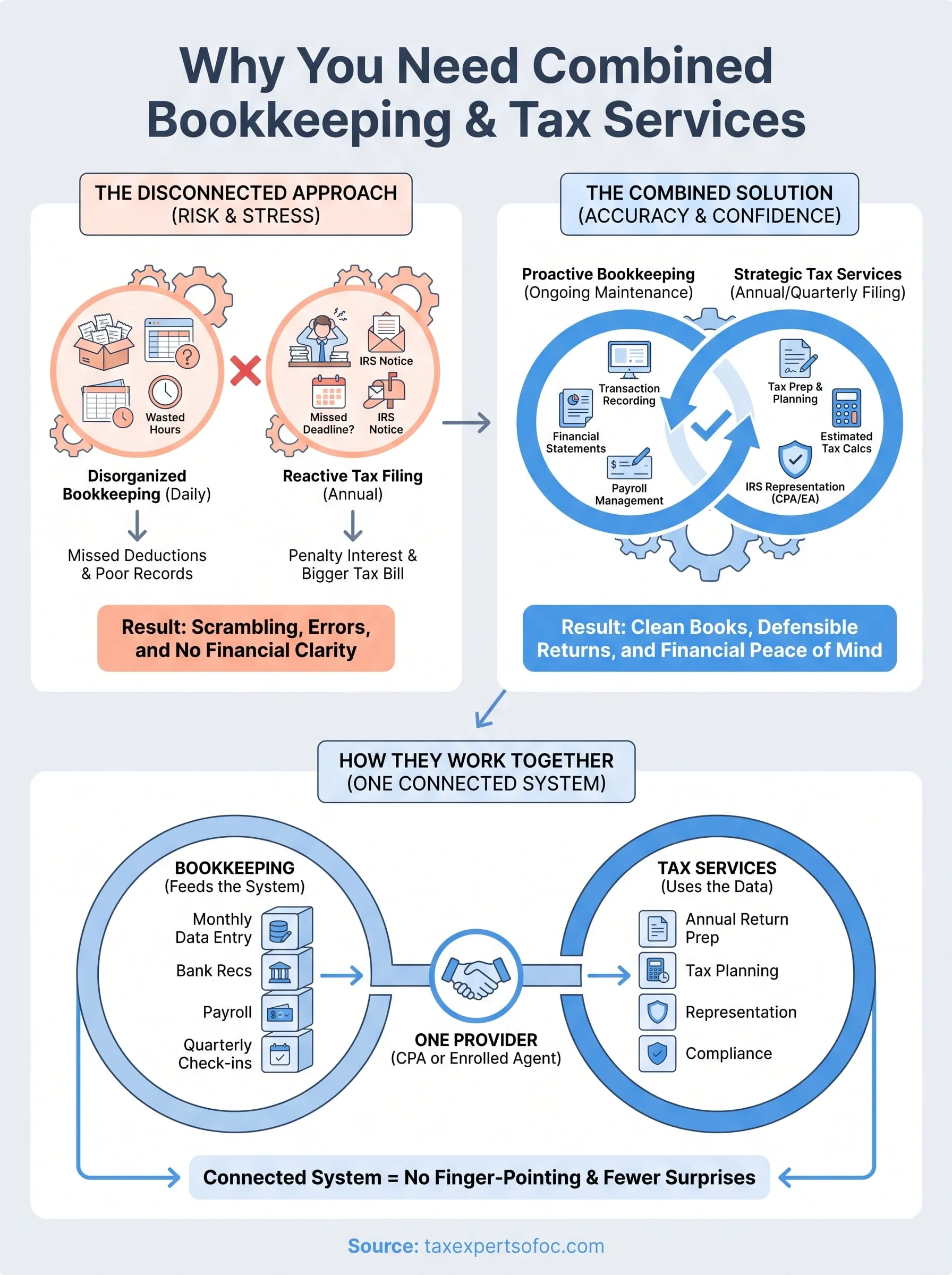
Skip regular bookkeeping and you're flying blind. Disorganized records mean you don't know your real profit margin, you miss quarterly estimated tax payments, and you can't answer basic questions like "can I afford to hire someone right now?" Tax season then becomes a scramble to reconstruct a year's worth of transactions, which almost always means missed deductions and a bigger tax bill than you should owe.
When bookkeeping gaps become tax problems
Most IRS notices we see at Tax Experts of OC trace back to a bookkeeping failure, not a tax filing one. A misclassified expense, an unreconciled bank account, or payroll taxes that never got deposited on time all show up months later as penalty letters. By then the fix costs far more, in fees and stress, than staying current would have.
Clean books all year are what make an accurate, defensible tax return possible.
The real cost of doing it yourself
Business owners who try to handle both jobs alone usually pay for it in one of three ways:
- Lost deductions because receipts and mileage logs never made it into a system
- Penalty interest from underpaid estimated taxes or late payroll deposits
- Wasted hours reconciling accounts at 11pm instead of running the business
Each of these is a direct financial hit, and none of them show up until it's too late to fix cheaply. According to the IRS, keeping accurate records isn't optional. It's required for anyone claiming business deductions, and poor recordkeeping is one of the fastest ways to trigger an audit flag.
One team, fewer surprises
Owners who bring bookkeeping and tax preparation together under one provider avoid the finger-pointing that happens when a bookkeeper's numbers don't match what the tax preparer expects. A CPA or Enrolled Agent who handles both sees the full financial picture: they catch a deduction the moment it happens, not seven months later when it's too late to document properly. That connection between daily recordkeeping and annual filing is exactly what separates a proactive tax strategy from a reactive one, and it's the difference between dreading tax season and walking into it with confidence.
How to choose the right bookkeeping and tax service provider
Finding the right accountant for small business taxes means looking past a slick website and checking who actually does the work. Ask whether a CPA or Enrolled Agent reviews your file personally, or whether you'll be handed off to rotating support staff who don't know your history. That distinction matters most the day you get an IRS letter and need someone who can represent you, not just someone who can enter numbers into software.
Credentials that actually matter
General bookkeeping software can log transactions, but it can't argue your case with the IRS or catch a deduction that requires professional judgment. Look for a firm where an Enrolled Agent or CPA signs off on your return, since both credentials carry federal representation rights that a bookkeeper alone doesn't have.
A provider without representation rights can't help you once the IRS actually calls.
Questions to ask before you sign
Run any candidate through this checklist for vetting a tax preparer before handing over your financial records:
- Do they offer a free initial consultation to review your situation before you commit?
- Is pricing disclosed upfront, or do you get a vague estimate that grows later?
- Can they handle multi-state filings if you have remote employees or clients?
- Do they combine bookkeeping and tax prep, or outsource one to a third party?
- Will the same person handle your books all year and your return in April?
Requesting a transparent pricing structure in writing, with the monthly and hourly bookkeeping rates spelled out, protects you from surprise invoices later. If a firm hesitates to answer any of these directly, treat that as a warning sign, not a formality. At Tax Experts of OC, we start every new client with a free 30-minute consultation specifically so you can ask these questions before committing to anything.
What a typical bookkeeping and tax services package includes
Packages vary by provider, but a solid combined service covers more than data entry. You should expect monthly bookkeeping, quarterly check-ins on tax liability, and annual return preparation, all bundled so nothing falls through the cracks between the bookkeeper and the preparer. Anything less leaves gaps that surface as surprises at filing time.

Core components you should see
Outsourced accounting and tax support should map cleanly onto your business calendar, not just show up once a year. Here's what a comprehensive package typically includes:
| Service | Frequency | Purpose |
|---|---|---|
| Transaction categorization | Monthly | Keeps books current and audit-ready |
| Bank/credit card reconciliation | Monthly | Catches errors and fraud early |
| Payroll processing | Per pay period | Ensures accurate withholdings and deposits |
| Financial statements | Monthly or quarterly | Shows real profit and cash flow |
| Estimated tax calculations | Quarterly | Avoids underpayment penalties |
| Tax return preparation | Annually | Files federal and state returns |
| IRS representation | As needed | Handles notices, audits, or collections |
Where scope often gets confusing
Questions about service scope trip up a lot of business owners comparing quotes. Some firms advertise "tax services" that only mean filing a return once a year, with no bookkeeping support behind it. Others sell bookkeeping software access with zero human review, which leaves you exposed if the IRS questions a deduction.
A package that skips monthly reconciliation isn't really a bookkeeping service, it's just data entry.
Verify exactly what's included before signing anything. Ask for a written scope of work listing deliverables and deadlines, not a vague monthly retainer description. That document becomes your reference point if a provider later tries to upsell services you assumed were already covered.
Bookkeeping vs. tax preparation: what's the real difference
Confusing these two functions is the single biggest mistake business owners make when shopping for help. Bookkeeping is the daily and monthly work of recording every transaction, reconciling accounts, and producing statements that show where your money actually went. Tax preparation is the annual (or quarterly) act of translating those records into a filed return that satisfies federal and state requirements. One feeds the other, but they're not interchangeable, and a provider who only does one leaves you exposed on the other side.
Different timelines, different goals
Think of bookkeeping as ongoing maintenance and tax prep as a once-a-year exam. A bookkeeper's job is accuracy in the moment: does this expense belong in this category, does this deposit match the invoice. A tax preparer's job is strategy and compliance: which deductions apply, which credits you qualify for, and how to file so you owe exactly what the law requires, no more, which is where the difference between planning and filing becomes obvious.
Bookkeeping tells you where you stand today. Tax preparation tells the IRS where you stood all year.
Why you need both, done together
Separating the two often means your tax preparer works from incomplete or outdated books, which forces guesswork at filing time. Combining bookkeeping and tax return services under one provider means the person filing your return already knows your numbers cold, because they've been reviewing them all year. That connection is what a genuine full-service tax and accounting relationship looks like, and it's what separates firms that just process paperwork from ones that actually manage your financial picture.
Putting your finances in the right hands
Good bookkeeping and tax services aren't a luxury for businesses that can afford extra help. They're the difference between guessing at your numbers and knowing them, between reacting to IRS letters and preventing them. Clean monthly records paired with a CPA or Enrolled Agent who prepares your return means nothing gets lost between the two functions, and nothing surprises you in April.
You've seen what a real combined package looks like, what questions separate a qualified provider from a software reseller, and why bookkeeping and tax prep were never meant to run as separate systems. Now it's just a matter of finding someone who treats your file as more than a once-a-year task.
If your books need attention or last year's return left you with questions, don't wait for another notice to force the issue. Schedule your free 30-minute consultation and see how monthly bookkeeping with CPA guidance from Tax Experts of OC gives you a straight answer about where you actually stand.