
Tax season shouldn't feel like a gamble on whether your preparer actually knows what they're doing. If you're searching for an accountant for small business taxes, you've probably already had a bad experience: a missed deduction, a surprise IRS notice, or a bookkeeper who couldn't answer basic questions about your LLC's filing status. That frustration is exactly why picking the right professional matters more than picking the cheapest one.
This guide walks you through exactly how to vet and hire an accountant who understands small business tax law, not just individual returns. You'll learn which credentials actually matter (CPA vs. Enrolled Agent vs. unlicensed preparer), what questions to ask during a consultation, and the red flags that signal you should walk away before signing an engagement letter.
We'll cover pricing structures, how to judge experience with your specific entity type, and why multi-state filing capability matters if you operate beyond one office. By the end, you'll know how to separate a true tax strategist from someone who just plugs numbers into software, and you'll be ready to schedule a consultation with confidence instead of guesswork.
What to consider before hiring a tax accountant
Before you start Googling "small business accountant near me," take a step back and think about what your business actually needs from a tax professional. Not every accountant handles the same work, and hiring the wrong type of preparer is one of the most common mistakes small business owners make. A good accountant for small business taxes does more than file a return once a year; they help you plan throughout the year so April doesn't turn into a scramble.
Know your entity type and its tax implications
Your business structure changes everything about how your taxes get filed. An LLC taxed as a sole proprietorship follows different LLC tax filing rules than an S-corp, and a partnership has its own reporting requirements entirely. Ask any candidate directly how many clients they currently serve with your exact entity type. Vague answers here are a warning sign.
A tax preparer who doesn't ask about your entity type in the first five minutes isn't paying attention to what actually determines your tax bill.
Decide between local and remote service
You don't need someone in your zip code anymore. Remote tax preparation services that work by phone and secure client portals can often provide faster turnaround and broader expertise than a one-person shop down the street. This matters even more if you operate in multiple states, since multi-state filing requires specific experience most local generalists don't have.
Weigh the real cost of a bad hire
Getting this decision wrong costs more than a wasted consultation. Missed deductions, incorrect entity elections, and late filings all carry financial consequences that compound over time.
| Mistake | Typical Consequence |
|---|---|
| Wrong entity election | Overpaying self-employment tax |
| Missed quarterly estimates | IRS underpayment penalties |
| Unfiled prior-year returns | Collections, liens, or levies |
| Sloppy bookkeeping | Audit exposure, denied deductions |
According to the IRS, small business owners face specific recordkeeping and filing obligations that vary by entity type and industry, and penalties for noncompliance can accumulate quickly.
Think beyond tax season
Finally, consider whether you need year-round support or just annual filing help. Businesses growing past a few employees often need year-round accounting support that combines bookkeeping, payroll, and strategic tax planning, not as separate services from separate vendors. If your accountant can only talk to you in March, you're missing opportunities to reduce your tax liability the other eleven months of the year. Keep this in mind as you move into the next step: defining exactly what your business needs before you start reaching out to candidates.
Step 1. Define your business's tax and accounting needs
Start by writing down what your business actually needs before you call anyone. A vague request like "I need help with taxes" gets you a vague answer back. Get specific about your entity type, your annual revenue, and whether you have employees, contractors, or inventory to track. This clarity saves you time on calls with candidates who aren't a fit and helps you spot an accountant for small business taxes who actually listens instead of reciting a generic pitch.
List your current pain points
Before anything else, make a list of what's currently broken. Are you behind on bookkeeping? Did you get an IRS notice you don't understand? Do you need help with unfiled returns from prior years? Write these down in plain language so you can hand them to a candidate during your first conversation.
Match services to your growth stage
Growing businesses need different support than a solo founder just getting started. Use this checklist to figure out what you should be asking for:
- Tax preparation only: annual filing for a simple LLC or sole proprietorship
- Bookkeeping plus tax prep: monthly reconciliation feeding into accurate filings
- Payroll support: setting up payroll for a small business becomes necessary once you hire your first W-2 employee
- Strategic tax planning: quarterly check-ins to reduce liability before year-end
- Outsourced CFO and controllership: financial strategy for businesses scaling past a few employees
Knowing exactly what you need before you call an accountant is the difference between hiring a specialist and hiring a stranger.
Decide if you need multi-state expertise
If you sell across state lines or have remote employees, note that now. Multi-state compliance requires specific experience, and not every local firm handles it well. Businesses that anticipate scaling should look at CPA-led tax planning services early, rather than waiting until a filing deadline forces the issue.
Step 2. Find qualified accountant candidates
Once you know what you need, start building a shortlist instead of picking the first name that shows up in a search. A small business tax accountant worth hiring usually comes recommended by someone who's actually used them, not just ranked well in a search engine, so it helps to know how to choose the right tax preparer before you start calling. Cast a wide net at first, then narrow it down based on responsiveness and fit for your entity type.
Ask for referrals from people you trust
Talk to other business owners in your industry, especially ones with a similar entity structure or revenue range. Referrals from a business attorney, banker, or insurance agent tend to carry more weight than online reviews alone, since these professionals see how accountants actually perform for their clients over time.
Search professional directories and licensing boards
Use state CPA society directories or the IRS Directory of Federal Tax Return Preparers to confirm a candidate holds an active license before you ever pick up the phone. This step alone filters out unlicensed preparers who advertise heavily but carry no real accountability.
A referral tells you who's competent; a licensing check tells you they're accountable.
Screen candidates before scheduling a full consultation
Run a short intake call or email exchange first to save everyone time. Ask these questions upfront:
- Do you specialize in my entity type (LLC, S-corp, partnership)?
- How many small business clients do you currently serve?
- Do you offer remote consultations if I'm not local?
- What's included in your engagement letter?
Candidates who dodge these questions or give vague, one-size-fits-all answers rarely turn into good long-term partners. Firms offering a free initial consultation, like Tax Experts of OC, let you test this fit before committing any money.
Step 3. Verify credentials, experience, and reputation
Once you've narrowed your shortlist, dig deeper before you hand over any financial documents. Anyone can claim to be a "tax expert" on a website, but CPA IRS representation rights mean only a licensed CPA or Enrolled Agent can speak for you before the IRS if things go wrong. Confirming this upfront protects you from unlicensed preparers who disappear the moment a return gets questioned.
Confirm licenses and standing
Check the credential type first, since it determines what a preparer can legally do for you.
| Credential | Can Prepare Returns | Can Represent You in an Audit | Typical Specialty |
|---|---|---|---|
| CPA | Yes | Yes | Accounting, planning, complex entities |
| Enrolled Agent | Yes | Yes | IRS disputes, back taxes, resolution |
| Unlicensed preparer | Yes | No | Simple individual returns only |
Verify status directly through your state's CPA licensing board or the IRS Enrolled Agent database rather than trusting a badge on a homepage.
Ask about direct experience with businesses like yours
Experience with your specific entity type matters more than years in practice alone. Ask how many S-corp or LLC returns they filed last year, and request an example of a tax situation similar to yours that they resolved. Someone who mostly files individual 1040s isn't the right fit for a growing business with payroll and quarterly obligations.
A credential proves they're licensed; experience with your entity type proves they're competent.
Check reviews and disciplinary history
Read recent reviews on Google and industry-specific platforms, paying attention to how the firm handled disputes or mistakes. Search your state board's disciplinary records too. A clean record combined with strong reviews from other small business owners is the reputation signal that actually matters here.
Step 4. Compare fees and choose the right fit
Now that you've verified credentials, it's time to talk money before you sign anything. Average tax preparation fees for an accountant for small business taxes vary widely, and the cheapest quote often hides scope limitations that surface later as extra invoices. Ask every finalist for a written estimate that spells out exactly what's included, not a vague hourly range.
Compare common fee structures
Different firms price their work differently, and knowing the model helps you compare apples to apples.
| Fee Structure | How It Works | Best For |
|---|---|---|
| Flat fee per return | Set price for filing, known upfront | Simple LLCs, sole proprietors |
| Hourly billing | Charged per hour of work performed | Complex or ongoing cases |
| Monthly retainer | Bundles bookkeeping, payroll, and tax prep | Growing businesses needing year-round support |
| Resolution-based fee | Set fee tied to a specific IRS problem | Back taxes, audits, unfiled returns |
The lowest quote rarely reflects the true cost once missed deductions and extra fees get added up.
Ask about payment flexibility
Unexpected tax debt often arrives at the worst possible time financially. Ask candidates directly whether they offer payment plans for clients facing hardship, and whether they can help you estimate monthly IRS payments, since firms without these options can add stress to an already difficult situation. A transparent firm answers this question without hesitation.
Make your final decision
Finally, weigh price against fit rather than choosing on cost alone. The right accountant combines fair, transparent pricing with real experience in your entity type and clear communication throughout the year. Firms like Tax Experts of OC that offer upfront pricing and a free consultation make this comparison easier, since you know the cost before committing to anything.
Choosing an accountant you can trust
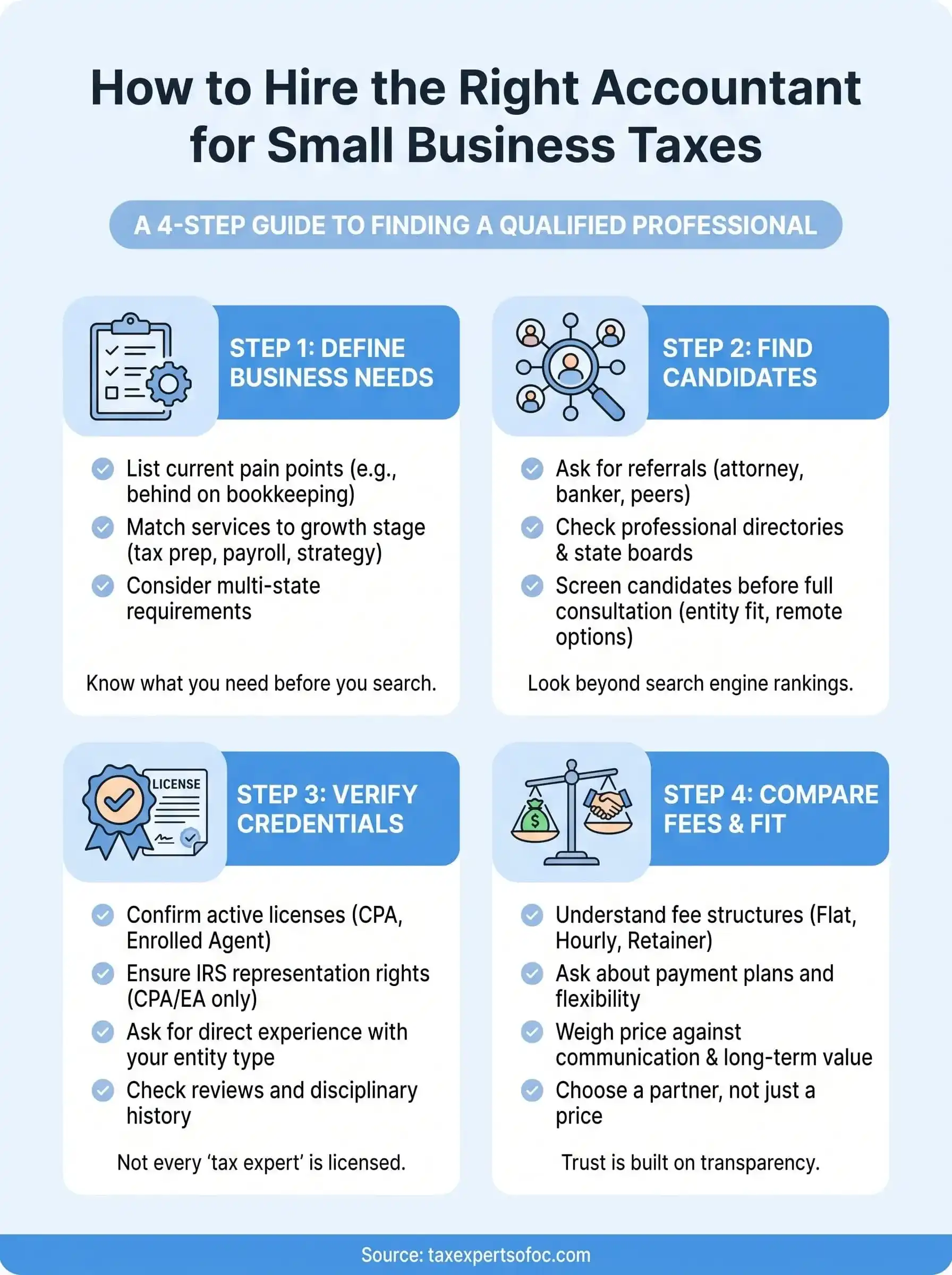
Finding the right accountant for small business taxes comes down to four things: knowing what you need, vetting real candidates, confirming credentials, and comparing pricing honestly. Skip any of these steps and you risk repeating the same frustration that sent you searching in the first place. Trust isn't built from a slick website or a low quote; it comes from a licensed professional who asks the right questions, explains your entity type clearly, and stays available past April.
Getting this right protects your business from penalties, missed deductions, and the stress of handling IRS problems alone. You've now got a clear process to follow, so use it before your next filing deadline sneaks up on you.
If you'd rather skip the guesswork, book a free consultation for personal and business tax preparation with Tax Experts of OC and talk directly with a CPA or Enrolled Agent who already knows small business taxes inside and out.