

Owing the IRS money you can't pay in full is stressful, but it doesn't have to be paralyzing. An IRS payment plan calculator helps you estimate what your monthly installment payments could look like, including setup fees and the interest that accrues over the life of your agreement. Having those numbers in front of you turns a vague financial threat into a concrete, manageable plan.
The IRS offers several installment agreement options, and the one you qualify for depends on factors like how much you owe, how quickly you can pay it off, and whether you're an individual or a business. Each option carries different fees, interest rates, and penalty structures, details that are easy to miscalculate if you're estimating on your own. Understanding these variables before you apply can save you from locking into terms that cost more than necessary.
At Tax Experts of OC, our CPAs and Enrolled Agents help clients across all 50 states negotiate and structure IRS payment plans every day. We've seen firsthand how running the numbers ahead of time changes the conversation with the IRS, and how costly it can be when people skip that step. This article walks you through how to calculate your estimated payments, what fees and interest to expect, which plan types fit different situations, and when it makes sense to get professional help before you commit to an agreement.
Why an IRS payment plan calculator matters
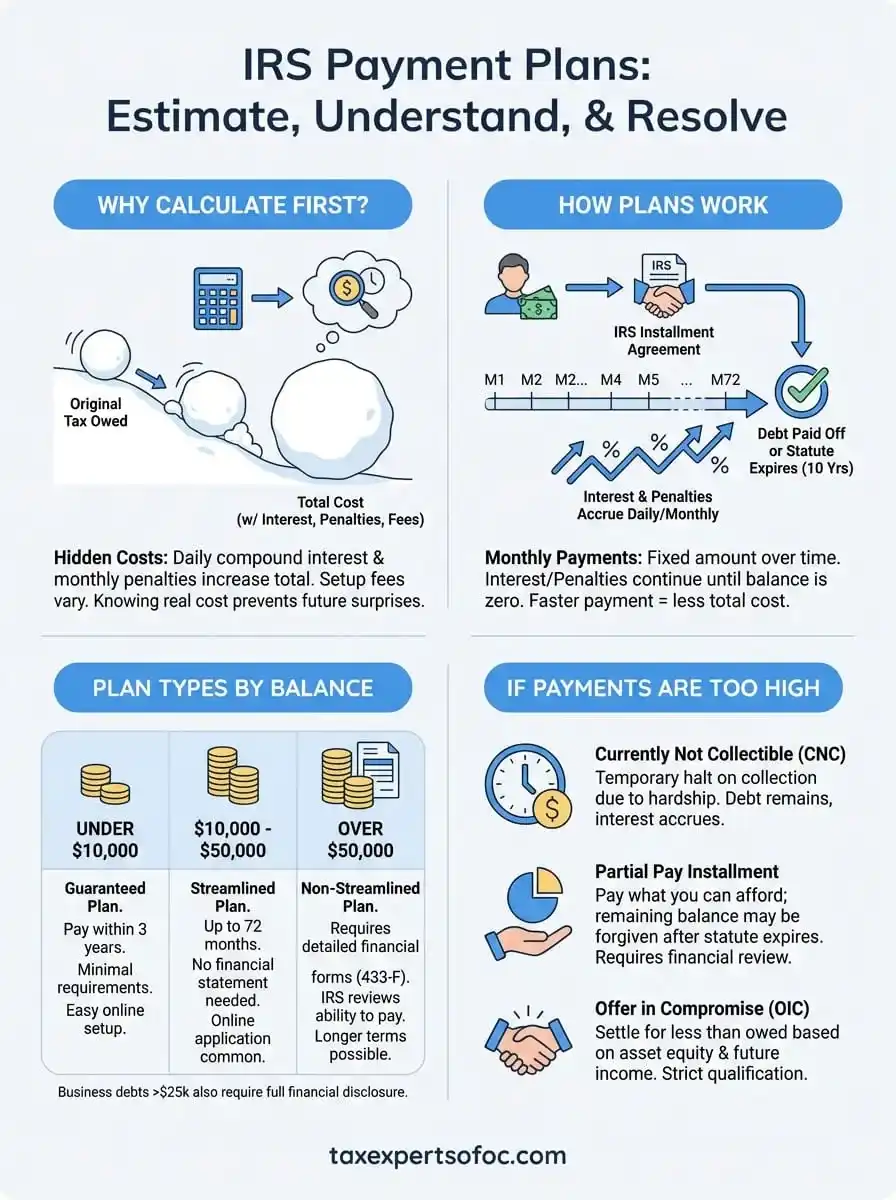
Most people facing an IRS tax debt focus on one number: what they owe. They forget that the final amount you actually pay is almost always larger than the original balance. Interest compounds daily, penalties continue to accrue, and setup fees vary based on how you apply and how fast you plan to pay. Running an IRS payment plan calculator before you commit gives you a realistic picture of the total cost, not just a monthly number you can afford today.
The real cost of skipping the math
When you skip the calculation step and agree to the first installment amount that seems manageable, you take on real risk. A payment that looks affordable in month one can become unsustainable over a 72-month term once you account for interest accruing on the unpaid balance every single day. The IRS charges interest at the federal short-term rate plus 3%, and that rate adjusts quarterly. On a $20,000 balance paid over six years, interest alone can add several thousand dollars to your total obligation.
Running the numbers before you apply is not optional if you want to control what you ultimately pay.
How accurate numbers shift your negotiating position
If you approach an installment agreement knowing your estimated monthly payment, total interest cost, and setup fee, you are in a much stronger position than someone simply reacting to whatever the IRS proposes. The IRS online application will suggest a payment based on your balance and the time remaining before the collection statute expires, but that suggestion is not necessarily the lowest amount you qualify for. Knowing what you can realistically afford, backed by solid calculations, lets you counter with a number that fits your budget while still meeting the IRS's requirements.
Your income, allowable living expenses, and asset equity all factor into what the IRS considers an acceptable payment under a non-streamlined plan. Documenting those figures accurately before you apply means you won't accidentally commit to a higher monthly amount than your financial situation actually requires.
Why defaults cost more than most people expect
Defaulting on an installment agreement is not simply a matter of starting over. When you miss a payment or fail to file a required return during the agreement period, the IRS can terminate your plan and resume collection activity, which may include levies on wages, bank accounts, or other assets. Re-establishing an agreement after a default comes with another setup fee and potentially less favorable terms than your original plan carried.
Setting a payment you can genuinely sustain over the full agreement term protects you from that outcome. A lower payment negotiated upfront is far better than agreeing to a number that stretches your budget thin and increases the chance you miss a payment several months in.
The value of running multiple scenarios
One of the most practical reasons to calculate before you apply is that you can compare different payoff timelines to see how each one changes your total cost. Paying off a $15,000 balance in 24 months versus 72 months produces very different totals once daily interest is factored in across the life of the agreement.
Seeing those numbers side by side helps you decide whether it makes financial sense to accelerate your payoff or whether a longer plan with lower monthly payments gives you the breathing room you need right now. Without running those scenarios first, you are making that decision without the information that matters most.
How IRS payment plans work in plain English
When you owe the IRS more than you can pay right now, an installment agreement lets you pay that balance over time in fixed monthly payments instead of facing immediate collection action. The IRS formally approves the plan, and as long as you stay current with payments and file all future returns on time, they generally hold off on levies and other enforcement. Using an IRS payment plan calculator helps you estimate what that monthly commitment will actually look like before you lock anything in.

The basic agreement structure
An installment agreement is essentially a contract between you and the IRS. You agree to pay a set amount each month, and the IRS agrees to accept that payment rather than pursuing forced collection. The agreement runs until your full balance, including all accrued interest and penalties, is paid off or until the collection statute expires, which is generally 10 years from the date the IRS assessed your tax debt.
Your payments apply to the oldest tax years first, and interest continues to accrue on the unpaid balance throughout the entire agreement. That means your balance does not simply freeze when you enter the plan; it keeps growing until each payment chips it down.
The IRS does not pause interest while your installment agreement is active, so the faster you pay, the less you pay overall.
The two main categories of plans
The IRS offers two broad categories of installment agreements: streamlined and non-streamlined. Streamlined plans have simpler qualification rules and do not require you to submit detailed financial information. If your balance falls below certain thresholds and you can pay it off within the required timeframe, you qualify automatically through the IRS online system.
Non-streamlined plans apply when your balance is higher or when the standard monthly payment under a streamlined plan is more than you can afford. These plans require you to document your income, expenses, and asset equity using IRS financial forms, and an IRS representative reviews that information before approving your payment amount. The qualification rules differ significantly between individuals and businesses, and the type of tax debt you carry also affects which plan options are available to you.
What to gather before you calculate
Before you open any IRS payment plan calculator or start estimating your monthly payment, you need specific financial data in front of you. Without it, any number you generate is a guess rather than a working estimate. Gathering these details first takes 20 to 30 minutes but saves you from building a payment plan on inaccurate assumptions.

Your total tax debt across all years
The IRS does not treat your balance as a single lump sum when you apply. Your debt is broken down by tax year and by type, which means penalties and interest are tracked separately from the original taxes you owe. Pull any IRS notices you have received, and log in to your IRS online account at irs.gov to confirm the exact balance for each year. You need that year-by-year breakdown to calculate interest accurately, because different years may have been assessed at different times and carry different amounts of accrued interest.
Confirming your exact balance through your IRS online account before you calculate prevents you from underestimating what you actually owe.
Your monthly income and allowable living expenses
The IRS uses a standard financial framework to evaluate what you can reasonably pay each month. You need your gross monthly income from all sources, including wages, self-employment income, rental income, and any other recurring payments. On the expense side, the IRS applies national and local Collection Financial Standards to cap what it considers allowable for housing, utilities, food, transportation, and healthcare. Knowing those limits before you calculate helps you estimate what the IRS will actually accept as a payment rather than what you think you can afford personally.
Your asset and account balances
Non-streamlined installment agreements require you to disclose asset equity, which includes the current market value of your home minus any mortgage balance, the value of your vehicles minus outstanding loans, and balances in checking, savings, and investment accounts. Even if you plan to apply for a streamlined plan, knowing your net asset position gives you a more complete picture of your financial exposure. If the IRS believes your assets could cover part of the debt, it may push back on a low monthly payment unless you can document why liquidating those assets would cause hardship.
How to estimate your monthly payment
Once you have your balance, income, and expense data ready, you can run a basic estimate using the same logic any IRS payment plan calculator applies. The IRS does not use a single fixed formula across all plan types, but the underlying approach follows a consistent structure: your total balance divided by the number of months in the repayment period gives you a baseline payment, which then gets adjusted for accruing interest.
The basic formula the IRS uses
For most streamlined plans, the IRS divides your total assessed balance by the number of months remaining before the collection statute expires or by the maximum term allowed for your balance tier. If you owe under $10,000, the IRS will generally accept any payment that retires the debt within three years. Balances between $10,000 and $50,000 qualify for a 72-month streamlined plan, which means the IRS takes your balance and divides it across 72 equal installments as a starting point before interest is layered in.
That baseline number is not your final monthly payment. Interest accrues on your unpaid balance throughout the entire agreement, so your actual monthly obligation runs slightly higher than the simple division suggests. The IRS charges interest at the federal short-term rate plus 3%, which adjusts quarterly. On a $20,000 balance spread across 72 months, your base monthly payment is roughly $278 before interest, but that accruing interest will add meaningfully to your total obligation over six years.
The simple division of balance by months gives you a floor, not your final total. Interest will push the real cost higher.
Running the numbers with your actual figures
Start with your confirmed IRS balance from your online account, then divide it by the number of months in the plan you intend to apply for. For a 72-month plan with a $15,000 balance, your base monthly payment is approximately $208. Then estimate interest by multiplying your balance by the current quarterly interest rate and distributing that cost proportionally across your payment term. Your IRS online account shows current interest rates and outstanding penalty balances, which gives you the inputs you need to calculate a realistic total.
Recalculate your estimate as you pay down the balance. Because interest accrues on the remaining unpaid balance each month, your total interest cost shrinks if you make larger payments early in the agreement. Even modest overpayments in the first year can cut your overall cost by several hundred dollars and shorten the effective length of your plan.
How to estimate setup fees and other costs
Setup fees are a fixed cost that many people overlook when they first use an IRS payment plan calculator to estimate their monthly obligation. The IRS charges a one-time user fee to establish an installment agreement, and the amount you pay depends entirely on how you apply and whether you set up direct debit. Factoring this fee into your total upfront prevents a surprise charge when your plan is approved.
What the IRS charges to set up your plan
The fee structure breaks down into four scenarios based on your application method and payment type. Applying online with direct debit set up from the start carries the lowest fee at $31. Applying online without direct debit costs $130. If you apply by phone, mail, or in person, the fees rise to $107 with direct debit and $225 without it. Low-income taxpayers whose household income falls at or below 250% of the federal poverty level can apply for a reduced fee of $43 or a complete waiver, which the IRS reviews automatically when you submit your application.
Choosing the online direct debit option cuts your setup fee by more than 85% compared to applying by phone without automatic payments.
| Application Method | Direct Debit | No Direct Debit |
|---|---|---|
| Online | $31 | $130 |
| Phone, mail, or in person | $107 | $225 |
| Low-income (qualified) | $43 or waived | $43 or waived |
Additional costs beyond the setup fee
The setup fee is a one-time charge, but penalties continue to accrue on your unpaid balance throughout the life of your agreement. The failure-to-pay penalty runs at 0.5% of your outstanding balance per month, though once you have an approved installment agreement in place, that rate drops to 0.25% per month. That reduction matters when you are planning your total cost, because it meaningfully lowers how much penalty accumulates while you are paying off the debt.
Returned payment fees are another cost to account for. If a direct debit payment fails because your account lacks sufficient funds, the IRS can charge a $25 returned payment fee per occurrence. Setting up automatic payments and keeping a buffer in the linked account protects you from that charge and from the bigger risk of defaulting on your plan due to a missed payment.
How interest and penalties change the total
When you use an IRS payment plan calculator to estimate your monthly payment, the base division of balance by months is only part of the picture. Interest and penalties continue to run on your unpaid balance throughout the entire life of your installment agreement, and understanding how each one compounds helps you see the real total before you commit to a plan.

How daily interest compounds on your balance
The IRS calculates interest daily on your outstanding balance, not monthly or annually. That means every day you carry an unpaid balance costs you a small additional amount, and those amounts add up significantly over a multi-year repayment term. The rate is the federal short-term rate plus 3%, adjusted each quarter. As of early 2026, that rate sits at approximately 7% annually, though it can shift depending on changes to the federal benchmark rate. You can confirm the current rate at irs.gov.
To put this in concrete terms, a $20,000 balance carried across a full 72-month plan at 7% annual interest adds roughly $4,500 to $5,000 in total interest by the time the debt is retired, depending on how quickly payments reduce the principal. Making larger payments early in the agreement lowers the running balance faster, which directly cuts the amount of interest that accrues in later months.
Paying even $50 to $100 more than your minimum monthly payment in the first year can reduce your total interest cost by several hundred dollars.
How the failure-to-pay penalty stacks on top
The failure-to-pay penalty runs at 0.5% of your unpaid balance per month under normal circumstances. Once the IRS approves your installment agreement, that rate drops to 0.25% per month, which is a meaningful reduction but still a real ongoing cost. On a $15,000 balance, 0.25% per month equals $37.50 in penalty charges added to your account each month, separate from the daily interest calculation.
Both charges apply simultaneously, which means your effective monthly cost is higher than either figure alone suggests. The penalty continues until your balance reaches zero, so a longer repayment term not only increases total interest but also extends how long the penalty keeps running. Choosing the shortest repayment term your budget can support limits both costs and keeps your total obligation as low as possible.
Plan types and rules by balance size
The IRS does not offer one universal installment agreement. Which plan you qualify for depends directly on how much you owe, and each tier comes with different rules around documentation, repayment terms, and IRS discretion. Using an IRS payment plan calculator to estimate your costs only gives you useful numbers if you apply them to the correct plan type for your specific balance.
Plans for balances under $10,000
If your total tax debt is below $10,000, the IRS offers what it calls a "guaranteed" installment agreement. As long as you have filed all required returns, have not had another installment agreement in the past five years, and can pay the full balance within three years, the IRS must approve your plan without reviewing your financial information. This is the most straightforward path available, and it requires minimal documentation to set up through the IRS online portal.
Plans for balances between $10,000 and $50,000
This balance range falls under the streamlined installment agreement, which gives you up to 72 months to pay without submitting detailed financial forms. The IRS does not require you to document income, expenses, or asset equity at this tier, which makes the application process significantly faster. Your monthly payment must be high enough to retire the full balance within the 72-month window, so your minimum payment is calculated by dividing your total balance by 72. This is the tier where most individual taxpayers land, and it is also where daily interest costs add up most noticeably over a full six-year term.
Choosing direct debit at this tier reduces your setup fee from $130 to $31 and lowers the chance of a missed payment triggering a default.
Plans for balances over $50,000
Once your balance crosses $50,000, the streamlined rules no longer apply. The IRS requires you to complete Form 433-F, the Collection Information Statement, which documents your income, monthly expenses, and asset equity in detail. An IRS representative reviews that information and determines your acceptable payment based on your documented ability to pay rather than a simple division formula. The maximum repayment term can extend up to 84 months in some cases, but the IRS retains more discretion over the terms at this level. Business tax debts over $25,000 follow a similar non-streamlined process and also require full financial disclosure before the IRS approves an agreement.
What to do if the payment is too high
Running an IRS payment plan calculator and finding that the minimum monthly payment exceeds what your budget can sustain is a common situation, and it does not mean you are out of options. The IRS has formal pathways designed for taxpayers who cannot afford a standard installment agreement, and knowing which one fits your circumstances helps you respond to the IRS with a specific request rather than simply hoping for flexibility.
Request Currently Not Collectible status
If your income barely covers your basic living expenses after accounting for allowable costs under the IRS Collection Financial Standards, you may qualify for Currently Not Collectible status. This classification temporarily halts IRS collection activity because the IRS has determined that collecting from you right now would create genuine financial hardship. Your debt does not disappear under this status, and interest and penalties continue to accrue, but the IRS stops pursuing levies and garnishments while your account carries this designation. The IRS reviews your financial situation periodically and can remove the status if your income increases enough to support a payment.
Currently Not Collectible status is not a long-term solution, but it gives you time to stabilize your finances before committing to a payment plan.
Submit a partial pay installment agreement
A partial pay installment agreement allows you to make monthly payments below the amount required to retire your full balance before the collection statute expires. Once the 10-year collection window closes, the IRS writes off whatever balance remains unpaid. To qualify, you must submit Form 433-A or 433-F to document that your income and allowable expenses leave you with less disposable income than a standard plan would require. The IRS approves these agreements with more scrutiny than streamlined plans, and it will review your financial situation every two years to determine whether your payment should increase.
Consider an Offer in Compromise
If your total asset equity and future income are both too low to realistically pay the full debt over the remaining collection period, an Offer in Compromise lets you settle the balance for less than you owe. The IRS calculates your minimum acceptable offer based on your reasonable collection potential, which combines your available monthly income with the net equity in your assets. Not every taxpayer qualifies, and the IRS rejects offers that do not meet its threshold, but if you do qualify, it permanently resolves the debt for a reduced amount.
How to apply and avoid default
Once you have used an IRS payment plan calculator to estimate your monthly payment and confirmed the plan type that fits your balance, the actual application takes less time than most people expect. The IRS online portal handles the majority of individual installment agreement requests, and most streamlined plan applications receive an immediate decision without waiting for review by an IRS representative.
Applying through the IRS online portal
The IRS Online Payment Agreement tool at irs.gov lets you apply for a new installment agreement, modify an existing one, or set up direct debit. You will need to verify your identity through the IRS's secure login system before the application opens. Once inside, you enter your balance information, choose your plan type, and select your preferred payment method. The system calculates your minimum monthly payment based on your balance and repayment term, and you can adjust the amount upward if you want to retire the balance faster and cut total interest. Completing the application with direct debit already selected lowers your setup fee from $130 to $31 and removes the risk of a forgotten manual payment causing a default.
Keeping your agreement active
Defaulting on an installment agreement happens in three main ways: missing a scheduled payment, failing to file a required return on time, or adding a new tax balance without notifying the IRS. Any one of these can trigger termination of your plan, which returns the IRS to full collection authority over your account. Setting up direct debit from a dedicated checking account eliminates the first risk entirely, since payments process automatically on the scheduled date each month.
File every required return on time while your installment agreement is active, even if you cannot pay a new balance in full when you file.
Filing on time matters because an unfiled return is treated as a separate compliance failure that violates the terms of your agreement regardless of whether your payments are current. If your financial situation changes and your scheduled payment becomes unaffordable, contact the IRS before you miss a payment rather than after. The IRS allows you to request a modification based on a documented change in income or expenses, and acting early gives you far more options than trying to reinstate a plan that has already been terminated.
Next steps if you need help
An IRS payment plan calculator gives you a solid starting point, but it cannot account for every variable that affects your specific situation. If your balance exceeds $50,000, your income barely covers your allowable expenses, or the IRS has already begun collection activity against you, calculating a monthly payment on your own is only part of what you need. A qualified professional can review your full financial picture, identify whether a standard plan, partial pay agreement, or Offer in Compromise gives you the best outcome, and handle the IRS on your behalf.
Tax Experts of OC works with individuals and businesses across all 50 states to structure IRS payment plans that fit real budgets and hold up over time. You can start with a free 30-minute consultation with no obligation. Reach out to our tax resolution team today and get clear answers before you commit to anything.